Cisco Unified Branch for Financial Services At a Glance
Available Languages
Bias-Free Language
The documentation set for this product strives to use bias-free language. For the purposes of this documentation set, bias-free is defined as language that does not imply discrimination based on age, disability, gender, racial identity, ethnic identity, sexual orientation, socioeconomic status, and intersectionality. Exceptions may be present in the documentation due to language that is hardcoded in the user interfaces of the product software, language used based on RFP documentation, or language that is used by a referenced third-party product. Learn more about how Cisco is using Inclusive Language.
Simplify branch operations across every financial site
A modern financial branch may combine teller services, advisory spaces, ATMs, IoT, cloud applications, and video collaboration. Each experience depends on secure, reliable connectivity, yet many IT teams still manage branch networking and security as separate technologies.
Cisco Unified Branch gives you a full-stack framework that brings together networking, security, cloud access, and management. It provides a common foundation for applying policies, understanding user-to-application performance, and supporting branch services across locations. The result is a stronger foundation for secure digital and in-person experiences with fewer operational silos.
During a merger or acquisition, IT teams may need to bring newly acquired branches into a common security and operating model without disrupting day-to-day services. Cisco Unified Branch can help apply an approved branch configuration across the combined organization, making it easier to scale standardized operations while accommodating local requirements.
Financial institutions can adopt the framework at a pace that fits their environment, starting with core connectivity and adding capabilities as priorities evolve. This helps teams build from the environment they have today while supporting secure services across locations.
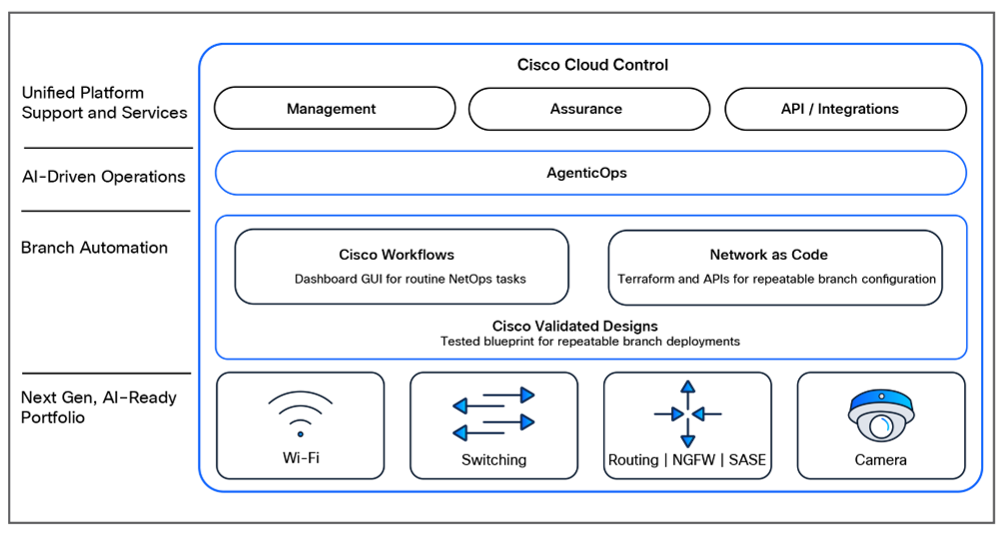
Cisco Unified Branch platform for financial services
● Simplify operations and management with Cisco® Cloud Control: Manage branch networking and security through one management model and dashboard. Automate processes, improve cross-branch visibility, and apply AI-powered analytics as your financial institution scales.
● Standardize and scale branch deployments: Use Cisco Validated Designs, zero-touch provisioning, Network as Code, and Cisco Workflows to deploy repeatable configurations across branches, including newly acquired locations.
● Protect sensitive financial data and prepare for evolving threats: Apply consistent branch security policies, extend protection with SASE, and build readiness for Post-Quantum Cryptography (PQC)
● Resolve network and application issues faster: Use Cisco ThousandEyes visibility, AgenticOps with Cisco AI Assistant and AI Canvas to correlate telemetry, identify root causes, and guide policy-governed actions from alert to resolution.
● Accelerate financial services experiences with AI-ready infrastructure: Use Wi-Fi 7, secure routers, smart switches, cameras, and cellular gateways with a programmable operating system to support branches, advisory spaces, ATMs, IoT, cloud applications, and video collaboration.
Operate every financial branch with consistent control
Treat each branch as one managed platform rather than a collection of individual devices. Define desired capabilities, performance, and security intent, then apply that intent across routing, switching, wireless, and integrated security.
A common dashboard connects configuration, assurance, and operations, while validated templates and workflows make deployments repeatable. Cisco Unified Branch is designed for broad compatibility, so financial institutions can build on existing Cisco investments and add capabilities over time.
This platform approach reduces integration work, improves configuration consistency, strengthens visibility across the user-to-application path, and gives IT a clearer way to support service levels as branch needs change.
Modernize your financial services branches with a secure, repeatable operating model.
Visit Cisco Unified Branch Networking to explore Cisco Unified Branch or request a consultation.