Omron and Cisco Accelerating AI-Driven Machine Vision White Paper
Available Languages
Bias-Free Language
The documentation set for this product strives to use bias-free language. For the purposes of this documentation set, bias-free is defined as language that does not imply discrimination based on age, disability, gender, racial identity, ethnic identity, sexual orientation, socioeconomic status, and intersectionality. Exceptions may be present in the documentation due to language that is hardcoded in the user interfaces of the product software, language used based on RFP documentation, or language that is used by a referenced third-party product. Learn more about how Cisco is using Inclusive Language.
Overview and Business Drivers for AI-Driven Machine Vision Applications
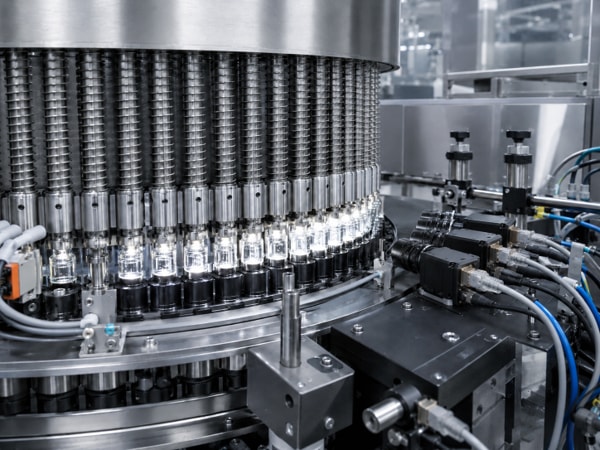
Manufacturers globally are constantly looking to improve product quality, increase output and efficiency, and automate processes and activities wherever they can. Machine Vision systems are built into many production systems for these reasons. Machine Vision in manufacturing production systems is used for a host of applications—product quality assessment, coordinating robotic operations (e.g., pick and place, tool/placement), scanning products or containers for text or barcodes, and safety for mobile assets. Also, the vision sensors used in the cameras are rapidly improving—the granularity with which images are produced is improving, and the speed at which the data can be produced is increasing.
This is where Artificial Intelligence or Machine Learning (AI/ML) applications can improve Machine Vision processes—process more data, with faster turnaround, with more adaptability and with lower rates of false positives. AI/ML is significantly improving on the existing rules-based vision processing to AI/ML inferencing, enabling improved area or line-scan and 3-D scanning. Machine vision vendors such as Omron are at the forefront of these innovations.
Cisco® and Omron are partnering to help manufacturing customers accelerate their AI/ML-driven machine vision applications. We tested and validated our products together and provide customers, system implementers, Original Equipment Manufacturers (OEMs), and partners with deployment guidance and reference architectures so that they can confidently deploy these solutions. This guidance is intended to guide IT or OT personnel in deploying Cisco industrial networking and security capabilities for Machine Vision applications supplied by Omron Vision—cameras and management/analysis software.
Manufacturers are significantly increasing the number of cameras and vision systems they are deploying because they are driving significant business benefits, including:
● Improved product quality with finer detection of product and inventory anomalies
● Less downtime and waste with better handling of environmental variances leading to fewer false positives.
● Improved robotic operations with Machine Vision applications guiding and improving robotic operations such as pick-and-place and autonomous mobile robots (AMRs)
● Increased output where AI/ML can process more vision data from multiple sources more quickly to speed up manufacturing processes
● Support for traceability and product customization by generating Unique Device Identification (UDI) during production where product images act as the signature of customized product
Critical Challenges Facing Customers Deploying AI-Driven MV
Deploying these new AI-driven machine vision applications and cameras can pose significant challenges on existing industrial networks designed for low-bandwidth, latency sensitive industrial automation system. These new devices and applications face the following challenges:
● Bandwidth. As vision cameras get more sensitive, the amount of data they can produce increases, which requires higher bandwidth. It is common that machine vision cameras operate at 1 Gb/s and are starting to move to multi-Gig support (2.5 Gb/s or higher). And even with cameras with on-board GPUs, the event data needs to be saved and archived in the cloud. For example, in-scan tunnel solutions must capture live video feed when a “safety event” occurs. All this data movement requires more bandwidth in the industrial edge network as it makes it way to the cloud.
● The average cost of Ethernet cable drops in North America is $2500/per station. Customers want to consolidate data and optimize the drop locations they already have and use the connections more effectively.
● Power. Many of the cameras, especially with embedded AI compute technology, require significant power input to operate, potentially leading to more cables and infrastructure.
● Customers worry that the amount and size of the vision data communications will overwhelm and impact existing industrial automation traffic, driving up latency, jitter, and packet loss, which leads to outages and downtime
● Cybersecurity is a growing concern, and the vision system data often represents significant intellectual property. Enterprise customers want to know how to deploy network and IT security technology to protect the vision systems and data.
● Understanding how to design and deploy Machine Vision applications is a key concern, especially on converged networks where a number of capabilities need to be configured and the operations teams have limited background/experience in networking.
Better Together: Omron and Cisco
Cisco and Omron share the goal of accelerating the digital transformation of manufacturing. Together, the companies address the full path of Machine Vision data, from image capture to secure data transport and analysis. Omron brings years of Machine Vision experience as well as complete industrial automation systems–sensors, actuators, and controllers, while Cisco delivers a secure and scalable network architecture to connect, power and manage them. Our combined experience and technologies come together to form a Machine Vision solution that is lower-cost, lower-risk, faster to deploy, and easier to operate.
Omron Automation is a global industrial automation partner providing integrated technologies across sensing, control, safety, vision, motion, and related automation systems. For manufacturers deploying AI-driven Machine Vision, Omron brings the production-floor expertise, vision hardware, software, and automation integration needed to capture, analyze, and act on image data in real time.
Omron’s Machine Vision portfolio includes smart cameras and vision sensors, vision systems, PC-based vision, industrial cameras, and Machine Vision software for inspection, measurement, traceability, identification, and positioning applications. Omron’s vision systems combine Machine Vision cameras and image-processing software to help manufacturers perform inspection and support full traceability, while the broader portfolio scales from compact smart-camera deployments to multi-camera, controller-based architectures for demanding production environments.
Our Solution and Reference Architecture for Machine Vision Systems
Key Requirements for AI-Driven Machine Vision
● Bandwidth: The chips in Machine Vision cameras are improving rapidly—their sensitivity and ability to transfer data quickly increase the amount of data they can transmit. 1 Gbps cameras are standard, and Omron now offers multi-gigabit or 10Gb cameras. The industrial network needs to support the higher data loads.
● Decreased latency: Cameras are producing more data, and the Machine Vision analytic applications are also drastically improving their ability to quickly process that data. Manufacturing processes operate at high speeds. Higher resolution images need to be processed ever faster. Network latency must be low and consistent to allow these systems to perform quickly and without error.
● Power over Ethernet (PoE): Often, the more capable the camera, the more power it consumes. Cameras with embedded compute capability to process and analyze the onboard data increase power budgets. Currently available network infrastructure that supports PoE, PoE+, and 4PPoE may be needed to reduce cable installation costs by supplying power over the same cable as the data connection.
● Synchronization: A critical aspect of the camera’s function is capturing video or pictures at the right time in the manufacturing process. This signaling can be done over I/O, but requires more cabling, or directly over the data path via the network with support for IEEE 1588 Precision Time Protocol.
● Prioritization in converged networks: Machine Vision data must be processed quickly but can delay other more critical traffic or overloading the network. Separate networks or directly-connected devices may alleviate this but are expensive and limiting. Converged networks can differentiate and prioritize critical traffic, lower costs, and increase flexibility. Our joint design and implementation guidance covers several techniques to maintain low-latency and high-bandwidth connectivity for Machine Vision traffic, including QoS, frame pre-emption, and support for Jumbo frames.
● Security: The images captured by Machine Vision systems are often considered intellectual property; they may represent key manufacturing processes or products and are critical aspects of the manufacturing process. The devices and the data need cybersecurity protection. The Cisco Validated Design (CVD) outlines how TrustSec/Secure Group Tag (SGT) micro-segmentation can protect the Machine Vision systems and the data they produce
Machine Vision Reference Architecture
Addressing the AI-driven Machine Vision requirements, the following solution architecture is recommended by Omron and Cisco.
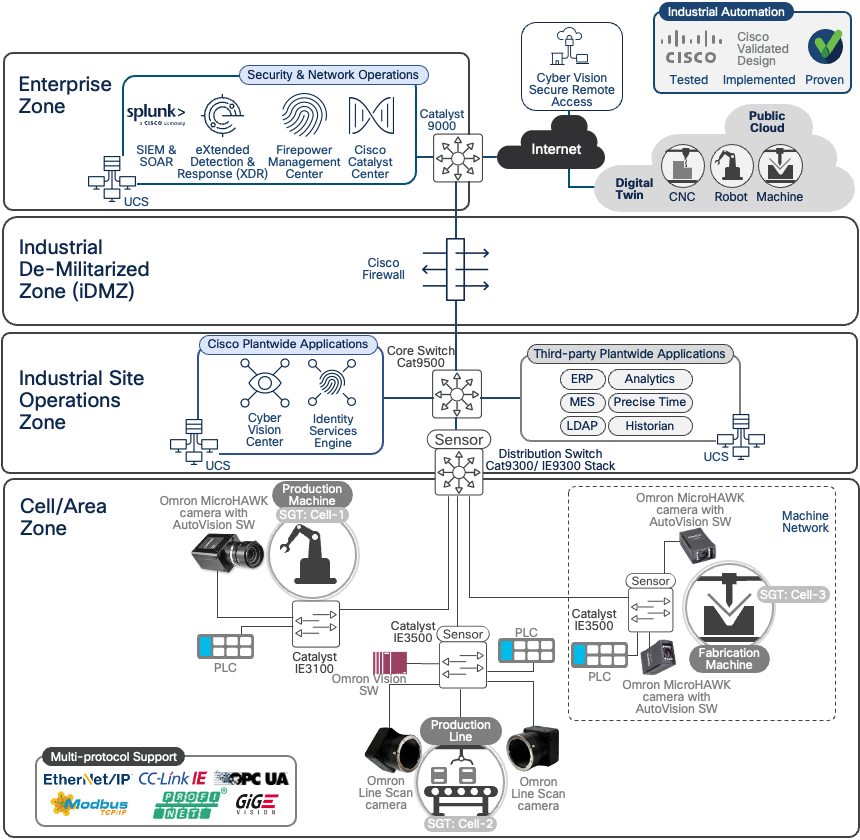
Omron-Cisco Machine Vision network architecture
Omron Components
High-Resolution Machine Vision Cameras
Omron high-resolution Machine Vision cameras capture the image data required for inspection, measurement, identification, and traceability applications. As camera resolution and frame rates increase, these devices deliver reliable bandwidth, low latency, and proper synchronization across the industrial network.
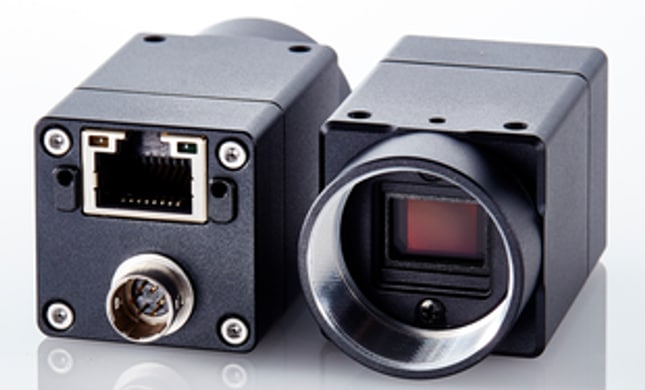
Omron Sentech's updated line of GigE Vision cameras includes a multitude of state-of-the-art CMOS Sensors, frame rates as fast as 282 FPS, and resolutions up to 20MP. Line scan GigE cameras transfer image lines as fast as 51khz. The GigE Vison Camera series is ideal for applications requiring high data rates, long cable lengths, and easy setup. GigE Vision is a great solution for the automotive, packaging, and Machine Vision/industrial industries.
Machine Vision management and analysis software
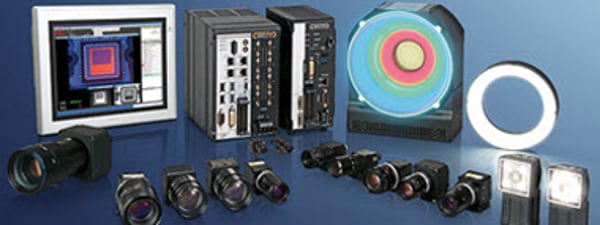
Omron Machine Vision software supports configuration, inspection, analysis, and result handling for vision applications. The software processes image data from cameras, applies inspection logic, and communicates results to the broader automation system for quality control, traceability, and production decision-making.
Cisco Components
Cisco Industrial Ethernet (IE) switches: Available in DIN-rail, IP67-rated, and rackmount form factors, Cisco Catalyst® IE9300, IE3500, IE3100 Rugged Series, and IE3500 Heavy Duty Series switches deliver high-speed ports including 1GE, 2.5GE, and 10GE options to support demanding industrial AI applications, and offer high-wattage PoE (up to 90W per port, up to 720W total per switch), enabling flexible deployment of cameras and sensors. They integrate robust security with Cisco’s Trust Anchor, Cisco Cyber Vision for visibility, segmentation, and secure remote access, as well as Cisco SGT segmentation with Cisco Identity Services Engine (Cisco ISE). These switches offer high-capacity, low-latency Layer 2/3 switching, all managed by Cisco Catalyst Center.
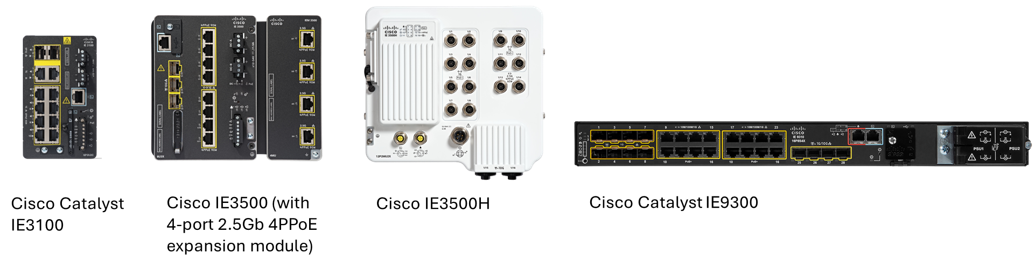
Table 1. IE Switches for Machine Vision cameras
| IE Switch Family |
Port Speeds (count) |
PoE |
Jumbo Frame |
Cyber Vision, SGT |
||||
| 10Gb |
2.5Gb1 |
1Gb1 |
4PPoE |
PoE/PoE+ |
Budget |
|||
| IE3500 |
3 |
0/4 |
8/24 |
12 |
|
480 W |
Yes |
Yes |
| IE3500H |
2 |
2 |
12 |
2 |
12 |
240 W |
Yes |
Yes |
| IE9300 |
4 |
8 |
16 |
8 |
16 |
720 W |
Yes |
Yes |
| IE3100 |
- |
- |
10 |
2 |
6 |
240 W |
Yes |
No |
Cisco Cyber Vision: In an era of increasing cyberthreats, security cannot be an afterthought. Cisco integrates security directly into the network fabric, helping ensure that your vision systems are protected without compromising production availability.
Cisco Cyber Vision combines the three OT security capabilities every industrial organization needs into a single, network native solution: continuous visibility into your OT security posture to help reduce the attack surface, AI-assisted network segmentation to protect industrial operations, and secure remote access to control risks from remote experts.
With Cyber Vision you can identify every camera, IP Communications (IPC), and server on the network and flag any anomalous behavior. Segmentation with Cyber Vision allows you to microsegment the network to help ensure that a camera can communicate only with its designated vision server. If a device were to become compromised, the threat would be unable to move laterally to other critical assets or production lines.
Systems integrators and vendors often need remote access to tune vision systems. Cyber Vision allows for auditable, role-based, and time-bound remote connections, eliminating the risk of uncontrolled access.
Cisco Identity Services Engine (ISE) is a comprehensive network security policy management platform that enables secure access control (via TrustSec in the network infrastructure) and visibility for users and devices across wired, wireless, VPN, and 5G networks.
Cisco Catalyst Center is a powerful network management system that leverages AI to connect, secure, and automate network operations. It simplifies the management of Cisco Catalyst network infrastructure including IE switches, ensuring a consistent user experience across wired and wireless networks.
Validation Highlights and Design Recommendations
Cisco and Omron deployed the solution architecture and tested the technologies in Cisco Industrial Automation test bed. The testbed also supports a range of industrial automation and control vendors and protocols to represent manufacturing systems. We validated that key requirements were being met in realistic production scenarios. Our observations included:
● Deterministic timing and synchronization—the cameras were able to process switch-provided precise time and perform their functions in a timely manner
● Low network latency and jitter for both industrial automation and Machine Vision traffic when the network is properly designed and configured and with the congestion
● Edge operations—the applications were deployed in our industrial access networks to process the large amount of vision traffic, but were able to communicate with local or remote applications
● Security segmentation and asset visibility—the GigE-Vision control data was processed by the Industrial Cybersecurity agents, and segmentation policies were applied without slowing or impacting the camera’s operations
These validation observations demonstrate that AI-driven Machine Vision can behave as a predictable, secure, and scalable industrial subsystem when timing, traffic behavior, edge operations, and security are treated as first-class architectural concerns. Intentional system design enables organizations to move beyond experimentation and adopt Machine Vision with confidence in production environments.
Key network design considerations for AI-driven Machine Vision include:
● Use high-bandwidth network infrastructure that supports multiple 10 Gb interfaces for uplinks and 1 Gb or 2.5 Gb interfaces for camera connectivity, such as the IE3500, IE3500H, and IE9300. For lower speed camera connectivity, consider IE3100.
● Where supported, PoE‑capable switches can power Omron vision devices, reducing cable infrastructure and simplifying deployment.
● Use Precision Time Protocol (PTP) from the network to synchronize multi-camera systems.
● Apply Quality of Service (QoS) policies and Frame Preemption that prioritize PTP, control traffic, and image transfer.
● Use network infrastructure that supports Jumbo Frames such as the IE3500 for image transfer to lower latency and jitter.
● Place cameras and 4Sight image processing GPU/IPC servers in the same, dedicated L2 domain/VLAN.
● Carefully plan the switch hop count in the vision path. QoS and Frame Preemption help maintain low latency, but moving vision data farther may increase required bandwidth.
● Use Cisco’s Secure Group Tag (SGT) technology to create zones and conduits (microsegmentation) to manage communication flows into and out of the image processing VLANs/domains.
For more details, refer to the Cisco Validated Design (CVD) Machine Vision in Industrial Automation Environments Design and Implementation Guide.
Cisco and Omron have collaborated to help our joint customers accelerate their deployment of AI-driven Machine Vision applications. We have designed and tested our technologies working in a production-like system and validated the key application requirements were met. We have documented the results in the CVD so that customers, system implementers, and machine builders can benefit from the knowledge we developed and confidently deploy Machine Vision applications in the production systems. AI-ready industrial networks from Cisco help to accelerate deployment of Omron-based machine vision systems by simplifying deployment, reducing the cost/time associated with extensive cable infrastructure, and providing key design recommendations that improve chances for a successful deployment. In the end, our customers more quickly realize the key benefits: improved product quality, less downtime, improved operations, and increased output.