No Distance Too Far: Rural Healthcare’s Digital Future Starts Now Solution BriefHow rural health systems and state leaders can turn historic federal funding into a connected, lasting care backbone
Available Languages
Bias-Free Language
The documentation set for this product strives to use bias-free language. For the purposes of this documentation set, bias-free is defined as language that does not imply discrimination based on age, disability, gender, racial identity, ethnic identity, sexual orientation, socioeconomic status, and intersectionality. Exceptions may be present in the documentation due to language that is hardcoded in the user interfaces of the product software, language used based on RFP documentation, or language that is used by a referenced third-party product. Learn more about how Cisco is using Inclusive Language.
The Moment Has Arrived for Rural Healthcare
Rural hospitals are not smaller versions of urban health systems. Across much of the country, they are the primary—and sometimes only—source of emergency care, inpatient services, and ongoing clinical support across large geographic regions.
Yet rural healthcare is at a critical inflection point. Workforce shortages, financial pressure, and aging infrastructure are contributing to hospital closures and creating the risk of expanding healthcare deserts. For many communities, maintaining access to care increasingly depends on how quickly health systems can modernize and adapt.
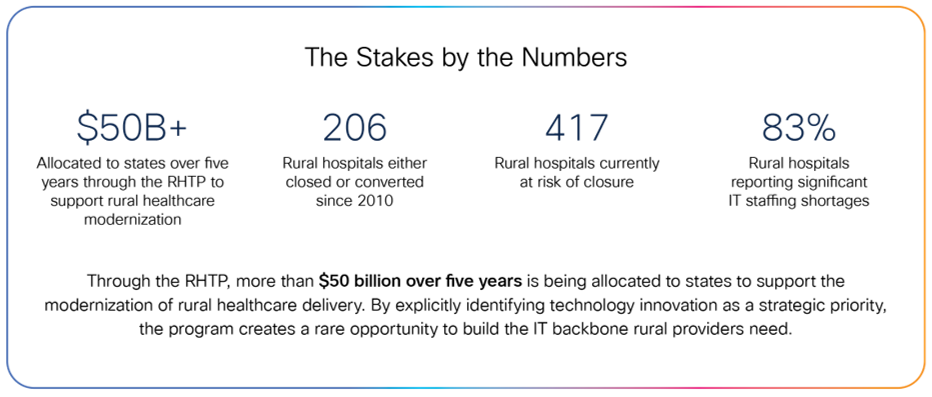
Federal policy has begun to recognize this challenge. The Rural Health Transformation Program (RHTP) represents a historic federal commitment to help stabilize and modernize rural healthcare delivery.
The opportunity now is to move from funding availability to coordinated execution. This eBook is designed to help state leaders and rural health executives translate funding into an actionable blueprint—one that helps health systems strengthen continuity of care, expand access to services, and improve coordination across care networks.
How RHTP Funding Supports Rural Health Transformation
Under the RHTP, CMS allocates funding to states through state plan cooperative agreements. In collaboration with rural providers, regional health systems, and state Medicaid agencies, states identify eligible initiatives such as IT modernization, telehealth infrastructure, and cybersecurity improvements.
Subawards may support a broad range of healthcare organizations, including rural hospitals, primary care and community health centers, and behavioral and mental health providers. Additional eligible subrecipients may include local governments, tribal entities, educational and workforce organizations, community and social service agencies, health system partners, and privatesector innovation providers.
To receive and sustain funding, states must demonstrate measurable outcomes, maintain audit-ready reporting, and establish multi-year sustainability plans.
The Stakes Are Real, and So Is the Solution
The pressures are structural, not temporary—and they demand a connected foundation.
The pressures facing rural healthcare are structural— not temporary. Addressing them requires more than isolated upgrades; it requires a connected foundation that strengthens how care is delivered, operated, and sustained over time.
Closures Are Accelerating
Long-term viability depends on rural health systems modernizing how care is delivered and creating innovative new service models that better support rural communities.
When both clinical and IT capacity are constrained, expanding reach depends less on adding headcount and more on changing how services are delivered—through shared resources, virtual collaboration, and automation.
The Clinical and IT Workforce Squeeze
| Clinical Access |
IT Capacity |
| Most Health Professional Shortage Areas (HPSAs) are in rural communities, limiting access to care and increasing pressure on existing providers. |
83% of rural hospitals report significant IT staffing shortages, with many relying on a single generalist to manage infrastructure, user support, and incident response. |
Essential Services Are Disappearing
● Only 41% of rural hospitals provide labor and delivery services.
● Only 7% of oncologists practice in rural communities.
● 60% of rural residents live in a Mental Health Professional Shortage Area (MHPSA).
● As gaps in rural healthcare are not distributed evenly, health equity needs to be a priority and addressed.
The result? Longer travel, delayed care, or no local access at all. When patients cannot always travel to care, care must reach them through secure video, remote workflows, and coordinated specialty access.
The Digital Infrastructure Gap Is Now a Patient-Care Risk
● 68% of rural hospitals run EHR systems more than 8 years old—a factor that may increase modernization and interoperability challenges.
● Over 60% of rural healthcare facilities reported experiencing at least one significant cyber incident in the past two years, increasing operational and clinical risk.
These challenges become manageable when rural providers leverage enterprise-grade monitoring, patching, and incident management—delivered through a managed backbone that alleviates the burden on local resources.
Sources: Healthcare Dive, NRHA, NLM
The Demand for Secure Modernization
Beyond interoperability, aging systems carry a compounding security risk: infrastructure that has reached end-of-support has no vendor remediation path when new vulnerabilities emerge—making it a persistent, unpatchable target. Identifying and prioritizing this exposure is a critical first step in building a resilient digital backbone
Four Pillars of a Rural Health Digital Backbone
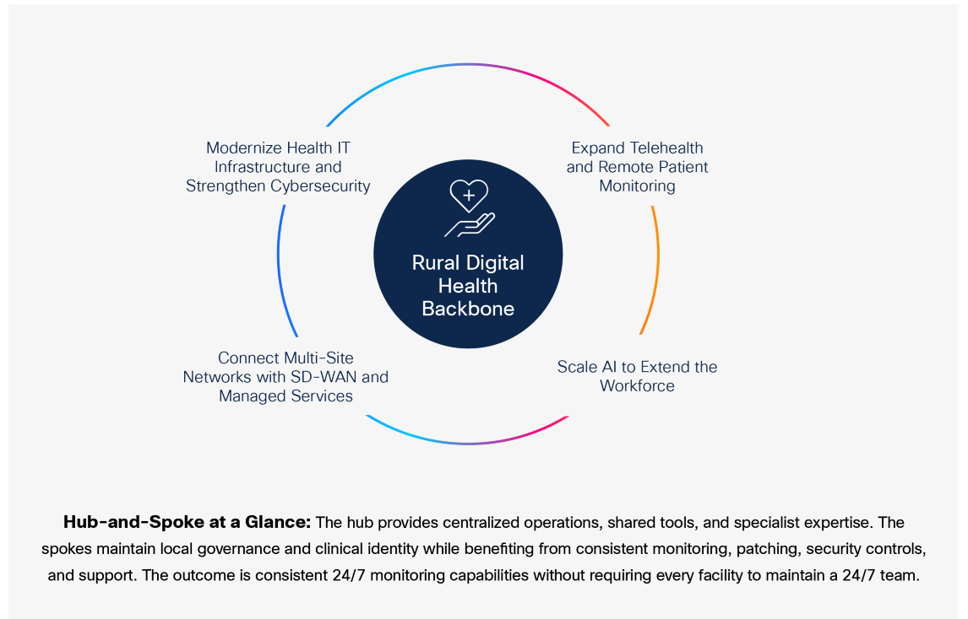
The goal is not to add to an already-extensive collection of products, but to build a scalable solution and operating model—a backbone designed to support rural hospitals in building operational resilience.
One approach is a hub-and-spoke delivery model, where a regional hub—such as a regional health system, academic medical center, staterun IT department, managed services operation, or other state-designated entity—provides standardized capabilities to rural facilities. This allows each site to extend access, strengthen security, stay connected, and support its compliance obligations without having to build everything independently.
Four Pillars of a Rural Health Digital Backbone (cont.)
1. Modernize Health IT Infrastructure and Strengthen Cybersecurity
● Why it matters: Many rural providers operate aging technology environments that can slow modernization and limit interoperability.
● Why now: Trusted Exchange Framework and Common Agreement (TEFCA) and continued CMS interoperability efforts are tightening expectations for secure data exchange and digital readiness.
● What’s at stake: Cyber incidents and limited security capacity are creating operational risk across rural healthcare environments.
Cisco Capability
Cisco’s security and infrastructure portfolio can be delivered as a managed service by partners, reducing the burden on local IT staff and enabling centralized governance from the hub. Cisco Cloud Control unifies visibility and policy across the network and security estate, while Cisco IQ provides proactive, AI-driven advisory intelligence—including lifecycle visibility and risk-based recommendations— so hub teams can stay ahead of emerging threats. Cisco Resilient Infrastructure Services combines exposure assessment, modernization, and continuous defense into a structured program suited to the operational realities of rural care networks.
2. Expand Telehealth and Remote Patient Monitoring
● Why it matters: Telehealth becomes reliable only when the underlying backbone is dependable—with stable connectivity, prioritized clinical traffic, and secure identity-based access.
● Why now: Reliable virtual experiences reduce friction for clinicians and patients by making remote care easier to deliver and access.
● How it works: Cisco Webex Health enables oneclick connections and EHR-integrated workflows that connect virtual interactions directly into clinical systems and day-to-day operations.
Expanded Telehealth Context
Rural telehealth depends on more than the video platform. Reliable care delivery requires: (1) sufficient last-mile bandwidth, including cellular failover for remote sites; (2) clinical traffic prioritization via SD-WAN to prevent EHR lag during peak usage; (3) identity-based access management so providers can connect securely from any location. Cisco addresses all three layers as part of the backbone— not as separate point solutions.
3. Connect Multi-Site Networks with SD-WAN and Managed Services
● SD-WAN creates resilient connectivity and application prioritization across clinics, critical access hospitals, and regional hubs.
● Managed services shift operating burden from reactive break/fix support to proactive monitoring, helping rural providers extend network and security capabilities despite limited local capacity
Cisco Capability
Cisco Catalyst SD-WAN with ThousandEyes network intelligence provides path-aware routing, application visibility, and automated failover—ensuring clinical applications like EHRs and telehealth platforms receive prioritized, reliable bandwidth even across constrained rural links.
State Policy Consideration
For state RHTP program officers, SD-WAN and managed network services may qualify as infrastructure modernization investments under RHTP. A hub-managed SD-WAN deployment covering multiple spoke sites can be structured as a shared services arrangement, maximizing cost efficiency and simplifying per-site reporting. Confirm eligibility with your CMS state contact before committing funding.
4. Scale AI to Extend the Workforce
● AI helps extend clinical and operational capacity by reducing administrative burden and surfacing issues earlier so teams can respond faster.
● A centralized command model allows one team to support many sites by consistently identifying, prioritizing, and routing routine operational and security signals.
Cisco Capability
The Cisco Data Fabric powered by Splunk delivers AI-powered threat detection and response across the network, endpoints, and cloud environments— without requiring local security analysts at every spoke site. AI-assisted documentation tools integrated with Webex Health reduce clinician administrative burden by capturing and structuring visit notes in real time.
Governance Note for State Policy Leaders
When evaluating AI investments state leaders should assess vendor governance frameworks: How is patient data used in model training? What audit logging is available? Does the solution comply with HIPAA’s minimum necessary standard and applicable state privacy laws? Cisco’s AI governance framework includes on-premises or private-cloud deployment options that keep PHI within state-defined boundaries.
What’s Possible When the Digital Backbone Is Built
A single day across a rural health network—when the infrastructure is already in place.
Maria Smith, Regional Services Director
Oversees IT and operations across a network of rural facilities from the regional hub.
● 7:30 AM: Opens her Cisco Cloud Control dashboard from home and spots a firmware alert at a satellite clinic—resolving it remotely in minutes, with no travel or disruption.
● Reviews overnight network health across every spoke site from a single pane of glass.
● Approves a standardized patch to roll out simultaneously across all critical access hospitals, without on-site visits.
● Outcome: What used to require a half-day field visit is resolved before Maria’s first cup of coffee. In this scenario, centralized operations help IT resolve issues in a fraction of the time it once took.
Dr. Jim Okafor, Specialist Physician, Regional Hub
Enables clinicians to extend specialty care to communities that have no local access.
● 9:15 AM: Launches Cisco Webex Health to connect a rural patient with specialty expertise—no app downloads or complex setup required.
● Captures key discussion points with AI-assisted documentation, reducing administrative burden during the visit.
● By integrating directly with the EHR, consult data flows automatically into the patient’s care plan to ensure clinicians maintain full continuity.
● Outcome: A patient who once faced a 90-minute drive each way now accesses specialist care from home. By leveraging a connected backbone, clinicians have reduced referral-to-consult times from weeks to just days.
Sam Whitfield, IT and Security Generalist, Critical Access Hospital
The single staffer responsible for infrastructure, user support, and incident response at a spoke site.
● 2:00 PM: A phishing attempt targets a staff mailbox. Cisco Umbrella helps block the threat before it reaches user devices, and an alert is logged to support audits.
● Relies on the hub’s Security Operations team for 24/7 monitoring--gaining round-the-clock coverage without a dedicated on-site team.
● Built-in protections and centralized operations let Sam focus on local needs instead of chasing threats alone.
● Outcome: No patient records were compromised in this scenario. The incident is documented with logging that helps the organization meet its audit and reporting obligations within minutes—a critical advantage given CMS and HIPAA reporting timelines.
Lena Torres, Care Coordinator
Helps care teams keep patients connected to care between visits across a large geographic region
● 4:30 PM: Reviews remote patient monitoring data that helps flag a concerning trend for clinical review by the right specialist.
● Reliable connectivity and monitoring help keep patients engaged in care without requiring travel.
● Coordinates a follow-up virtual consult in minutes, closing the loop on continuity of care.
● Outcome: Early access to monitoring data helps the care team flag a trend for clinical review before it escalates. Independent studies report reductions in 30-day readmissions, and Cisco’s connectivity and infrastructure can help support remote monitoring programs like these
Making the Rural Health Backbone a Reality
The Challenge of Modernizing Under Pressure
Modernizing rural healthcare brings financial and operational challenges amid thin margins, workforce shortages, and aging systems. These pressures can stall projects, fragment investments, and make it difficult to sustain progress beyond an initial grant cycle.
Common hurdles in rural modernization projects include:
● Unclear goals and undefined outcomes
● Undefined costs for pilots versus scaling • Uncertain infrastructure and connectivity readiness
● Limited local security and IT capacity
● Data privacy and compliance risk (HIPAA, TEFCA, CMS)
The Grant-Ready Advantage
In an era of historic federal funding through the RHTP, the ability to provide data-backed evidence of progress is a competitive advantage. A unified backbone centralizes data, making it easier to provide the audit trails and performance metrics needed to secure and sustain multiyear funding.
A Structured Approach to Turning Funding Into Outcomes
● Step 1: Readiness Assessment
Evaluate connectivity, security posture, and clinical workflows.
● Step 2: Backbone Blueprint
Define the hub-and-spoke model, shared services, and standardized capabilities.
● Step 3: Operate and Scale
Establish a regional command model and extend capabilities site by site.
Key Outcomes: standardized project vetting, clear roles and stakeholder alignment, data sovereignty and security controls, and maximized impact and cost efficiency across the network.
What Early Movers Are Learning
Health systems that have begun building regional digital backbones ahead of full RHTP deployment are learning three consistent lessons:
● Connectivity assessments almost always uncover more infrastructure gaps than expected—starting early avoids costly delays later.
● Shared services models require governance agreements between facilities before technology is deployed; legal and operational alignment takes time.
● Reporting infrastructure is as important as clinical infrastructure—states that build centralized metrics dashboards early are better positioned for multiyear funding renewal.
Organizations that treat the backbone as a compliance asset—not just a technology project—consistently outperform those that don’t.
Start Building Your Rural Health Digital Backbone
Resilience, continuity of care, and expanded access cannot be achieved through isolated upgrades or disconnected systems. The challenge is no longer deploying more technology—it is enabling systems to connect, data to flow, and care networks to operate as a coordinated whole.
Cisco’s connected infrastructure and technologies can help turn transformation goals into an executable roadmap:
1. Request a Readiness Assessment: Schedule a nocost 90-minute session with your Account Executive to map your connectivity, security posture, and RHTP readiness across your network.
2. Explore the Hub-and-Spoke Model: Extend enterprise-grade capabilities without taxing local resources. Download Cisco’s Hub-and-Spoke Implementation Guide.
3. Leverage Funding Alignment: Cisco’s Public Funding Office can map eligible RHTP use cases to your specific state allocation and help structure a multiyear funding roadmap.
4. Visualize Your Digital Transformation: Use Cisco’s Healthcare Portfolio Explorer to see how integrated solutions solve specific clinical and operational challenges across your entire health system.