Building the Foundation for the Modern City Solution BriefWhy cities need to rethink infrastructure before they rethink AI
Available Languages
Bias-Free Language
The documentation set for this product strives to use bias-free language. For the purposes of this documentation set, bias-free is defined as language that does not imply discrimination based on age, disability, gender, racial identity, ethnic identity, sexual orientation, socioeconomic status, and intersectionality. Exceptions may be present in the documentation due to language that is hardcoded in the user interfaces of the product software, language used based on RFP documentation, or language that is used by a referenced third-party product. Learn more about how Cisco is using Inclusive Language.
The Modern City at an Inflection Point
Today’s cities are at a critical inflection point. As urbanization accelerates, city leaders have an obligation to improve quality of life while managing aging infrastructures and limited budgets.
The modern city is no longer just concrete and steel. It is a dynamic digital environment where automated traffic management, autonomous vehicles, drones, and smart grids are transforming urban life. And as IT and Operational Technology (OT) converge, cities need to manage more connected systems while maintaining operational efficiency and consistent security across environments.
Additionally, the network becomes the foundation of urban resilience, ensuring that data flows securely from the edge to the cloud. Without a unified, Zero Trust-based foundation, innovation threatens that resilience by exposing cities to operational disruption, data breaches, and rising ransomware costs.
Resilience today extends beyond uptime. It requires maintaining service continuity in the face of persistent threats. The network supports this extension by providing the visibility, threat detection, and automated response needed to keep critical systems running.
Your path forward: This solution brief outlines how to move beyond a fragmented infrastructure to one that is unified, interoperable, and secure—showing you how your city can transform from reactive environments into proactive, resilient hubs of innovation.
By 2030, the proportion of the global population living in cities will grow to 60%, placing unprecedented pressure on existing digital and physical systems.
Source: United Nations/Deloitte
The Digital Deficit is Redefining City Technology Leadership
Many cities are now operating with a growing digital deficit—the gap between what existing infrastructure was designed to support, and what modern operations now require to meet resident expectations. Systems are in place, but they are not integrated at the level required to support real-time operations and close that gap.
This, in turn, is redefining the role of city technology leadership, whose responsibility now includes the digital systems embedded in traffic systems, light poles, transit networks, and public spaces. These systems generate data, act as compute nodes that process data, and serve as control points that trigger real-time actions.
Managing these systems requires a new level of oversight. Leaders are accountable for the performance of distributed systems, the security of environments that span both IT and OT, and the ability to scale infrastructure beyond the data center.
In short, the role now extends beyond managing IT systems to overseeing the full digital layer that supports how the city operates.
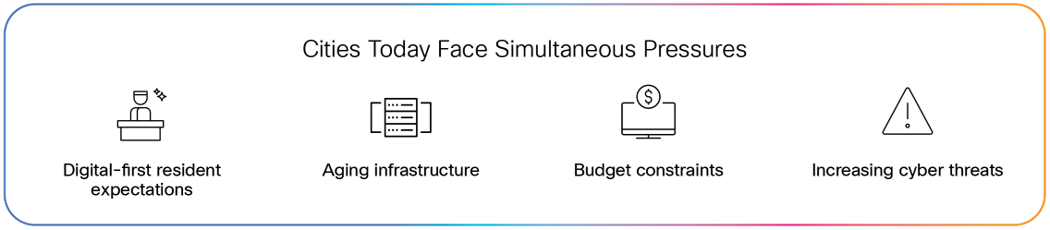
Despite urban growth, 53% of city officials report that organizational silos and a lack of data integration prevent them from addressing urban resilience effectively.
Source: Deloitte Insights
5 Strategic Challenges for City IT and Security Leaders
As the role of city technology leadership expands, so do the challenges associated with managing connected systems at scale. The challenge is not a lack of technology—systems are already deployed—but they are not integrated at the level required to support real-time operations.
Data does not move seamlessly, systems do not operate together, and visibility across environments remains limited.
Addressing these challenges requires a unified approach. Digital transformation depends on a shared platform that connects systems, not on isolated point solutions deployed over time.
1. Converging IT and OT
It is essential that systems across transportation, utilities, and public safety operate on a shared IP-based infrastructure, breaking down the siloes that currently exist between IT and OT.
2. Orchestrating the Edge
A resilient infrastructure is required to operate across distributed locations and often harsh environments, supporting operations outside the traditional data center.
3. Securing the Cyber-Physical System
Maintain a consistent Zero Trust security posture across IT and OT, extending security to physical infrastructure and services while addressing risk to public safety and operations.
4. Delivering Real-Time Intelligence
Data should flow from edge to cloud to support AI-driven insights, with real-time data used to drive decision-making and operations.
5. Ensuring Lifecycle Sustainability
Infrastructure should be designed to operate over extended lifecycles (7–10 years), supporting continuous upgrades and evolution as requirements change, reducing the need for full system replacement cycles.
Digitization of the Right of Way
For decades, the city CIO and CTO’s operated within the “carpeted space”—the controlled environment of the data center and office. Today, critical digital infrastructure extends into the “uncarpeted space,” which includes sidewalks, intersections, and public transit corridors that support city life.
As the network extends into the Right of Way (RoW), the digital perimeter expands into the physical world. This expansion necessitates security across distributed public infrastructure, along with device and edge compute management outside of controlled environments—all while maintaining visibility across both IT and OT.
The “uncarpeted space” is harsh, distributed, and historically siloed. Addressing it requires a unified, IP-based network that applies the same security rigor and reliability to traffic cabinets as it does to core systems.
Turning Assets to Data Engines
Every piece of municipal infrastructure becomes a node in a massive, distributed computer—nodes that serve as the fuel to bring AI to life. By digitizing the RoW, cities transform physical assets into active, intelligent contributors to their mission.
● Smart Light Poles: Provide real-time monitoring and environmental data collection while supporting mobility that improves cellular and Wi-Fi connectivity.
● Traffic Cabinets: Function as “edge data centers,” processing traffic data locally to enable sub-second decision-making for autonomous vehicles and emergency response.
● Modernized Transit Hubs: Bus stops are evolving into digital service points, offering real-time scheduling and safety alerts that improve commuter experience and transit adoption.
● Public Connectivity: Extends secure, high-capacity Wi-Fi into public spaces, so they become hubs for education, work, and community engagement.
● Mobile Sensor Networks: Municipal fleets now act as a roving sensor network, identifying road hazards and infrastructure degradation in real time, shifting maintenance from reactive to predictive.
Unlocking The Value of Municipal RoW Assets
Beyond hardware, cities possess a high-value asset in their RoW infrastructure. The greatest hurdle to modernizing digital services is the “cost of the trench”—the expensive, disruptive process of street excavation. Strategic management of existing conduit changes that equation.
● Operational Synchronization: Aligning conduit installation with scheduled road work minimizes excavation, lowers project costs, and reduces community disruption.
● Asset Mapping: Maintaining accurate conduit inventories enables data-driven decisions for infrastructure maintenance and future expansion.
● Connectivity Foundation: A unified, IP-based network ensures the same security and reliability for street-level assets—such as traffic cabinets and sensors—as for core systems.
The Right-of-Way is the city’s largest data source, fueling AI-driven services. Integrating these assets into a secure, intelligent network supports a more responsive and resilient city.
To move beyond the limitations of legacy infrastructure, it is essential that cities transition to a unified, AI-driven architecture, that brings together platform, infrastructure, and outcomes. This approach supports operational continuity and security at scale. By shifting to a proactive, automated framework, cities can reduce operational overhead, strengthen security, and support future AI initiatives without needing to “rip and replace” existing assets.
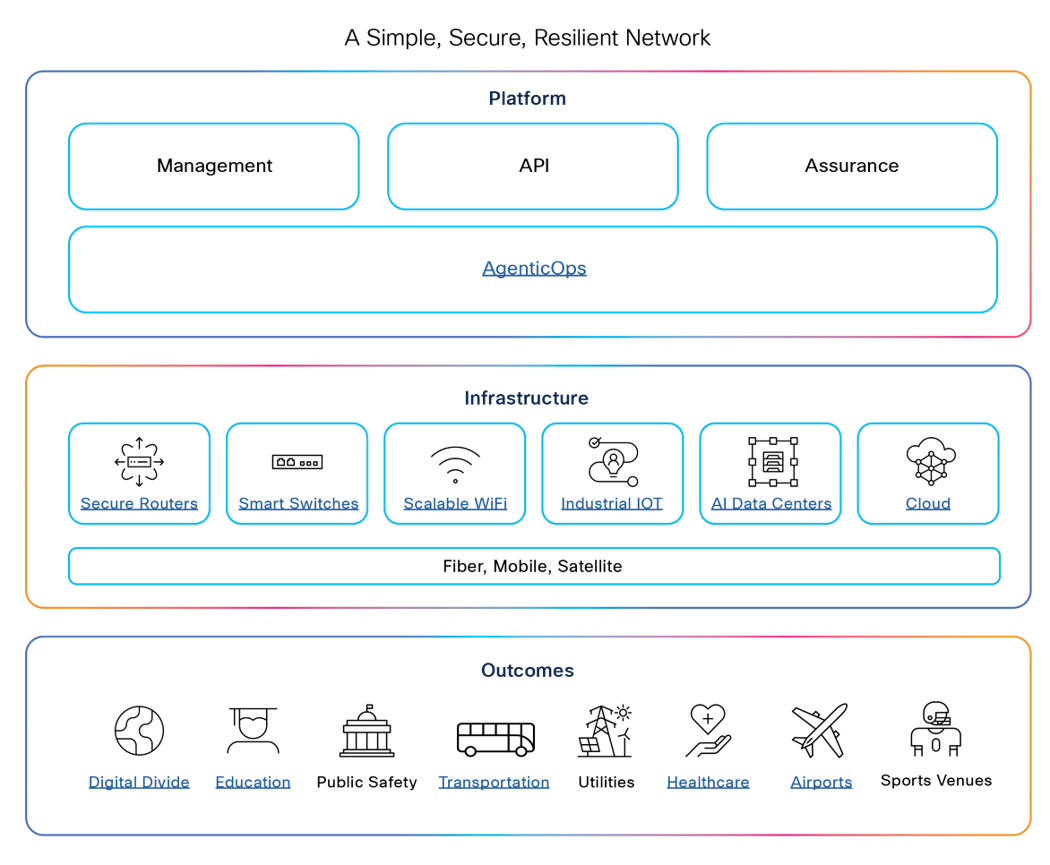
Platform: AgenticOps for Autonomous Operations
IT and security teams face telemetry volumes that exceed their ability to respond manually. AgenticOps uses agents to assist in correlating IT and OT data, supporting:
● Deterministic Resolution: Automates routine remediation and incident response to reduce Mean Time to Resolution (MTTR).
● Policy Enforcement: Enables the implementation of consistent Zero Trust security postures across distributed physical and digital assets, including manned and unmanned systems.
● Operational Visibility: Provides a “single pane of glass” for API-driven management, eliminating siloed visibility that slows decision-making.
Infrastructure: Edge-to-Cloud Intelligence
Infrastructure should be viewed as a distributed compute fabric, not just a connectivity layer. This approach optimizes data gravity by processing information where it is generated, supporting:
● Edge Intelligence: Uses localized compute nodes (routers/switches) to perform real-time analysis, reducing latency for time-sensitive applications such as traffic management and public safety.
● AI-Ready Compute: Integrate high-performance data centers with the network fabric to support the heavy compute requirements of AI workloads.
● Hybrid Data Flow: Dynamically route data between the edge and cloud based on latency and security requirements, ensuring operational data remains accessible and protected.
Outcomes: Measurable Operational Impact
Technology deployment is secondary to the operational KPIs it supports. A unified, connected infrastructure enables measurable improvements across:
● Transportation: Optimize traffic in real time and predict maintenance to reduce congestion and delays.
● Digital Access: Deliver secure, high-capacity broadband as a utility, maintaining operational integrity while expanding access to services and economic opportunities.
● Service Continuity: Improve reliability in high-density environments such as stadiums and transit hubs through automated, self-healing network segments.
Cisco Validated Designs are Proven Blueprints for Success
Cisco Validated Designs (CVDs) provide tested, documented architectural blueprints that help mitigate deployment risk and accelerate project timelines. They assist in establishing a secure, scalable, and reliable foundation from day one, while minimizing integration friction.
Explore Cisco Validated Designs
Shifting From Tech Spend to Constituent Outcomes
For the modern city technology leader, return on investment is no longer measured solely in financial terms—it’s measured by constituent outcomes. Success is defined by the ability to meet mandates, improve public safety, and maximize the utility of taxpayer dollars.
Success is measured by outcomes, not by the number of devices deployed. By aligning infrastructure strategy with these core municipal metrics, cities shift from managing their “digital deficit” to building resilient, high-performance operations.
Infrastructure plays a direct role in these outcomes, yet it has traditionally been viewed as a cost center. Reframing infrastructure as an enabler of municipal KPIs changes how performance is measured and reported, how data can be used to inform operational improvements, and how funding and executive buy-in are secured.
Value Realization Framework
A unified, AI-driven infrastructure acts as the data engine that allows cities to report on (and improve) the metrics that matter most:
● Public Safety & Vision Zero: Real-time traffic analytics supports a shift from reactive response to predictive safety, reducing emergency response times and traffic-related fatalities.
● Operational Efficiency & Sustainability: Predictive, sensor-based management reduces total cost of ownership through lower energy consumption and maintenance costs.
● Digital Access & Service Continuity: A unified platform for broadband and WiFi services ensures equitable digital service access and boosts resident satisfaction.
Turning Data into Action
Connected infrastructure generates data that drives real-time operational improvements across public safety and sustainability.
● Public Safety (Emergency Response): A unified, edge-aware network supports automated traffic pre-emption, reducing time-to-scene for first responders and improving life-safety outcomes.
● Sustainability (Smart Lighting): An IP-based, connected lighting infrastructure can reduce energy costs by up to 70% while generating data that informs planning and policy decisions.
The Grant-Ready Advantage
In an era of federal infrastructure grants, the ability to provide data-backed evidence of progress is a competitive advantage. A unified platform centralizes data, making it easier to provide the audit trails and performance metrics required to secure and sustain multi-year funding.
Bridging the Funding Gap
Navigating federal and state grants can be complex. The Cisco Public Funding Office works with municipalities to identify, track, and align funding opportunities to digital infrastructure goals.
Explore grant resources with the Public Funding Office
Cities are already implementing connected infrastructure across a wide range of use cases, from targeted pilots to citywide deployment. Across all, the focus remains on measurable outcomes:
● Improving operations
● Enhancing public safety
● Advancing sustainability
Kansas City, MO
Deploying smart poles to support IoT and expand public WiFi access. Learn more
Cary, NC
Integrating data systems to improve visibility and coordination across operations. Learn more
Fort Worth, TX
Modernizing infrastructure while expanding digital inclusion initiatives. Learn more
El Paso, TX
Centralizing resident services to improve access and service delivery. Learn more
Pearland, TX
Enhancing public safety through real-time operational visibility. Learn more
As systems expand across departments and environments, maintaining consistent security and control becomes more complex. Infrastructure needs to scale while enforcing security across both carpeted and uncarpeted environments, all while enabling AI-driven innovation. Long-term success depends on infrastructure that is both secure, scalable, and supports innovation.
Cisco’s platform-based architecture addresses this by applying Zero Trust across all layers, connecting systems through an API-first approach, and embedding compliance into the foundation. This creates a consistent model for securing, connecting, and managing systems across departments.
The result is a unified infrastructure that supports security across IT and OT, scales with demand, and enables interoperability across departments and agencies — delivering mission-critical outcomes with consistent control and visibility.
Cybersecurity is now the #1 obstacle to AI adoption.
71% of organizations state that cybersecurity is very important to AI-ready infrastructure deployment.
Only 20% of organizations report having fully collaborative IT/OT cybersecurity.
Source: 2026 State of Industrial AI Report