AI-Powered Public Safety Solution BriefBuilding Safer, Faster, and More Resilient Emergency Response with Cisco
Available Languages
Bias-Free Language
The documentation set for this product strives to use bias-free language. For the purposes of this documentation set, bias-free is defined as language that does not imply discrimination based on age, disability, gender, racial identity, ethnic identity, sexual orientation, socioeconomic status, and intersectionality. Exceptions may be present in the documentation due to language that is hardcoded in the user interfaces of the product software, language used based on RFP documentation, or language that is used by a referenced third-party product. Learn more about how Cisco is using Inclusive Language.
Why Public Safety Is at an Inflection Point
Public safety is one of the most visible and missioncritical responsibilities of government. Police departments, fire services, emergency medical services, 911 operations, emergency management teams, fusion centers, and emergency operations centers operate continuously to protect residents, stabilize incidents, and coordinate response across jurisdictions.
The operating environment is changing quickly. Residents expect faster emergency response, clearer communication, greater transparency, and stronger protection of sensitive information. At the same time, agencies are managing staffing constraints, rising call volumes, major weather events, cyber risk, and a rapidly expanding set of connected devices, sensors, cameras, and drones.
Many agencies have adopted new tools in response to these pressures. But when systems are deployed independently, the result can be fragmented operations: separate dashboards, disconnected data, inconsistent communications, and security gaps. Public safety modernization therefore requires more than new devices. It requires a secure digital foundation that helps agencies share trusted information, coordinate action, and maintain continuity in the moments that matter.
The Scale of Public Safety
● Public safety operations span counties, cities, agencies, dispatch centers, field responders, public facilities, roadways, airspace, and critical infrastructure.
● Police and fire services can represent the largest portions of local general fund spending.
● Technology investments must improve coordination, resilience, and security rather than create new silos.
U.S. Public Safety Landscape
● ~3,140 counties
● ~19,000 cities
● ~7,900 correctional facilities
The Expanding Scope of Public Safety
Public safety is often associated with policing, but protecting communities requires coordination across a broader emergency response ecosystem. Fire departments, EMS, 911 dispatch centers, emergency managers, fusion centers, Emergency Operations Centers (EOCs), and law enforcement agencies all rely on timely information and resilient communications.
The justice system includes:
● Police and law enforcement agencies
● Fire departments
● Emergency medical services
● Dispatch and 911 operations
● Emergency Operations Centers
● Fusion centers and intelligence-sharing environments
● Drones, cameras, sensors, and connected field devices
● Emergency management and disaster response teams
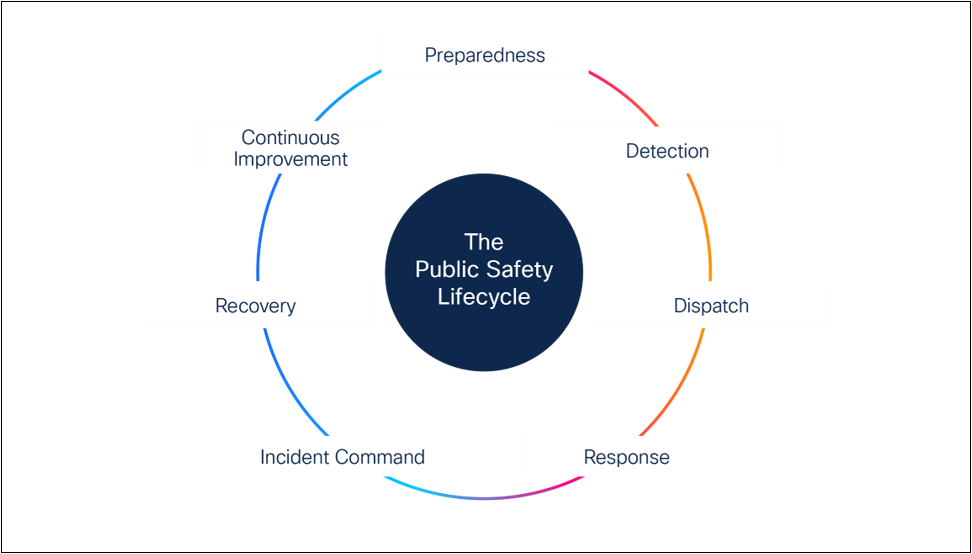
Technology now supports every stage of emergency preparedness and response: prevention, detection, dispatch, field response, incident command, recovery, and after-action review. The challenge is making these tools work together securely and reliably across departments and jurisdictions.
A 10,000-Foot View: Connected Community Operations
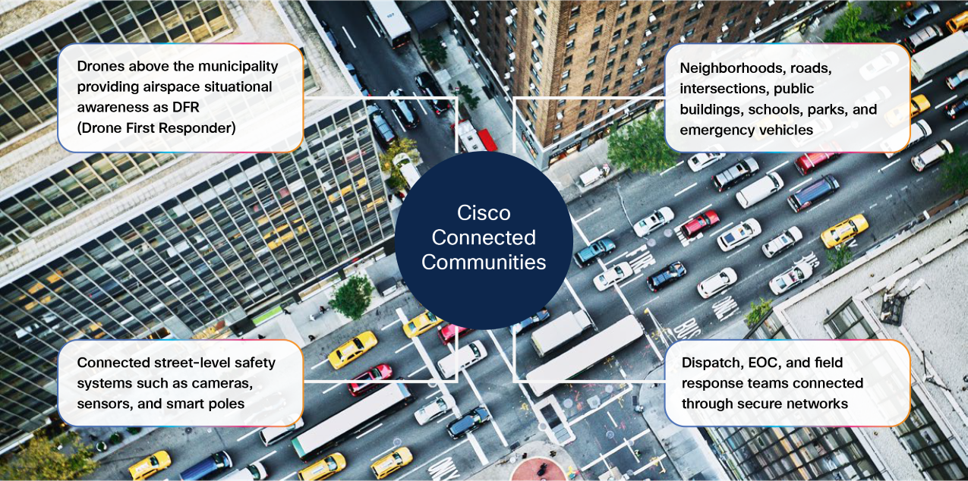
Public safety operates across the entire community. A single incident can begin in a neighborhood, move through a roadway or school campus, require dispatch coordination, involve police, fire, and EMS, and escalate to an EOC if the event becomes large or multi-jurisdictional.
A connected public safety environment links people, places, and data across streets, intersections, municipal facilities, schools, parks, critical infrastructure, and information and coordinate response in real time.
Visual Zones
Airspace Operations
Public safety drones provide situational awareness during emergencies and support search, rescue, and incident response.
Police, Fire, and EMS Response
Emergency responders support communities with rapid dispatch, medical response, fire protection, and coordinated field operations.
Street-Level Safety Systems
Connected sensors, cameras, and shared data help agencies monitor incidents and coordinate across jurisdictions.
Emergency Preparedness
Public buildings rely on coordinated planning and secure communications to protect people during critical events.
When Emergencies Happen: Coordinated Response in the Field
Fire and EMS
Fire, EMS, law enforcement, and dispatch teams must assess situations quickly and make decisions under pressure. Secure connectivity, collaboration tools, and AI-enabled intelligence can help responders understand what is happening before they arrive and coordinate more effectively during an incident.
Use Case 1:
Faster, Smarter Emergency Dispatch
What a Connected Response Can Look Like
● AI-assisted call handling helps dispatchers triage incoming calls.
● Drones provide an aerial overview before responders arrive.
● Dispatch centers, fire crews, EMS, and police share real-time incident data.
● Secure voice, video, and messaging help teams coordinate response.
Cisco’s Role
Resilient networking, secure collaboration platforms, and cloud or hybrid-cloud connectivity help maintain communication between dispatch centers, command teams, and field responders.
Use Case 2:
Incident Command and Field Collaboration
What a Connected Response Can Look Like
● Live video from body cameras, vehicle cameras, drones, and sensors improve real-time visibility.
● Unified command dashboards allow agencies to work from a shared operating picture.
● Translation and transcription tools help teams communicate with multilingual communities.
Cisco’s Role
Cisco Digital Public Safety capabilities integrate devices, video, sensors, and secure networks to support situational awareness and operational intelligence.
Use Case 3:
Emergency Operations Centers (EOCs)
What a Connected Response Can Look Like
● EOCs coordinate large-scale events such as wildfires, floods, hurricanes, major outages, and pandemics.
● Multiple agencies share operational dashboards and real-time feeds.
● Leaders coordinate resources, communications, and response priorities.
Cisco’s Role
Cisco Webex, secure networking, deployable connectivity, and video-enabled command centers support cross-jurisdictional coordination and continuity of operations.
The Foundation Behind Coordinated Field Response
Coordinated field response depends on a continuous flow of intelligence, data, and communication. Public safety agencies need systems that connect before anincident, remain resilient during disruption, and support learning after the response concludes.
Fusion Centers
Fusion centers operate continuously, gathering and analyzing information from local, state, federal, and private sources to identify risks before they escalate. They require secure data sharing, identity controls, threat detection, and governance to protect sensitive intelligence.
Emergency Operation Centers
EOCs activate during incidents to coordinate response, resources, communications, and situational awareness. EOCs rely on resilient connectivity, video collaboration, mapping, IoT data, and shared dashboards.
Common Operating Picture
A common operating picture gives agencies a shared, real-time view of threats, resources, and operational conditions. It helps leaders make decisions from the same trusted information instead of disconnected reports.
The AI Foundation for Public Safety
Public safety agencies are facing a triple pressure: staffing constraints, rising call volumes, and expanding digital evidence. AI can help synthesize operational data, highlight emerging risks, support faster decision-making, and reduce administrative burden. Human responders and emergency managers remain responsible for evaluating conditions and directing response efforts.
● Autonomous Incident Intelligence
AI agents can monitor IoT sensors, municipal cameras, and other data sources to help identify emerging risks and alert responders earlier.
● Command and Control AI
During high-stress events, AI can transcribe calls, summarize feeds, and suggest resource options for human review.
● Drones as First Responders (DFR)
Drone workflows can provide live situational awareness before human responders arrive.
● Interagency Interoperability
AI can help standardize and translate data formats across agencies to support a unified operational picture.
Cisco’s Role in Trusted AI
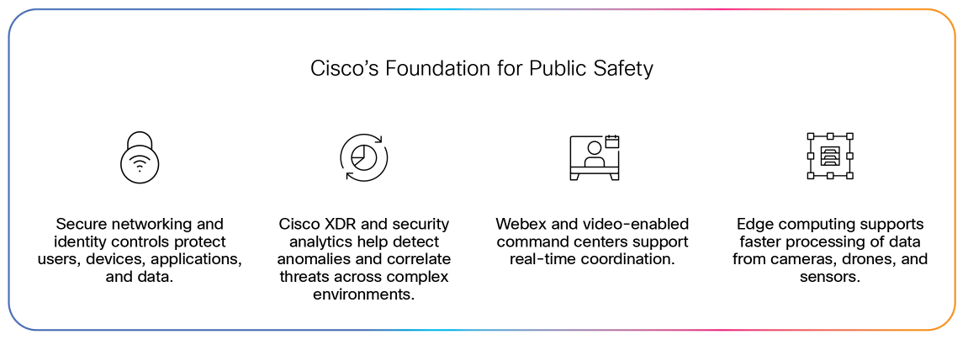
● Duo Agentic Identity helps ensure AI agents have trusted identities and appropriate access.
● Cisco AI Defense helps protect AI systems from manipulation and supports guardrails.
● Splunk and security operations capabilities can help detect and respond to threats against public infrastructure.
Cisco Enables Drone Operations Across Public Safety
Drones are becoming a critical source of public safety intelligence. They can provide aerial views during fires, crashes, search and rescue operations, crowd management, large scale events, disaster response, and hazardous incidents. To be useful, drone data must be captured, transmitted, secured, analyzed, and shared with responders and command teams.
● Real-time situational awareness
Near-real-time video and analytics help responders understand conditions before arrival.
● Secure and resilient connectivity
Redundant network infrastructure supports drone operations across field, cloud, and hybrid environments.
● Interagency collaboration
Secure communication allows drone data and other critical information to be shared across agencies.
● Public warning and notification
Incident broadcasting and emergency notifications can be enhanced by aerial awareness.
● IoT and drone integration
Drones, ground sensors, cameras, and analytics can work together as part of a digital public safety platform.
● First responder communications
Priority and preemptive communications support critical operational data transmission.
● AI-driven analytics
Video analytics can help detect risks and provide actionable insights.
Conclusion: Building Safer, More Equitable Communities
Public safety transformation is not achieved by isolated technology deployments. It requires connected systems that allow agencies to share information securely, communicate in real time, and operate as one coordinated ecosystem.
Cisco helps communities build the secure digital foundation needed to support faster response, stronger resilience, and better coordination across public safety operations. By connecting people, places, devices, and data, Cisco enables public safety agencies to act on trusted information when every second matters.
56,000+ government organizations across 190+ countries rely on Cisco
Learn More: Why Cisco for Public Safety, Courts and Corrections – Cisco