AI-Powered Justice Solution BriefBuilding Fairer, More Accessible, and More Efficient Courts and Corrections with Cisco
Available Languages
Bias-Free Language
The documentation set for this product strives to use bias-free language. For the purposes of this documentation set, bias-free is defined as language that does not imply discrimination based on age, disability, gender, racial identity, ethnic identity, sexual orientation, socioeconomic status, and intersectionality. Exceptions may be present in the documentation due to language that is hardcoded in the user interfaces of the product software, language used based on RFP documentation, or language that is used by a referenced third-party product. Learn more about how Cisco is using Inclusive Language.
Why Justice Systems Are at an Inflection Point
Justice systems are among the most complex responsibilities of state and local government. Courts, prosecutors, public defenders, private attorneys, correctional facilities, probation, parole, rehabilitation programs, and re-entry services must coordinate across a lifecycle that directly affects public trust, due process, safety, and individual outcomes.
The justice environment is changing. Courts must manage hybrid proceedings, large volumes of digital evidence, growing accessibility expectations, and the need to preserve clear records. Correctional systems must provide legal access, family connection, healthcare, education, rehabilitation, and secure facility operations while controlling cost and risk.
When justice technologies are implemented independently, they can create new friction: disconnected case information, inconsistent access, delays in evidence processing, and fragmented communications between courts, facilities, attorneys, and supervision agencies. Justice modernization requires secure, connected systems that support fairness, efficiency, and trust.
The Scale of Justice
● Justice includes courts, judges, prosecutors, defenders, attorneys, correctional facilities, probation, parole, rehabilitation, and re-entry services.
● Digital evidence, remote participation, video services, and AI transcription are changing everyday justice operations.
● Modernization must protect due process, confidentiality, evidence integrity, and public trust.
U.S. Justice Landscape
● ~3,140 counties
● ~19,000 cities
● ~40,000 courtrooms
The justice system extends far beyond the courtroom. Courts are one part of a broader network responsible for adjudication, legal access, custody, supervision, rehabilitation, and community re-entry.
The justice system includes:
● Courts and judges
● Prosecutors, public defenders, and private attorneys
● Court staff, clerks, and administrators
● Correctional facilities including jails, prisons, and detention centers
● Probation, parole, and community supervision agencies
● Rehabilitation, education, telehealth, and re-entry services
● Digital evidence, case management, records, and collaboration systems
Technology can support every stage of the justice lifecycle, from evidence handling and hearings to incarceration, rehabilitation, supervision, and successful re-entry. The goal is not simply digitization; it is a more connected operating model that improves access, timeliness, security, and outcomes.
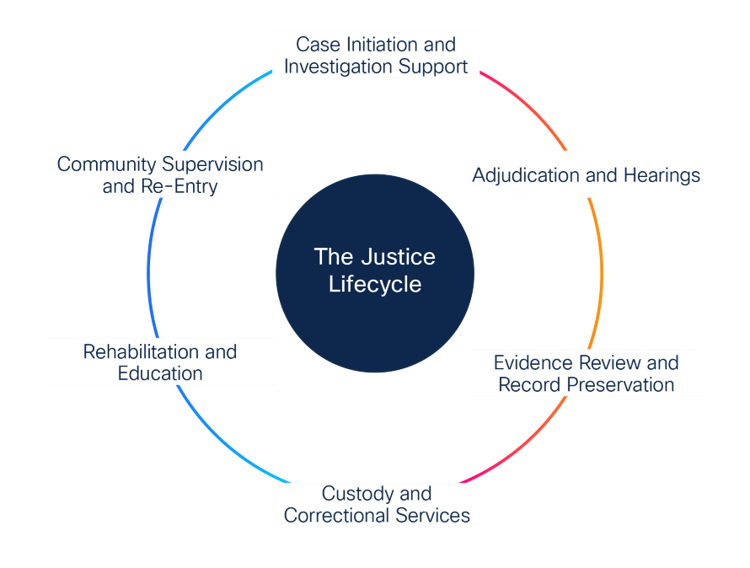
A 10,000-Foot View: Connected Justice Operations
A justice matter can move through many institutions before it is resolved. A person may interact with attorneys, court staff, judges, correctional facilities, probation or parole officers, service providers, and community re-entry programs. Each step depends on timely access to trusted information.
A connected justice environment links courthouses, detention centers, prisons, probation offices, legal service providers, and secure remote participation tools. The network becomes the foundation for collaboration, evidence access, video services, telehealth, education, and supervision.
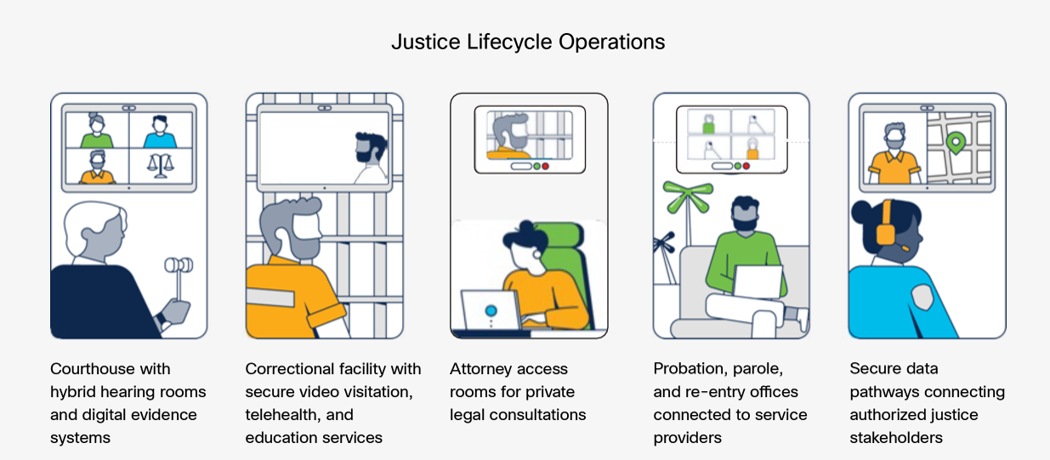
Visual Zones
Digital Courts
Courts rely on hybrid hearings, digital evidence, AI transcription, translation, and secure collaboration.
Connected Corrections
Facilities use secure video visitation, remote legal consultations, telehealth, education, and rehabilitation services.
Attorney and Court Access
Confidential video collaboration helps preserve legal access while reducing transportation risk and operational delays.
Community Supervision and Re-entry
Digital coordination supports probation, parole, rehabilitation, and reintegration services.
Supporting Fair and Timely Outcomes Through Connected Courts
Courts manage proceedings that determine how justice is carried out. Judges and court staff hold hearings, evaluate evidence, preserve records, and issue rulings. Digital technologies can help courts operate more efficiently while maintaining secure and accessible proceedings.
Use Case 1: Digital and Hybrid Courtrooms
What a Connected Courtroom Could Look Like
● Hearings include both in-person and remote participants.
● Witnesses and experts testify remotely through secure video collaboration platforms.
● Attorneys question witnesses directly, while juries can evaluate testimony in real time.
● Reliable, low-latency communication systems keep court proceedings clear and uninterrupted.
Cisco’s Role
Cisco collaboration platforms provide secure, high-quality video communication that supports hybrid proceedings while maintaining reliability, clarity, and security in legal environments.
“Cisco Webex made it possible for us to become one of the first fully remote courts in the entire nation.” Judge Marc Rothenberg, Marion County Superior Court Judge, retired
Watch the Video: Marion County Court (Indianapolis, IN)
Use Case 2: AI-Driven Transcription and Translation
What a Connected Courtroom Could Look Like
● Multi-language AI models reduce transcription from weeks to minutes.
● Evidence processing that once took days or months to near real time.
● AI-driven transcription and translation help capture context and intent across languages, improving accessibility and the accuracy of court records.
Cisco’s Role
Cisco provides the secure digital foundation required to support AI-driven transcription, translation, and real-time collaboration in court environments.
Use Case 3: Evidence and Data Security
What a Connected Courtroom Could Look Like
● Courts manage large volumes of digital evidence, in-clouding video recordings, documents, and forensic data.
● Official recordings of hearings are accurately preserved for appeals and legal review.
● Secure digital systems ensure that evidence is accessible only by authorized individuals.
● A secure infrastructure is in place to protect sensitive legal information
Cisco role
Cisco foundational platforms help protect court systems through Zero Trust Network Architecture, end-to-end encryption, and identity-based access controls that secure users, devices, and applications.
Secure Services and Supervision Beyond the Courtroom
Correctional facilities manage far more than detention. They must provide access to courts and counsel, maintain safe operations, connect individuals to families and services, and support rehabilitation. Digital collaboration tools increasingly shape how these services are delivered safely and efficiently.
Use Case 1: Video Visitation Services
What a Connected Environment Can Look Like
● Secure video platforms connect incarcerated individuals with approved visitors.
● Professional visitors and attorneys use private, high-quality video sessions.
● Facilities schedule and manage visits through secure digital workflows.
● Virtual visitation reduces transportation, escorting, and on-site processing burdens.
Cisco’s Role
Cisco-powered Video Visitation Services connects incarcerated individuals with attorneys, courts, family members, healthcare providers, education programs, and rehabilitation services through scheduled video sessions.
Use Case 2: Attorney and Court Access
What a Connected Environment Can Look Like
● Attorneys meet with clients remotely using secure collaboration.
● Courts conduct hearings without transporting individuals from facilities.
● Legal teams share information securely during remote consultations.
● Confidential communications protect attorney-client privilege.
Cisco’s Role
Cisco secure collaboration platforms enable confidential legal consultations and remote court participation, helping facilities support due process while reducing transportation risk and delay.
Use Case 3: Facility Operations and Safety
What a Connected Environment Can Look Like
● Connected cameras, sensors, and monitoring systems provide continuous visibility.
● AI continuously analyzes data from these systems to identify potential safety risks and changing conditions.
● Centralized control rooms monitor multiple areas or facilities.
● Real-time alerts help staff respond more quickly as situations develop.
Cisco’s Role
Cisco provides the secure infrastructure needed to support connected monitoring systems, protecting devices, data, and communications across correctional environments.
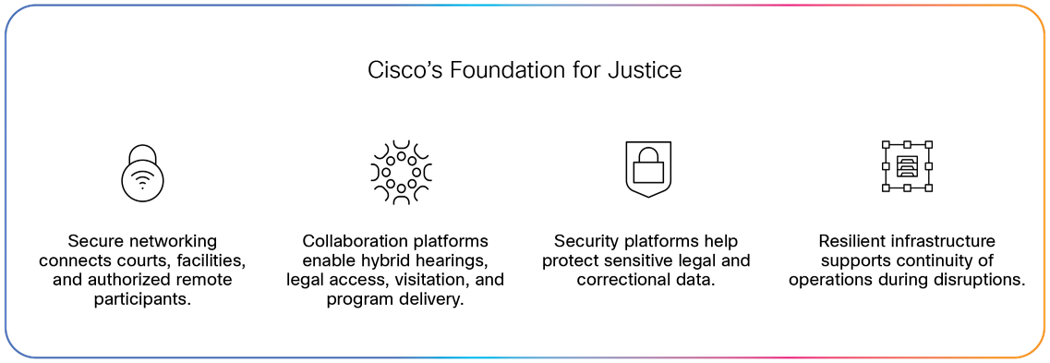
The Foundation for Justice Data, Security, and Trust
Justice operations depend on sensitive information: evidence, hearing records, legal communications, health information, custody data, supervision records, and personally identifiable information. Trust depends on ensuring the right people can securely access the right information at the right time while giving justice organizations the flexibility to adopt new technologies, accommodate evolving legal requirements, and share trusted information across authorized stakeholders.
Core foundation elements
● Identity and access management for authorized users and devices
● Zero Trust controls across applications, networks, and data
● End-to-end encryption for communications and evidence handling
● Resilient network infrastructure for courts, facilities, and remote services
● Auditability and governance for sensitive justice workflows
● Interoperability across courts, corrections, supervision, and service providers
Justice organizations are managing increasing volumes of digital evidence, records, video, and administrative work. AI can help reduce delays, improve accessibility, and support operational efficiency, but it must be deployed with strong governance, human oversight, privacy safeguards, and protections that help keep AI systems unbiased, safe, and secure.
● Autonomous Incident Intelligence
AI agents now continuously monitor IoT sensors, municipal cameras, and social feeds. They interpret behavioral contexts, such as distinguishing between a medical emergency and a public gathering, to alert responders before a situation escalates.
● AI Transcription and Translation
AI can support faster court records, multilingual access, and more accurate transcription that preserves context across languages.
● Evidence Processing
AI-assisted workflows can help organize and surface relevant information to support authorized review, while preserving human oversight.
● Correctional Operations
Analytics can help facilities monitor conditions, identify risks, and coordinate response.
● Administrative Efficiency
AI can help reduce repetitive work while helping justice organizations add new policies, governance requirements, and operational processes more quickly
● Governance and Human Oversight
Judges, court administrators, correctional leaders, and legal professionals remain responsible for decisions and accountability.
Key Use Cases for AI in Courts:
Use cases focus on leveraging AI to enhance judicial operations, improve data processing, and enable real-time analytics for better decision-making.
● Real-time data analytics and performance monitoring: AI-powered platforms enable courts to gain insights into system performance and availability to help anticipate and prevent outages.
● AI-enabled document and case management: AI models accelerate the processing of large volumes of documents for faster search, retrieval, and analysis.
● Enhanced video and audio processing: AI capabilities support multimodal processing of video, text, and audio data, which can be used for evidence analysis, transcription, and real-time translation services.
● Secure and scalable AI infrastructure: AI infrastructure optimized for demanding workloads such as large language models (LLMs), agentic AI, and multimodal models that improve operations and decision-making.
● Operationalizing AI workflows: AI solutions can streamline AI model development, deployment, and lifecycle management, ensuring consistent and secure AI operations across hybrid cloud environments.
Cisco’s Role in Trusted Justice AI
● Trusted identity helps ensure only authorized users and systems access sensitive data.
● AI Defense helps protect AI applications against manipulation, unsafe outputs, and misuse while supporting responsible AI adoption.
● Security operations capabilities help detect threats targeting justice infrastructure and AI-enabled environments.
● Secure networks and trusted data pipelines provide the foundation AI systems require.
Conclusion: Building Fairer, More Accessible Justice Systems
Justice modernization requires more than digitizing legacy processes. It requires connected systems that support due process, reduce delays, improve access, protect sensitive data, and strengthen trust across courts, corrections, supervision, and re-entry services.
Cisco helps justice organizations build the secure digital foundation needed to connect people, facilities, systems, and data. With secure collaboration, resilient networking, trusted identity, and integrated security, justice agencies can operate more efficiently while preserving fairness, confidentiality, and accountability.
Fairer and more accessible justice is not built by technology alone. But when justice increasingly depends on reliable information, secure communications, and timely access to services, the right digital foundation makes progress possible.