Basler and Cisco: Accelerating AI-Driven Machine Vision White Paper
Available Languages
Bias-Free Language
The documentation set for this product strives to use bias-free language. For the purposes of this documentation set, bias-free is defined as language that does not imply discrimination based on age, disability, gender, racial identity, ethnic identity, sexual orientation, socioeconomic status, and intersectionality. Exceptions may be present in the documentation due to language that is hardcoded in the user interfaces of the product software, language used based on RFP documentation, or language that is used by a referenced third-party product. Learn more about how Cisco is using Inclusive Language.
Overview and business drivers for AI-driven machine vision applications
Overview
Machine vision has long been a key feature in manufacturing processes, improving product quality, defect detection, robotic guidance, barcode/QR reading, process verification, safety monitoring, and the ability to sense the presence of products and inventory, among many other use cases. AI technology is transforming the business impact of machine vision applications. By enabling faster and more adaptive analysis of vision data, AI enhances the flexibility of machine vision systems, improves inspection speed, and quickly processes the higher data volumes generated by advanced vision sensors. Manufacturers are deploying more AI-driven machine vision applications to improve product quality, increase operational efficiency, automate activities, and improve production safety. However, deploying and operating AI-driven vision solutions can be complex. This white paper presents the Cisco and Basler validated design and implementation guidance that help customers accelerate the adoption of next-generation machine vision capabilities.
Basler is a leading provider of machine vision systems, supplying machine vision cameras, lenses, illumination, and the AI-driven software to analyze the vision data and operate the cameras. Cisco, as the leader in industrial networking, and Basler are collaborating to bring Cisco Validated Designs for industrial, AI-driven machine vision applications.
This solution overview provides a high-level description of how our companies collaborate to accelerate the deployment of resilient, secure, and capable AI-driven machine vision. Cisco and Basler have collaborated to provide design, deployment, and operational guidance so manufacturers, system implementers, and suppliers can quickly and confidently deploy machine vision in production systems.
Business drivers
Machine vision cameras are benefiting from improvements in sensing technology that make them more granular, more precise, and better able to transfer the richer image data faster to data-hungry AI applications. The improvements in AI capabilities enable processing of larger volumes of vision data faster, dealing better with changing conditions, driving better results. These technical capabilities are opening significant business value for manufacturers, including:
● Significant improvement in product quality, with better detection of errors and defects in products and inventory
● Increased uptime and reduced loss, as improved image data and processing are lowering the incidence of false fault detection
● Improved worker and equipment safety by detecting unsafe conditions faster and with greater accuracy
● Increased efficiency and speed, as machine vision systems can process image data faster, allowing manufacturers to increase output
● An expanded set of use cases, as AI-driven machine vision can handle changing conditions and complex image analysis
Challenges in deploying AI-driven machine vision
Clearly AI-driven machine vision applications provide many benefits for manufacturing production systems. But customers, systems integrators, and machine vision solution suppliers have had a number of key challenges to the deployment, scale, and operation of these applications, including:
● Limitations in available bandwidth in existing production networks
● Cost to deploy the cabling and infrastructure to connect, power, and synchronize machine vision cameras and vision analysis compute resources
● Concerns that machine vision traffic will negatively impact the network and/or that the network will negatively impact the timely processing of camera data, especially in high-speed vision applications
● Lack of understanding of how to effectively configure the network for optimal support
● Security concerns regarding integrating new devices and applications and moving the vision data around the plant and enterprise networks
Better together
Cisco and Basler share the goal of accelerating the digital transformation of manufacturing. Together, the companies address the full path of machine vision data, from image capture to secure data transport and analysis. Basler brings decades of experience in developing industrial cameras, software, and vision components, while Cisco delivers a secure and scalable network architecture to connect, power, and manage them. Our combined experience and technologies come together to form a machine vision solution that is lower cost, lower risk, faster to deploy, and easier to operate.
Target audience
The solution is developed for manufacturers, original equipment manufacturers (OEMs), systems integrators, and partners deploying machine vision applications and systems in factories, production systems, lines, and machines. It includes requirements, design considerations, reference architectures, deployment guidance, and operational considerations. These are meant to provide the target audience with the confidence and background needed to deploy Basler’s machine vision system on top of Cisco® industrial networking technology.
Basler AI/ML-driven machine vision solutions
Basler provides the building blocks for intelligent vision systems. Its portfolio includes high-resolution line-scan and area-scan cameras, 3D stereo and time-of-flight cameras, and a flexible software platform built around the Basler pylon SDK and pylon AI tools. These technologies enable accurate and deterministic image acquisition, the essential first step for any AI or ML pipeline. With support for GigE Vision, USB3 Vision, CoaXPress 2.0, and embedded interfaces such as the NXP i.MX 8M Plus, Basler allows manufacturers and systems integrators to deploy AI inference efficiently at the edge with low latency and minimized bandwidth demand across the entire network. The Cisco and Basler solution will be focused on Ethernet-based connectivity over GigE Vision, the standard for industrial machine vision communication over Ethernet networks.
Vision systems are becoming increasingly complex, and many customers have unique requirements. Basler’s vision system consultants, engineers, and customization specialists can help manufacturers, OEMs, and systems integrators by supporting their needs with robust custom vision systems that leverage Basler’s experience with the newest technologies in both vision and networking to create dynamic and stable vision solutions that make life easier, processes smoother, and applications more efficient. Basler’s solutions are deployed in a wide range of manufacturing and industrial use cases (see the figure below). Partnering with Cisco as a Cisco reseller (U.S. only) enables Basler to offer a complete multicamera and AI-enabled vision solution.
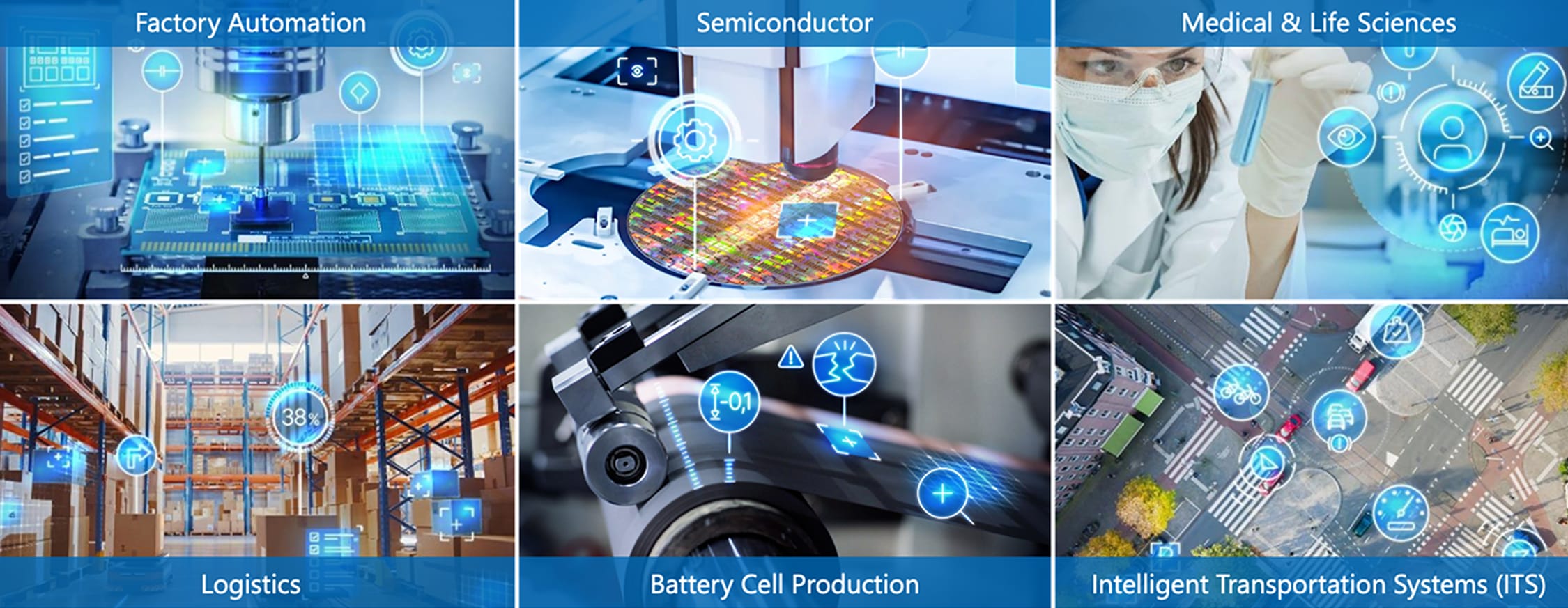
Use cases for Basler manufacturing and industrial solutions
Together, these open and scalable machine vision components deliver consistent, high-quality image data that AI/ML applications need to perform reliably in production environments and integrate seamlessly into Cisco’s industrial networking architecture.
Our solution and best practices to deploy machine vision applications
Cisco and Basler have validated machine vision technology and applications on industrial networks and are providing design and implementation best practices based on our joint expertise.
Based on our collaboration, the Machine Vision in Industrial Automation Cisco Validated Design (CVD) recommends architectures, design approaches, and implementation guidance to help overcome the challenges and accelerate the adoption of this important technology.
Key network and security requirements
As noted above, adding machine vision applications to production networks has some key challenges. The key network and security requirements we have identified include
● Bandwidth is a key consideration. The chips in machine vision cameras are improving rapidly—their sensitivity and ability to transfer data quickly increase the amount of data they can transmit. Cameras that operate at 1 Gbps are standard, and many vendors offer multigigabit or higher cameras. The industrial network needs to support the higher data loads.
● Decreased latency: Cameras are producing more data, and the machine vision analytic applications are also drastically improving their ability to quickly process that data. Manufacturing processes operate at high speeds. Higher-resolution images need to be processed ever faster. Network latency must be low and consistent to allow these systems to perform quickly and without error.
● Power over Ethernet (PoE): Often, the more capable the camera, the more power the camera consumes. Cameras with embedded compute capability to process and analyze the onboard data increase power budgets. Currently available network infrastructure that supports PoE, PoE+, and 4PPoE may be needed to speed deployment by supplying power over the same cable as the data connection.
● Synchronization: A critical aspect of the camera’s function is capturing video or pictures at the right time in the manufacturing process. This signaling can be done over I/O but requires more cabling, or it can occur directly over the data path via the network with support for IEEE 1588 Precision Time Protocol (PTP).
● Prioritization in converged networks: Machine vision data must be processed quickly and can delay other more critical traffic or overload the network. Separate networks or directly connected devices may alleviate these concerns but are expensive and limiting. Converged networks that can differentiate and prioritize critical traffic lower costs and increase flexibility. The Cisco and Basler solution covers several techniques to maintain low-latency and high-bandwidth connectivity for machine vision traffic, including quality of service (QoS) and support for jumbo frames.
● Security: The images captured by machine vision systems are often considered intellectual property; they may represent key manufacturing processes or products and are critical aspects of the manufacturing process. The devices and data need cybersecurity protection. The Cisco and Basler solution outlines how Cisco TrustSec® microsegmentation can protect the machine vision systems and the data they produce.
Machine vision reference architecture
In the joint Basler and Cisco validated design, Basler provided the imaging layer for end-to-end data-flow verification. Testing used Basler ace2 and racer2 cameras connected through Cisco Industrial Ethernet (IE) switches with IEEE 1588 PTP synchronization. The collaboration validated deterministic frame delivery across the Cisco network and demonstrated how the Basler pylon AI/ML platform performs inference directly at the edge, reducing upstream bandwidth requirements while maintaining image quality. Environmental testing confirmed stable operation under industrial temperature and vibration conditions, helping ensure readiness for factory deployment.
We have integrated the machine vision systems into our converged industrial automation architecture. By using this architecture and the solution guidance provided, we help customers and systems integrators confidently deploy capable AI-driven machine vision systems and overcome the challenges described previously.
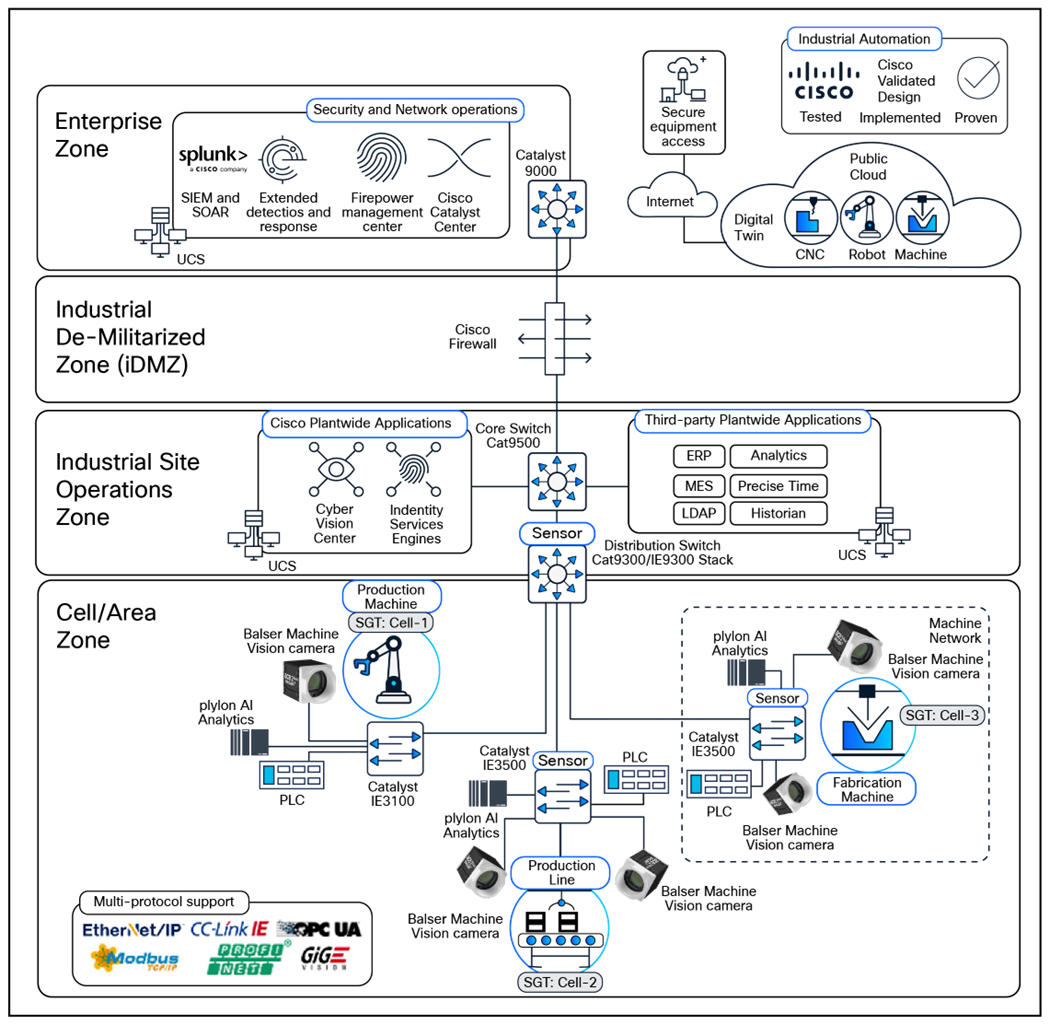
Architecture for the Machine Vision in Industrial Automation Cisco Validated Design
Key components
The key components of the validated architecture include technologies from Cisco and Basler.
The key components from Basler include:
● High-performance, PoE-powered, GigE Vision cameras for area-scan and line-scan applications
● pylon AI/ML-powered computer vision software
● Camera attachments and accessories (such as lenses and lighting)

Basler cameras, lenses, lighting, accessories, acquisition cards, and analytics software
The key Cisco components include:
Cisco industrial Ethernet switches: Available as DIN-rail, IP67-rated, and rackmount form factors, Cisco Catalyst™ IE9300 and IE3100 Rugged Series and Cisco IE3500 Rugged Series and IE3500 Heavy Duty Series Switches deliver high-speed ports including 1GE, 2.5GE, and 10GE options to support demanding industrial AI applications, and offer high-wattage PoE (up to 90W per port, up to 720W total per switch) enabling flexible deployment of cameras and sensors. They integrate robust security with Cisco’s Trust Anchor, Cisco Cyber Vision, TrustSec segmentation, and Secure Equipment Access for zero-trust remote management of connected assets. These switches offer high-capacity, low-latency Layer 2/3 switching, all managed by Cisco Catalyst Center.
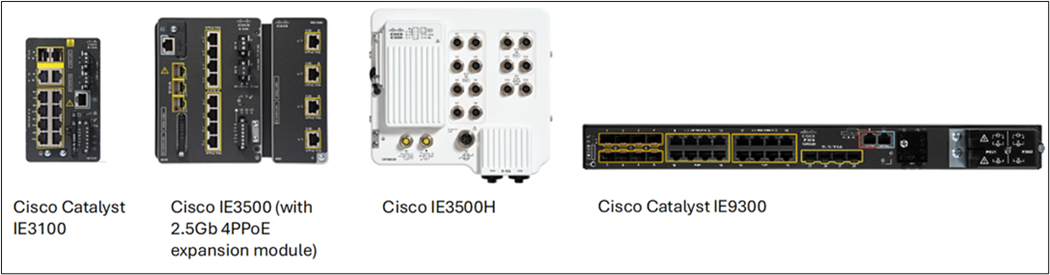
Cisco Industrial Ethernet switches
Table 1. Cisco Industrial Ethernet switches for machine vision cameras
| IE switch series |
Port speeds (count) |
PoE |
Jumbo frame |
Cisco Cyber Vision, TrustSec, Secure Equipment Access (SEA) |
||||
| 10 Gbps |
2.5 Gbps1 |
1 Gbps1 |
4PPoE |
PoE/PoE+ |
Budget |
|||
| IE3500 |
3 |
0/4 |
8/24 |
12 |
|
480 W |
Yes |
Yes |
| IE3500H |
2 |
2 |
12 |
2 |
14 |
240 W |
Yes |
Yes |
| IE9300 |
4 |
8 |
16 |
8 |
16 |
720 W |
Yes |
Yes |
| IE3100 |
- |
- |
10 |
2 |
6 |
240 W |
Yes |
SEA only |
Cisco Cyber Vision provides deep, continuous visibility into connected OT assets by automatically inventorying devices and mapping their communication patterns. It assesses vulnerabilities by highlighting those actively exploited, enabling prioritized remediation. The solution continually monitors the network for threats helping early detection and response. Cyber Vision leverages AI to group assets based on their industrial roles, helping operations teams define logical zones for network segmentation policies. Integrated within Cisco industrial switches, this combination delivers a unified networking and security architecture that simplifies deployment, enhances operational resilience, and enables adaptive segmentation aligned with industrial processes and standards like IEC 62443.
Cisco Secure Equipment Access (SEA) provides controlled zero-trust secure remote access designed specifically for OT environments. It enables least-privileged access by allowing users to connect only to specific devices, using only approved protocols, and only during authorized times, aligned with the requester's responsibilities. SEA eliminates the need for traditional VPNs by embedding Zero Trust Network Access (ZTNA) gateway functionality directly into Cisco industrial switches, simplifying deployment and scaling without requiring dedicated hardware or complex firewall configurations.
Cisco Identity Services Engine (ISE) is a comprehensive network security policy management platform that enables secure access control (via TrustSec in the network infrastructure) and visibility for users and devices across wired, wireless, VPN, and 5G networks.
Cisco Catalyst Center is a powerful network management system that leverages AI to connect, secure, and automate network operations. It simplifies the management of Cisco Catalyst network infrastructure, including IE switches, helping ensure a consistent user experience across wired and wireless networks.
Manufacturers are looking to deploy more AI-driven machine vision cameras and solutions as advances in technology are significantly improving the quality, speed, and amount of data that can be processed. This leads to benefits in key production metrics such as safety, output, quality, and uptime. With this solution, Cisco and Basler are collaborating to help our customers, systems integrators, and OEMs accelerate the deployment of these machine vision systems to realize the benefits more quickly and with lower risk by relying on our experience and jointly validated testing.