Overview
The Cisco® 8000 Series Secure Routers deliver the industry’s most complete secure networking experience, combining cutting-edge security, routing, assurance, and SD-WAN capabilities in a unified platform. Designed for diverse use cases—from branches and campuses to data centers—these secure routers empower businesses to adapt dynamically to evolving demands. Featuring the all-new secure networking processor, the customized silicon is built for high-bandwidth AI/ML workloads while reducing power consumption and operational costs. The Cisco 8000 Series provides the foundation for resilient networks that scale with your business needs.
Cisco 8000 Series Secure Routers FAQ
Q. What are the Cisco 8000 Series Secure Routers?
A. The Cisco 8000 Series Secure Routers offer a comprehensive range of solutions for modern network architectures. From small branches to large enterprises, these platforms provide advanced security, SD-WAN capabilities, and high-performance routing to meet diverse business needs.
Q. What is the relative positioning among the various series within the portfolio?
A. Refer to the table below. See the Router Selector for more details on model selection.
Table 1. Cisco 8000 Series Secure Routers positioning
| Platform |
Positioning |
Performance |
| Cisco 8100 Series Secure Routers |
Small branch: Flexible 1GE LAN/WAN secure connectivity including 5G, DSL, XGS-PON options |
IPsec: Up to 1.5 Gbps (512B) Threat protection: Up to 1 Gbps (EMIX) |
| Cisco 8200 Series Secure Routers |
Medium-sized branch: Lead series for midsize organizations, with 1GE, 2.5GE, and 10GE LAN/WAN secure connectivity along with cellular backup options |
IPsec: Up to 5 Gbps (512B) Threat protection: Up to 2.4 Gbps (EMIX) |
| Cisco 8300 Series Secure Routers |
Large branch: Purpose-built for integrated edge computing and 1GE, 2.5GE, 5GE, and 10GE LAN/WAN secure connectivity with additional expandability |
IPsec: Up to 30 Gbps (512B) Threat protection: Up to 7 Gbps (EMIX) |
| Cisco 8400 Series Secure Routers |
Campus: High-performance 1GE, 10GE, and 25GE secure connectivity for WAN aggregation |
IPsec: Up to 45 Gbps (512B) Threat protection: Up to 10.9 Gbps (EMIX) |
| Cisco 8500 Series Secure Routers |
Data center: Highest-performance 1GE, 10GE, 40GE, and 100GE secure connectivity for data center hub access |
IPsec: Up to 63 Gbps (512B) IPsec tunnels: 10,000 |
| Cisco 8600 Series Secure Routers |
Data center: Highest scale and performance with high port density 1GE, 10GE, 40GE, and 100GE |
IPsec: Up to 160 Gbps (512B) IPsec tunnels: 12,000 |
Q. What security solutions are offered with the Cisco 8000 Series Secure Routers?
A.
Threat detection, prevention, and response
Features designed to detect, prevent, and respond to security threats in real time:
● Intrusion Prevention and Detection (IPS/IDS)
● Advanced Malware Protection (AMP)
● Anomaly detection and machine learning
Network perimeter security
Features that safeguard the network’s edge and control external access:
● Enterprise firewall with application awareness
● Zone-based firewall
● Network Address Translation (NAT)
● Secure access service edge (SASE) integration
Web and DNS security
Features that protect users and devices from web-based and DNS-layer threats:
● URL filtering
● DNS web-layer security agent
● SSL proxy
Identity and access control
Features that enforce secure access to the network, administrative interfaces, or resources:
● Cisco TrustSec®
● Identity-based networking (802.1X)
● Role-based command-line interface (CLI) access
● Access Control Lists (ACLs)
● Authentication and integrity verification
Routing and traffic security
Features that help ensure secure routing, traffic isolation, and mitigation of malicious traffic:
● Virtual route forwarding (VRF)-aware security
● Source-based remotely triggered black hole (RTBH) filtering
● Unicast reverse path forwarding (RPF)
Infrastructure and control plane protection
Features that protect the control plane and administrative access to devices:
● Control plane protection (CoPP)
● Secure Shell (SSH) v2
● Management plane protections
Device and system security
Features that help ensure the integrity, security, and reliability of hardware and software:
● Secure Boot with signed images and hardware anchoring with Secure Unique Device Identity (SUDI)
● Secure storage
● Run-time defenses
● Recovery mechanisms
Q. What is the minimum Cisco IOS
® XE Software release for the Cisco 8000 Series Secure Routers?
A. The Cisco 8000 Series Secure Routers run Cisco IOS XE Software, which supports routing and SD-WAN. The minimum IOS XE Software versions are listed in the table below.
Table 2. Minimum Cisco IOS XE releases
| Model |
Minimum IOS XE Software version |
| C8570-G2, C8550-G2, C8475-G2, C8455-G2, C8375-E-G2 |
IOS XE 17.15.3 |
| C8355-G2, C8235-E-G2, C8231-E-G2, C8235-G2, C8231-G2, C8161-G2, C8151-G2, C8140-G2, C8130-G2 |
IOS XE 17.18.1 |
| C8130-VAI-G2, C8130-VAP-G2, C8151- CVAI-G2, C8151-CVAP-G2, C8131-G2 |
IOS XE 26.1.1 |
| C8221-G2, C8225-G2 |
IOS XE 26.1.2 |
| C8221L-G2, C8650-G2 |
IOS XE 26.1.3 |
| C8211-G2, C8130H-G2, C8151H-C-G2 |
IOS XE 26.1.2 |
Note: The C8130H-G2, C8130-G2, C8130-VAI-G2, C8130-VAP-G2, and C8140-G2 support routing mode only.
Q. Which Cisco 8000 Series Secure Routers support Cisco ThousandEyes
®?
A. ThousandEyes is supported on all platforms except models with 4GB DRAM.
Q. What configuration, management, and monitoring options are available for the Cisco 8000 Series Secure Routers?
A. The 8000 Series Secure Routers can be managed and/or monitored via
● Cisco Catalyst™ SD-WAN Manager
● Cisco Catalyst Center
● Simple Network Management Protocol (SNMP)
● Onboard Cisco IOS XE Software WebUI
● NETCONF, RESTCONF, and YANG models
● CLI
Q. What are the software and licensing options for the Cisco 8000 Series Secure Routers?
A. There are two distinct licensing and subscription options for routing or SD-WAN deployments:
● Routing Essentials (perpetual and included with hardware purchase)
● Routing Advantage subscription
SD-WAN requires a flexible 12- to 84-month term under the Cisco Networking Subscription with the following benefits:
● Platform-class licensing: Each platform class is categorized as small, medium, large, or extra large based on the throughput, performance, and positioning characteristics of the underlying hardware platforms.
● Elimination of bandwidth tiering: Licenses for the next-generation hardware will not be segmented by bandwidth tiers.
● License portability: Licenses can be managed via Catalyst Center, SD-WAN Manager, or the Cisco Meraki™ dashboard (WAN only).
● Management: Licenses can be managed via Catalyst Center, SD-WAN Manager, or Meraki dashboard (WAN only).
All SD-WAN license entitlements are subscription-based, with two tiers available: Cisco WAN Essentials and Cisco WAN Advantage.
Cisco 8100 Series Secure Routers FAQ
Q. What are the different models within the Cisco 8100 Series?
A. The Cisco 8100 Series Secure Routers consist of the following models: C8130-G2, C8130-VAI-G2, C8130-VAP-G2, C8130H-G2, C8131-G2, C8140-G2, C8151-G2, C8151-CVAI-G2, C8151-CVAP-G2, C8151H-C-G2, and C8161-G2. The models have various combinations of WAN interfaces, cellular, Power over Ethernet (PoE), and security options.
Q. Can I upgrade the DRAM and flash?
A. No. Neither the DRAM nor the flash are upgradable.
Q. Is the Cisco 8100 Series fanless?
A. Yes, the Cisco 8100 Series Secure Routers are fanless.
Q. Is the Cisco 8100 Series PoE and PoE+ capable?
A. Yes, the C8161-G2 supports either four PoE ports or two PoE+ ports.
Q. What power supplies are used on the Cisco 8100 Series?
A. The C8130-G2, C8130H-G2, and C8131-G2 can be powered by a 30W or 66W AC power supply. The C8130-VAI-G2, C8130-VAP-G2, C8140-G2, C8151-CVAI-G2, C8151-CVAP-G2, C8151-G2, and C8151H-C-G2 require a 66W AC PSU. The C8161-G2 requires a 150W AC PSU.
Q. Does the Cisco 8100 Series support an external power supply?
A. All power supplies are external.
Q. Does the Cisco 8100 Series support a DC power supply?
A. All power supplies are AC-DC. No DC-DC power supplies are supported.
Q. Does the Cisco 8100 Series have a power button?
A. No. There is no power button on the Cisco 8100 Series Secure Routers.
Q. How many GE WAN ports are available with the Cisco 8100 Series?
A. The C8130-G2, C8131-G2 come with one RJ-45 1GE WAN port plus one RJ-45/SFP 1GE WAN combo port only. The C8140-G2, C8151-G2, and C8161-G2 come with two RJ-45/SFP 1GE WAN ports. The C8130-VAI-G2, C8130-VAP-G2, C8151-CVAI-G2, and C8151-CVAP-G2 come with one RJ-45/SFP 1GE WAN combo port, one XGS-PON/10G BASE-T port, and one RJ-11 (xDSL) port. C8130H-G2 and C8151H-C-G2 comes with 1x RJ-45 1GE WAN plus 1 x 10G Copper port.
Q. What are the different mounting options for the Cisco 8100 Series?
A. The Cisco 8100 Series platforms can be rack, wall, or desk mounted or placed on a desktop. When mounting two Cisco 8100 Series routers in a rack, you must leave at least 1RU (1.75 inches, 4.45 cm) of space between the devices for proper ventilation and cooling. This helps ensure that the equipment operates efficiently and reduces the risk of overheating.
Q. Does the Cisco 8100 Series have feature parity with the Cisco ISR 1000 Series?
A. Yes, the Cisco 8100 Series has software feature parity with the Cisco 1000 Series Integrated Services Routers (ISR 1000 Series).
Q. What VPN technologies are supported on the Cisco 8100 Series?
A. The Cisco 8100 Series supports the following VPN technologies: FlexVPN, Dynamic Multipoint VPN (DMVPN), Group Encrypted Transport VPN (GETVPN), Site-to-Site VPN, and Multiprotocol Label Switching (MPLS) VPN.
Q. Which Cisco 8100 Series platforms support cellular?
A. The C8151-G2 and C8161-G2 platforms support 5G/Cat7 LTE with cellular pluggable interface modules (PIMs). The C8151-CVAI-G2, C8151-CVAP-G2, and C8151H-C-G2 models support embedded 5G Release 17 cellular.
Q. Do the Cisco 8100 Secure Routers support dual SIMs?
A. Yes. The PIM supports dual SIMs in active-standby mode in the C8151-G2 and C8161-G2 models. The C8151-CVAI-G2, C8151-CVAP-G2, and C8151H-C-G2 support dual nano SIM slots.
Q. Do the Cisco 8100 Secure Routers support eSIM technology?
A. Yes, eSIM is supported on the C8151-G2 and C8161-G2 platforms.
Q. Can the Cisco 8100 Series fall back to 4G?
A. Yes, the Cisco 8100 Series supports 4G as well, and can fall back from 5G to 4G/LTE.
Q. What is XGS-PON, and in which platforms is it supported?
A. The C8130-VAI/P-G2 and C8151-CVAI/P-G2 platforms support one XGS-PON/10GBASE-T WAN port, delivering 10-Gbps symmetric fiber access for multiuser environments. XGS-PON stands for 10-Gigabit symmetric passive optical network, providing equal upload and download speeds over passive fiber infrastructure.
Q. Why are service providers migrating from DSL to XGS-PON, and what additional 10GE options are available?
A. Service providers are moving to XGS-PON to meet increasing bandwidth demands from 4K/8K streaming, cloud applications, video conferencing, and multiple connected devices, while enabling future use cases such as IoT, smart cities, and 5G backhaul. XGS-PON also reduces operational costs by replacing legacy copper with scalable passive fiber. In addition, the C8130-VAI/P-G2 and C8151-CVAI/P-G2 platforms support an SFP-10G-BASE-T module, providing flexible 10GE WAN connectivity (actual throughput may vary from the full line rate).
Q. What is the primary difference between the C8130H-G2 and C8151H-C-G2 routers?
A. The C8130H-G2 focuses on Ethernet routing capabilities, while the C8151H-C-G2 additionally provides 5G cellular connectivity along with SD-WAN, security, and ThousandEyes features.
Q. What are the throughput expectations for platforms with 10G XGSPON and 10G Copper ports?
A. These platforms support 10G-capable interfaces. However, the actual achievable throughput may be lower, depending on factors such as device architecture, processing capabilities, and traffic conditions.
Cisco 8200 and 8300 Series Secure Routers FAQ
Q. What are the models within the Cisco 8300 and 8200 Series?
A. The Cisco 8300 and 8200 Series Secure Routers include the following models:
● C8375-E-G2: Cisco 8300 Series with one service module (SM), one network interface module (NIM) slot, one pluggable interface module (PIM) slot, two 1GE/10GE Small-Form-Factor Pluggable (SFP) ports, and four Multigigabit Ethernet (2.5GE) RJ-45 WAN ports, with Cisco UPOE®+ support on the last two ports.
● C8355-G2: Cisco 8300 Series with one PIM slot, four 1GE/10GE SFP/ SFP+ ports, four Multigigabit Ethernet (5GE) RJ-45 ports, and two 1GE RJ-45 ports, with UPOE+ support on all four Multigigabit ports.
● C8235-E-G2: Cisco 8200 Series with one PIM slot, one NIM slot, two 1GE/10GE SFP/SFP+ ports, and two Multigigabit Ethernet (2.5GE) RJ-45 ports, with UPOE+ support on both Multigigabit ports.
● C8321-E-G2: Cisco 8200 Series with one PIM slot, one NIM slot, two 1GE/10GE SFP/SFP+ ports, and two Multigigabit Ethernet (2.5GE) RJ-45 ports, with UPOE+ support on both Multigigabit ports.
● C8235-G2: Cisco 8200 Series with one PIM slot, two 1GE/10GE SFP/ SFP+ ports, and eight Multigigabit Ethernet (2.5GE) RJ-45 ports, with UPOE+ support on ports 6-7 and PoE support on ports 4-5.
● C8231-G2: Cisco 8200 Series with two 1GE/10GE WAN SFP/SFP+ ports, four Multigigabit Ethernet (2.5GE) RJ-45 ports with PoE+ support on port 7, and four 1GE RJ-45 ports.
● C8225-G2: Cisco 8200 Series with two 1GE/10GE SFP/SFP+ ports and eight 1GE RJ-45 ports.
● C8221-G2: Cisco 8200 Series with two 1GE/10GE SFP/SFP+ ports and eight 1GE RJ-45 ports.
● C8221L-G2: Cisco 8200 Series with two 10GE RJ-45 ports and eight 1GE RJ-45 ports.
● C8211-G2: Cisco 8200 Series with two 1GE RJ-45/SFP combo ports and four 1GE RJ-45 ports.
Q. What are the key differences between the Catalyst 8300 and 8200 Edge Platforms and the Cisco 8300 and 8200 Series Secure Routers?
A. The Cisco 8300 and 8200 Series Secure Routers are the next generation of secure WAN appliances, offering the following key benefits:
● Higher IPsec performance and scale
● Higher Cisco Express Forwarding performance
● Higher built-in WAN port density
● Improved backplane connectivity with high-speed connections
● Fixed and modular DRAM options
● 256-bit WAN MACsec on all front-panel ports
● 128-bit LAN MACsec on select models
● Embedded Layer 2 ports on select models
Q. What are the key capabilities of the Cisco 8300 and 8200 Series Secure Routers?
A. The Cisco 8300 and 8200 Series Secure Routers offer:
● SD-WAN and SD-Routing capabilities
● Support for Kernel-based Virtual Machine (KVM) containers, providing support for integrated applications
● Support for applications including Snort® IDS/IPS, URL filtering, advanced malware protection, Cisco Secure Malware Analytics, SSL proxy, and TCP optimization
● Open API programmability using NETCONF and YANG
● Zero-touch provisioning (ZTP)
● Multiple options for WAN, LAN, voice, storage, and edge computing (Cisco UCS® E-Series) modules on the Cisco 8300 Series
● Multiple options for WAN, LAN, and cellular on the Cisco 8200 Series
● Support for border node and control plane node functionalities in Cisco Software- Defined Access (SD-Access)
● Application quality of experience (AppQoE), TCP optimization, data redundancy elimination (DRE), Forward Error Correction (FEC), and packet duplication
● Comprehensive options for wireless WAN through LTE Cat7 and 5G
Q. Will the Cisco 8300 Series Secure Routers provide 100% module parity with the previous generation of platforms?
A. The figure below shows the list of validated modules on the Cisco 8300 Series.
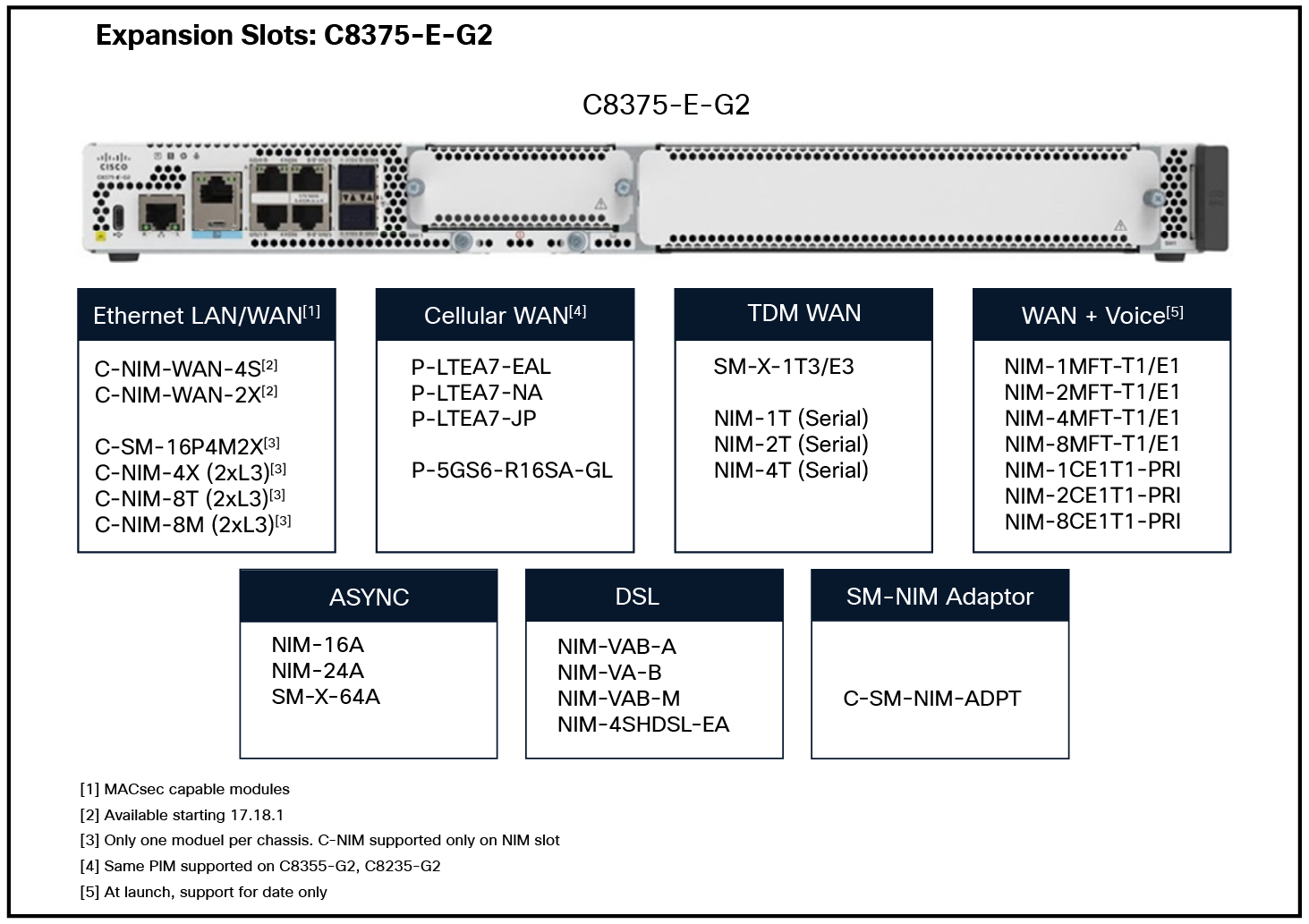
Figure 1.
Validated modules on the Cisco 8300 Series Secure Routers
Q. Will the Cisco 8200 Series Secure Routers provide 100% module parity with the previous generation of platforms?
A. The figure below shows the list of validated modules on the Cisco 8200 Series.
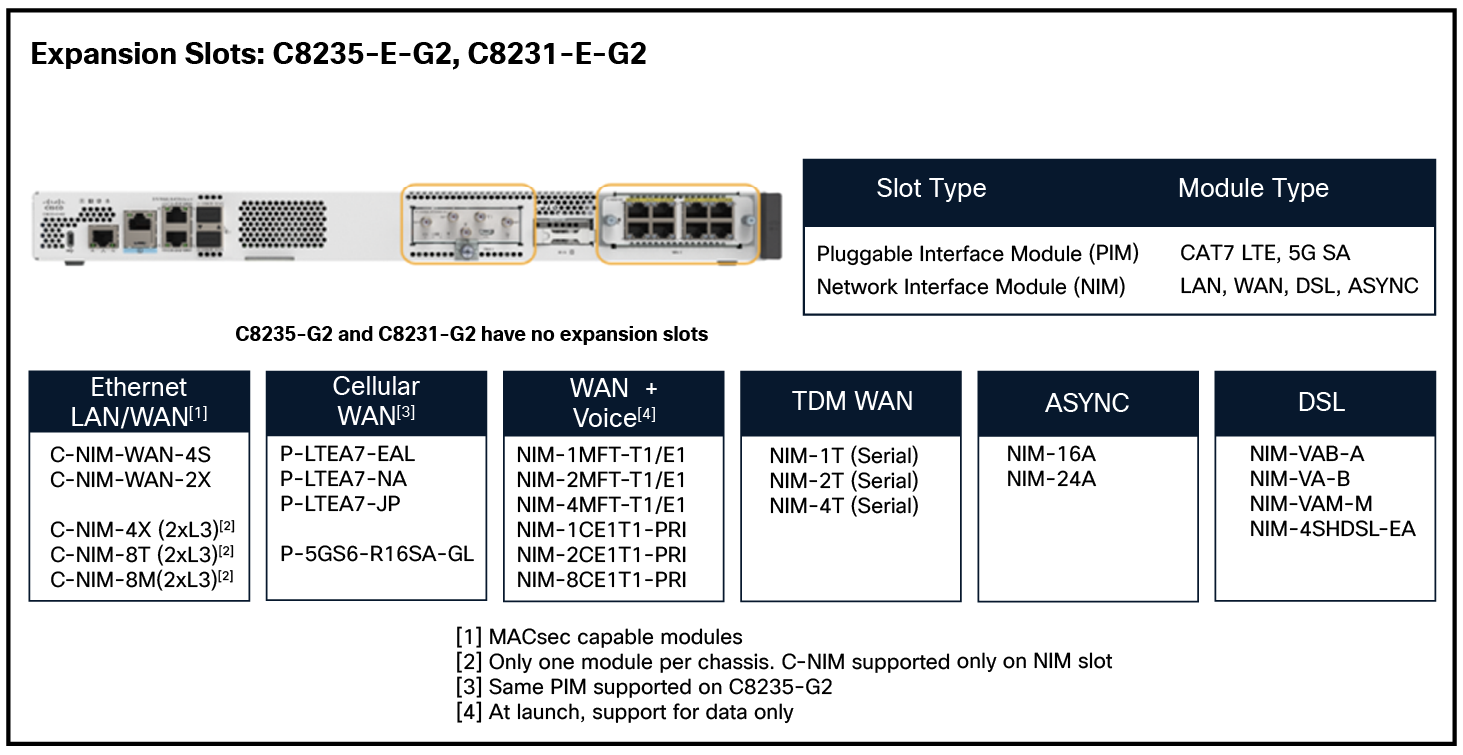
Figure 2.
Validated modules on the Cisco 8200 Series Secure Routers
Q. What are the available onboard Ethernet WAN port options on the Cisco 8300 and 8200 Series Secure Routers?
A. The onboard Ethernet WAN port options are outlined in the table below.
Table 3. Onboard Ethernet WAN port options on the Cisco 8300 and 8200 Series Secure Routers
| Platform |
Gigabit Ethernet SFP |
Multigigabit Ethernet RJ-45 |
Gigabit Ethernet RJ-45 |
| C8375-E-G2 |
2 |
4 |
– |
| C8355-G2 |
4 |
4 |
2 |
| C8235-E-G2 |
2 |
2 |
- |
| C8235-G2 |
2 |
8 |
– |
| C8231-E-G2 |
2 |
2 |
- |
| C8231-G2 |
2 |
4 |
4 |
| C8225-G2 |
2 |
- |
8 |
| C8221-G2 |
2 |
- |
8 |
| C8221L-G2 |
- |
- |
10 |
| C8211-G2 |
2 |
- |
6 |
Q. What are the SM and NIM hardware configuration options on the Cisco 8300 and 8200 Series Secure Routers?
A. The NIM and SM hardware configuration options are shown in the table below.
Table 4. NIM and SM configuration options on the Cisco 8300 and 8200 Series Secure Routers
| Platform |
SM |
NIM |
PIM |
| C8375-E-G2 |
1 |
1 |
1 |
| C8355-G2 |
0 |
0 |
1 |
| C8235-E-G2 |
0 |
1 |
1 |
| C8235-G2 |
0 |
0 |
1 |
| C8231-E-G2 |
0 |
1 |
1 |
| C8231-G2 |
0 |
0 |
0 |
Q. What are the different DRAM configuration options on the Cisco 8300 and 8200 Series Secure Routers?
A. DRAM configuration options are shown in the table below.
Table 5. Memory configuration options on the Cisco 8300 and 8200 Series Secure Routers
| Platform |
Total default DRAM |
DRAM upgrade options |
| C8375-E-G2 |
16 GB |
32 GB |
| C8355-G2 |
16 GB |
– |
| C8235-E-G2 |
16 GB |
- |
| C8235-G2 |
16 GB soldered |
– |
| C8231-E-G2 |
8 GB |
- |
| C8231-G2 |
8 GB soldered |
– |
| C8225-G2 |
16 GB soldered |
- |
| C8221-G2 |
8 GB soldered |
- |
| C8221L-G2 |
8 GB soldered |
- |
| C8211-G2 |
8 GB soldered |
- |
Note: For the C8375-E-G2, a single dual inline memory module (DIMM) configuration is supported. The upgrade option available is one 32-GB DIMM.
Q. Is Online Insertion and Removal (OIR) supported on the Cisco 8300 and 8200 Series Secure Routers?
A. Yes, OIR is supported on the Cisco 8300 and 8200 Series Secure Routers. OIR commands are issued before removing and after installing a module. (Example:
hw-module subslot 2/0 stop/start)
A.
Note: Surprise replacement of the system fan tray is not supported. To replace the fans, the system has to be powered down prior to the removal of fans inside the fan tray.
Q. Do the Cisco 8300 and 8200 Series Secure Routers support redundant power supplies?
A. Yes. The Cisco 8300 and 8200 Series support redundant power supplies.
Q. What are the power supply options for the Cisco 8300 and 8200 Series Secure Routers?
A. The available power supply options are detailed in the following table.
Table 6. Power supply options for the Cisco 8300 and 8200 Series Secure Routers
| Platform |
Type of PSU |
Dual AC |
Dual DC |
PoE AC PSU |
| C8375-E-G2 |
Internal |
Yes |
Yes |
Yes |
| C8355-G2 |
External |
Yes |
No |
Yes |
| C8235-E-G2 |
Internal – Primary External – Secondary (AC or DC) |
Yes |
No |
Yes |
| C8235-G2 |
External |
No |
No |
Yes |
| C8231-E-G2 |
Internal - Primary External - Secondary (AC or DC) |
Yes |
No |
Yes |
| C8231-G2 |
External |
No |
No |
Yes |
| C8225-G2 |
External |
Yes |
No |
No |
| C8221-G2 |
External |
Yes |
No |
No |
| C8221L-G2 |
External |
Yes |
No |
No |
| C8211-G2 |
External |
Yes |
No |
No |
Q. What front-panel ports are PoE-capable on the Cisco 8300 and 8200 Series Secure Routers?
A. The table below outlines the PoE-capable ports in the Cisco 8300 and 8200 Series Secure Routers.
Table 7. PoE-capable ports on the Cisco 8300 and 8200 Series Secure Routers
| Platform |
Front-panel ports |
| C8375-E-G2 |
Ports 2-3 UPOE+) |
| C8355-G2 |
Ports 0-3 (UPOE+) |
| C8235-E-G2 |
Ports 0-1 (UPOE+) |
| C8235-G2 |
Ports 4-5 (PoE), 6-7 (UPOE+) |
| C8231-E-G2 |
Ports 0-1 (UPOE+) |
| C8231-G2 |
Port 7 (PoE+) |
Q. Are solid-state drives (SSDs) supported on the Cisco 8300 and 8200 Series Secure Routers?
A. 600-GB and 2-TB M.2 NVMe SSDs are supported on the Cisco 8300 Series for container-based application hosting services and for general storage purposes.600-GB E1.S SSDs are supported on the Cisco 8200 Series for container-based application hosting services and for general storage purposes.
Q. Do the front-panel ports on the Cisco 8300 and 8200 Series Secure Routers have Layer 2, Layer 3, or flex capability?
A. The front-panel ports on the Cisco 8300 and 8200 Series Secure Routers provide various connectivity options as listed in the table below.
Table 8. Connectivity options on the front-panel ports of the Cisco 8300 and 8200 Series Secure Routers
| Platform |
WAN Ports |
Flex Ports |
LAN Ports |
| C8375-E-G2 |
2x 10GE SFP/SFP+ 4x 2.5GE mGig RJ-45 (2x UPOE+) |
- |
– |
| C8355-G2 |
2x 10GE SFP/SFP+ 2x 5GE mGig RJ-45 (2x UPOE+) |
2x 5GE mGig RJ-45 (2x UPOE+) 2x 1GE RJ-45 |
2x 10GE SFP/SFP+ |
| C8235-E-G2 |
1x 10GE SFP/SFP+ 2x 2.5GE mGig RJ-45 92x UPOE+) |
- |
- |
| C8235-G2 |
1x 10GE SFP/SFP+ 2x 2.5GE mGig RJ-45 (2x UPOE+) |
2x 2.5GE mGig RJ-45 (1x PoE+) |
4x 2.5GE mGig RJ-45 |
| C8231-E-G2 |
1x 10GE SFP/SFP+ 2x 2.5GE mGig RJ-45 (2x UPOE+) |
- |
- |
| C8231-G2 |
2x 10GE SFP/SFP+ 2x 2.5GE mGig RJ-45 (1x PoE+) |
2x 2.5GE mGig RJ-45 |
4x 1GE RJ-45 |
| C8225-G2 |
2x 10GE SFP/SFP+ 2x 1GE RJ-45 |
2x 1GE RJ-45 |
4x 1GE RJ-45 |
| C8221-G2 |
2x 10GE SFP/SFP+ 2x 1GE RJ-45 |
2x 1GE RJ-45 |
4x 1GE RJ-45 |
| C8221L-G2 |
2x 10GE RJ-45 |
2x 1GE RJ-45 |
6x 1GE RJ-45 |
| C8211-G2 |
2x 1GE RJ-45/SFP combo port |
2x 1GE RJ-45 |
2x 1G RJ-45 |
Q. Do the Cisco 8300 and 8200 Series Secure Routers support EtherChannel?
A. There is no support for Layer 2 EtherChannels on the onboard ports. Layer 2 EtherChannels are supported only via the C-SM-16P4M2X switch module on the C8375-E-G2 platform, both Link Aggregation Control Protocol (LACP) and Port Aggregation Protocol (PAgP). Layer 3 EtherChannel is supported on onboard ports and NIMs (including flex ports for onboard and NIM) and includes only LACP support.
Q. What cellular WAN options are available?
A. 5G standalone and Cat7 LTE are supported on the Cisco 8300 and 8200 Series Secure Routers in the PIM slot. In addition, these platforms support Cisco cellular gateways, providing deployment flexibility.
Q. Do the Cisco 8300 and 8200 Series Secure Routers support dual SIMs?
A. Yes. The PIM supports dual SIMs in active-standby mode.
Q. Do the Cisco 8300 and 8200 Series Secure Routers support eSIM technology?
A. Yes, eSIM is supported.
Q. What broadband technologies are supported on the Cisco 8300 Series?
A. We have NIMs that support multimode VDSL2 and ADSL/2/2+ NIM Annex A, B, and M. We also support SHDSL capability with the SHDSL NIM.
Q. Do the Cisco 8300 and 8200 Series Secure Routers have feature parity with previous generations of Catalyst 8300 and 8200 Series Edge Platforms?
A. Yes. The Cisco 8300 and 8200 Series Secure Routers have feature parity with the Catalyst 8300 and 8200 Series Edge Platforms.
Q. How do the C8211/C8221/C8225-G2 and C8231/C8235-G2 models differ?
A. All models provide similar levels of throughput and scale. The key differences are based on the specific requirements of your deployment:
● The C8231-G2 and C8235-G2 feature integrated PoE and cellular capabilities.
● The C8211-G2, C8221L-G2, C8221-G2, and C8225-G2 feature power supply redundancy in a small form factor and include post-quantum Secure Boot for enhanced security in medium-sized branch offices.
Q. Will FXS and FXO NIMs be supported on the Cisco 8300 and 8200 Series?
A. Yes. FXS/FXO NIM support is planned for all models equipped with NIM slots, including the C8231-E-G2, C8235-E-G2, and C8375-E-G2. Support is currently on the roadmap for Release 26.1 in autonomous mode.
Q. Can I use TDM or PRI NIMs for voice services on the 8300 and 8200 Series platforms?
A. At this time, time-division multiplexing (TDM) and primary rate interface (PRI) NIMs (such as the NIM-xMFT-T1/E1 and NIM-xCE1T1-PRI series) are supported for data-only applications. This applies to the C8231-E-G2, C8235-E-G2, and C8375-E-G2. Voice support for these modules is not available at launch and is on the roadmap for a future release for TDM NIMs only (planned for autonomous mode).
Q. Does the C8375-E-G2 support physical PVDM modules or SM-X-PVDM DSP-Farm modules?
A. The Cisco 8000 Series Secure Routers are transitioning from hardware-based packet voice digital signal processors (PVDMs) to virtual digital signal processors (vDSPs). Consequently, physical PVDM and SM-X-PVDM modules are not supported. vDSP technology provides the necessary media resources without requiring dedicated hardware slots.
Q. Which platforms support vDSP, and when will it be available?
A. vDSP support begins in Release 17.18.2 and requires an add-on Routing Advantage License. It is supported in autonomous mode only. The following platforms are included:
● C8231-G2, C8231-E-G2
● C8235-G2, C8235-E-G2
● C8355-G2
● C8375-E-G2
Q. What is the status of CUBE/SRST support on the Cisco 8000 Series?
A. Cisco Unified Border Element (CUBE) and Survivable Remote Site Telephony (SRST) support begins in Release 17.18.2, specifically for the C8375-E-G2. This support is only for autonomous mode.
● Feature parity: CUBE/SRST on the C8375-E-G2 offers full feature parity with the Catalyst 8300 Series platform, including support for CUBE local transcoding interface (LTI), Secure Real-Time Transport Protocol (SRTP), Session Initiation Protocol (SIP) signaling/media interworking, and box-to-box high availability (active-standby).
● Cisco Unified Communications Manager integration: SIP trunks are supported with UCM v15 starting in Release 17.18.2.
Cisco 8400 and 8500 Series Secure Routers FAQ
Q. What are the Cisco 8400 and 8500 Series Secure Routers?
A. The Cisco 8400 Series Secure Routers are designed as campus edge routers to address the transition from 10 Gigabit Ethernet to 25 Gigabit Ethernet at the WAN. These routers are powered by an all-new secure networking processor (SNP) to accelerate routing, encryption, and threat protection in a compact 1RU form factor.
The Cisco 8500 Series Secure Routers are designed as enterprise aggregation routers for data center or colocation deployments. These routers are powered by the third-generation Cisco QuantumFlow Processor
® application-specific integrated circuit (ASIC) to accelerate routing and encryption in a compact 1RU form factor,
Q. What are the different models of the Cisco 8400 Series Secure Routers?
A. The Cisco 8400 Series has the following two models:
● C8455-G2: Eight 1GE + two 1GE/10GE + two 10GE/25GE
● C8475-G2: Eight 1GE + eight 1GE/10GE + four 10GE/25GE
Q. What are the different models of the Cisco 8500 Series Secure Routers?
A. The Cisco 8500 Series has the following two models:
● C8550-G2: Twelve 1GE/10GE
● C8570-G2: Twelve 1GE/10GE + two 40GE + two 40GE/100GE (max 240GE total)
Q. What parts are field-replaceable on the Cisco 8400 and 8500 Series Secure Routers?
A. See the table below. The fan tray can be replaced, but it is not hot-swappable.
Table 9. Field-replaceable and hot-swappable parts on the Cisco 8400 and 8500 Series Secure Routers
| Part |
Field-replaceable unit (FRU) |
Hot-swappable (OIR) |
| DRAM |
Yes |
No |
| M.2 storage |
Yes |
No |
| Fan tray |
Yes |
No |
| Power supplies |
Yes |
Yes |
Q. Are there redundant power supplies in the Cisco 8400 and 8500 Series Secure Routers?
A. Yes, redundant power supplies are included by default.
Q. What VPN technologies are supported on the Cisco 8400 and 8500 Series Secure Routers?
A. The Cisco 8400 and 8500 Series Secure Routers support VPN technologies including FlexVPN, DMVPN, and GETVPN.
Q. Is MACsec supported on the Cisco 8400 and 8500 Series Secure Routers?
A. Yes, WAN and LAN MACsec are supported on all built-in ports of the Cisco 8400 and 8500 Series Secure Routers.
Q. Are threat protection, advanced malware protection, and URL filtering supported on the Cisco 8400 and 8500 Series Secure Routers?
A. Threat protection, advanced malware protection, and URL filtering are all supported on the Cisco 8400 Series. They are not supported on the Cisco 8500 Series.
Q. Is broadband aggregation (Broadband Network Gateway [BNG]/ L2TP Access Concentrator [LAC], L2TP Network Server [LNS], and Intelligent Wireless Access Gateway [iWAG]) supported on the Cisco 8400 and 8500 Series Secure Routers?
A. Broadband aggregation is supported on the Cisco 8500 Series. It is not supported on the Cisco 8400 Series.
Q. Do the Cisco 8400 and 8500 Series Secure Routers have feature parity with the Catalyst 8500 Series Routers?
A. The Cisco 8400 Series has feature parity with the Catalyst 8500L, while the Cisco 8500 Series has feature parity with the Catalyst 8500.
Q. Are the Cisco 8400 and 8500 Series Secure Routers ENERGY STAR certified?
A. Yes, all Cisco 8400 and 8500 Series Secure Routers are ENERGY STAR certified.
Cisco 8600 Series Secure Routers FAQ
Q. What are the Cisco 8600 Series Secure Routers?
A. The Cisco 8600 Series Secure Routers are high-performance aggregation routers designed for data center or colocation deployments. These routers are powered by the third-generation Cisco QuantumFlow Processor ASIC to accelerate routing and encryption.
Q. What are the different models of the Cisco 8600 Series Secure Routers?
A. The Cisco 8600 Series has one model:
● C8650-G2: Twenty 1GE/10GE + six 40GE/100GE
Q. What is the maximum number of ports that can be enabled on the C8650-G2?
A. All twenty 1GE/10GE SFP+ ports and all six QSFP28 ports can be enabled at the same time on the C8650-G2. Customers will need to decide if they want each of the QSFP28 ports to operate at 100GE or 40GE.
Q. Are Ethernet breakout cables supported?
A. The C8650-G2 platform does not support breakout cables
Q. What parts are field-replaceable on the Cisco 8600 Series?
A. See the table below. The fan tray can be hot swappable. Replace the fan module within 3 minutes to maintain proper cooling of the chassis.
Table 10. Field-replaceable and hot-swappable parts on the Cisco 8600 Series Secure Routers
| Part |
Field-replaceable unit (FRU) |
Hot-swappable (OIR) |
| DRAM |
Yes |
No |
| M.2 storage |
Yes |
No |
| Fan tray |
Yes |
Yes |
| Power supplies |
Yes |
Yes |
Q. Are there redundant power supplies in the Cisco 8600 Series Secure Routers?
A. Yes, redundant power supply is included by default (N+1). N+2 is optional.
Q. What power supply options are available for the Cisco 8600 Series Secure Routers?
A. The Cisco 8600 Series supports up to four 1100W AC or 950W DC power supplies.
Q. Does the Cisco 8600 Series support mixing the AC and DC power supplies in the same chassis?
A. No. All the power supplies need to be the same hardware PID.
Q. What is the airflow direction for the power supply?
A. The airflow for the power supply in the Cisco 8600 Series Secure Routers is front (port side) to back (bezel side).
Q. How is power usage distributed among the power supplies on the C8650-G2?
A. All installed power supplies are used at all times. A minimum of two power supplies is required. If a third or fourth power supply is installed, the load for the system will be evenly distributed among all the installed power supplies. There is no way to configure a given power supply to be in standby mode with no active usage.
Q. What VPN technologies are supported on the Cisco 8600 Series Secure Routers?
A. The Cisco 8600 Secure Routers support VPN technologies including FlexVPN, DMVPN, and GETVPN.
Q. Is MACsec supported on the Cisco 8600 Series Secure Routers?
A. Yes, WAN and LAN MACsec are supported on all built-in ports of the Cisco 8600 Series Secure Routers.
Q. Is there a performance penalty when enabling MACsec?
A. The packets-per-second forwarding rate of the platform is not affected by enabling MACsec on any or all ports on the Cisco 8600 Series Secure Routers. MACsec does add protocol headers that will affect throughput, but that is inherent to the protocol.
Q. Are threat protection, advanced malware protection, and URL filtering supported on the Cisco 8600 Series Secure Routers?
A. Threat protection, advanced malware protection, and URL filtering are NOT supported on the Cisco 8600 Series.
Q. Is broadband aggregation (BNG/LAC, LNS, and iWAG) supported on the Cisco 8600 Series Secure Routers?
A. Broadband aggregation is supported on the Cisco 8600 Series.
Q. Do the Cisco 8650-G2 Secure Routers have feature parity with the C8500-20X6C Series Routers?
A. The Cisco 8650-G2 Secure Routers have feature parity with C8500-20X6C.
Q. What Layer 2 tunneling mechanisms are available on the Cisco 8600 Series Secure Routers?
A. Cisco 8600 Series Secure Routers support Layer 2 Tunneling Protocol (L2TP) v2 and v3, Ethernet VPN (EVPN), Overlay Transport Virtualization (OTV), and Virtual Private LAN Service (VPLS) as the Layer 2 tunneling mechanisms.
Q. What features from Cisco trustworthy solutions are offered on the Cisco 8600 Series Secure Routers?
A. The security features of trustworthy solutions that are offered on the Cisco 8600 Series Secure Routers include:
● Secure Boot with signed images and hardware anchoring with Secure Unique Device Identifier (SUDI)
● Secure storage
● Run-time defenses
● Authentication and integrity verification
● Recovery mechanisms
● Management plane protections
Q. Do the Cisco 8600 Series Secure Routers have separate hardware to accelerate VPN operations?
A. The C8650-G2 has hardware-accelerated encryption and decryption in the third-generation Cisco QuantumFlow Processor.