AI Troubleshooting for Industrial Networks At a Glance Improve productivity and operational uptime by maximizing network availability
Available Languages
Bias-Free Language
The documentation set for this product strives to use bias-free language. For the purposes of this documentation set, bias-free is defined as language that does not imply discrimination based on age, disability, gender, racial identity, ethnic identity, sexual orientation, socioeconomic status, and intersectionality. Exceptions may be present in the documentation due to language that is hardcoded in the user interfaces of the product software, language used based on RFP documentation, or language that is used by a referenced third-party product. Learn more about how Cisco is using Inclusive Language.
In the modern factory, the production line runs on the network. Every robot, sensor, and controller that keeps operations running smoothly depends on sustained connectivity to function. And when that connectivity fails, the consequences can be extremely costly. Aside from the financial toll, a single point of failure in Operational Technology (OT) can cascade into production halts, safety incidents, regulatory exposures, and supply chain disruptions. Time is of the essence to minimize the fallout, which is why the speed at which OT teams can detect, diagnose, and resolve network issues is paramount.
Given the specialized focus of many OT roles, members of these teams have various levels of networking expertise or troubleshooting experience. And oftentimes, escalation is necessary to resolve issues. When a connectivity issue strikes during production, the clock is already running: each minute spent opening a ticket, waiting for an available network specialist, and walking them through the problem is another minute of halted production. The result is a gap between where the problem lies and where the expertise lives, something that’s measured in lost production time that can never be recovered.
From firefighting to frontline resolution
Closing this gap between network issues and expertise needed to fix them requires more than faster escalation paths. For most organizations, that means putting the expertise directly in the hands of the OT team from the moment it is needed.
Imagine a system that doesn’t wait for a human to notice a problem, but instead proactively surfaces it. A system that doesn’t require network engineers to interpret the data but translates it into language and context that the OT team already understands. And one that doesn’t simply identify what broke but informs the team exactly how to fix it – all in the time that it takes to read a notification.
This is the foundation of an agentic approach to industrial network operations: continuous monitoring, automated diagnosis, and actionable guidance delivered instantly to those closest to the problem.
Smarter network diagnostics for rapid resolution with AgenticOps
Cisco’s AI Troubleshooting for Industrial Networks is an ambient agentic AI system designed to empower OT teams by simplifying network troubleshooting and monitoring in industrial settings. By continuously monitoring the network and notifying OT teams of any network issues it finds, it delivers both root cause analysis and actionable remediation steps, providing the necessary expertise to help teams identify and resolve problems quickly.
AI Troubleshooting for Industrial Networks gathers data from the network to identify, troubleshoot, and recommend fixes for any issues it detects. It significantly simplifies operations for OT teams by translating complex network addresses into familiar asset. Its diagnostics and recommendations are backed by Cisco’s extensive experience in complex networking environments. This streamlined approach is critical for OT teams who cannot afford the time required for traditional troubleshooting.
AI Troubleshooting for Industrial Networks:
● Proactively notifies users in real time of networking issues with step-by-step guidance to quickly resolve the issue
● Provides a clear visualization of the network topology that helps identify and isolate the exact location of any networking fault
● Features an intuitive natural language conversational interface for seamless interactions with technicians and maintenance personnel
● Automatically logs every alert for post-incident review and to support audits
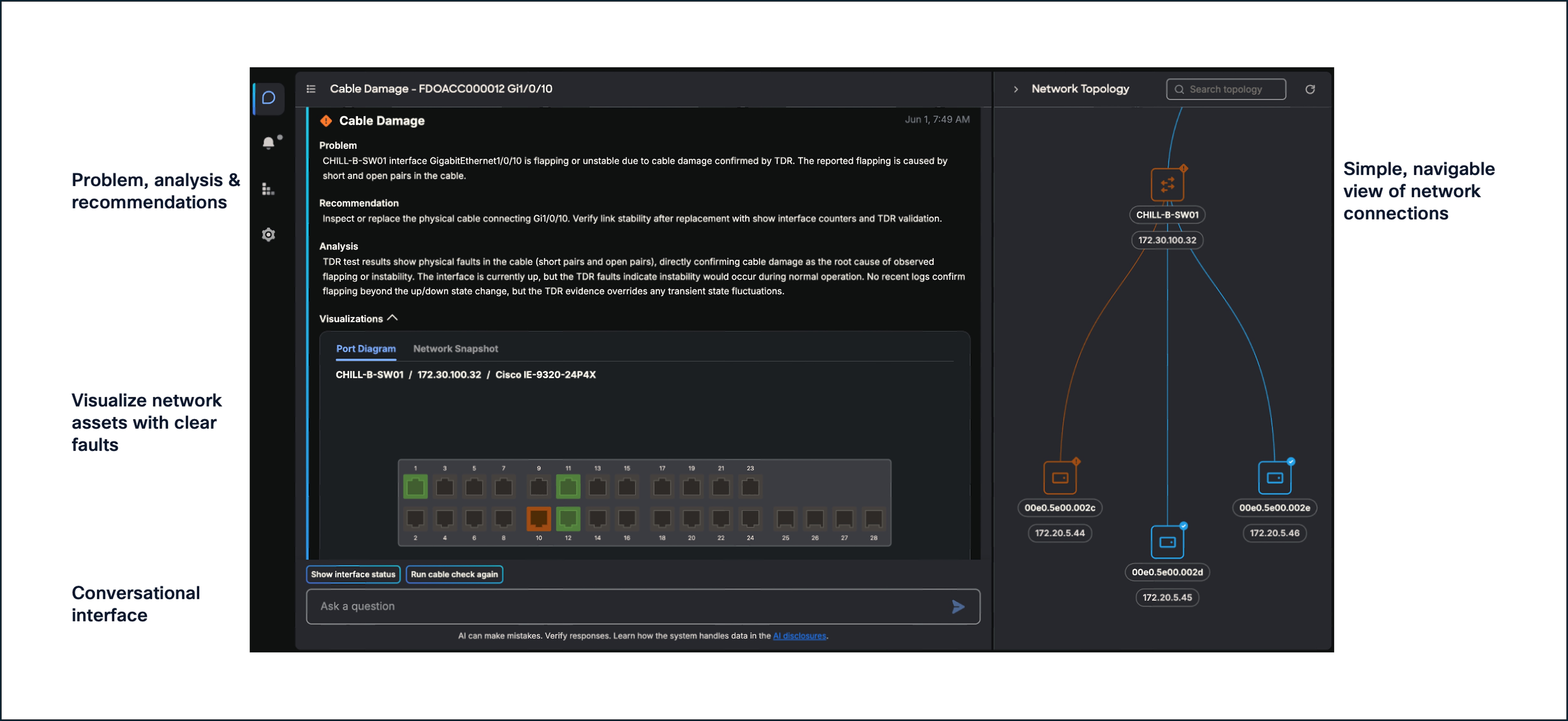
Intuitive and navigable interface shows diagnosis, root cause, recommended fix, and topology on a single screen
AI Troubleshooting for Industrial Networks is installed locally to keep sensitive network and production data secure. It gathers network data and uses AI to analyze the data, summarize the results, and provide clear answers on how to fix any issues it detects.
Proactive notifications: AI Troubleshooting for Industrial Networks offers continuous, proactive monitoring that detects a broad spectrum of potential failures. Whether it identifies an asset going offline, detects physical cable damage, observes a switch experiencing a power failure, or encounters other network-related irregularities, it gathers all relevant telemetry data, performs a comprehensive root-cause analysis, and pushes a notification to the user containing the findings and a clear, actionable recommended fix. Users have all the information needed to fix issues on the spot, helping them minimize downtime and keep production running smoothly.
Interactive topology: Beyond monitoring, the system maintains and displays a full, searchable network topology at all times. It intelligently highlights malfunctioning equipment directly on the map, making it effortless for users to spot malfunctioning equipment as issues arise. Users can easily drill down into any part of the network map to see exactly what’s happening, giving them clear, detailed information need to make quick decisions.
Conversational interface: Users can interact with the agentic system through simple, natural language prompts, treating it like a knowledgeable networking expert specifically trained to understand OT language and use cases. Using the conversational interface, users may ask for help with specific problems (such as “Why does paint-area-plc01 go down?), or more general network state, (such as “Show me what’s connected to [switch name]” or “What VLANs are configured on [IP address or switch name]?”).
To support continuous improvement and operational accountability, the system automatically preserves a comprehensive record of every alert generated and every interaction between the user and the AI. It allows for detailed post-incident analysis and internal audits. By maintaining this audit trail, OT teams can effectively learn from past events, identify recurring trends, and ensure full transparency across their network operations.
AI Troubleshooting for Industrial Networks offers significant advantages for manufacturing and similar industrial environments:
● Maximize operational uptime: Get all the information needed to resolve any detected issues in a one-click notification, making it easier to maintain uptime.
● Visualize the entire network with a real-time map: Gain instant clarity with an accurate, intuitive map of complex industrial networks, including all sensors, controllers, robots, machines, and other endpoints.
● Empower OT teams and boost productivity: Enable every frontline personnel to solve network issues quickly and confidently, regardless of their networking skill level, and reduce the need for escalations.
● Free up bandwidth for networking experts: Reduce the burden networking specialists by AI-powered routine diagnostics and troubleshooting, freeing them to focus on strategic initiatives and innovation instead of constant firefighting.
● Build a repository of institutional knowledge: With every alert and incident automatically preserved, teams have access to an audit trail for post-incident analysis and regulatory compliance. This allows OT teams to learn from past troubleshooting sessions, identify recurring trends, and maintain complete transparency and accountability.
Learn more about how Cisco AI Troubleshooting for Industrial Networks can be applied to your environment! Watch this quick overview video and schedule a live consulting session with a Cisco industrial networking expert.