Cisco · Security Cloud · Network Security
A day in the life of a
Network Security Leader
How Cisco's Hybrid Mesh Firewall consolidates fragmented security controls across cloud, on-prem, and AI workloads — delivering unified discovery, protection, and continuous monitoring.
When AI goes off script
Your new AI-powered finance chatbot just went live. This application spans cloud and on-prem data centers, accesses sensitive financial data your customers will use to make real-time financial decisions.
The queries look normal. But something is off. Suddenly, your SOC detects unusual container traffic. An attacker is trying to manipulate your chatbot.
The challenge? By the time you're alerted, the risk is already spreading.
Start the clock
You need to contain the threat, secure the application, and protect the rest of your environment — now — before the attacker pivots from the cloud to your on-prem environment.
But your traditional firewalls only see packets, not intent. They have no insight into LLMs, microservices, or encrypted east-west traffic.
Cisco's Hybrid Mesh Firewall sees it all: intent, identity, and impact.
Spot the anomaly
A newly deployed AI runtime chatbot triggers an investigation, revealing vulnerabilities in the underlying models.
The Cisco AI Defense dashboard surfaces risk across every application and model in your environment.
Application dependency & runtime discovery
Penetration testing reveals the AI chatbot connects to on-prem data centers via Kubernetes microservices, with overly permissive pod access enabling direct communication across front-end, processing, and database layers — and risk of lateral movement.
Further analysis identifies a critical connectivity pod with an RCE vulnerability — a high-risk entry point.
Get application & user access insights
Firewall analysis shows encrypted traffic flowing from the cloud into both the front-end and processing tiers of the finance application, while also revealing unexpected user access via SSH — highlighting potential security gaps across the application and user activity.
Identify and secure LLM weakness
When routine testing identifies LLM weaknesses, we don't just raise an alert. We build guardrails to prevent attackers from exploiting your AI app.
Security guardrails block prompt injection, while privacy guardrails block PII — names, addresses, email addresses, IP addresses, passport numbers, and Social Security Numbers.
Restrict lateral movement
Validate and test segmentation policies before deployment to safely limit access between workloads — ensuring stronger security without disrupting application performance.
Flow analysis pinpoints which pod-to-pod communications should be permitted, rejected, or isolated.
Encrypted visibility & enforcement
Encrypted Visibility Engine (EVE) gives security teams full visibility into encrypted traffic — without sacrificing privacy or performance.
It detects threats across QUIC and TLS without decryption, allowing safe traffic, blocking malicious activity, and selectively decrypting unknown flows for deeper inspection — before they cause harm.
Real-time monitoring & response
Runtime guardrails continuously watch the AI environment, detecting new injection techniques and providing recommendations to strengthen defenses in real time.
Every blocked prompt injection is logged with full event detail — rule match, enforcement point, policy applied, and the exact conversation thread.
From AIOps to AgenticOps
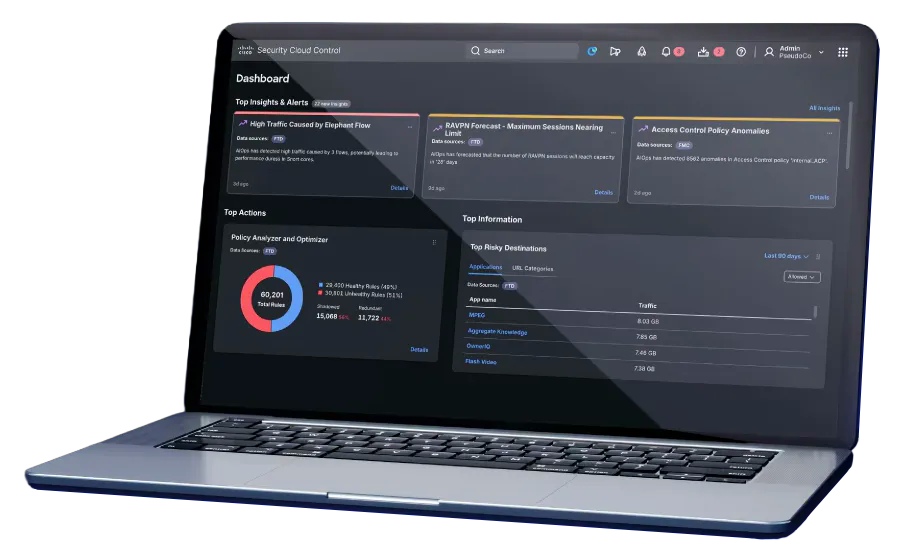
Shift from reactive firefighting to proactive protection. Continuously analyze configurations, health, diagnostics, and traffic patterns to detect anomalies and configuration drifts in real time — so issues are identified and resolved before they affect operations.
Mission Accomplished!
You haven't just stopped attacks — you've gained full visibility and control across your cloud, on-prem, and hybrid environments. You're stopping unauthorized lateral movement. You're seeing and understanding encrypted traffic. Your AI app stays protected.
Because at Cisco, security isn't just reactive — it's wherever you need protection.
Every workload.
Every connection.
Every time.
Cisco Hybrid Mesh Firewall · Powered by Talos Intelligence
Powered by Cisco Talos — the world's largest commercial threat intelligence team