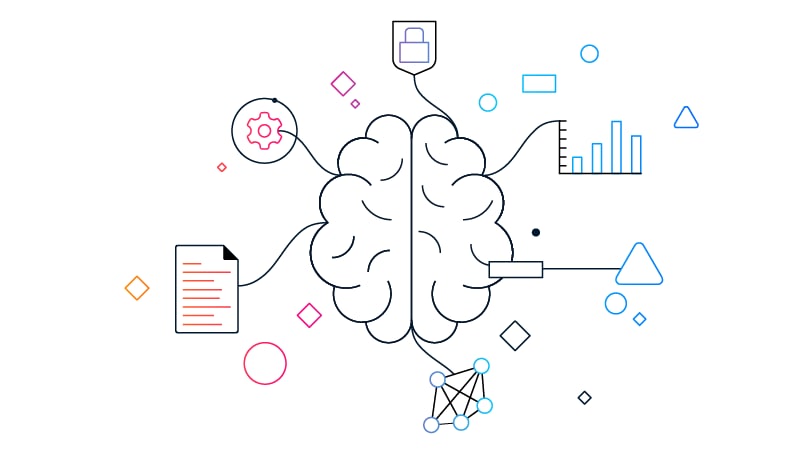
Artificial intelligence shown as a stylized brain connected to icons for data, security, analytics, and networking.

What is AI infrastructure?

AI infrastructure is the set of systems needed to run AI workloads—the tasks a system runs to build, run, and maintain AI models—in production. It includes compute, storage, networking, and the software layers that connect them. 

AI infrastructure vs. traditional infrastructure: Key differences

While traditional IT infrastructure is designed for general-purpose applications and transactional data, AI infrastructure is purpose-built to handle the massive computational and data-throughput requirements of machine learning.

Here are some key infrastructure differences:

Serial vs. parallel processing

Traditional infrastructure is built around the Central Processing Unit (CPU), which is designed for serial processing—executing tasks one after another.

In contrast, AI infrastructure relies on accelerators like GPUs that excel at parallel processing. This allows the system to perform thousands of mathematical operations simultaneously, which is essential for training and running large-scale AI models.

Throughput vs. latency

Standard enterprise applications often prioritize low latency for small, frequent data transactions, such as database queries. AI workloads, however, require massive "bandwidth" or throughput.

The infrastructure must be capable of moving terabytes of data from storage to the processors without interruption, as any delay in data delivery leaves expensive compute resources sitting idle.

Lossless vs. lossy networking

In traditional networking, "lossy" environments are common: if a data packet is dropped, the system simply retries. However, in a distributed AI training job where hundreds of nodes are synchronized, a single dropped packet can cause the entire process to stall.

That’s why AI infrastructure requires "lossless" networking fabrics, often utilizing protocols like RoCE—to ensure the constant, jitter-free communication required for model synchronization.

Predictable vs. bursty workloads

Traditional workloads are often relatively predictable or follow steady cycles. AI infrastructure must be built to handle extreme "bursty" demand, particularly during model training phases where every available resource is pushed to its limit for days or weeks at a time.

This requires a different approach to power, cooling, and resource orchestration than a standard data center.

How AI infrastructure works

AI infrastructure moves large volumes of data through a coordinated set of systems that prepare data, run AI models, and keep them operating reliably in production.

At a high level, this process follows a clear flow:

  1. Data is stored and prepared
  2. Compute resources execute training and inference
  3. Software frameworks coordinate execution
  4. Operational systems manage deployment and monitoring

1. Data storage and data movement

AI systems repeatedly read large amounts of data while models are being trained or updated. A single training run can scan the same dataset many times, sometimes across multiple machines at once. That’s why storage in AI infrastructure is designed for speed and consistency. Data must reach compute resources fast enough to keep training jobs running without interruption.

Large datasets are usually kept in scalable objects or distributed storage systems. During active training, subsets of that data are placed closer to compute on faster storage layers. This reduces wait time when models request data.

To meet these demands, AI storage often utilizes Parallel File Systems (such as Lustre or Weka). Unlike standard storage, these systems allow thousands of compute nodes to read and write to the same data simultaneously at extreme speeds, preventing the 'data starvation' that can leave expensive GPUs sitting idle.

If data cannot be delivered quickly or consistently, compute resources remain idle. As a result, training slows down and costs rise. 

2. Compute resources for training and inference

Once data is available, the system uses compute resources to train models and run inference. This is where the bulk of AI work happens.

Training and inference require the same mathematical operations to be performed thousands or millions of times in parallel. General-purpose CPUs can execute these operations, but they become inefficient and slow as models and datasets grow.

AI infrastructure, therefore, uses accelerators, such as GPUs and other specialized processors, that can handle parallel computation at scale. These processors execute multiple operations simultaneously, which reduces training time and supports high-throughput inference.

3. Networking for distributed workloads

As models and datasets grow, training and inference spread across multiple servers to complete work within practical time limits. When workloads are distributed, machines must constantly exchange information:

  • During training, they share model updates and intermediate results.
  • During inference, they coordinate requests and responses. 

This communication happens repeatedly throughout execution.

AI infrastructure uses high-bandwidth, low-latency networks to keep this coordination efficient. Fast networks reduce the time machines spend waiting for each other, which maintains steady progress across the system.

If the network cannot keep up, compute resources stall even when processing power is available. 

To achieve this, AI networking often relies on protocols like RDMA (Remote Direct Memory Access) and RoCE (RDMA over Converged Ethernet). These allow data to move directly between the memory of different servers without involving the CPU, which is the only way to maintain the ultra-low latency required for constant model synchronization.

4. Frameworks, orchestration, and operations

Once data, compute, and networking are in place, software systems are needed to coordinate how work runs across the infrastructure. This layer turns raw resources into something teams can actually use:

  • AI frameworks define how models are built, trained, and executed. They control how data flows through models, how computation is parallelized, and how training jobs are structured. 
  • Orchestration systems manage how jobs run across available resources. They decide where workloads are placed, how resources are allocated, and how the system responds when something fails. 
  • Operational platforms (MLOps and LLMOps) handle what happens after models are created. These specialized systems support deployment into production, track model versions, monitor for data drift, and manage the unique lifecycle of large language models.

4 types of AI infrastructure deployment models

AI infrastructure can be deployed in four different ways based on where data resides, how quickly results are required, and how much operational control an organization needs:

On premises

On premises AI infrastructure runs in an organization’s own data centers. It is used when data residency, security controls, or predictable performance are non-negotiable.

This model is suitable for stable, long-running workloads and environments with strict regulatory or governance requirements, where infrastructure must remain under direct organizational control.

Cloud-based

Cloud-based AI infrastructure provides on-demand access to compute and storage without owning physical hardware. Teams use it to scale quickly, experiment, or handle workloads with variable demand.

This model prioritizes flexibility and speed over direct control and is chosen when infrastructure needs change frequently.

Hybrid

Hybrid AI infrastructure combines on-premises and cloud resources within a single operating model. Organizations may use cloud resources for burst training or experimentation, while keeping sensitive data or steady inference workloads on premises.

This approach is common where cost, control, and scalability must be balanced across different AI workloads.

Edge

Edge AI infrastructure places compute close to where data is generated, such as devices, factories, or local sites. It is used when low latency is required or when sending data to a central system is impractical.

For example, an on-site system can analyze sensor data locally and respond immediately, without waiting for a round-trip to a central data center.

Key benefits of AI-optimized infrastructure

A well-designed AI infrastructure provides the foundation for high-performance modeling, ensuring that compute, storage, and networking work in unison to deliver results.

  • Accelerated model development: AI infrastructure allows training to run across multiple machines and accelerators simultaneously to complete work faster. This reduces the time between experiments and enables the development of models that would otherwise exceed the limits of standard hardware.
  • Optimized resource utilization: A coordinated stack ensures that compute resources remain active by synchronizing storage, networking, and scheduling. When accelerators spend less time waiting for data, organizations achieve a higher return on their significant hardware investments.
  • Deployment flexibility: AI-optimized infrastructure allows workloads to run on-premises, in the cloud, or at the edge based on specific operational needs. This versatility makes it easier to meet data residency and latency requirements without the need to redesign the entire system for different environments.
  • Enhanced scalability: Modern infrastructure is built to handle the high throughput and intensive processing required by increasingly large foundation models. This ensures system stability and consistent performance even as AI initiatives grow in scale and complexity.

Challenges in AI infrastructure deployment

While AI infrastructure provides the necessary power for modern workloads, it also introduces specific constraints regarding cost, complexity, and security.

  • Capital and capacity planning: AI infrastructure relies on specialized hardware and high-performance networks that require significant upfront investment. Because demand often spikes during training cycles, organizations must carefully manage capacity to avoid either costly resource idling or performance-degrading queues.
  • Data security and governance: AI workloads involve sensitive data moving across various storage systems and compute nodes, creating complex access control requirements. Without unified governance, it is difficult to maintain a complete audit trail and ensure consistent policy enforcement across different environments.
  • Legacy system integration: Many existing data platforms were designed for transactional workloads rather than the continuous, data-intensive demands of AI pipelines. Bridging the gap between traditional IT and modern AI infrastructure often requires custom integration, increasing both operational complexity and the risk of failure.

The future of AI infrastructure

While accelerators remain central, organizations are increasingly constrained by storage throughput, memory capacity, and network performance. This reflects a shift toward viewing AI infrastructure as a balanced system where data movement and coordination are as important as raw processing power.

At the same time, infrastructure demand is shifting toward inference and low-latency workloads as more AI models move into production. This is driving greater use of cloud-based accelerators and architectures that support fast, distributed serving, often closer to where data is generated. As a result, AI infrastructure is being optimized for continuous, real-time operation rather than occasional large training runs.


Related topics

What is AI in networking?

AI in networking leverages machine learning to automate, optimize, and secure network operations for better performance and reliability.

What is an AI server?

AI servers process complex AI workloads, including large-scale model training and real-time inference.

What is neocloud?

Neocloud providers offer specialized, high-performance infrastructure designed to power AI workloads. 

Guide: Agentic AI Infrastructure

Understand the requirements for supporting autonomous AI agents and intelligent workflows in the enterprise.

What is an AI agent?

AI agents achieve specific goals through their ability to perceive an environment, reason through tasks, and take action. 

What is agentic AI?

Agentic AI can perceive information, plan complex tasks, and act independently to achieve high-level goals.

Explore the portfolio of Cisco-developed AI infrastructure technologies, from silicon to full-stack systems, designed to help all AI ecosystem participants thrive in the agentic AI era.