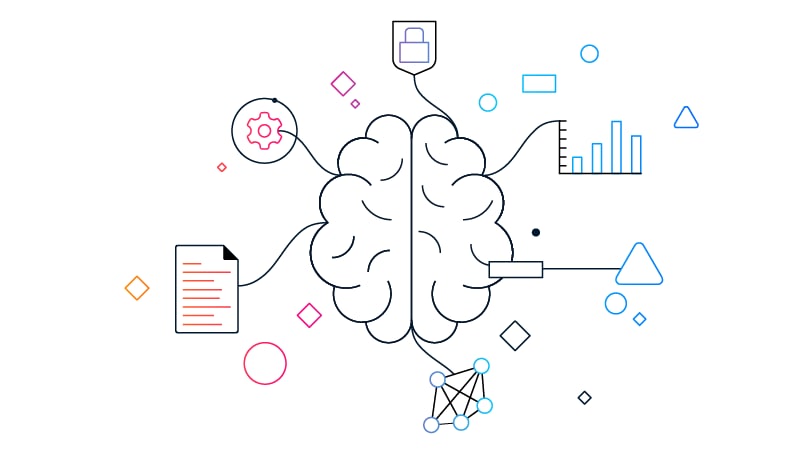
Artificial intelligence shown as a stylized brain connected to icons for data, security, analytics, and networking.

What is a frontier model?

A frontier model represents the current state of the art in AI, defined by its massive scale and ability to perform complex, multi-step reasoning tasks.

Defining frontier models

A frontier model is a category of foundation model that represents the peak of current artificial intelligence capabilities. These models are distinguished by their unprecedented scale and their "emergent properties"; capabilities such as advanced logical reasoning or coding proficiency that were not explicitly programmed but appeared as a result of massive training.

In a regulatory context, frontier models are often defined by the sheer volume of compute used during their development — typically exceeding 10^26 floating-point operations (FLOPs). To put this in perspective, this represents a level of computational effort that requires hundreds of millions of dollars in specialized hardware and months of processing time in massive AI factories.

The progression leading up to this era reveals a steady shift from rigid parameters to dynamic adaptability:

  • The rules-based era: Hardcoded algorithms limited by strict manual parameters.
  • The deep learning era: Neural networks capable of recognizing complex patterns but lacking true contextual understanding.
  • The generative era: Early large language models capable of drafting text and code, but requiring constant human prompting.
  • The frontier era: Advanced models, such as the GPT-4 series, Claude 3.5, and Llama 3, capable of driving multi-step workflows and taking autonomous action with human-on-the-loop oversight.

Frontier models vs. foundation models

To understand the impact of the frontier models, it is helpful to compare these systems against the standard foundation models that preceded them.

Feature

Standard foundation models

Frontier models

Scale

Millions to billions of parameters

Trillions of parameters; $10^{26}$ FLOPs+

Reasoning

Basic pattern matching & summarization

Complex, multi-step logical reasoning

Training Cost

Thousands to millions of dollars

Hundreds of millions of dollars

Capabilities

Specific to trained domains

Emergent properties (skills not explicitly taught)

Deployment

Can often run on standard servers

Requires specialized AI infrastructure

The dual-use nature of frontier AI

Because of their advanced reasoning capabilities, frontier models are considered "dual-use" technologies. This means they possess the potential for significant positive impact—such as accelerating medical research or automating complex security defenses—but could also be misused to create sophisticated malware or automate large-scale social engineering. This inherent risk is why the "frontier" is often the focus of intense debate regarding safety, alignment, and the implementation of rigorous "red teaming" before a model is released to the public.

How frontier models are developed

Developing a frontier model is an industrial-scale engineering feat that requires a tightly integrated stack of data, hardware, and software. The process generally follows a continuous lifecycle:

1. Data curation and ingestion

The process begins with gathering petabytes of diverse data, ranging from public text and code to scientific journals. This stage is critical for ensuring the model has a sufficiently broad knowledge base to develop the emergent reasoning skills that define the frontier.

2. Large-scale pre-training

Models are trained using a specialized AI factory architecture, utilizing thousands of interconnected GPUs and a lossless network fabric (such as RoCEv2). This "brute force" phase allows the model to learn deep patterns and relationships across billions of parameters simultaneously.

3. Alignment and safety tuning 

After the initial training, models undergo Reinforcement Learning from Human Feedback (RLHF). This stage "aligns" the model’s reasoning with human values and safety standards, ensuring that the outputs are helpful, accurate, and harmless.

4. Model optimization 

Because frontier models are massive, developers use techniques like quantization (reducing numerical precision) and distillation (transferring knowledge to a smaller model). These methods allow "frontier-class" intelligence to run efficiently on enterprise-grade hardware.

Enterprise use cases for frontier models

By providing a sophisticated "brain" for complex business processes, frontier models enable a wide range of enterprise applications that were previously impossible.

In the field of autonomous software engineering, frontier models enable the creation of self-healing software that can identify, debug, and fix code in real-time. In the scientific community, these models are used for drug discovery, where they can synthesize vast amounts of research to identify new chemical compounds in a fraction of the time required by human researchers. For strategic operations, these models act as high-level orchestrators, analyzing market trends, supply chain data, and internal telemetry to provide complex decision support that accounts for thousands of variables simultaneously.

Key benefits of frontier models

  • Advanced reasoning: These models can navigate complex, multi-step challenges that require a deep understanding of context and nuance.
  • Unprecedented task autonomy: Emergent reasoning skills allow frontier models to handle "zero-shot" tasks they were never specifically trained for.
  • Accelerated innovation: By processing and synthesizing vast amounts of specialized data, these models identify patterns that would take humans years to uncover.
  • Enhanced operational velocity: When integrated into the enterprise fabric, these models can automate the decision-making process for real-time systems.

Challenges of the frontier

  • Extreme compute and energy demands: Running these models requires high-density data centers with advanced power and liquid cooling solutions.
  • Model governance and "black box" risks: The complexity of these models makes it difficult to understand exactly how they arrive at specific conclusions.
  • New security attack vectors: The power to take action makes these models vulnerable to "prompt injection" and other adversarial AI tactics.
  • High capital expenditure: The cost of the hardware, specialized talent, and energy required to maintain frontier-class capabilities is substantial.

The future of frontier models

The next phase of the frontier is defined by the move toward multi-modality and sovereignty. Future models will natively process text, audio, and video simultaneously, allowing them to perceive and act in the physical and digital worlds with human-like fluidity.

As market analysts predict a massive surge in AgenticOps—an operational model where AI agents are capable of planning, executing, and validating multi-step workflows autonomously—the enterprise focus will shift from "size" to "efficiency," potentially leading to the rise of sovereign AI models that run entirely within an organization's own boundaries.

Common questions about frontier models

A frontier model is defined by being at the absolute cutting edge of AI capabilities, typically characterized by massive scale, high training costs, and the ability to perform complex reasoning.

No, while frontier models show signs of "general" reasoning, they are not Artificial General Intelligence (AGI); they remain highly advanced tools operating within probabilistic frameworks.

Security involves a "Shields Up" approach, using governance layers to monitor for prompt injection, ensuring data privacy through private hosting, and implementing "human-on-the-loop" oversight.

Generally, no. Due to their size and the need for high-speed data movement, frontier models require specialized AI infrastructure and AI servers, including high-performance GPUs and lossless networking fabrics.


Related topics

What is AI in networking?

Leveraging ML and AI to automate, optimize, and secure network operations for better performance and reliability.

What is an AI server?

AI servers process complex AI workloads, including large-scale model training and real-time inference.

What is sovereign AI?

How nations and organizations develop and control their own AI models, aligning with regulations and privacy standards. 

What is network orchestration?

Automating the configuration, management, and coordination of network resources to streamline service delivery across complex, multi-domain environments. 

What is an AI agent?

AI agents achieve specific goals through their ability to perceive an environment, reason through tasks, and take acion. 

What is Model Context Protocol (MCP)?

An open standard that allows AI models to securely connect to and exchange context with external data and applications. 

The Glasswing Moment: See what’s beneath Mythos

Frontier models like Anthropic's Claude Mythos Preview are changing what defenders and attackers can find, connect, and act on. Cisco has seen what this shift means for the infrastructure the world runs on — and we need a new operating model for resilient infrastructure.