Solving the floating dock challenge
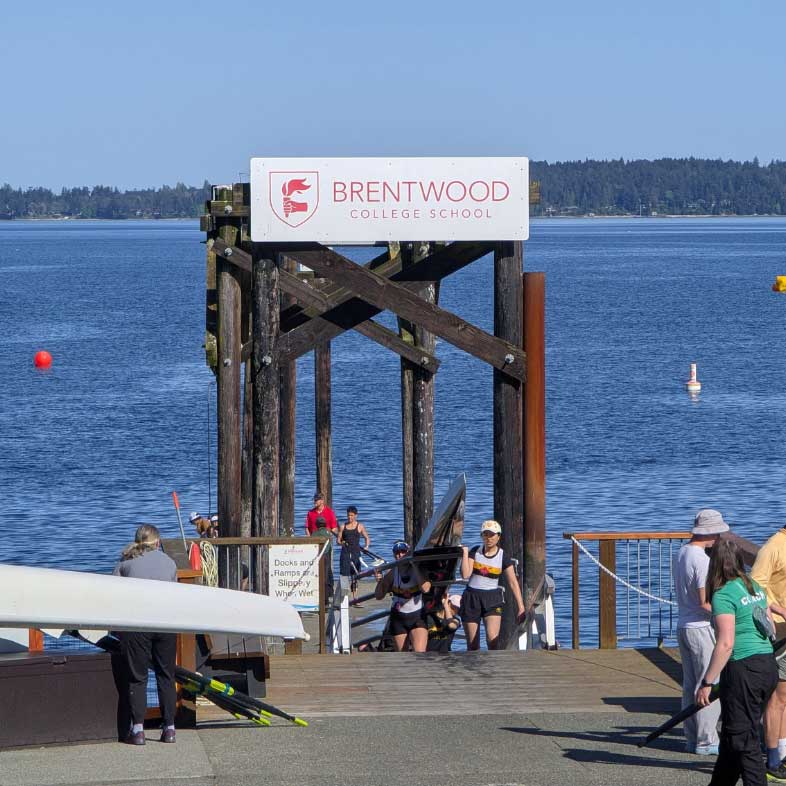
The primary challenge was the regatta’s floating start dock, positioned three kilometers offshore. Previous attempts using cellular and Starlink failed to provide the necessary stability. "Down at sea level, cellular coverage was inadequate, and satellite solutions suffered from synchronization issues," explains Cisco technical lead Ian Procyk.
Satellite solutions like Starlink require a "hand-off" between satellites, necessitating protocols like Secure Reliable Transport (SRT) and a 1.5–2 second buffer to maintain stability. "The challenge is a massive timing mismatch," Ian notes. "If you buffer dock feeds to account for satellite delays, but onshore cameras are real-time, you lose synchronization. A rower might cross the finish line on one camera while another still shows them approaching. That lack of continuity is confusing to the viewer."
The alternative to these options was Cisco Ultra-Reliable Wireless Backhaul (URWB) in Cisco Catalyst IW9167E access points. Antenna selection was driven by the differing physical characteristics of the deployment environment: the dock is in constant motion, while the campus roof provides a stable, fixed anchor. Using a high-gain, narrow-beam antenna on the dock would have been counterproductive, as even minor shifts in the water would cause the signal to drift and drop. To mitigate this, the team deployed a broader, dual polarity patch antenna with a wider beamwidth (14dBi 30-degree) to the dock. This broader pattern provided a consistent connection despite the dock’s constant movement. On the rooftop, a high-gain 22dBi antenna with a 9-degree beam was used. The higher gain, antenna made up for the slightly compromised antenna on the dock, ensuring a stable, high-capacity bridge.
The marine environment also posed challenges. When RF signals travel over water, they don't just move directly from the transmitter to the receiver; they also bounce off the surface of the ocean. These reflections arrive at the receiver at slightly different times than the primary signal. This multipath can create significant challenges which could leads to constant rate-shifting and unstable throughput. To combat this, the team increased the guard interval to 3.2 microseconds in the URWB configuration. By extending this interval, they provided the receiver with a longer window to process the incoming data, effectively allowing it to ignore the delayed, reflected signals and maintain a clean, stable connection.
URWB provided a fiber-like wireless link that enabled a successful broadcast without a single link fade or synchronization error. "The signal did not fade," Shay notes. "That for us is incredible. We’ve been struggling with that for years." The team was able to transmit the camera feeds and support on-site timing data without a single link drop.