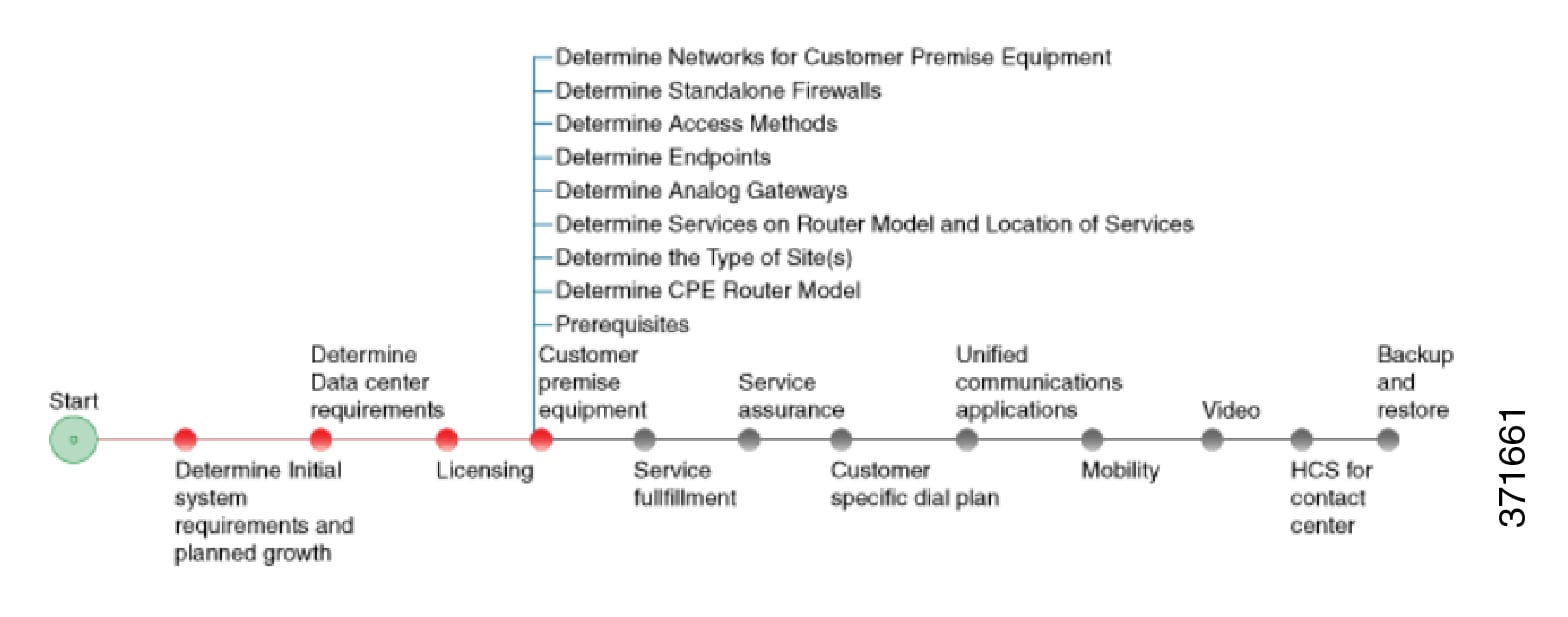
Customer Premise Equipment

Prerequisites

Before you plan the customer premise equipment, make sure that you:

  • Review and have access to the Cisco Hosted Collaboration Solution Release 14 Solution Reference Network Design Guide.

  • Complete the actions outlined in previous sections of this guide including:

    • Initial system requirements and planned growth

    • Data center requirements


Note

Make sure to review the Cisco Hosted Collaboration Solution Compatibility Matrix for a full list of licensing details.

Customer Premise Equipment Workflow

Determine the Type of Site(s)

Determine the type of site(s) that you plan to deploy. For detailed information on the different sites, refer to Determine Your HCS Data Center Deployment Model.

Dedicated Server

Dedicated server refers to an Cisco HCS model of applications available for Micro Node deployments where one C-series server contains only one customer, but may have one or more UC applications running on the same server for that customer (for example Cisco Unified Communications Manager or Cisco Unity Connection).

Determine Customer Premise Equipment Router Model

Procedure


Determine your router model based on the following UC application criteria:

  • Cisco Unified Survivable Remote Site Telephony (SRST)

  • Session Border Controller

  • PSTN Local Breakout - VoiceXML gateway

  • Cisco Unified Communications Domain Manager media resources such as conferencing, transcoding and Media Termination Point

    Note 

    Cisco HCM-F will deprecate the support of Cisco Unified Communications Domain Manager in the upcoming releases with limited support for existing integration, Cisco HCS partners and customers are advised to take necessary steps to align their requirements.

Your HCS system needs a router, such as ISR G2 series. Make sure you have accurate cards, licensing and so forth for this router. You should take all of these considerations into the type of router you choose as this device does many of the key functions of your customer premise system. Many different models are available with a wide range of performance and scale capacities. For more details, refer to http://www.cisco.com/go/isr.


Determine Services on Router Model and Location of Services

Procedure


Step 1

Determine what services you need to run on your router model:

  • Session Border Controller

  • SRST

Step 2

Determine if these services will reside on your router model, typically ISR G2, or on other standalone routers.

Step 3

Determine customer premise conferencing resources.


Determine Analog Gateways

Procedure


Determine the analog gateways that you need based on the devices that will be used:

  • ATA series

  • VG series

  • ISR router models


Determine Endpoints

Procedure


Determine the TelePresence and video endpoints that will be used:

  • Desktop hard phones

  • Desktop clients

  • Mobile clients

  • Video endpoints


Determine Access Methods

Procedure


Determine access methods:

  • MPLS: This is typical preferred choice for an HCS deployment.

  • Site-to-Site VPN: The customer premise router must be enabled and capable of supporting IPsec VPN.

  • Flex VPN: FlexVPN is deployed in HCS as a site-to-site VPN, between the customer site and the hosted HCS datacenter.

  • AnyConnect: Cisco AnyConnect VPN Client provides secure SSL connections for remote users.

  • Expressway OTT


Determine Standalone Firewalls

Procedure


Determine your standalone firewalls. Consider the following for customer premise equipment:

  • NATting is or is not performed at the customer premise
  • Multiple routers or single router at customer premise
  • IP addressing at customer premise

Make sure that whatever set up you choose, that all ports are open for the Cisco HCS system, refer to Cisco Hosted Collaboration Solution Release 14 Solution Reference Network Design Guide.