CMAS Service Support

Feature Summary and Revision History

Summary Data

Table 1. Summary Data

Applicable Product(s) or Functional Area

AMF

Applicable Platform(s)

SMI

Feature Default Setting

Enabled - Always-on

Related Documentation

Not Applicable

Revision History

Table 2. Revision History

Revision Details

Release

First introduced.

2021.04.0

Feature Description

This feature describes broadcasting of warning messages. CBE (Cell Broadcast Entity) broadcasts the warning message to multiple AMFs. Each AMF sends list of gNB or TAI to broadcast the message. One or more NG-RAN nodes schedule the broadcast of the new message and the repetitions in each cell. After the NG-RAN broadcast the warning message, a report is sent back to the AMF from where the message received.

How it Works

This section describes how this feature works.

Call Flows

This section describes the key call flow for this feature.

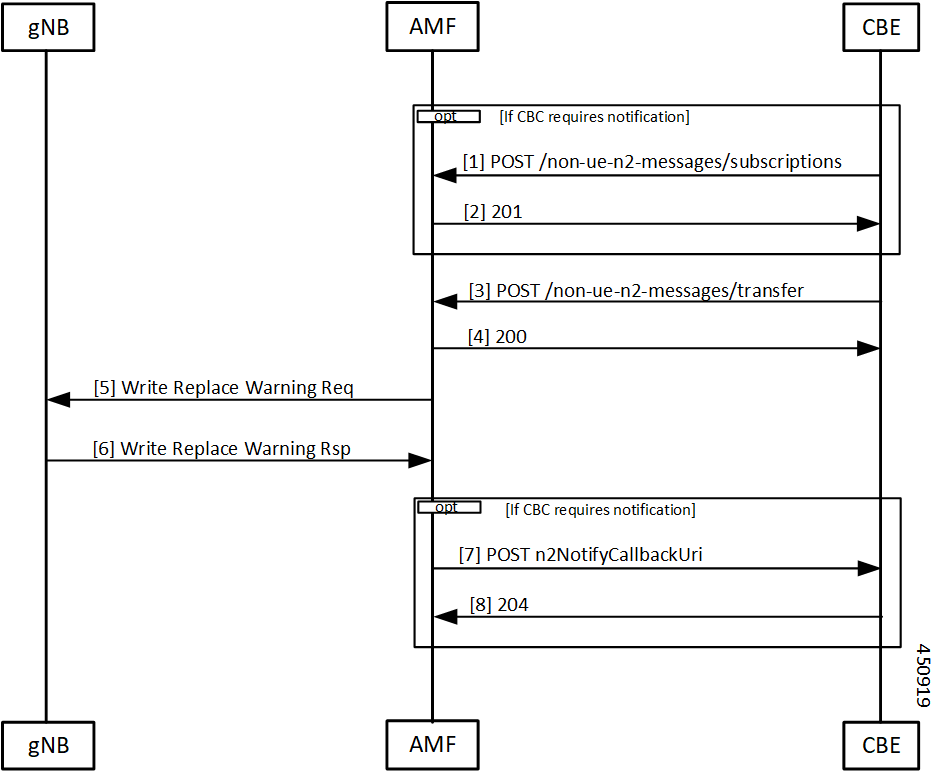
CMAS Subscription, Message Delivery, Notification Call Flow

This section describes the CMAS Subscription, Message Delivery, Notification call flow.

Figure 1. CMAS Subscription, Message Delivery, Notification Call Flow
Table 3. CMAS Subscription, Message Delivery, Notification Call Flow Description

Step

Description

1

The CBCF creates and sends a NonUeN2InfoSubscribe to the AMF in order to be notified by the NG-RANs about the UE coverage of warning messages sent. The message type is the only parameter for this subscription. The CBE cannot subscribe for a subset of warning messages.

2

The AMF creates a subscription and returns the location of the subscription to the CBE. The CBCF uses this location if it needs to modify or cancel the subscription.

3

The CBCF creates a Write-Replace Warning Request NG-RAN message containing the warning message to broadcast. The message contains Message Identifier, Serial Number, list of NG-RAN TAIs, Warning Area List NG-RAN, OMC ID, CWM Indicator, Send Write-Replace-Warning-Indication, Global RAN Node ID, Warning Area Coordinates. This becomes a binary part to a Non-UE Message Transfer request to the AMF. The CBCF also optionally sends list of TAI or list of gNBs to AMF that need to receive this message.

4

The AMF responds to the CBCF that sending of Warning messages to the gNodeB has started.

5

The AMF determines the set of gNB that need the message needs to be send to. This could be a list of gNB if the CBCF send the list, all gNB in a list of TAI, or all the gNB that are connected to the AMF. The AMF does NOT interpret the binary information that is part of the request. The AMF then sends a WRITE REPLACE WARNING REQUEST to the gNB.

6

The gNB responds to the Warning message after broadcasting it.

7

If the CBCF has registered for notifications, the AMF notifies the CBCF. Each message that is sent by the gNB becomes an individual notification, as the specifications do not allow multiple binary payloads in a single message.

8

The CBCF responds to the notification from the AMF.

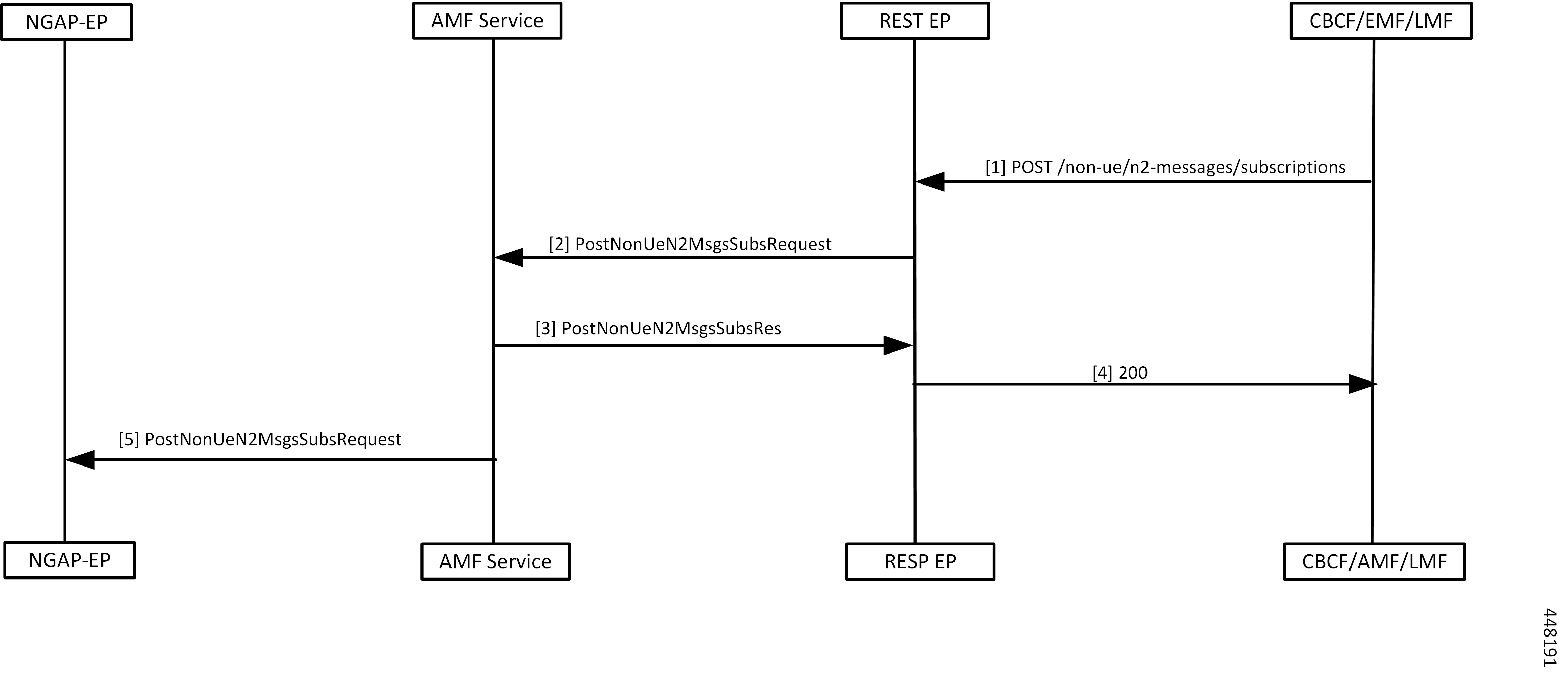
Non-UE N2 Messages Subscription Call Flow

This section describes the Non-UE N2 Messages Subscription call flow.

Handling of subscriptions from various peer nodes are identical, irrespective of the requesting entity a CBCF, an LMF, or a peer AMF. Handling of these subscriptions takes place as per message category.

Figure 2. Non-UE N2 Messages Subscription Call Flow
Table 4. Non-UE N2 Messages Subscription Call Flow Description

Step

Description

1

Peer node sends a subscription request to the AMF, which reaches the REST EP.

This message is either a PWS-BCAL (Broadcast Completed Area List or Broadcast Cancelled Area List) or PWS-RF (Restart Indication or Failure Indication).

2

REST EP forwards this message to the AMF service.

3

AMF service saves the subscription to the “database” and sends success response to REST EP. The saved subscription contains the URI of the remote node, and the parameters for the subscriptions. The AMF creates a unique location URI for this subscription and includes it in the response.

4

REST EP responds with a 201 to the peer node.

5

AMF service forwards this information to the NGAP EP.

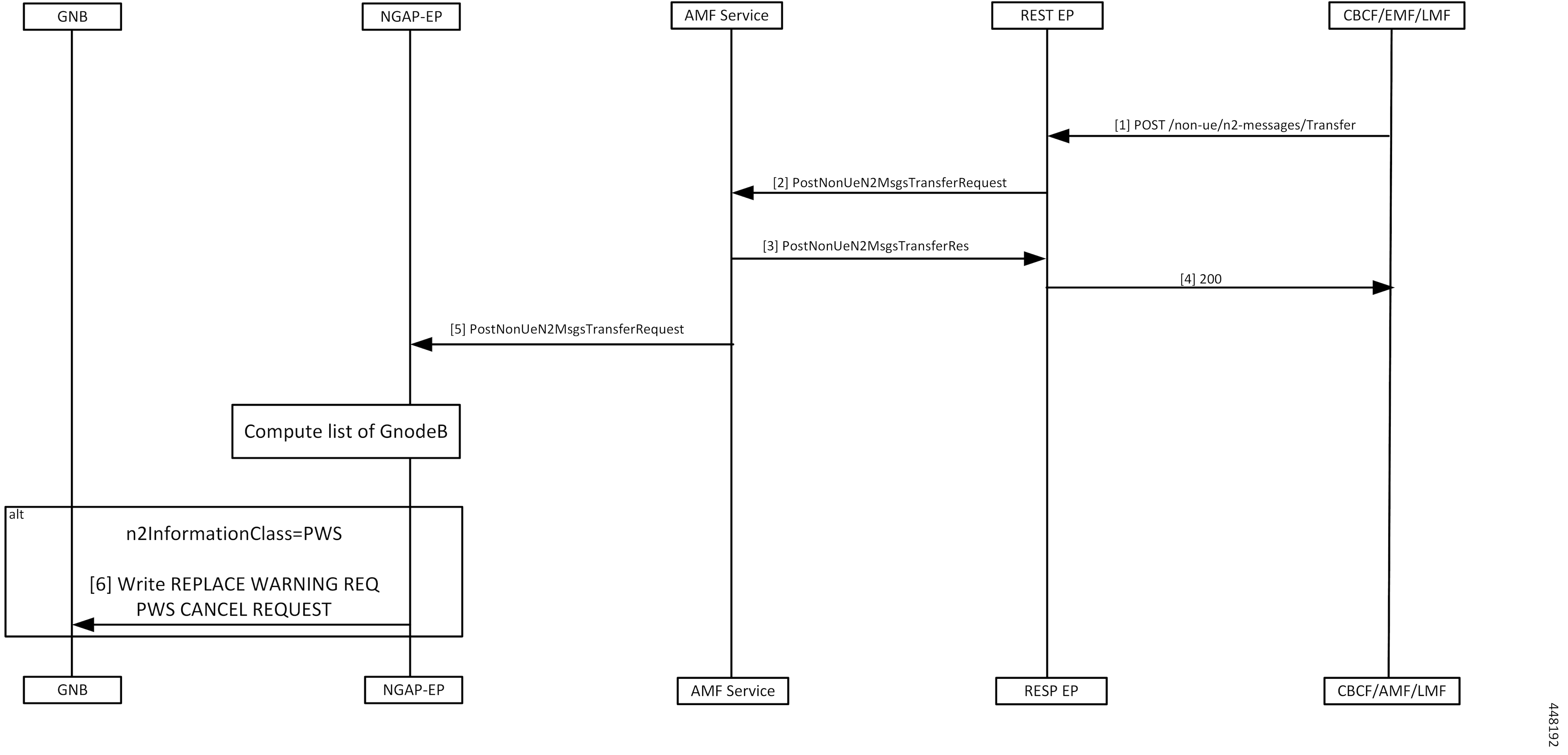
Non-UE N2 Messages Transfer Call Flow

This section describes the Non-UE N2 Messages Transfer call flow.

The AMF does not analyze the binary contents of the received message from any of its peer nodes.

Figure 3. Non-UE N2 Messages Transfer Call Flow
Table 5. Non-UE N2 Messages Transfer Call Flow Description

Step

Description

1

Peer node sends a Non-UE N2 message transfer request to the AMF. REST EP receives this request and forwards to the AMF service.

2

AMF does the following while handling warning messages (these messages may contain filters, for example, gNB or TAIs that must match):

  • Upon receiving the warning message, AMF service checks for protocol errors and returns error response if there is any.

  • If the warning message contains filters, then it forwards the message to all NG-RANS that match the filters.

  • If the warning message doesn’t contain filters, then it forwards the message to all NG-RANs connected to this AMF.

  • If the warning message contains filters but no matching NG-RANs then it doesn’t send any warning message.

3

If the AMF service can handle this message, it sends success response to the REST EP.

  • Saves PWS messages to obtain correlation in responses, if the CBCF requests the responses to be send.

4

REST EP sends the response to the peer that sends the request.

5

The AMF service forwards the request to NGAP EP. NGAP EP uses the parameters of the request to find the list of gNodeB to send these messages.

6

NGAP EP forwards the message to gNodeB with the following scenarios:

  • NGAP copies the N2 payload without any changes, and forwards it to the gNB, when the message has the N2InformationClass set to PWS.

  • AMF performs the following actions, when the sendRanResp field in PWS Information is True.

    • Saves the msgIdentifier and serial number of the message.

    • Saves the notification control block for PWS information.

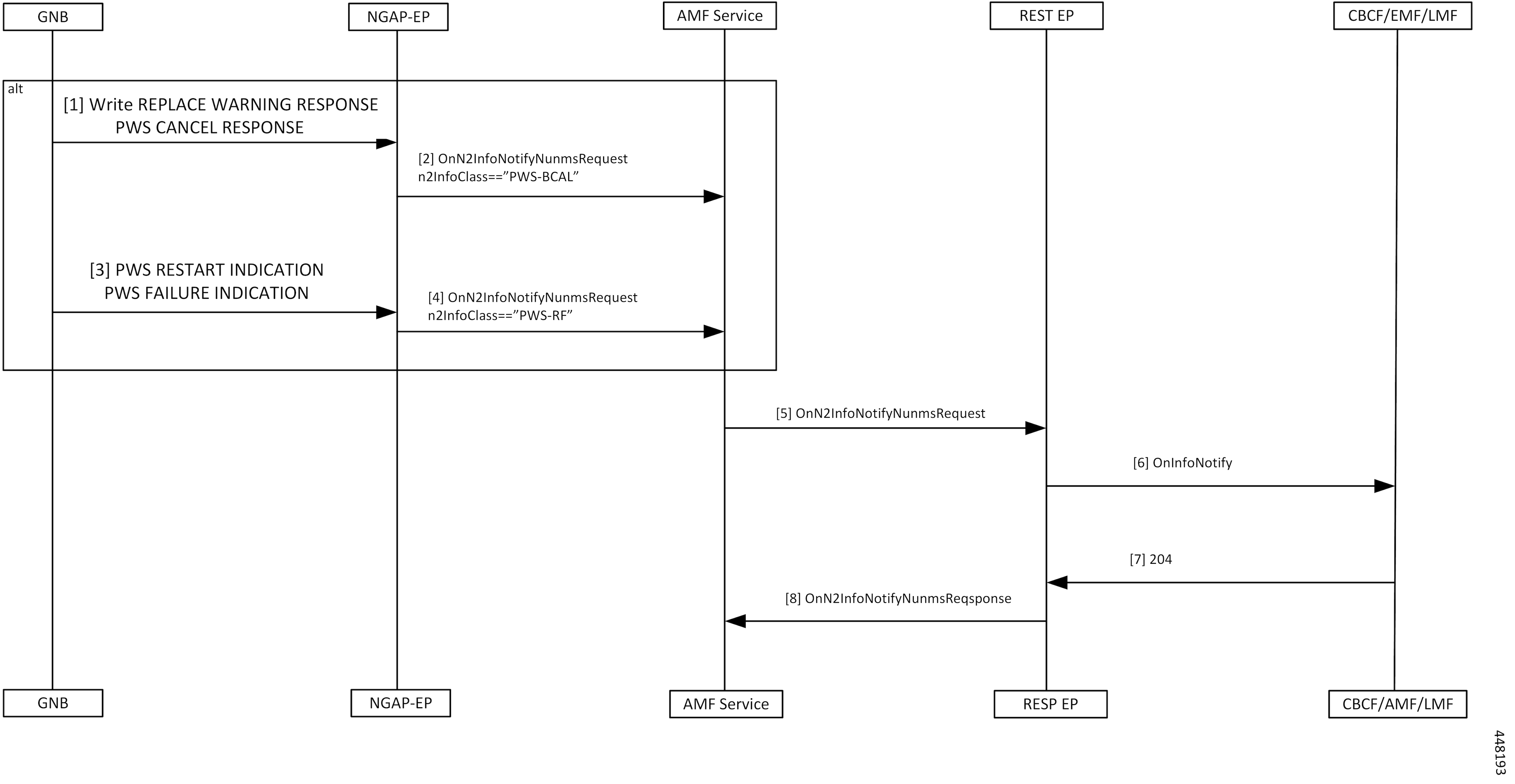
Non-UE Message Notification Call Flow

This section describes Non-UE Message Notification call flow.

Figure 4. Non-UE Message Notification Call Flow
Table 6. Non-UE Message Notification Call Flow description

Step

Description

1

gNB sends a WRITE REPLACE WARNING RESPONSE or PWS CANCEL RESPONSE to NGAP EP.

2

NGAP EP generates a callback with n2InfoClass set to PWS-BCAL with the following conditions.

  • Subscription for notification for this event is available.

  • Serial number corresponds to a request originally send with sendRanResponse as True.

3

If the gNB sends a PWS RESTART INDICATOR or a PWS FAILURE INDICATION, it reaches the NGAP EP.

4

If there is a subscription for notification of PWS events, NGAP EP generates a callback with n2InfoClass set to PWS-RF.

5

AMF service forwards the onN2InfoNotifyRequest to REST EP.

6

REST EP sends the message to the peer node.

7

The Peer Node responds with a 204 OK.

8

REST EP forwards the onN2InfoNotifyResponse to AMF.

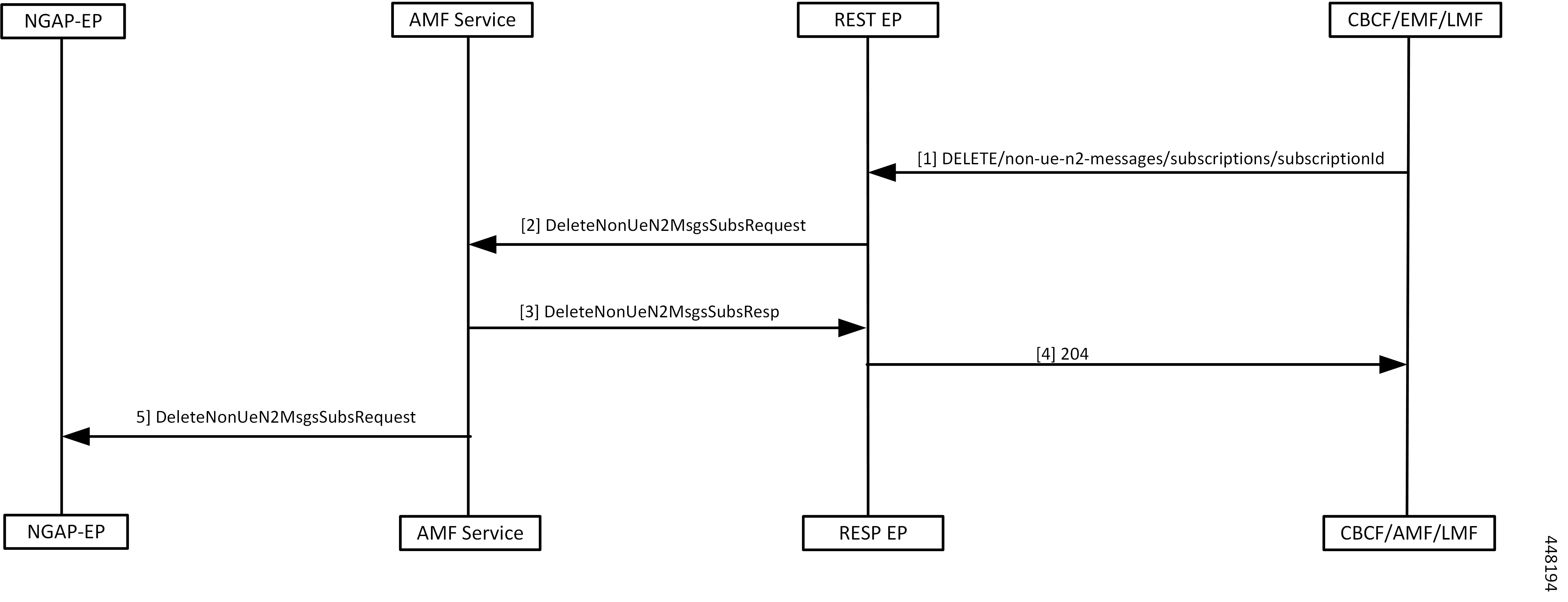
Non-UE Notification Subscription Deletion Call Flow

This section describes the Non-UE Notification Subscription Deletion call flow.

Upon reception of Non-UE events notification in the AMF, existing subscription gets deleted.
Figure 5. Non-UE-Notification Subscription Deletion Call Flow
Table 7. Non-UE Notification Subscription Deletion Call Flow Description

Step

Description

1

Peer node to the AMF sends a DELETE message with the ID assigned during the subscription process.

2

REST-EP forwards the request to AMF service.

3

AMF service deletes it from the database before sending response to the REST-EP.

4

REST-EP forwards the response to the peer node.

5

AMF service sends the request to NGAP EP to remove existing subscription from NGAP EP.