Usage Guidelines for User Defined Routes

Introduction to the Cisco CSR 1000v Route Tables

This section provides guidelines which will help you to decide user-defined routes to add to the route tables. When a Cisco CSR 1000v is deployed in a Virtual Network using the Microsoft Azure Marketplace template, a route table is created for each subnet to which the Cisco CSR 1000v has a network connection. For example, if you deploy a 4-NIC version of the Cisco CSR 1000v from the Microsoft Azure Marketplace, 4 subnets are created. Each subnet has an associated route table. No routes are automatically installed in the route table.

For further information on defining user-defined routes, also see the Microsoft Azure documentation: https://docs.microsoft.com/en-us/azure/, and search for "user defined routes".

User Defined Routes in the Same Virtual Network

By default, the Microsoft Azure network infrastructure provides a basic routing service which interconnects all the subnets within a virtual network. Packets can be passed between any virtual machines within the same virtual network without the assistance of the Cisco CSR 1000v.

However, if you need inter-subnet packets to be delivered to the Cisco CSR 1000v (to implement advanced services such as filtering and QoS), then you need to install a user defined route in the routing table for the subnet that designates the Cisco CSR 1000v as the next hop router.

Routing between Virtual Networks or On-Premises Networks

The Microsoft Azure network infrastructure does not by default interconnect different virtual networks or connect virtual networks to on-premises networks. To connect to these networks, you must create a user-defined route in each route table to specify the Cisco CSR 1000v as the next hop router to each remote network. The user-defined route can be either a default route or a specific destination route. To force traffic through the Cisco CSR 1000v, install either a default route or a specific destination route in the route table that points to the Cisco CSR 1000v. (Refer to the two examples below.)


Note

If a default route is installed in a route table, all traffic is diverted to the specified next hop. This causes a problem if you have virtual machines with an allocated public IP address (used for management access to the VM). If you have a default route in the route table associated with the subnet, the virtual machine is not reachable via its public IP address.

Note

Microsoft Azure supports a feature called VNET Peering, which can interconnect virtual networks as long as they are hosted in the same region. In order to use VNET Peering and utilize services within the Cisco CSR 1000v, you need to add a user-defined route to force traffic through the Cisco CSR 1000v.

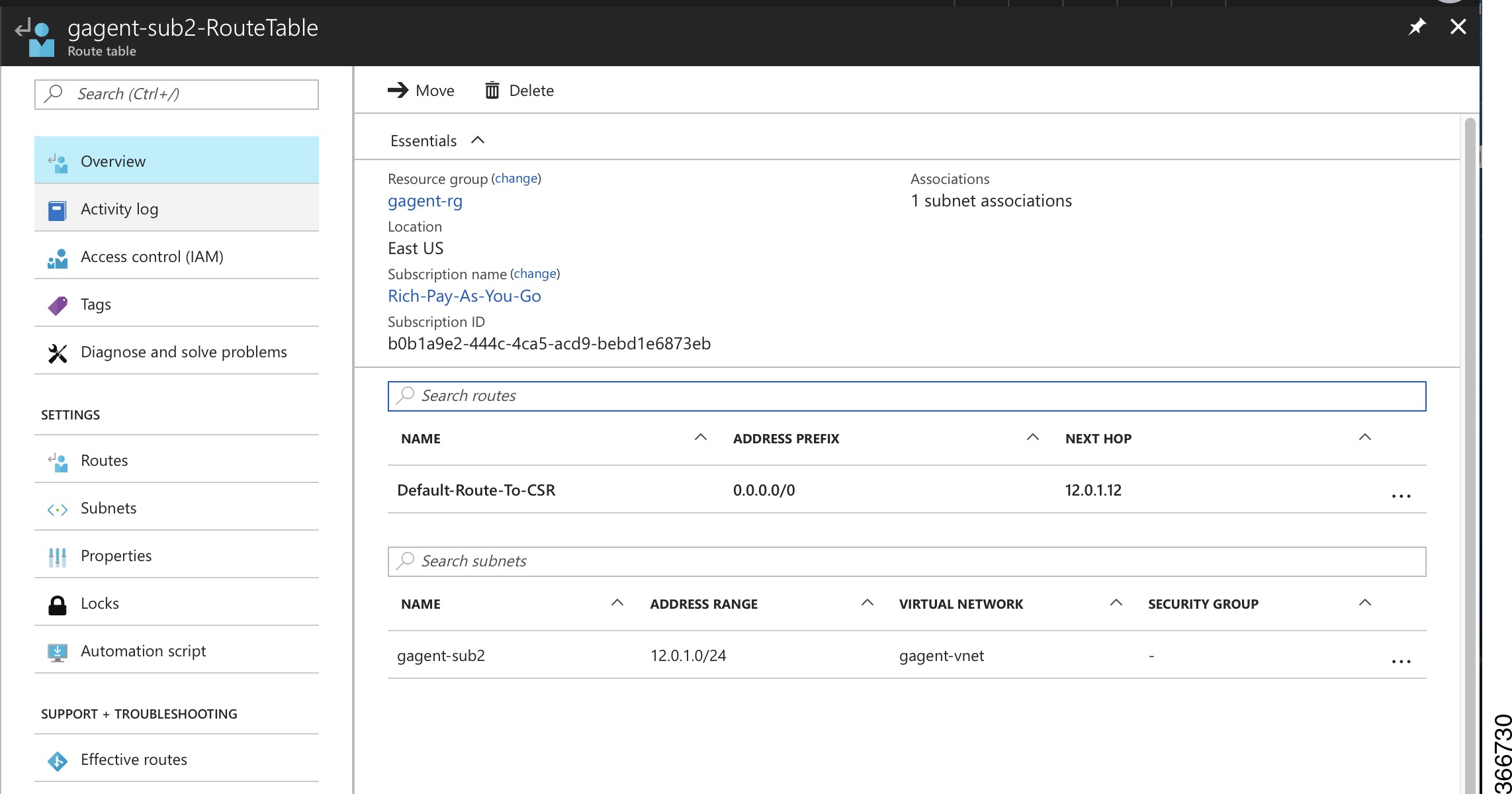
The following example shows a default route pointing to the Cisco CSR 1000v.

Figure 1. Routing table in Microsoft Azure with a default route to the Cisco CSR 1000v

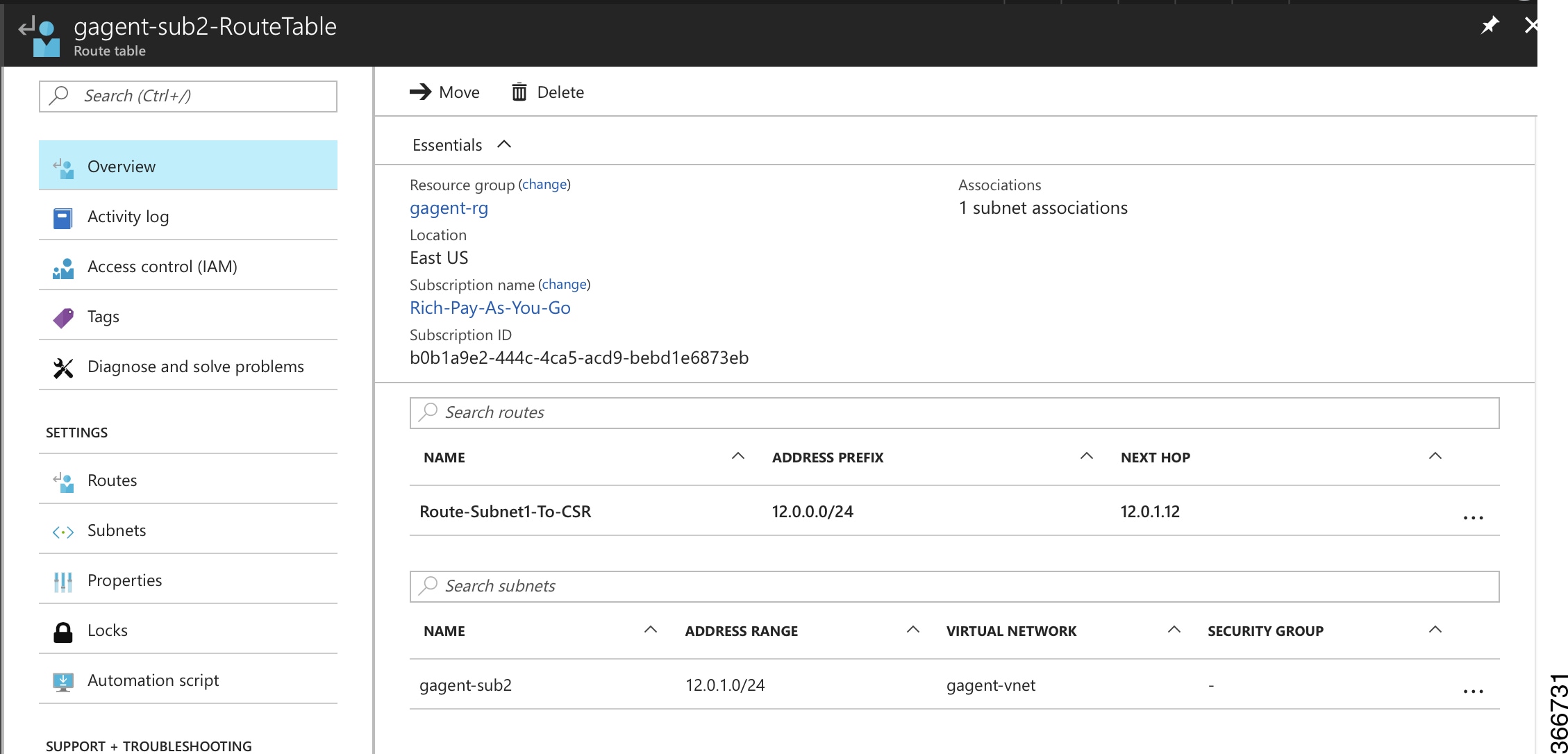
The following example shows a specific destination route pointing to the Cisco CSR 1000v.

Figure 2. Routing table in Microsoft Azure with a specific destination route to the Cisco CSR 1000v

User Defined Routes for High Availability

You can deploy two Cisco CSR 1000v's in the same virtual network to provide 1:1 redundancy for high availability. A Cisco CSR 1000v, configured with high availability, monitors the reachability of its peer router. If the Cisco CSR 1000v believes that the peer router has gone down, it installs its own IP address in the route table. This causes traffic to be routed through the "working" Cisco CSR 1000v.

When you configure user defined routes, you need to decide if you want the entries in the route table to be updated when there is a failure of one of the Cisco CSR 1000v peer routers. You must configure a redundancy node for each user-defined route table if the route table is one in which the high availability feature needs to redirect traffic to the “working” Cisco CSR 1000v.

For Cisco IOS XE Everest 16.6, all the routes in the route table specified by a redundancy node are updated in the case of a Cisco CSR 1000v peer failure.