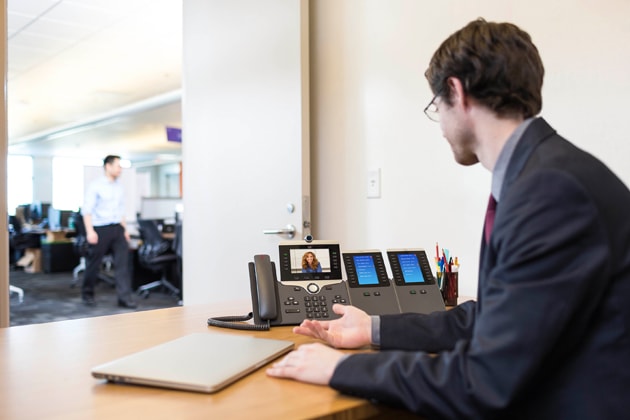
Cisco® Unified Communications Solutions unify voice, video, data, and mobile applications on fixed and mobile networks, enabling easy collaboration every time from any workspace.
Key Features and Benefits
• Cost-effective operations through a single, integrated voice and data platform for all branch-office needs: Highly reliable routers, including the Cisco 1800, 2800, 2900, 3800, and 3900 Series Integrated Services Routers, provide robust quality of service (QoS), network security, encryption, firewall, and network modules that deliver content networking and enhanced VPN services to address branch- and small-office business needs. The system delivers integrated IP telephony, gateway, voicemail, and Automated-Attendant functions, allowing you to deploy one device to address all your business needs, thereby simplifying management, maintenance, and operations and delivering a lower total cost of ownership (TCO).
• Sophisticated key system and private-branch-exchange (PBX) capabilities: Small offices have different workflows and require specialized features to support their work practices. Cisco Unified Communications Manager Express delivers a robust set of telephony features for the small office and delivers innovative value-added multimedia capabilities through XML and Java midlets. These capabilities, which traditional systems cannot deliver, enhance the productivity of the end user and the business.
• Application integration: The Cisco Unified Communications Express Services Interface application programming interface (API) facilitates development of computer telephony integration (CTI) between Cisco Unified Communications Manager Express and third-party applications to enable call monitoring, call control, and call provisioning with any Cisco Unified CME Skinny Client Control Protocol (SCCP) endpoint. As a result, Cisco Unified CME can now be integrated with a variety of value-added unified communications service applications, in either co-located or service provider-hosted deployment scenarios, to support the critical unified communications services that are part of the end user's business process.
• Contact-center capabilities: From basic call queuing to sophisticated contact centers for small to medium-sized companies, branch-office locations, or departments, you can deploy agent-assisted or self-service applications to reduce business costs and improve customer response by providing sophisticated and basic automatic call distributor (BACD), interactive voice response (IVR), CTI, and agent and desktop services.
• Interoperability with Cisco Unified Communications Manager: You can deploy Cisco Unified Communications Manager at larger sites and Cisco Unified Communications Manager Express at branch-office locations where local call processing is required without a dependency on the WAN. Using H.323 or Session Initiation Protocol (SIP) trunking, you can route calls over the WAN with calling-party name and number information, plus compressed voice for better WAN bandwidth usage.
• Cisco Unified CallConnectors for desktop CTI: You can simplify communications and facilitate collaboration between users and customers with the easy-to-use interface of the Cisco Unified CallConnector suite. These products extend customer information with call control to the Microsoft Windows desktop, providing integration with popular customer-relationship-management (CRM) products or Microsoft Windows for more effective communications.
• Investment protection and ease of upgrade to centralized call-processing systems: With a simple software configuration change on the router, you can convert an integrated-services-router system with Cisco Unified Communications Manager Express to a highly available Cisco Unified Survivable Remote Site Telephony (SRST) gateway in a centralized Cisco Unified Communications Manager deployment architecture. This flexibility helps ensure full investment protection for successful businesses that might outgrow the system capacity.
• Remote maintenance and troubleshooting: You can use the industry-standard Cisco IOS Software command-line interface (CLI) or user-friendly GUI to configure and administer Cisco Unified Communications Manager Express.
IP Phone Support
Table 1. IP Phone Support per Platform
Table 2. Supported Cisco Unified IP Phone Models
• Display-based features with easy-to-use softkeys
• Customer choice of using SCCP or SIP for commonly deployed IP phones
• Language localization and feature customization along with support for XML-based applications
• Support for IEEE 802.3af or Cisco Prestandard Power over Ethernet from a Cisco Catalyst® switch, or Cisco EtherSwitch® network module or high-speed WAN interface card available on the Cisco 1800, 2800, 2900, 3800, and 3900 Series Integrated Services Routers
Figure 1. Cisco Unified IP Phone Family

Product Features
Table 3. Cisco Unified Communications Manager Express 8.5 Features
|
Feature |
Description |
|
Phone features |
• Maximum 450 phones per system
• Up to 34 line appearances per phone
• Attendant console functions using Cisco Unified IP Phone Expansion Module 7915 and 7916 modules
• Fast transfer: Blind or consult
• Busy Lamp Field (BLF)
• Silent ringing options
• Distinctive ring per line
• Automatic line selection for outbound calls
• Call forward on busy, no answer, and all (internal or external)
• Call-forward-all restriction control
• Do not disturb (DND)
• Feature ring with DND set
• IP phone display of DND state
• Dial-plan pattern load on SIP phones
• Diversion of calls directly to voicemail
• Customization of softkeys
• Enable and disable call-waiting notification per line
• Call waiting with overlay directory number
• Call-waiting ring
• Dual or eight call line appearances per button
• After-hours toll-bar override
• Auto answer with headset
• European date formats
• Hook flash pass-through across analog PSTN trunks
• Idle URL: Periodically push messages or graphics on IP phones
• Last-number redial
• Live record to Cisco Unity® Express mailbox
• Local name directory lookup
• On-hook dialing
• Station speed dial with configuration changes from IP phone
• System speed dial for 10,000 numbers
• Silent and feature ring options
• SIP-based line-side subscribe, providing basic presence of phone status
• Transfer to voicemail softkey
• Call barge with privacy on shared lines
• Access features using softkeys or feature access codes
• Remote teleworker IP phone support
• Dynamic hunt-group join or leave
• Support for analog phones using Cisco ATA 186 Analog Telephone Adaptor or Cisco VG224 Analog Voice Gateway in SCCP mode
• Support for fax machines on foreign-exchange-station (FXS) ports or ATA using H.323, SCCP, or SIP
• Support for Cisco VG202 and VG204 Analog Voice Gateways
• XML application services on Cisco Unified IP display phones
• Station-to-station video with voice using Cisco Unified Video Advantage or Cisco Unified IP Phone 7985G endpoints
• Extension mobility within the single site
• Wideband audio (G.722) and Internet low bit rate codec (iLBC)
• Single number reach for mobility in Cisco IOS Software
• Whisper intercom
• Shared line on SIP phones with privacy and barge-in capabilities
• Customizable phone telephony user interface (TUI) with button layout control
• Improved security with customizable services and directories page
• Programmable line keys (PLK) on Cisco IP Phone TUI
• My Phone Apps support for BLF speed-dial configuration
• Normalized +E.164 support for Cisco Unified IP Phones (SCCP)
|
|
Trunk features |
• Analog foreign-exchange-office (FXO) Loop and Ground Start
• Ear and mouth (E&M)
• Basic Rate Interface (BRI) and Primary Rate Interface (PRI) support (NI2, 4ESS, 5ESS, EuroISDN, DMS100, and DMS250) and several other switch types currently supported in Cisco IOS Software
• Caller ID name and number
• Automatic number identification (ANI)
• Digital trunk support (T1/E1)
• Direct inward dialing (DID)
• Direct outward dialing
• E1 R2 support
• Dedicated trunk mapping to phone button
• H.323 trunks with H.450 support
• H450.12 automatic detection of H.450 support for remote H.323 endpoints
• H.323-to-H.323 hairpin call routing for non-H.450-compliant H.323 endpoints
• SIP trunks and RFC 2833 support
• Transcoding with G.711, G.729a, and iLBC
• Call forwarding busy, no answer, all
• Calling line identification presentation (CLIP) and calling name identification presentation (CNIP)
• Connected line identification presentation (COLP) and connected name identification presentation (CONP)
• Message waiting indicator (MWI) and message center support
• MWI pass-through QSIG-to-time-division multiplexing (TDM) voicemail
• Overlap sending support on ISDN PRI and BRI trunks
|
|
System features |
• Account codes and call-detail-record (CDR) field entry
• Call-back busy subscriber and camp-on
• Per-phone call-coverage rules
• Call hold and retrieve
• Call park: Personal and directed
• Call transfer and park recall
• Call park assign to extension
• Call pickup directed
• Call pickup local group
• Call pickup explicit group
• Call transfer: Consultative and blind
• Call waiting
• Cancel Call waiting soft key
• Call park and pickup on both SCCP and SIP phones
• CTI with Microsoft CRM and Outlook using Cisco IOS Software Telephony Services Provider (TSP)
• E911 with two emergency location numbers per zone; unlimited zones per site
• Eight-party impromptu conferencing
• Directory services using XML
• Hunt groups: Sequential, circular, parallel (blast), and longest idle
• Hunt-group dynamic log in and log out
• Hunt-groups statistics: Daily and hourly
• Intercom
• Ad-hoc conferencing (8 parties)
• Meet-me conferencing (32 parties)
• Five music-on-hold (MoH) streams (internal)
• Night service bell or call forwarding
• Overlay extensions for enhanced call coverage
• Called-name display for overlay extensions
• Paging: Internal through IP phones or to external system
• Per-call caller ID blocking
• Secondary dial tone
• Standards-based network call transfer and call forwarding using H.450
• Additional system speed-dial option through XML service
• Time-of-day and day-of-week call blocking
• Customizable called-name display
• Support of SRST fallback service phone autoregistration
• Basic automatic call distributor (B-ACD) (three queues) with Automated Attendant and call statistics
• Display of number of calls in queue on IP phone
• Agent log in and log out of B-ACD hunt group
• Integration with Cisco Unified Contact Center Express 5.0 for advanced call-center features with support for up to 50 agents, agent supervisors, call recording, silent monitoring, and reporting features
• Secure Real-Time Transport Protocol (SRTP) providing media encryption for calls on the IP network
• Secure voice IP phone certificate authentication and provisioning plus secure device signaling using Transport Layer Security (TLS)
• Video over SIP trunk with H.264 codec support
• Multilevel Precedence and Preemption (MLPP) support over PRI trunks
• Enhanced MLPP with support for supplementary services, including three-way conference, call park, and call pickup
• BLF monitoring of conference directory numbers and call-park slots
• Cisco Unified Communications Manager Express and Cisco Unity Express username and password synchronization
• Support for IPv6 on SCCP and SIP IP phones
• Enhanced security with Logical Partition Class of Restriction for Closed User Group (CUG)
• Optional unlock of meet-me conference bridge
• New IP Trusted Authentication List for enhanced security
• Forced Authorization Code (FAC) for improved call screening and accounting
• Secure Sockets Layer (SSL) VPN support for Cisco Unified IP Phones
• Secure Sockets Layer (SSL) VPN support for Cisco Adaptive Security Appliance (ASA)
• Fixed mobile convergence (FMC) with media flow around on SIP trunks
|
|
Voicemail features |
• Integrated voicemail and Automated-Attendant solution with Cisco Unity Express
• Integration with Cisco Unity Voicemail and Cisco Unity unified messaging, or third-party voicemail integration (H.323, SIP, or dual tone multifrequency [DTMF])
|
|
International localization |
• Per-phone localization for up to five local languages per system, including English, Bulgarian, Chinese Mandarin and Cantonese, Croatian, Czech, Danish, Dutch, European Spanish, Finnish, French, German, Greek, Hungarian, Italian, Japanese Kanji and Katakana, Korean, Norwegian, Polish, Portuguese, Romanian, Russian, Serbian, Slovakian, Slovenian, Swedish, Turkish, Latvian, Lithuanian, Estonian, and Hebrew
|
|
Management features |
• Automatic assignment of extensions to phones for easy phone additions
• Extension assigner, allowing for deployment of new phones using voice prompts
• Single web-based GUI for moves, adds, and changes for system and integrated voicemail with three levels of GUI administration: System administrator, customer administrator, and user
• Centralized network management deployments using Cisco CNS Configuration Engine
• Telephony-service setup and configuration using HTML Quick Configuration Tool
• Simple Network Management Protocol (SNMP) support with Cisco Unified Operations Manager or third-party management consoles
|
|
APIs for development and integration |
• Client integration: You can connect Cisco Unified CME with Microsoft CRM and Salesforce.com using Telephony Application Programming Interface (TAPI) Windows driver based on Cisco IOS Software TSP.
• Server integration: You can connect Cisco Unified CME with third-party applications using the Cisco Unified Communications Express Services Interface API. This API enables protocol interaction between Cisco Unified CME and third-party applications to perform CTI functions, including call monitoring, call control, and call provisioning with any SCCP device registered with the Cisco Unified CME. It includes two elements: embedded CTI protocol support within Cisco Unified CME and Java Function Library (referred to as the "UC Express Services SDK") that co-resides on an external server with the third-party application. This API can support either co-located or service provider-hosted application deployment scenarios. For more information, please refer to: http://developer.cisco.com/web/ucxapi/home.
|
Summary
Cisco Unified Communications Services
For More Information