cnSGW-C Overview

Product Description

cnSGW-C is a Control Plane Network Function (NF) of the converged core network (4G-5GC). The Serving Gateway Control Plane Function (cnSGW-C) is built on top of the SMI architecture. cnSGW-C acts as a UE anchor and supports mobility procedures, along with session setup and termination procedures, as specified in 3GPP TS 23.401 and 3GPP TS 23.214.

The Serving Gateway Control Plane Function (cnSGW-C) provides the functionality of the S-GW as defined by TS 23.401 [2], except for the functions that are performed by the SGW-U, as described in 3GPP Spec 23.214 Table 4.3.2-1. In addition, the cnSGW-C is responsible for selecting the SGW-U (as described in 3GPP Spec 23.214 clause 4.3.3) and for controlling the SGW-U with respect to the functions described in TS 23.214 Table 4.3.2-1.

With SMF (IWF) support based on Cisco Cloud Native Platform, it is recommended to support cnSGW-C functionality on Cloud Native Platform for better hardware utilization and O&M activities.

Converged Core Overview

The converged core solution provides an advanced, cloud-native, converged control plane with the capability to support 4G and 5G devices, and use cases.


Important


This release supports only the cloud-native integrated S-GW and SMF instance with S5C and cnSGW-C functionalities.


The converged core solution removes the operational complexity by providing a unified core network to handle all types of subscribers and use cases.

The operator has the following benefits:

  • Improves the overall network efficiency by reducing signaling between cnSGW-C and SMF while handling a 4G subscriber or handoff from 5G to 4G coverage area.

  • Reduces latency introduced due to the extra hop SGW-U for a subscriber in 4G coverage area, by collapsing the data path in the Converged UPF, thus improving the overall user experience.

  • Provides ability to use a unified subscriber policy and billing infrastructure using SBA interfaces for 4G and 5G devices.

The solution supports the following converged control plane and user plane functions:

  • Converged Control Plane Functions

    • Integrates S-GW and SMF network functions as a single deployment, under a single Kubernetes namespace, to support 4G and 5G devices from E-UTRAN/NR (converged core gateway)

    • Supports logical network functions (data)

  • Converged User Plane Functions

    • Integrates UPF and SGW-U functionalities as a single network function

    • Provides simultaneous support for N4 and Sxa interfaces

    • Terminates multiple control planes in a single deployment

Use Cases

This section describes the use cases that cnSGW-C supports:

Deployment Architecture and Interfaces

cnSGW-C is a part of the converged core network functions portfolio with a common mobile core platform architecture. The core network functions include Access and Mobility Management Function (AMF), Policy Control Function (PCF), Session Management Function (SMF), and User Plane Function (UPF).

cnSGW-C Architecture

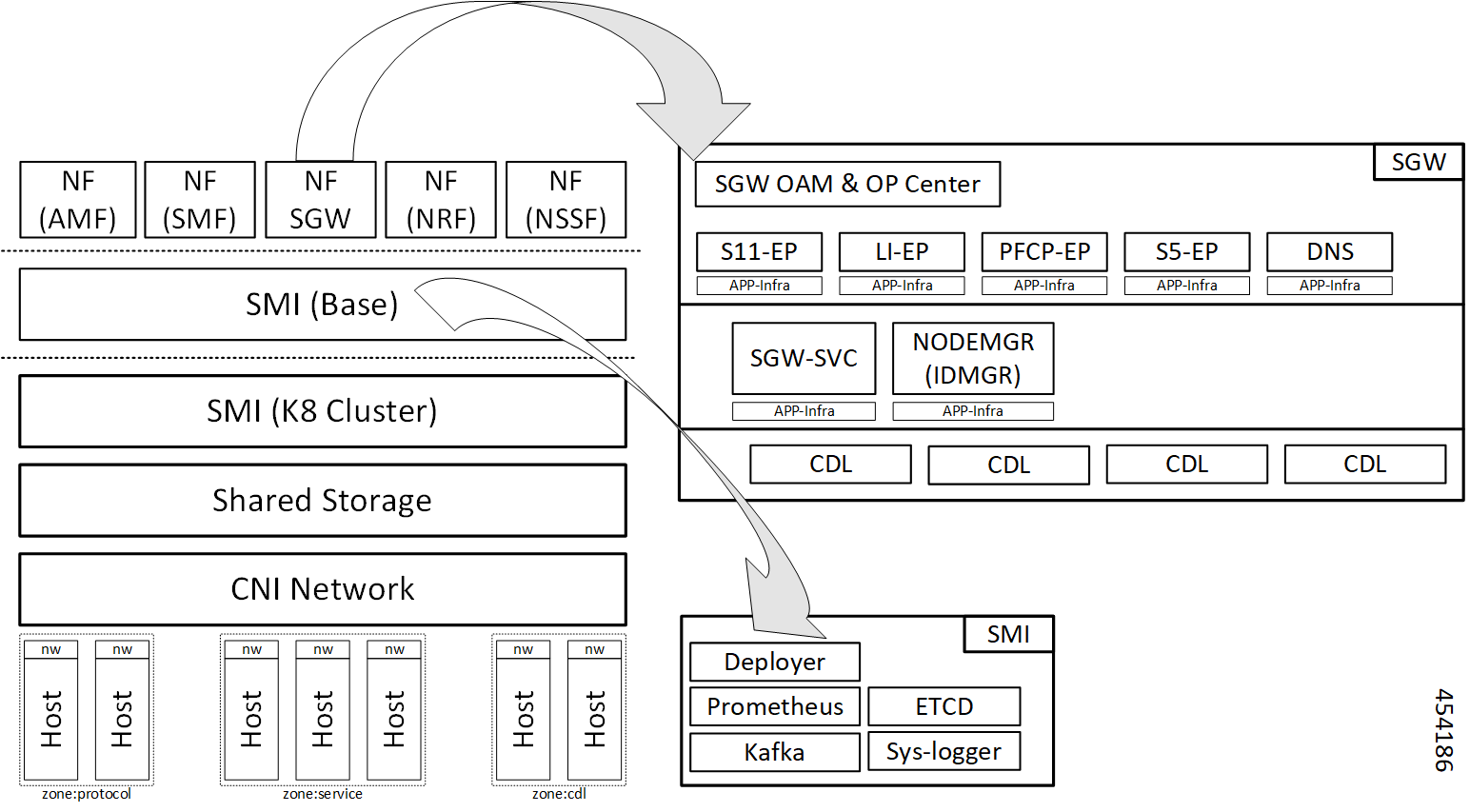
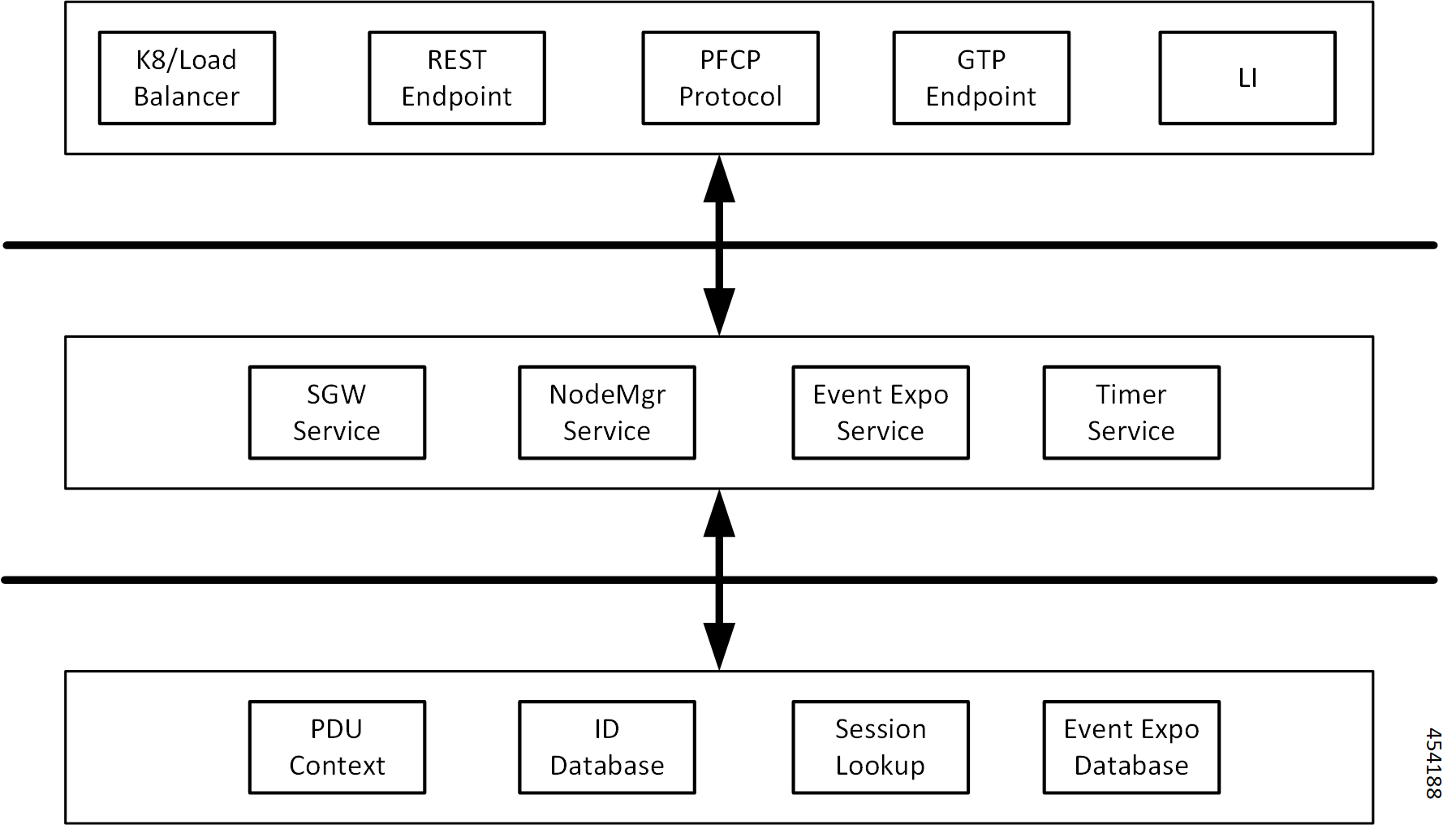
cnSGW-C network function consists of loosely coupled microservices. The microservice decomposition is based on a three-layered architecture, as illustrated in the following figure:

Figure 1. cnSGW-C Architecture

The following are the three layers of the cnSGW-C architecture:

  • Layer 1 - Protocol and Load Balancer services (Stateless)

  • Layer 2 - Application services (Stateless)

  • Layer 3 - Database services (Stateful)

cnSGW-C Deployment

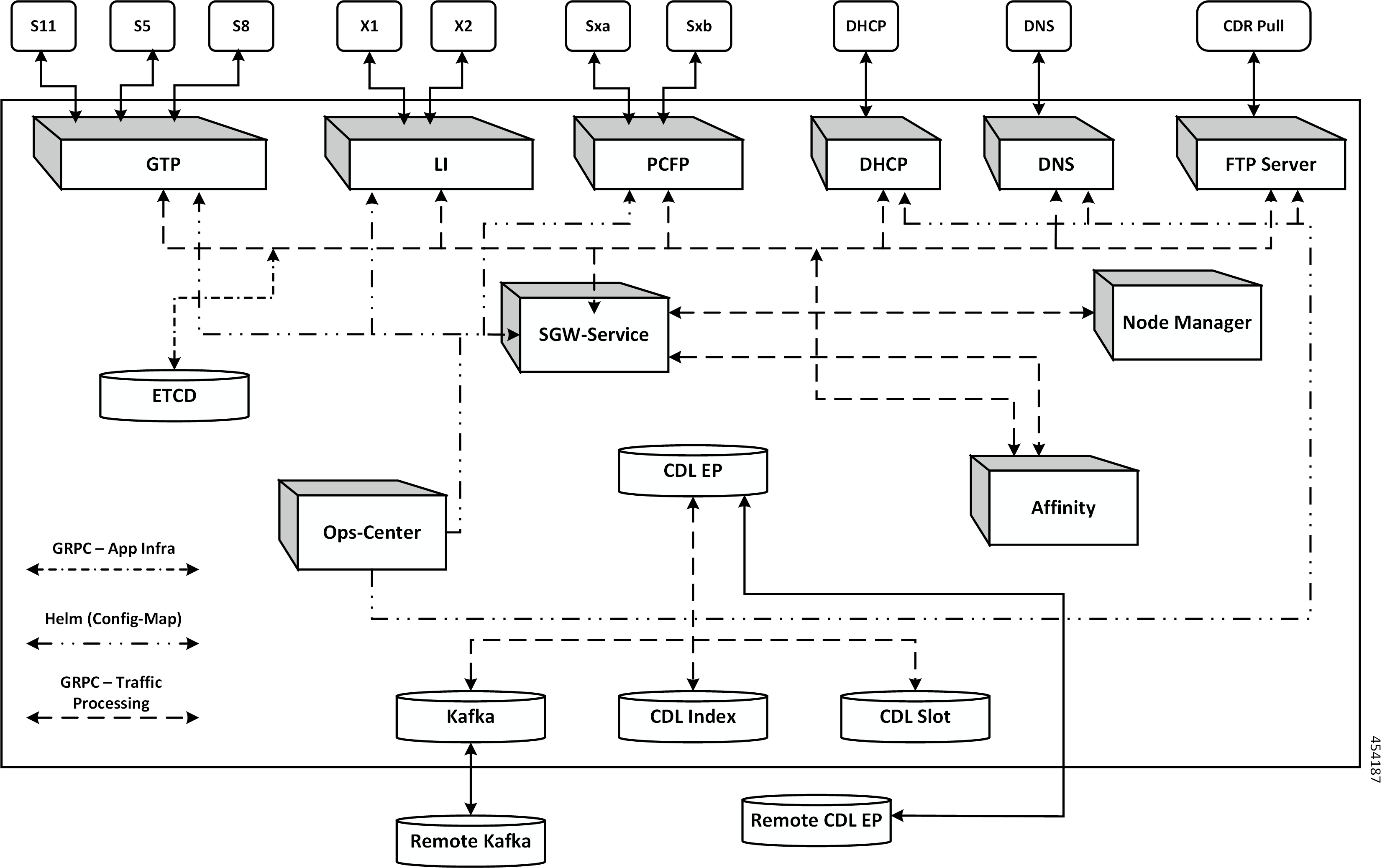
cnSGW-C NF is deployed in a separate namespace as an independent NF.

Figure 2. cnSGW-C Deployment
Figure 3. cnSGW-C HELM Chart

Converged Core Architecture

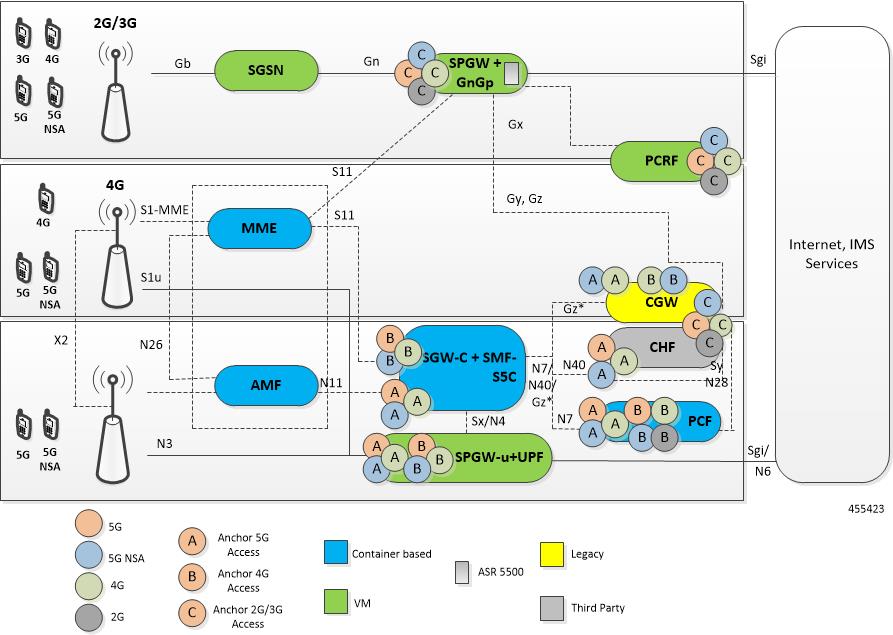
The converged core solution provides a single unified platform which is based on SMI architecture. The supporting architecture integrates the cloud-native S-GW and SMF deployment with 5GC and cnSGW-C functionalities. The solution uses 3GPP-defined SBA interfaces for policy and charging functions.

In the converged core architecture, the 4G and 5G capable UEs are anchored on the same control plane instance. The control plane instance provides the SMF, 5GC, and cnSGW-C functionalities.

The handoffs between 4G and 5G access types are seamless for 5G capable devices. The handoffs from LTE to UTRAN (bi-directional communication between 4G/5G and 3G/2G) are not seamless for 4G capable devices.

The following figure illustrates the supported network architecture.

Figure 4. Converged Core Architecture

The UPF deployed as a part of this solution is a VPC-SI VM. The UPF deployment is VM-based, and supports:

  • SGW-U, PGW-U, and UPF functionalities in the same instance, and exposes the Sxa, Sxb, Sxab, or N4 interface towards the control plane.

  • Multiple CP instances (up to 4) simultaneously.

Converged Core Deployment

The converged core deployment is based on the converged control plane and unified user plane infrastructure for all use cases.

In the converged core deployment, all 4G and 5G-capable UEs are anchored on the 5G core (SMF) with SBA interfaces towards PCF.

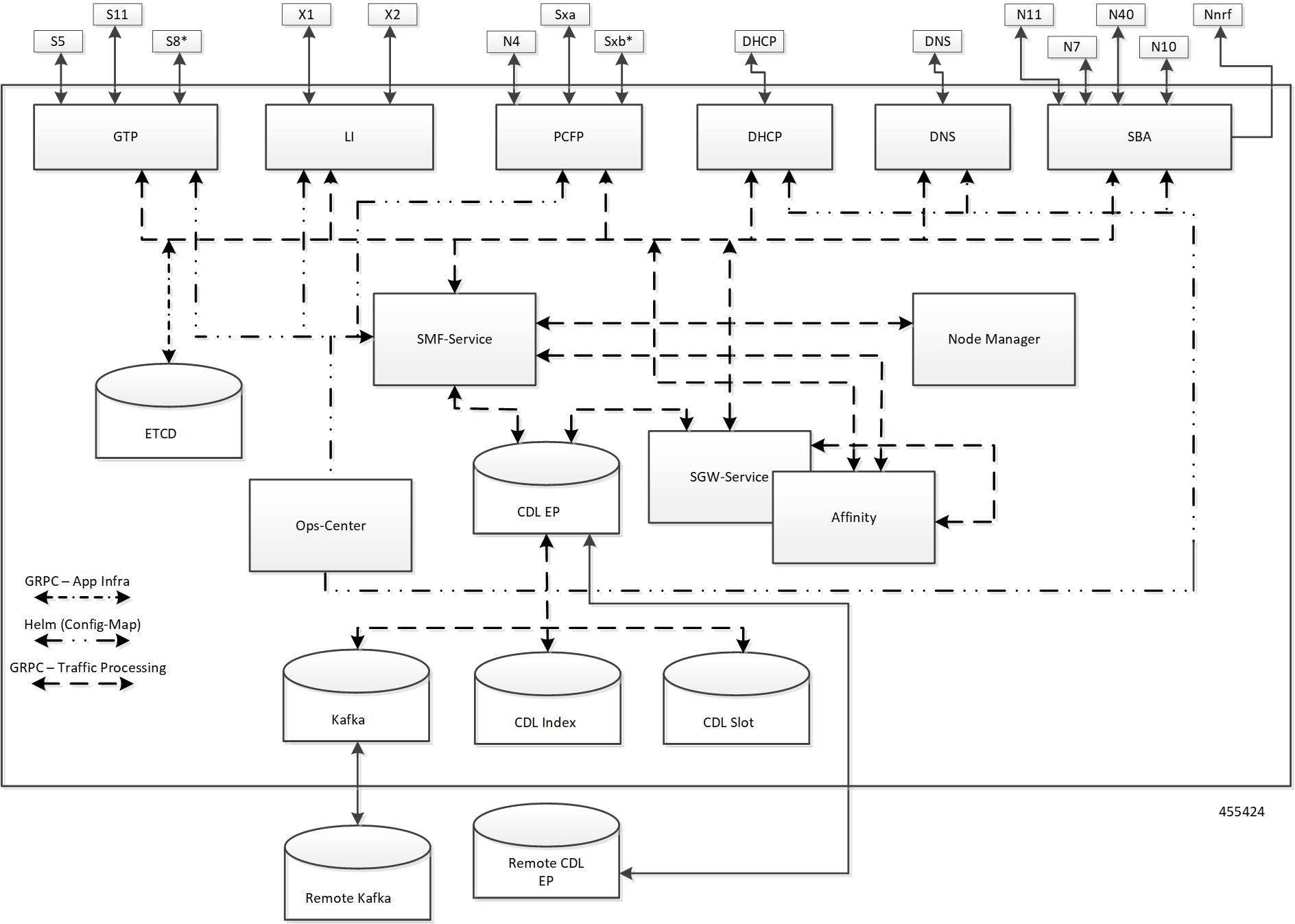
The converged core deployment has a converged Ops Center that allows the configuration of cnSGW-C and SMF services along with other microservices. A single product helm chart is used to install components.

The following figure illustrates the Kubernetes deployment for the converged S-GW and SMF network function.

Figure 5. Kubernetes Deployment

The protocol layer services are shared across SMF and S-GW. The GTP endpoint terminates the S11 interface and S5/S8 interface. Similarly, the PFCP (protocol) endpoint terminates the N4 and Sxa interfaces.

The SMF and S-GW services are deployed as distinct pods and the session processing is segregated. Both the service pods use CDL for storing subscriber sessions.

Supported Interfaces

This section describes the interfaces supported between cnSGW-C and other network functions in the 5GC.

  • S11—Reference point between the SGW and the MME

  • S5/S8—Reference point between the SGW and the PGW/SMF

  • Sxa—Reference point between the SGW-C and the SGW-U

  • Gz—Reference point between the SGW-C and the Charging Server

Standards Compliance

cnSGW-C complies with the following 3GPP standards:

  • 3GPP TS 23.401 "General Packet Radio Service (GPRS) enhancements for Evolved Universal Terrestrial Radio Access Network (E-UTRAN) access"

  • 3GPP TS 23.402 "Architecture enhancements for non-3GPP accesses"

  • 3GPP TS 29.274 "Evolved General Packet Radio Service (GPRS) Tunnelling Protocol for Control plane (GTPv2-C);"

  • 3GPP TS 23.214 "Architecture enhancements for control and user plane separation of EPC nodes"

  • 3GPP TS 29.244 "Interface between the Control Plane and the User Plane nodes"

  • 3GPP TS 24.008 "Mobile radio interface Layer 3 specification; Core network protocols; Stage 3"

  • 3GPP TS 23.007 "Restoration procedures"

  • 3GPP TS 22.153 "Multimedia priority service"

  • 3GPP TS 33.107 "3G security; Lawful interception architecture and functions"