Introduction to CMX Analytics
CMX analytics is a system that provides a set of data analytic tools packaged for analyzing Wi-Fi device locations that comes from the Mobility Services Engine (MSE). The CMX analytics service is part of advanced location service, that was first integrated into the MSE in Release 7.4.
When a wireless device is enabled in a network, it transmits probe request packets to identify the wireless network in its vicinity. Even after connecting to the access point in the Wireless LAN (WLAN), the client devices continue to transmit probe request packets to identify other access points for better quality of service. The access point gathers the request and the associated Receiver Signal Strength Indicator (RSSI) from the various wireless devices and forwards them to the Wireless LAN Controller (WLC). The controller then forwards this information to the MSE for analysis.
The basic data that is collected from various APs, when analyzed, produces information and knowledge about the movement and behavior patterns of people who are using Wi-Fi devices in the building. A building can be an airport, shopping mall, city center, and so on.
- Estimates the number of visitors, the amount of time they spend, and the frequency of their visits within a venue.
- Provides detailed insight into the behavior patterns of people moving and interacting within a venue.
- Analyzes business performance by measuring the effect of in-venue marketing.
- Improves customer satisfaction though sufficient staffing during peak times, proper signage, and make changes to the underutilized areas.
With the CMX analytics, organizations can get a lot of useful business intelligence from WiFi and location technologies. For location technology to work, you require precise maps and triangulated computation from at least three Access Points (APs). In many deployments, where there is only a couple of APs, it is not possible to do a triangulated location computation. With presence analytics, the organizations with one or two AP deployments can still use the WiFi technology to understand the customer pattern and behavior. For more information on presence analytics, see Chapter 6, “Presence Analytics”.
CMX Analytics service is configured to have the following modes:
- Location only mode—To collect data for location enabled zones, you must import zones from the Prime Infrastructure (PI).
- Presence only mode—To collect data only for presence enabled sites, you must create presence sites and no need to import any zones from the PI.
- Mixed mode—To collect data for both location zones and presence sites, you must import zones from the PI and create presence sites.
CMX Analytics Within the Cisco Unified Wireless Network
Cisco Unified Wireless Network (CUWN) solution ensures that your business achieves the highest level of network security and versatility. Cisco UWN solution empowers your network with the ability to offer secure wireless networking, either within your office for increased mobility or bridging between your office buildings. The following are the components of CUWN:
- Access Points—The Access point is the end point on the network side that provides the wireless access.
- Wireless LAN Controllers—The WLAN controllers are highly scalable and flexible platforms that enables system wide services for mission-critical wireless in medium to large-sized enterprises and campus environments. Designed for 802.11n and 802.11 ac performance and maximum scalability, the WLAN controllers offer enhanced uptime with the ability to simultaneously manage from 5000 access points to 250 access points; superior performance for reliable streaming video and toll quality voice; and improved fault recovery for a consistent mobility experience in the most demanding environments.The controller actively manages these APs w.r.t what channel it operates, how does the client gets attach to it, what security types are supported and so on.
- Cisco Prime Infrastructure—With the Prime Infrastructure, network administrator have a single solution for RF prediction, policy provisioning, network optimization, troubleshooting, user tracking, security monitoring, and wired and wireless LAN systems management. Robust graphical interfaces make wired and wireless LAN deployment and operations simple and soft-effective. Detailed trending and analysis reports make the Prime Infrastructure vital to ongoing network operations.
- Mobility Services Engine—The Cisco Mobility Services Engine (MSE) is an open platform that provides a new approach for delivery of the mobility services and applications. The MSE is managed by the Prime Infrastructure and supports various services. There are two models of the MSE available:
– Cisco 3355 Mobility Services Engine
– Cisco Mobility Services Engine Virtual Appliance
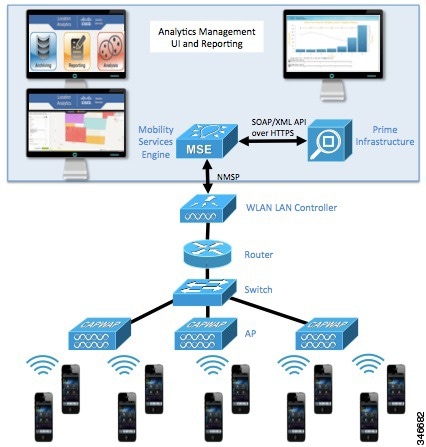
The following figure shows the overall architecture within which the CMX analytics system fits in. The CMX analytics system contains the following components:
Figure 1-1 CMX analytics Architecture
Getting Information on Your Network
The process of downloading and creating a database of devices or path information is automatic. If the installation is new, then the collection of data starts immediately and continues to download increments of data every 15 minutes. If you are upgrading to an existing MSE that has been collecting data, then the system downloads data from the previous 3 days or from the last successful download (whatever is shortest) before continuing every 15 minutes. The analytics is available immediately when the data is in the database.

Note Analytics is run on currently available data that is stored in the Analytics database. The amount of raw data is limited and is based on the available disk space on the MSE. For data to remain current, a rollover or pruning is necessary at some point. The number of days available for analytics is therefore depends on the amount of points able to be stored. Currently default is 8 million points pruned back to 7.9 million points. The reports however are run from an Aggregated or Summary database which is considerably smaller than the Analytics database. This holds data for a much longer period of time, which means that eventually the available dates for reporting will have a wider coverage than that for the analytics.
 Feedback