HCS System Overview
The Cisco Hosted Collaboration Solution (HCS) enables service providers to offer managed and hosted Unified Communications (UC) and collaboration services to multiple autonomous business customers by hosting UC applications in the cloud. Using this architecture, service providers can manage and deploy new highly reliable and scalable collaboration services to small- or medium-sized businesses and enterprises. This capability allows a service provider to offer differentiated services, as well as create new revenue possibilities.
Cisco HCS architecture enables the service provider to provide multiple cloud-based UC services to their customers, ranging in size from twenty to thousands of subscribers. Cisco HCS architecture also allows multicluster deployment of UC applications, allowing Large Enterprise Subscribers (LES) with tens of thousands of individuals to be serviced from the service provider cloud.
With Cisco HCS, service providers managed by Cisco have the opportunity to create “as a service” offers based on Cisco UC and collaboration applications. Service providers can monetize Cisco's broad portfolio of applications, streamline operations with a complete management system, optimize their capital investments in the data center through virtualization, and assure the highest quality of experience for their customers.
Cisco HCS enables service providers to offer voice, video, voicemail, instant messaging and presence, and mobility from the following product and service offerings:
- Cisco Unified Communications Manager
- Cisco Unity Connection
- Cisco Unified Communications Manager IM and Presence Service
-
Cisco Unified Attendant Console
-
Cisco Unified Mobility and mobile Smartphone clients
-
Cisco Hosted Collaboration Solution for Contact Center
-
IP Multimedia Subsystem Integration service
-
Cisco WebEx
-
Cisco TelePresence
-
Cisco Emergency Responder
-
Cisco Paging Server
The figure that follows provides a high-level view of Cisco HCS showing key functions such as virtualization, management, data center and aggregation, and a variety of different deployment models.
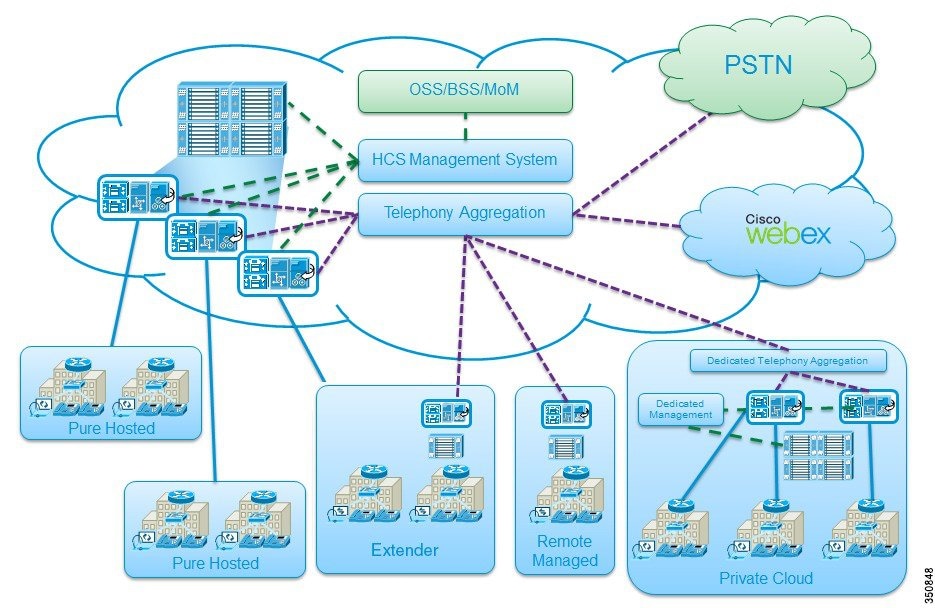
- Cisco HCS Pure Hosted
A Cisco HCS Pure Hosted deployment model is used if all of the UC applications reside in the Service Provider Cisco HCS data center and endpoints are located at one or more remote customer sites. This deployment is typically the most common deployment for service providers because it is the simplest to deploy and manage as all the call control and management servers are in the Service Provider Cisco HCS data center.
A typical customer is one who has Unified Communications applications on premises already and now wants to outsource the day-to-day operation to a service provider.
Cisco Unified Communications Domain Manager is highly modular, customizable, and scalable and can grow based on service provider needs. Cisco Unified Communications Domain Manager lends itself to service provider processes and environments easily, because it has full feature parity with applications it manages and has the ability to synchronize changes made to applications from other tools.
In Unified Communications Domain Manager 8.1(x), Unified Communications application data is maintained in Cisco Unified Communications Domain Manager which causes some potential out-of-sync and overwrite conditions when changes are made directly on the Unified Communications applications. In Cisco Unified Communications Domain Manager the application data for the UC applications is maintained in the applications themselves and not in Cisco Unified Communications Domain Manager and the data is pulled from the UC applications when needed. New settings on existing features and even new features can be added easily in Cisco Unified Communications Domain Manager.
Cisco Unified Communications Domain Manager has simplified interfaces for onboarding and user management using Lightweight Directory Access Protocol (LDAP), Secure-Sign On (SSO), and orchestration capabilities that allow you to provision multiple applications and services for users with minimum steps. It also provides full API coverage northbound to service provider integration systems including application APIs, along with simplified aggregate, enriched APIs.
Unified Communications Domain Manager 8.1(x) provides a fixed user interface hierarchy which cannot be changed whereas Cisco Unified Communications Domain Manager offers a flexible hierarchy. Cisco Unified Communications Domain Manager allows you to customize the branding, themes, and menu layouts for various users in the system using roles. You can determine the depth and names of elements in the hierarchy. Predefined dial plan workflows and provisioning templates in Unified Communications Domain Manager 8.1(x) can be customized and bundled in Cisco Unified Communications Domain Manager to meet customer requirements.
Unified Communications Domain Manager 8.1(x) and Cisco Unified Communications Domain Manager can coexist in a single deployment with the following restrictions: -
An individual customer can be managed by only a single Cisco Unified Communications Domain Manager version, either Unified Communications Domain Manager 8.1(x) or Cisco Unified Communications Domain Manager.
-
Customers previously onboarded or provisioned in Unified Communications Domain Manager 8.1(x) must be maintained in the 8.1(x) version. Cisco recommends that new customers be onboarded and provisioned with Cisco Unified Communications Domain Manager.
-
Customer names must be unique across both versions of Cisco Unified Communications Domain Manager. (The same name cannot be defined in both systems.)
-
Customers onboarded and provisioned on different Cisco Unified Communications Domain Manager versions cannot share UC applications.
-
Unified Communications Domain Manager 8.1(x) supports UC application versions from 8.x to current (10.x).
-
Cisco Unified Communications Domain Manager supports only UC application (10.x) versions.
-
- Cisco HCS Remote Managed
A Cisco HCS Remote Managed deployment is used if all Unified Communications applications are on premises, with Cisco HCS providing central breakout if necessary, and remote management through Hosted Collaboration Mediation Fulfillment and Cisco Unified Communications Domain Manager.
- Cisco HCS Extender
Cisco HCS Extender can have some or all of the Unified Communications applications on premises with some constraints on the server types, ESXi, C-series servers, and so on.
- Cisco HCS Hosted Private Cloud (also known as Large Enterprise)
A Cisco HCS Hosted Private Cloud deployment is typically for a customer who needs a standalone deployment. This model has its own license that cannot be shared with any other deployment models and must have its own management system dedicated to only one customer. This deployment shares common aggregation systems with Cisco HCS but the remaining parts are dedicated to one customer.
 Feedback