Overview
Cisco HCS System Overview
The Cisco Hosted Collaboration Solution (HCS) allows service providers to offer managed and hosted unified communications (UC) and collaboration services to multiple autonomous business customers by hosting UC applications in the cloud. Using this architecture, service providers can manage and deploy new highly reliable and scalable SIP-enabled services to enterprises. This allows a service provider to offer differentiated services, as well as create new revenue possibilities.
Cisco HCS architecture enables the service provider to provide multiple cloud-based UC services to their customers with varying employee ranges, from 250 to thousands of subscribers. Cisco HCS architecture also allows multicluster deployment of UC applications, allowing Large Enterprise Subscribers (LES) with tens of thousands of individuals to be serviced from the service provider cloud.
With HCS, the service provider partners managed by Cisco have the opportunity to create subscription-based, “as a service” offers based on Cisco UC and collaboration applications, commonly known as Unified Communications as a Service (UCaaS). Partners can monetize the Cisco broad portfolio of applications, streamline operations with a complete management system, optimize their capital investments in the data center through virtualization, and assure the highest quality of experience for their customers.
Cisco HCS allows partners to offer voice, video, voicemail, instant messaging and presence, and mobility from the following product and service offerings:
-
Cisco Unified Communications Manager
-
Cisco Unity Connection
-
Cisco Unified Communications Manager IM and Presence Service
-
Cisco Unified Mobility and mobile smart phone clients
-
IP Multimedia Subsystem Integration service
-
Contact Center
-
Cisco WebEx
-
Cisco Unified Attendant Console
-
Cisco TelePresence
The figure that follows provides a high-level view of the Cisco Hosted Collaboration Solution.
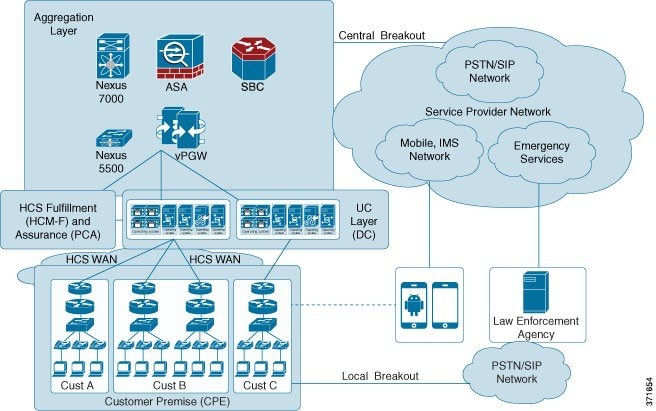
As shown in the figure, Cisco HCS is built on the following layers:
-
The aggregation layer is required in a Cisco HCS deployment to aggregate all the Cisco HCS customers at a higher layer to centralize the routing decision for all the off-net and interenterprise communication. Multiple devices are used in the aggregation layer, such as Cisco Unified Border Element - Service Provider Edition, Cisco Unified Border Element - Enterprise Edition or Perimeta Metaswitch, which act as a media and signaling anchoring device as session border controller, and Cisco vPGW Softswitch (this is a soft switch that acts as a class 4 switch and performs all the dial plan management for off-net and inter-enterprise communications). In this layer, the SBC is used as a Cisco HCS demarcation that normalizes all the communication between the HCS and the outside world, either a different IP network or the IP Multimedia Subsystem (IMS) cloud. Cisco vPGW Softswitch and SBC, Perimeta Metaswitch, or Cisco Unified Border Element (Enterprise Edition) in the case of a Micro Node deployment, are used for Central Breakout. The customer has an option for PSTN breakout through local gateway at the CPE side.
-
The UC infrastructure layer is architected around the VMDC reference architecture-based data center design to provide a highly scalable, reliable, cost effective, and secure environment to host multiple Cisco HCS customers that meet the unique SLA requirements for each application and customer.
In this architecture, the UC layer services components (such as Unified Communications Manager, Cisco Unity Connection, and Cisco Unified Communications Manager IM and Presence Service) are deployed as a single tenant (dedicated per customer) in the cloud on the multicustomer UC infrastructure. The hardware is shared using the virtualization among many enterprises and the software (applications) is dedicated per customer.
-
The Customer/CPE layer provides the connectivity to the end devices that includes phones, mobile devices, and local gateways. In addition to the end user interfaces, this layer provides connectivity from the customer site to the provider network. The customer network is connected to the Cisco HCS service provider data center over the MPLS VPN cloud.
For more information about the architecture, as well as information on the Micro Node and Small PoD deployment models, see the Cisco Hosted Collaboration Solution, Release 10.6(1) Solution Reference Network Design Guide at http://www.cisco.com/en/US/partner/products/ps11363/products_implementation_design_guides_list.html.
Cisco HCS Telephony, Design and Dial Plan Overview
Using Cisco Hosted Collaboration Solution (Cisco HCS) architecture you can configure Unified Communications Manager and other Cisco HCS elements (such as IOS devices, PSTN gateway, Cisco Unity Connection, and Cisco Unified Communications Manager IM and Presence Service) in a standard and repeatable way. Cisco HCS uses Cisco Unified Communications Domain Manager to provide automation and standardization to those configurations. Cisco Unified Communications Domain Manager employs bulk loaders to provision and onboard customers. Central to this goal, the routing architecture and associated element configuration meet in a configurable model that is used within Unified Communications Domain Manager. This model is often referred to as the Cisco HCS Dial Plan Model.
The main purpose of the Cisco HCS Dial Plan Model is to create a preintegrated baseline configuration of Unified Communications Manager applications. The Dial Plan Model can then be integrated into the platform and the service provider infrastructure with minimal effort. The Dial Plan Model configures not only the end customer equipment like Unified Communications Manager or on-premises routers, but also the interaction with aggregation layers using products such as Cisco PSTN Gateway, Session Management Edition, or Cisco Unified Border Element for those functions. The Cisco HCS team provides these standard configurations, but the service providers must customize parts of the model for a particular environment.
For the end customers, the dial plan is designed to handle a significant portion of the corporate dialing schemes. The Cisco HCS Dial Plan includes a standardized model on how to handle intrasite, intersite, and PSTN calls, generally using a site + extension methodology. It also spans advanced routing requirements of elements like central versus local breakout for PSTN calls and also handles the different numbering requirements across multiple countries.
The intersection point between the dial plan and Unified Communications Domain Manager comes in the definition of standard telephony services that abstract Unified Communications Manager configurations into simpler choices that correspond to the feature plans a service provider wants to offer, and end customer to consume. For example, the partitions, calling search spaces, and translation patterns are predefined based on a choice of simple outbound, inbound, call forwarding, and time of day settings, which in Unified Communications Domain Manager are exposed as service types. These services are combined into feature packages and templates that define a user or lines telephony services.
Given the central role to the architecture and the provision workflow, this document outlines the key architectural elements that define the Cisco HCS Dial Plan Model, the mechanics of how the model is constructed, and the resulting service configurations in Unified Communications Domain Manager. In addition, the model can be customized to fit different infrastructure requirements and customized service types.
Reference Models and Loaders
Avoid mixing bulk loaders and models from multiple sources without first taking steps to ensure the loaders are fully aligned.
CUCDM-HCS 8.1.4 Platform Build Process for a list of the bulk loaders and Dial Plan Models to be used with Cisco Unified Communications Domain Manager 8.1(4).
 Feedback