Jabber Guest - Dual NIC Deployment
The documentation set for this product strives to use bias-free language. For the purposes of this documentation set, bias-free is defined as language that does not imply discrimination based on age, disability, gender, racial identity, ethnic identity, sexual orientation, socioeconomic status, and intersectionality. Exceptions may be present in the documentation due to language that is hardcoded in the user interfaces of the product software, language used based on RFP documentation, or language that is used by a referenced third-party product. Learn more about how Cisco is using Inclusive Language.
|
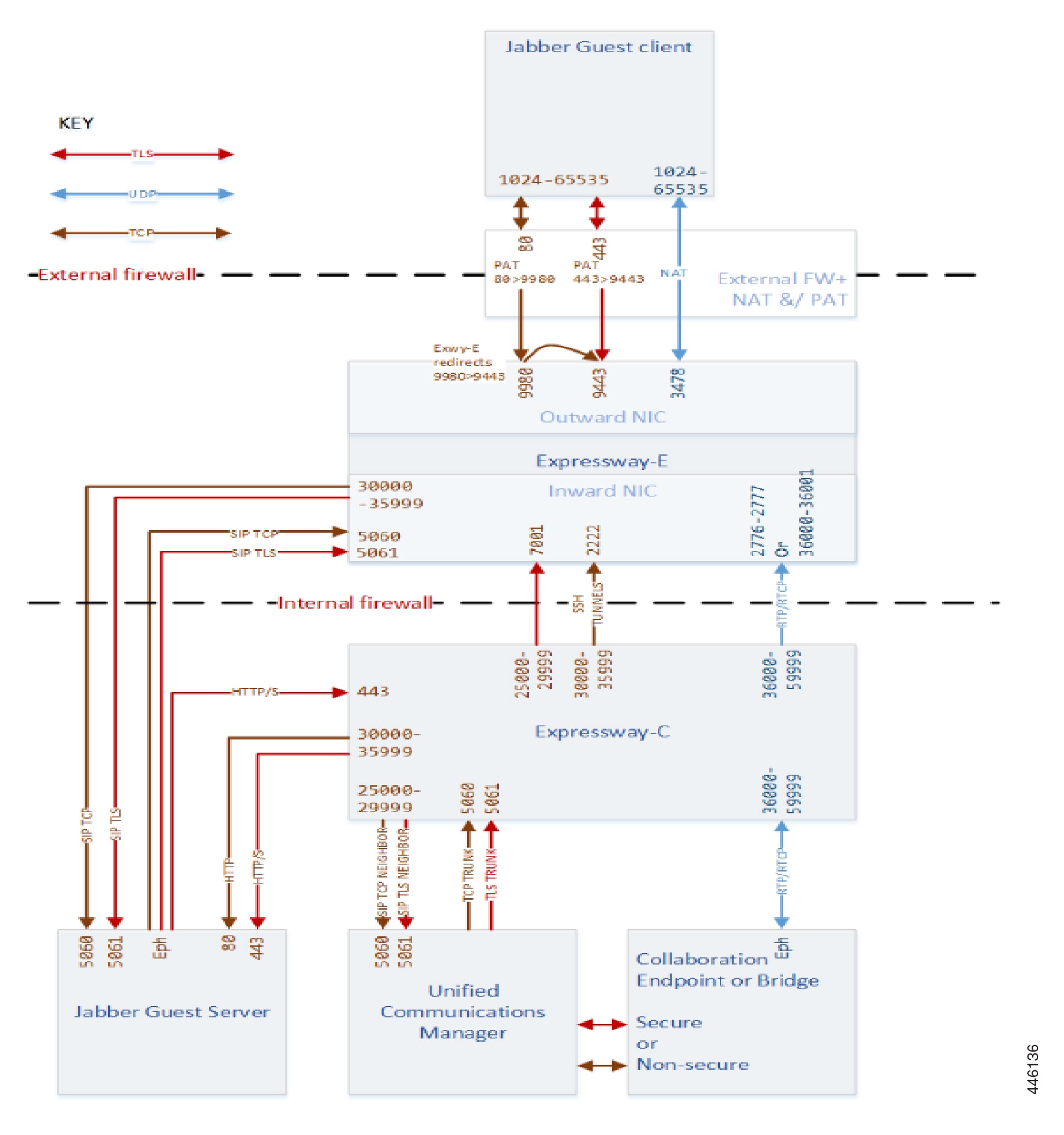
Purpose |
Src. IP |
Src. ports |
Protocol |
Dest. IP |
Dst. Ports |
|---|---|---|---|---|---|
|
Jabber Guest Client Signaling (HTTP always redirected to HTTPS) |
Any (web browser) |
1024-65535 |
TCP |
Expressway-E Public IP |
80 |
|
Jabber Guest Client Secure Signaling (HTTPS) |
Any (web browser) |
1024-65535 |
TLS |
Expressway-E Public IP |
443 |
|
To avoid port conflicts, traffic to Expressway-E public:80 must NAT&PAT to private:9980. HTTP is always redirected to HTTPS. |
TLS |
Expressway-EPrivate IP (Outward NIC) |
9980 #1 |
||
|
To avoid port conflicts, traffic to Expressway-E public:443 must NAT&PAT to private:9443 |
TLS |
Expressway-EPrivate IP (Outward NIC) |
9443 #2 |
||
|
Jabber Guest Client Media (TURN) |
Any (web browser |
1024-65535 |
UDP |
Expressway-E Public IP |
3478 (S/M systems) 3478-3483 (L systems)*3 |
|
SIP TCP signaling |
Expressway-E private IP |
30000-35999 |
TCP |
Jabber Guest Server |
5060 |
|
SIP TLS signaling |
Expressway-E private IP |
30000-35999 |
TLS |
Jabber Guest Server |
5061 |
|
SIP TCP signaling |
Jabber Guest Server |
Eph |
TCP |
Expressway-E private IP |
5060 |
|
SIP TLS signaling |
Jabber Guest Server |
Eph |
TLS |
Expressway-E private IP |
5061 |
|
Multiplexed media traversal |
Expressway-C |
36000-59999 |
UDP |
Expressway-E Inward NIC |
2776-2777 or 36000-36001 |
|
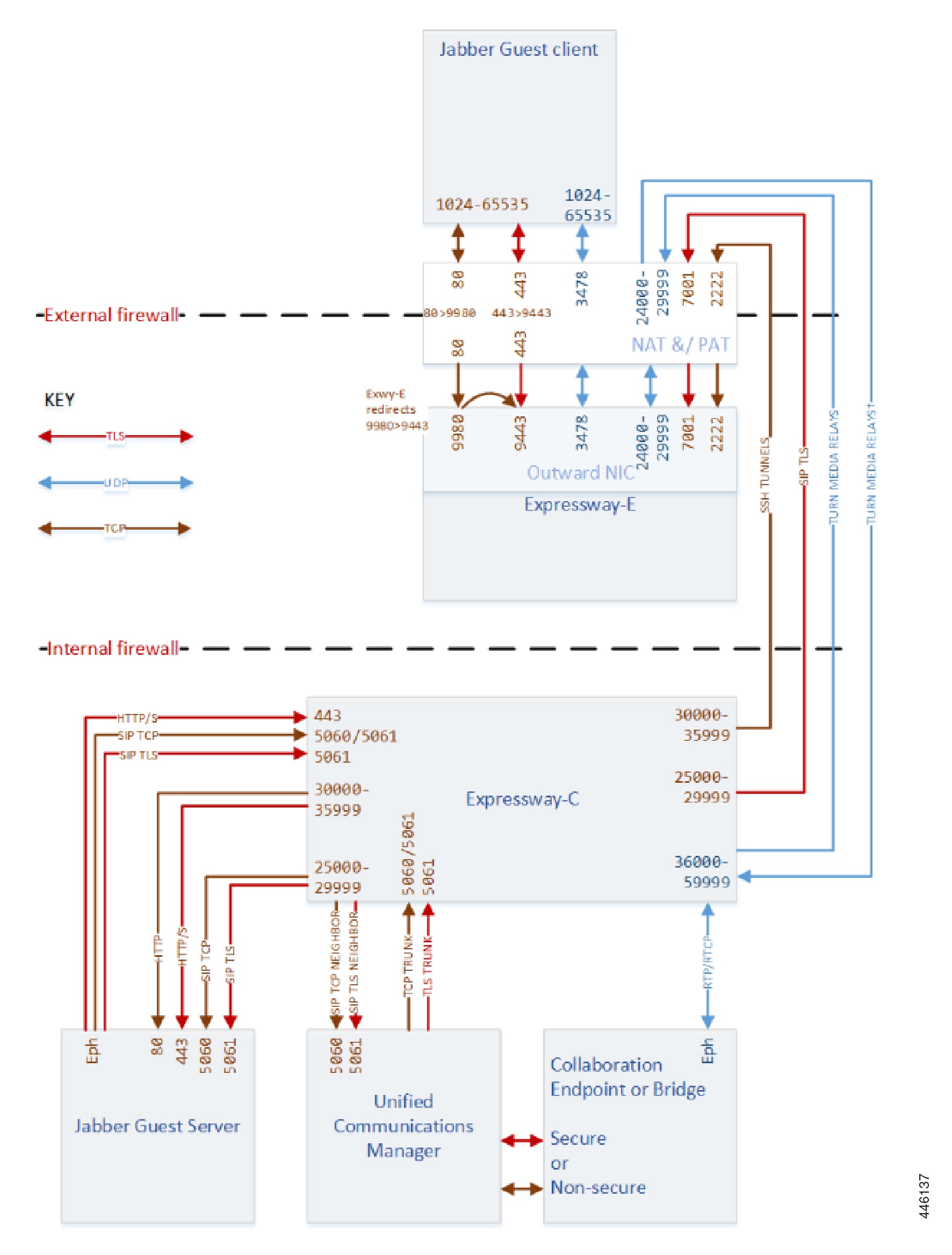
Purpose |
Src. IP |
Src. ports |
Protocol |
Dest. IP |
Dst. Ports |
|---|---|---|---|---|---|
|
Jabber Guest Client Media (TURN) |
Any |
1024-65535 |
UDP |
Expressway-E Public IP |
3478 (S/M systems) 3478-3483 (L systems)*4 |
|
Jabber Guest Client Signaling (HTTP always redirected to HTTPS) |
Any |
1024-65535 |
TCP |
Expressway-E Public IP |
80 |
|
Jabber Guest Client Secure Signaling (HTTPS) |
Any |
1024-65535 |
TLS |
Expressway-E Public IP |
443 |
|
To avoid port conflicts, traffic to Expressway-E public:80 must NAT&PAT to private:9980. HTTP is always redirected to HTTPS. |
TLS |
Expressway-E Private IP |
9980 #5 |
||
|
To avoid port conflicts, traffic to Expressway-Epublic:443 must NAT&PAT to private:9443 |
TLS |
Expressway-E Private IP |
9443 #6 |
||
| SSH Tunnels from Expressway-C to Expressway-E | Expressway-C | 35000-35999 | TCP | Expressway-E Public IP | 2222 |
| SIP Signaling | Expressway-C | 25000-25999 | TLS | Expressway-E Public IP | 7001 |
| TURN media relays | Expressway-C | 36000-59999 | UDP | Expressway-E Public IP | 24000-29999 |
| TURN media relays**7 | Expressway-E Public IP | 24000-29999 | UDP | Expressway-C | 36000-59999 |
| SIP TCP signaling | Expressway-C | 30000-35999 | TCP | Jabber Guest Server | 5060 |
| SIP TLS signaling | Expressway-C | 30000-35999 | TLS | Jabber Guest Server | 5061 |
|
SIP TCP signaling |
Jabber Guest Server |
Eph |
TCP |
Expressway-C |
5060 |
|
SIP TLS signaling |
Jabber Guest Server |
Eph |
TLS |
Expressway-C |
5061 |
 Note |
If you are using single NIC deployments, the communication between core and edge must use NAT reflection, while the destination IP from core to edge would be the Public. |
 Feedback