Configuring ITD

This chapter describes how to configure Intelligent Traffic Director (ITD) on the Cisco NX-OS device.

Finding Feature Information

Your software release might not support all the features documented in this module. For the latest caveats and feature information, see the Bug Search Tool at https://tools.cisco.com/bugsearch/ and the release notes for your software release. To find information about the features documented in this module, and to see a list of the releases in which each feature is supported, see the "New and Changed Information"chapter or the Feature History table in this chapter.

Information About ITD

Intelligent Traffic Director (ITD) is an intelligent, scalable clustering and load-balancing engine that addresses the performance gap between a multi-terabit switch and gigabit servers and appliances. The ITD architecture integrates Layer 2 and Layer 3 switching with Layer 4 to Layer 7 applications for scale and capacity expansion to serve high-bandwidth applications.


Note


The documentation set for this product strives to use bias-free language. For the purposes of this documentation set, bias-free is defined as language that does not imply discrimination based on age, disability, gender, racial identity, ethnic identity, sexual orientation, socioeconomic status, and intersectionality. Exceptions may be present in the documentation due to language that is hardcoded in the user interfaces of the product software, language used based on RFP documentation, or language that is used by a referenced third-party product.


ITD provides adaptive load balancing to distribute traffic to an application cluster. With this feature on the Cisco Nexus 7000 Series switch, you can deploy servers and appliances from any vendor without a network or topology upgrade.

ITD Feature Overview

Intelligent Traffic Director offers simplicity, flexibility, and scalability. This makes it easier for customers to deploy a traffic distribution solution in a wide variety of use cases without the use of any external hardware. Here are a few common deployment scenarios:

  • Firewall cluster optimization

  • Predictable redundancy and scaling of security services such as Intrusion Prevention System, Intrusion Detection System and more.

  • High-scale DNS solutions for enterprise and service providers

  • Scaling specialized web services such as SSL Accelerators, HTTP compression, and others

  • Using the data plane of the network to distribute high bandwidth applications

The following example use cases are supported by the Cisco ITD feature:

  • Load-balance traffic to 256 servers of 10Gbps each.

  • Load-balance to a cluster of Firewalls. ITD is much superior than policy-based routing (PBR).

  • Scale up NG IPS and WAF by load-balancing to standalone devices.

  • Scale the WAAS / WAE solution.

  • Scale the VDS-TC (video-caching) solution.

  • Replace ECMP/Port-channel to avoid re-hashing. ITD is resilient.

Benefits of ITD

ITD on the Cisco NX-OS switch enables the following:

High Scalability
  • Hardware based multi-terabit scaling for Layer 3 and 4 services and applications load balancing and traffic redirect

  • High performance, line-rate 1, 10, 40, and 100 Gigabit Ethernet (GE) traffic distribution connectivity

Operational Simplicity

  • Transparent connectivity for appliance and server clustering

  • Optimized for fast and simple provisioning

Investment Protection

  • Supported on all Cisco Nexus 5000, 6000, 7000, and 9000 switching platforms. No new hardware is required.

  • End device agnostic. It supports all servers and service appliances.

Deployment Modes

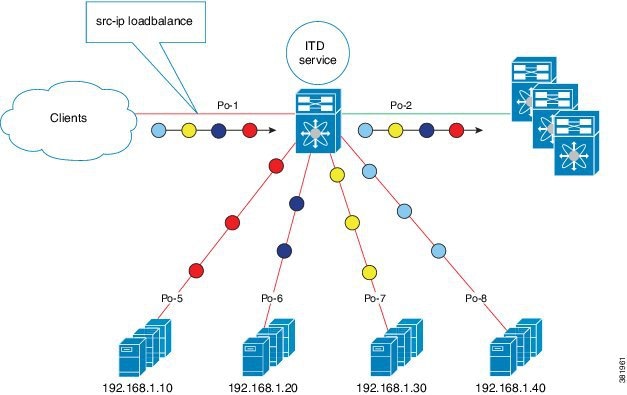
One-Arm Deployment Mode

You can connect servers to the Cisco NX-OS device in one-arm deployment mode. In this topology, the server is not in the direct path of client or server traffic, which enables you to plug in a server into the network with no changes to the existing topology or network.

Figure 1. One-Arm Deployment Mode


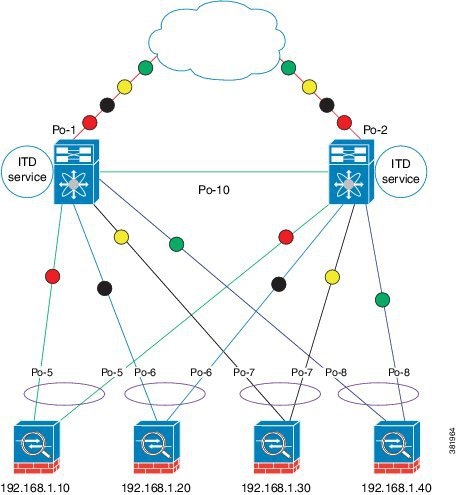
One-Arm Deployment Mode with VPC

The ITD feature supports an appliance cluster connected to a virtual port channel (vPC). The ITD service runs on each Cisco NX-OS switch and ITD programs each switch to provide flow coherent traffic passing through the nodes.

Figure 2. One-Arm Deployment Mode with VPC


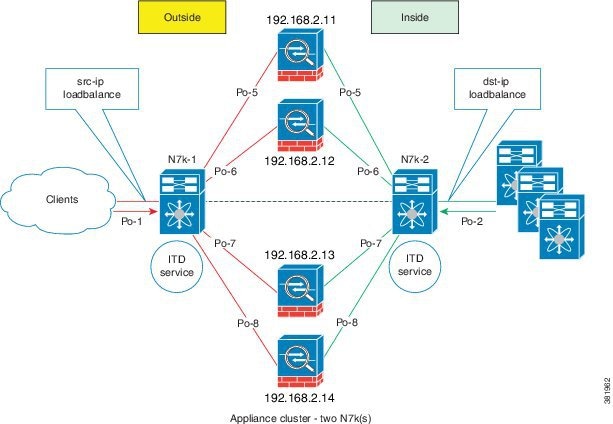
Sandwich Deployment Mode

The sandwich deployment mode uses two Cisco NX-OS 7000 Series switches to provide stateful handling of traffic.

The main requirement in this mode is that both forward and reverse traffic of a flow must go through the same appliance. Examples include firewalls and load balancer deployments, where traffic between client and server must flow through the same appliance.

The key features are:

  • An ITD service for each network segment—one for outside network and another for inside network.

  • A source-IP load balancing scheme where the ITD service operates on the interface that connects to the outside world in an ingress direction.

  • A destination-IP load balancing scheme where the ITD service operates on the interface that connects to the servers in the ingress direction.

Figure 3. Sandwich Deployment Mode


Server Load-Balancing Deployment Mode

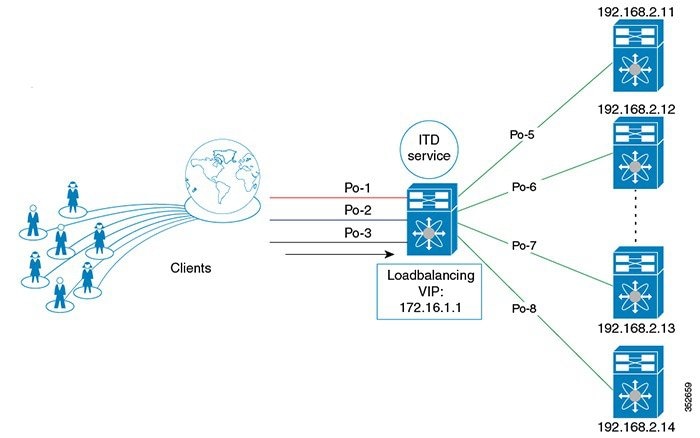
The ITD service can be configured to host a virtual IP (VIP) on a Cisco NX-OS 7000 Series switch. Internet traffic destined for the VIP will be load balanced to the active nodes. Unlike traditional server load balancers, source NAT is not needed as the ITD service is not a stateful load balancer.


Note


You need to configure ITD service similarly on each Cisco NX-OS 7000 Series switch. The ITD service configuration needs to be done manually on each switch.


Figure 4. ITD Load Distribution with VIP


Attention


Configure a single VIP address for an ITD service serving a group of nodes (or device group).

Device Groups

The ITD feature supports device groups. When you configure a device group you can specify the following:

  • The device group's nodes

  • The device group's probe

VRF Support

The ITD service can be configured in the default VRF as well as non-default VRFs.

Ingress interface(s) and device-group nodes must all belong to the same VRF for the ITD service to redirect traffic. You must ensure that all ingress interface(s) and node members of the associated device group are all reachable in the configured VRF.

Load Balancing

The ITD feature enables you to configure specific load-balancing options by using the loadbalance command.

The optional keywords for the loadbalance command are as follows:

  • buckets —Specifies the number of buckets to create. Buckets must be configured in powers of two. One or more buckets are mapped to a node in the cluster. If you configure more buckets than the number of nodes, the buckets are applied in round robin fashion across all the nodes.

  • mask-position — Specifies the mask position of the load balancing. This keyword is useful when a packet classification has to be made based on specific octets or bits of an IP addresses. By default the system uses the last octet's starting most significant bits (MSBs).

    If you prefer to use nondefault bits/octets, you can use the mask-position keyword to provide the starting point at which bits the traffic classification is to be made. For example, you can start at the 8th bit for the second octet and the 16th bit for the third octet of an IP address.

  • src or dst ip— Specifies load balancing based on source or destination IP address.

  • src ip or src ip-l4port— Specifies load balancing based on source IP address, or source IP address and source L4 port.

  • dst ip or dst ip-l4port— Specifies load balancing based on destination IP address, or destination IP address and destination L4 port.

Hot Standby

ITD supports N+1 redundancy where M nodes can act as standby nodes for N active nodes.

When an active node fails, ITD looks for an operational standby node and selects the first available standby node to replace the failed node. ITD reconfigures the switch to redirect the traffic segment that was originally headed toward the failed node to the newly active node. The service does not impose any fixed mapping of standby nodes to active nodes.

When the failed node becomes operational again, it is reinstated as an active node and traffic from the acting standby node is redirected back to the original node and the standby node reverts to the pool of standby nodes.

When multiple nodes fail, traffic destined to all failed nodes gets redirected to the first available standby node.

A node can be configured as a standby at the node-level or device-group-level. A node-level standby receives traffic only if its associated active node fails. A device-group-level standby receives traffic if any of the active nodes fail.

Multiple Ingress Interfaces

You can configure the ITD service to apply traffic redirection policies on multiple ingress interfaces. This feature allows you to use a single ITD service to redirect traffic arriving on different interfaces to a group of nodes. The ingress interface command enables you to configure multiple ingress interfaces.

The same ingress interface can be configured in two ITD services, allowing one IPv4 ITD service and one IPv6 ITD service.

Configuring the same ingress interface in both IPv4 and IPv6 ITD services allows both IPv4 and IPv6 traffic to arrive on the same ingress interface. An IPv4 ITD policy is applied to redirect IPv4 traffic and an IPv6 ITD policy is applied to redirect IPv6 traffic.


Note


Make sure the ingress interface is not configured in more than one IPv4 ITD service and/or more than one IPv6 ITD service. The system does not automatically check this.


System Health Monitoring

ITD supports health monitoring functionality to do the following:
  • Monitor the ITD channel and peer ITD service.

  • Monitor the state of the interface connected to each node.

  • Monitor the health of the node through the configured probe.

  • Monitor the state of ingress interface(s).

With health monitoring, the following critical errors are detected and remedied:
  • ITD service is shut/no shut or deleted.

  • iSCM process crash.
  • iSCM process restart.
  • Switch reboot.

  • Supervisor switchover.

  • In-service software upgrade (ISSU).

  • ITD service node failure.

  • ITD service node port or interface down.

  • Ingress interface down.

Monitor Node

The ITD health monitoring module periodically monitors nodes to detect any failure and to handle failure scenarios.

ICMP, TCP, UDP, DNS and HTTP probes are supported to probe each node periodically for health monitoring. A probe can be configured at the device-group level or at node-level. A probe configured at the device-group level is sent to each node member of the device-group. A probe configured at a node-level is sent only to the node it is associated with. If a node-specific probe is configured, only that probe is sent to the node. For all the nodes that do not have node-specific probe configuration, the device-group level probe (if configured) is sent.


Note


HTTPS probe is not supported on ITD.


IPv4 Control Probe for IPv6 Data Nodes

For an IPv6 node (in an IPv6 device-group), if the node is a dual-homed node (that is, it supports IPv4 and IPv6 network interfaces), an IPv4 probe can be configured to monitor the health. Since IPv6 probes are not supported, this provides a way to monitor health of IPv6 data nodes using a IPv4 probe.


Note


IPv6 probes are not supported.


Health of an Interface Connected to a Node

ITD leverages the IP service level agreement (IP SLA) feature to periodically probe each node. The probes are sent at a one second frequency and sent simultaneously to all nodes. You can configure the probe as part of the cluster group configuration. A probe is declared to have failed after retrying three times.

Node Failure Handling

Upon marking a node as down, the ITD performs the following tasks automatically to minimize traffic disruption and to redistribute the traffic to remaining operational nodes:

  • Determines if a standby node is configured to take over from the failed node.

  • Identifies the node as a candidate node for traffic handling, if the standby node is operational.

  • Redefines the standby node as active for traffic handling, if an operational standby node is available.

  • Programs automatically to reassign traffic from the failed node to the newly active standby node.
Monitor Peer ITD Service

For sandwich mode cluster deployments, the ITD service runs on each Cisco NX-OS 7000 series switch. The health of the ITD channel is crucial to ensure flow coherent traffic passing through cluster nodes in both directions.

Each ITD service probes its peer ITD service periodically to detect any failure. A ping is sent every second to the peer ITD service. If a reply is not received it is retried three times. The frequency and retry count are not configurable.


Note


Since only a single instance of the ITD service is running on the switch in one-arm mode deployment, monitoring of the peer ITD is not applicable.


ITD channel failure handling

If the heartbeat signal is missed three times in a row, then the ITD channel is considered to be down.

While the ITD channel is down, traffic continues to flow through cluster nodes. However, since the ITD service on each switch is not able to exchange information about its view of the cluster group, this condition requires immediate attention. A down ITD channel can lead to traffic loss in the event of a node failure.

Failaction Reassignment

Failaction for ITD enables traffic on the failed nodes to be reassigned to the first available active node. Once the failed node comes back, it automatically resumes serving the connections. The failaction command enables this feature.

When the node is down, the traffic bucket associated with the node is reassigned to the first active node found in the configured set of nodes. If the newly reassigned node also fails, traffic is reassigned to the next available active node. Once the failed node becomes active again, traffic is diverted back to the new node and resumes serving connections.


Note


You must configure probe under an ITD device group, before enabling the failaction feature.


The following example shows the failaction assignment functionality before and after pre-fetch optimization.

Without pre-fetch optimization:

Let us consider an example of 4 Nodes with 256 buckets, and each node has 64 buckets.

  • Suppose Node 1 and Node 3 fails. ITD will process node failure notification one at a time.

  • ITD processes Node 1 failure first and reassigns Node 1's 32 buckets to Node 2, Node 3, and Node 4. 64 buckets are reassigned. Node 2 (32+22), Node 3 (32+21), and Node 4(21).

  • ITD receives Node 3 failure notification. It has to move Node 3 (32 + 21) buckets to Node 2 and Node 4. So this time, total 53 buckets need to be reassigned.

  • Node 1 failure (64 buckets are moved) + Node 3 failure (85 buckets are moved) = total 149 buckets are reassigned.

With pre-fetch optimization:

Let us consider an example of 4 Nodes with 256 buckets, and each node has 64 buckets.

  • Suppose Node 1 and Node 3 fails. ITD will check the status of all the nodes before reassigning the buckets.

  • Now, it moves Node 1's 32 buckets to Node 2 and Node 4. And moves Node 3's buckets to Node 2 and Node 4.

  • Node 1 failure (64 buckets are moved) + Node 3 failure (64 buckets are moved) = total 128 buckets are reassigned.

Failaction Reassignment Without a Standby Node

When the node is down, the traffic bucket associated with the node is reassigned to the first active node found in the configured set of nodes. If the newly reassigned node also fails, the traffic bucket is reassigned to the next available active node. Once the failed node comes back and becomes active, the traffic is diverted back to the new node and starts serving the connections.

If all the nodes are down, the packets get routed automatically.

  • When the node goes down (probe failed), the traffic is reassigned to the first available active node.

  • When the node comes up (probe success) from the failed state, it starts handling the connections.

  • If all the nodes are down, the packets get routed automatically.

Failaction Reassignment with a Standby Node

When the node is down and if the standby is active, the traffic serves the connections and there is no change in the bucket assignment. When both the active and standby nodes are down, the traffic bucket associated with the node is reassigned to the first active node found in the configured set of nodes. If the newly reassigned node also fails, the traffic bucket is reassigned to the next available active node. Once the failed node comes back up and becomes active, the traffic is diverted back to the new node and begins serving connections.

  • When the node goes down (probe failed) and when there is a working standby node, traffic is directed to the first available standby node.

  • When all nodes are down including the standby node, the traffic is reassigned to the first available active node.

  • When the node comes up (probe success) from failed state, the node that came up starts handling the connections.

  • If all the nodes are down, the packets are routed automatically.

No Failaction Reassignment

When failaction node reassignment is not configured, there are two possible scenarios:

  • Scenario 1: Probe configured; and:

    • with standby configured; or
    • without standby configured.
  • Scenario 2: No probe configured.

No Failaction Reassignment with a Probe Configured

The ITD probe can detect the node failure or the lack of service reachability.

  • If the node fails and a standby is configured, the standby node takes over the connections.

  • If the node fails and there is no standby configuration, the traffic gets routed and does not get reassigned, as failaction is not configured. Once the node recovers, the recovered node starts handling the traffic.

No Failaction Reassignment without a Probe Configured

Without a probe configuration, ITD cannot detect the node failure. When the node is down, ITD does not reassign or redirect the traffic to an active node.

Licensing Requirements for ITD

ITD requires an Enhanced Layer 2 Package license. For a complete explanation of the Cisco NX-OS licensing scheme and how to obtain and apply licenses, see the Cisco NX-OS Licensing Guide.

Prerequisites for ITD

ITD has the following prerequisites:

  • You must enable the ITD feature with the feature itd command.

  • The following commands must be configured prior to entering the feature itd command:

    • feature pbr

    • feature sla sender

    • feature sla responder

    • ip sla responder

Guidelines and Limitations for ITD

ITD has the following configuration guidelines and limitations:

  • From Cisco NX-OS Release 8.4(3), statistics for an ITD service that has include ACL is supported.

  • From Cisco NX-OS Release 8.4(2), the ACLs created by ITD are not displayed in the show ip/ipv6 access-list command output. You need to use show ip/ipv6 access-list dynamic command to get the ITD ACL list.

  • Ensure that all node IPs in use by ITD services with the destination NAT feature enabled are reachable when the service is initially brought up. Also services with destination NAT enabled are required to be shut before reloading the switch. Service shut followed by a no-shut is recommended if nodes are unreachable during service enablement or if the service is enabled across reloads.

  • Ensure that all node IPs in use by ITD services with the destination NAT feature enabled are Layer-2 adjacent.

  • ITD services with destination NAT feature is not supported with fail-action mechanisms of fail-action distribute and fail-action node-per-bucket.

  • ITD sessions are not supported on device-groups used by services with NAT destination feature enabled.

  • ITD NAT is not supported on Cisco Nexus 7000 and Cisco Nexus 7700 Series switches.

  • A combination of ITD Standby, Hot Standby, and Failaction mechanism is not supported in a single device-group.

  • Hot Standby is not supported with the bucket distribute failaction method.

  • When ITD service is enabled, access-lists, route-maps, tracks, and IP SLA are auto-configured. Ensure that you do not modify or remove these configurations. Modifying these configurations disrupts ITD functionality.

  • Virtual IP type and the ITD device group nodes type should be either IPv4 or IPv6, but not both.

  • From Cisco NX-OS Release 8.4(2), a total number of 2000 ACEs are supported for multiple Include ACLs.

  • You can configure upto 8 ACLs in a ITD service.

  • You can configure either VIP or Include ACL on a single ITD service, but not both.

  • IPv6 probes are not supported for a device group with IPv6 nodes, however IPv4 probes can be configured to monitor an IPv6 data node if the node is dual-homed (that is, it has both IPv6 and IPv4 networks interfaces).

  • Configuration rollback is only supported when the ITD service is in shut mode in both target and source configurations.

  • SNMP is not supported for ITD.

  • ITD does not support FEX, either with ingress or egress traffic.

The Optimized Node Insertion/Removal feature is supported:

  • Without standby nodes and backup nodes

  • Not supported with weights

  • Not supported with NAT (Cisco NX-OS 7000 Series switch)

  • Not supported with the Include ACL feature configured

  • Not supported with Node level probes.

The following are ITD guidelines and restrictions for IPv6:

  • IPv6 with IPv4 probe is supported on F3 (on Nexus 7000 Series and Nexus 7700) and F2E (Nexus 7700) modules only.

  • IPv6 probe for the IPv6 standby node is not supported.

  • IPv6 probe for the IPv6 hot-standby node is supported.

  • IPv6 services for ITD is not supported on F2E Line Cards.

  • ITD service groups and modules does not support IPv6 NAT destination.

  • Beginning with Cisco NX-OS Release 8.2(1), IPv6 is supported on M3 modules.

  • ITDv6 supports only the failaction reassign and failaction least-bucket.

The following are ITD guidelines and restrictions for IPv4:

  • In the Cisco NX-OS Release 7.3(0)D1(1), the Include ACL feature is supported for IPv4 only.

  • The following fail-action methods are supported on IPv4:

    • reassign

    • least-bucket

    • per-bucket

    • bucket-distribute

Configuring ITD

The server can be connected to the switch through a routed interface or port-channel, or via a switchport port with SVI configured.

Enabling ITD

Before you begin

Before you configure the feature itd command you must enter the feature pbr and feature ipsla commands.

Procedure

  Command or Action Purpose

Step 1

switch# configure terminal

Enters global configuration mode.

Step 2

switch(config)# feature itd

Enables the ITD feature.

Configuring a Device Group

Before you begin

Enable the ITD feature.

Procedure

  Command or Action Purpose

Step 1

switch# configure terminal

Enters global configuration mode.

Step 2

switch(config)# itd device-group name

Creates an ITD device group and enters into device group configuration mode.

Step 3

switch(config-device-group)# node ip ipv4-address

Specifies the nodes for ITD. Repeat this step to specify all nodes.

To configure IPv6 nodes, use the node ipv6 ipv6-address .

Note


An ITD device group can have either IPv4 or IPv6 nodes, but not both.

Step 4

switch(config-dg-node)# [mode hot-standby] [standby ipv4-address] [weight value] [probe {icmp| tcp port port-number| udp port port-number| dns {hostname| target-address} | http get filename} [frequency seconds] [[retry-down-count| retry-up-count] number] [timeout seconds]

Specifies the device group nodes for ITD. Repeat this step to specify all nodes.

The weight value keyword specifies the proportionate weight for the node for weighted traffic distribution.

The mode hot-standby specifies that this is node is to be designated as standby node for the device-group.

A node-level standby can be associated for each node. The standby value specifies the standby node information for this active node.

A node-level probe can be configured to monitor health of the node. The Probe value specifies probe parameters to use for monitoring health of this active node.

Note


IPv6 probes are not supported.

Step 5

switch(config-device-group)# probe {icmp | tcp port port-number | udp port port-number | dns {hostname |target-address} | http get filename } [frequency seconds] [[retry-down-count | retry-up-count] number] [timeout seconds]

Configures the cluster group service probe.

You can specify the following protocols as the probe for the ITD service:

  • ICMP

  • TCP

  • UDP

  • DNS

  • HTTP

The keywords are as follows:

  • retry-down-count —Specifies the consecutive number of times the probe must have failed prior to the node being marked DOWN.

  • retry-up-count —Specifies the consecutive number of times the probe must have succeeded prior to the node being marked UP.

  • timeout —Specifies the number of seconds to wait for the probe response.

  • frequency —Specifies the time interval in seconds between successive probes sent to the node.

Note


IPv6 probes are not supported.

Configuring an ITD Service

Before you begin

  • Enable the ITD feature.

  • Configure the device-group to be added to the ITD service.

Procedure

  Command or Action Purpose

Step 1

switch# configure terminal

Enters global configuration mode.

Step 2

switch(config)# itd service-name

Configures an ITD service and enters into ITD configuration mode.

Step 3

switch(config-itd)# device-group device-group-name

Adds an existing device group to the ITD service. The device-group-name specifies the name of the device group. You can enter up to 32 alphanumeric characters.

Step 4

switch(config-itd)# virtual ip ipv4-address ipv4-network-mask device-group device-group-name [advertise {enable |disable} ]

Allows you to configure a VIP for ITD device group with route creation based on health of device group node.

Step 5

switch(config-itd)# ingress interface interface

Adds an ingress interface or multiple interfaces to an ITD service.

  • Use a comma (“,”) to separate multiple interfaces.

  • Use a hyphen (“-”) to separate a range of interfaces.

Step 6

switch(config-itd)# load-balance {method {src {ip | ip-l4port [tcp | udp] range x y} | dst {ip | ip-l4port [tcp | udp] range x y}} | buckets bucket-number | mask-position position}

Configures the load-balancing options for the ITD service. The keywords are as follows:

  • buckets —Specifies the number of buckets to create. Buckets must be configured in powers of two.

  • mask-position — Specifies the mask position of the load balance.

  • method —Specifies the source IP address or destination IP address, or source IP address and source port, or the destination IP address and destination port based load-balancing.

Step 7

switch(config-itd)# virtual ip ipv4-address ipv4-network-mask [tcp | udp {port-number | any}] [advertise {enable | disable}]

Configures the virtual IPv4 address of the ITD service.

Configure a single VIP address for an ITD service serving a group of nodes (or device group).

Note


To configure an IPv6 virtual address, use the virtual ipv6 ipv6-address ipv6-network-mask | ipv6-prefix/length} [ip | tcp {port-number | any} | udp {port-number | any}] [advertise {enable | disable}]

The advertise enable keywords specify that the virtual IP route is advertised to neighboring devices.

The tcp , udp , and ip keywords specify that the virtual IP address will accept flows from the specified protocol.

Step 8

switch(config-itd)# failaction node per-bucket

When a particular node is failed, the least bucketed node is identified and the buckets are distributed across the rest of the active nodes starting from the least bucketed node.

Step 9

switch(config-itd)# failaction node reassign

Enables traffic to be reassigned, following a node failure. The traffic to the failed node gets reassigned to the first available active node.

Step 10

switch(config-itd)# vrf vrf-name

Specifies the VRF for the ITD service.

Step 11

switch(config-itd)# no shutdown

Enables the ITD service.

Step 12

switch(config-itd)# exclude access-list acl-name

Excludes traffic from redirection. The acl-name specifies the matching traffic that should be excluded from ITD redirection.

Verifying the ITD Configuration

To display the ITD configuration, perform one of the following tasks:

Command

Purpose

show itd [itd-name] [brief]

Displays the status and configuration for all or specified ITD instances.

  • Use the itd-name argument to display the status and configuration for the specific instance.

  • Use the brief keyword to display summary status and configuration information.

show itd [itd-name | all] {src | dst} ip-address] statistics [brief]

Displays the statistics for ITD instances.

  • Use the itd-name argument to display statistics for the specific instance.

  • Use the brief keyword to display summary information.

Note


Before using the show itd statistics command, you need to enable ITD statistics by using the itd statistics command.

show running-config services

Displays the configured ITD device-group and services.

show itd session device-group

Lists all the sessions configured.

show itd session device-groupdevice-group-name

Lists the ITD session matching the name of the device-group.

These examples show how to verify the ITD configuration:


switch# show itd

Name           Probe LB Scheme  Status   Buckets
-------------- ----- ---------- -------- -------
WEB            ICMP  src-ip     ACTIVE   2

Exclude ACL
-------------------------------
 exclude-smtp-traffic

Device Group                                         VRF-Name
-------------------------------------------------- -------------
WEB-SERVERS


Pool                           Interface    Status Track_id
------------------------------ ------------ ------ ---------
WEB_itd_pool                   Po-1       UP       3

Virtual IP                              Netmask/Prefix Protocol     Port
------------------------------------------------------ ------------ ----------
10.10.10.100 / 255.255.255.255                        IP           0

  Node  IP                  Config-State Weight Status     Track_id  Sla_id
  ------------------------- ------------ ------ ---------- --------- ---------
  1     10.10.10.11        Active       1      OK           1         10001

        Bucket List
        -----------------------------------------------------------------------
        WEB_itd_vip_1_bucket_1


  Node  IP                  Config-State Weight Status     Track_id  Sla_id
  ------------------------- ------------ ------ ---------- --------- ---------
  2     10.10.10.12        Active       1      OK           2         10002

        Bucket List
        -----------------------------------------------------------------------
        WEB_itd_vip_1_bucket_2

switch# show itd brief

Name           Probe LB Scheme  Interface  Status   Buckets
-------------- ----- ---------- ---------- -------- --------
WEB            ICMP  src-ip     Eth3/3     ACTIVE   2

Device Group                                         VRF-Name
-------------------------------------------------- -------------
WEB-SERVERS


Virtual IP                              Netmask/Prefix Protocol     Port
------------------------------------------------------ ------------ ----------
10.10.10.100 / 255.255.255.255                        IP           0

  Node  IP                  Config-State Weight Status     Track_id  Sla_id
  ------------------------- ------------ ------ ---------- --------- ---------
  1     10.10.10.11        Active       1      OK           1         10001
  2     10.10.10.12        Active       1      OK           2         10002

switch(config)# show itd statistics

Service        Device Group             VIP/mask               #Packets
--------------------------------------------------------------------------------
test            dev              9.9.9.10 / 255.255.255.0	      114611  (100.00%)

Traffic Bucket        Assigned to      Mode       Original Node   #Packets
--------------------------------------------------------------------------------
test_itd_vip_0_acl_0  10.10.10.9       Redirect    10.10.10.9      57106  (49.83%)

Traffic Bucket        Assigned to      Mode       Original Node   #Packets
--------------------------------------------------------------------------------
test_itd_vip_0_acl_1  12.12.12.9       Redirect    12.12.12.9      57505  (50.17%)
switch (config)# show running-config services

version 6.2(10)
feature itd

itd device-group WEB-SERVERS
probe icmp
node ip 10.10.10.11
node ip 10.10.10.12

itd WEB
device-group WEB-SERVERS
virtual ip 10.10.10.100 255.255.255.255
ingress interface po-1
no shut

Warnings and Error Messages for ITD

The following warnings and error messages are displayed for ITD:

When you reach the maximum number of configurable nodes, this message is displayed:
Already reached maximum nodes per service
If you configure the same node IP when it is already configured part of an ITD service, this message is displayed:
This IP is already configured, please try another IP
When you try to change or remove a device group, probe, or ingress interface after the IDT service is enabled, one of these messages is displayed:
Probe configuration is not allowed, service is enabled
Ingress interface configuration is not allowed, service is enabled
Node configuration is not allowed, service is enabled
If the ITD service is already enabled or disabled, one of these messages is displayed:
In service already enabled case
In service already disabled case
When you try to change the failaction configuration after the ITD service is enabled, this message is displayed:
Failaction configuration is not allowed, service is enabled.

Configuration Examples for ITD

This example shows how to configure an ITD device group:
switch(config)# feature itd
switch(config)# itd device-group dg
switch(config-device-group)# probe icmp
switch(config-device-group)# node ip 192.168.2.11
switch(config-device-group)# node ip 192.168.2.12
switch(config-device-group)# node ip 192.168.2.13
switch(config-device-group)# node ip 192.168.2.14
This example shows how to configure a virtual IPv4 address:
switch(config)# feature itd
switch(config)# itd test
switch(config-itd)# device-group dg
switch(config-itd)# ingress interface Po-1
switch(config-itd)# virtual ip  172.16.1.10 255.255.255.255 advertise enable tcp any
This example shows how to configure a virtual IPv6 address:
switch(config)# feature itd
switch(config)# itd test
switch(config-itd)# device-group dg
switch(config-itd)# ingress interface Po-1
switch(config-itd)# virtual ipv6 ffff:eeee::cccc:eeee dddd:efef::fefe:dddd tcp 10 advertise enable
This example shows how to configure device-group-level standby node. Node 192.168.2.15 is configured as standby for the entire device group. If any of the active nodes fail, the traffic going to the failed node will be redirected to 192.168.2.15:
switch(config)# feature itd
switch(config)# itd device-group dg
switch(config-device-group)# probe icmp
switch(config-device-group)# node ip 192.168.2.11
switch(config-device-group)# node ip 192.168.2.12
switch(config-device-group)# node ip 192.168.2.13
switch(config-device-group)# node ip 192.168.2.14
switch(config-device-group)# node ip 192.168.2.15	
switch(config-dg-node)# mode hot standby
switch(config-dg-node)# exit
This example shows how to configure node-level standby node. Node 192.168.2.15 is configured as standby for node 192.168.2.11 only. Only when node 192.168.2.11 fails, the traffic going to node 192.168.2.11 is redirected to 192.168.2.15:
switch(config)# feature itd
switch(config)# itd device-group dg
switch(config-device-group)# probe icmp
switch(config-device-group)# node ip 192.168.2.11
switch(config-dg-node)# standby ip 192.168.2.15
switch(config-device-group)# node ip 192.168.2.12
switch(config-device-group)# node ip 192.168.2.13
switch(config-device-group)# node ip 192.168.2.14
switch(config-dg-node)# exit
This example shows how to configure weight for proportionate distribution of traffic. Nodes 1 and 2 would get three times as much traffic as nodes 3 and 4:
switch(config)# feature itd
switch(config)# itd device-group dg
switch(config-device-group)# probe icmp
switch(config-device-group)# node ip 192.168.2.11 
switch(config-dg-node)# weight 3
switch(config-device-group)# node ip 192.168.2.12 
switch(config-dg-node)# weight 3
switch(config-device-group)# node ip 192.168.2.13
switch(config-device-group)# node ip 192.168.2.14
switch(config-dg-node)# exit
This example shows how to configure a node-level probe. Node 192.168.2.14 is configured with TCP probe and ICMP probe is configured for device-group. TCP probe gets sent to node 192.168.2.14 and ICMP probe gets sent to nodes 192.168.2.11, 192.168.2.12 and 192.168.2.13:
switch(config)# feature itd
switch(config)# itd device-group dg
switch(config-device-group)# probe icmp
switch(config-device-group)# node ip 192.168.2.11 
switch(config-device-group)# node ip 192.168.2.12 
switch(config-device-group)# node ip 192.168.2.13
switch(config-device-group)# node ip 192.168.2.14
switch(config-dg-node)# probe tcp port 80
switch(config-dg-node)# exit
This example shows how to configure probe for standby mode. Node 192.168.2.15 is configured as standby for node 192.168.2.11 only. While ICMP probe is configured for device-group, TCP probe is configured for standby node 192.168.2.15. ICMP probe gets sent to nodes 192.168.2.11, 192.168.2.12, 192.168.2.13 and 192.168.2.14. TCP probe gets sent to node 192.168.2.15:
switch(config)# feature itd
switch(config)# itd device-group dg
switch(config-dg-node)# probe icmp
switch(config-device-group)# node ip 192.168.2.11
switch(config-device-group)# standby ip 192.168.2.15
switch(config-dg-node-standby)# probe tcp port 80 
switch(config-dg-node)# node ip 192.168.2.12 
switch(config-device-group)# node ip 192.168.2.13
switch(config-device-group)# node ip 192.168.2.14
switch(config-dg-node)# exit
This example shows how to configure IPv4 probe for IPv6 node.dg-v6 is an IPv6 device group and IPv6 probes are not supported. Assuming node 210::10:10:14 is dual-homed (i.e. it supports both IPv6 and IPv4 network interfaces and IPv4 node address is 210. 10.10.1), an IPv4 probe can be configured to monitor the health of the node. The below example shows TCP probe configured to be sent to IPv4 address 192.168.2.11 for monitoring health of IPv6 data node 210::10:10:14:
switch(config)# feature itd
switch(config)# itd device-group dg-v6
switch(config-device-group)#  node ipv6 210::10:10:11
switch(config-device-group)#  node ipv6 210::10:10:12
switch(config-device-group)# node ipv6 210::10:10:13
switch(config-device-group)# node ipv6 210::10:10:14
switch(config-dg-node)# probe tcp port 80 ip 192.168.2.11
switch(config-dg-node)# exit
This example shows how to configure failaction node per-bucket for a service with ACL:
switch(config)# feature itd
switch(config)# itd test
switch(config-itd)# device-group dg_v6
switch(config-itd)# ingress interface vlan66
switch(config-itd)# failaction node per-bucket 
switch(config-itd)# access-list ipv6 acl_v6 
switch(config-itd)# no shut 
This example shows how to configure exclude ACL for ITD service. In the below example, an exclude ACL 'exclude-SMTP-traffic' is configured to exclude SMTP traffic from ITD redirection.:
switch(config)# feature itd
switch(config)# itd test
switch(config-device-group)# device-group dg
switch(config-itd)# ingress interface Po-1
switch(config-itd)# vrf RED
switch(config-itd)# exclude access-list exclude-SMTP-traffic
switch(config-idt)# no shut
This example shows how to configure VRF for ITD service:
switch(config)# feature itd
switch(config)# itd test
switch(config-itd)# device-group dg
switch(config-itd)# ingress interface Po-1
switch(config-itd)# vrf RED
switch(config-idt)# no shut
This example shows how to enable statistics collection for ITD service:

Note


You must enable statistics collection for 'show itd statistics' to show the packet counters.

switch(config)# itd statistics test
This example shows how to disable statistics collection for ITD service:

switch(config)# no itd statistics test

Configuration Example: One-Arm Deployment Mode

The configuration below uses the topology in the following figure:

Figure 5. One-Arm Deployment Mode


Step 1: Define device group


switch(config)# itd device-group DG
switch(config-device-group)# probe icmp
switch(config-device-group)# node ip 192.168.2.11
switch(config-device-group)# node ip 192.168.2.12
switch(config-device-group)# node ip 192.168.2.13
switch(config-device-group)# node ip 192.168.2.14

Step 2: Define ITD service


switch(config)# itd Service1
switch(config-itd)# ingress interface port-channel 1
switch(config-itd)# device-group DG
switch(config-itd)# no shutdown

Configuration Example: One-Arm Deployment Mode with VPC

The configuration below uses the topology in the following figure:

Figure 6. One-Arm Deployment Mode with VPC


Device 1

Step 1: Define device group


N7k-1(config)# itd device-group DG
N7k-1s(config-device-group)# probe icmp
N7k-1(config-device-group)# node ip 192.168.2.11
N7k-1(config-device-group)# node ip 192.168.2.12
N7k-1(config-device-group)# node ip 192.168.2.13
N7k-1(config-device-group)# node ip 192.168.2.14

Step 2: Define ITD service


N7k-1(config)# itd Service1
N7k-1(config-itd)# ingress interface port-channel 1
N7k-1(config-itd)# device-group DG
N7k-1(config-itd)# no shutdown

Device 2

Step 1: Define device group


N7k-2(config)# itd device-group DG
N7k-2(config-device-group)# probe icmp
N7k-2(config-device-group)# node ip 192.168.2.11
N7k-2(config-device-group)# node ip 192.168.2.12
N7k-2(config-device-group)# node ip 192.168.2.13
N7k-2(config-device-group)# node ip 192.168.2.14

Step 2: Define ITD service


N7k-2(config)# itd Service1
N7k-2(config-itd)# ingress interface port-channel 2
N7k-2(config-itd)# device-group DG
N7k-2(config-itd)# no shutdown

Configuration Example: Sandwich Deployment Mode

The configuration below uses the topology in the following figure:

Figure 7. Sandwich Deployment Mode


Device 1

Step 1: Define device group


N7k-1(config)# itd device-group DG
N7k-1s(config-device-group)# probe icmp
N7k-1(config-device-group)# node ip 192.168.2.11
N7k-1(config-device-group)# node ip 192.168.2.12
N7k-1(config-device-group)# node ip 192.168.2.13
N7k-1(config-device-group)# node ip 192.168.2.14

Step 2: Define ITD service


N7k-1(config)# itd HTTP
N7k-1(config-itd)# ingress interface port-channel 1
N7k-1(config-itd)# device-group DG
N7k-1(config-itd)# load-balance method src ip
N7k-1(config-itd)# no shutdown

Device 2

Step 1: Define device group


N7k-2(config)# itd device-group DG
N7k-2(config-device-group)# probe icmp
N7k-2(config-device-group)# node ip 192.168.2.11
N7k-2(config-device-group)# node ip 192.168.2.12
N7k-2(config-device-group)# node ip 192.168.2.13
N7k-2(config-device-group)# node ip 192.168.2.14

Step 2: Define ITD service


N7k-2(config)# itd HTTP
N7k-2(config-itd)# ingress interface port-channel 2
N7k-2(config-itd)# device-group DG
N7k-2(config-itd)# load-balance method dst ip
N7k-2(config-itd)# no shutdown

Configuration Example: Server Load-Balancing Deployment Mode

The configuration below uses the topology in the following figure:

Figure 8. ITD Load Distribution with VIP


Step 1: Define device group

switch(config)# itd device-group DG
switch(config-device-group)# probe icmp
switch(config-device-group)# node ip 192.168.2.11
switch(config-device-group)# node ip 192.168.2.12
switch(config-device-group)# node ip 192.168.2.13
switch(config-device-group)# node ip 192.168.2.14

Step 2: Define ITD service


switch(config)# itd Service2
switch(config-itd)# ingress interface port-channel 1
switch(config-itd)# ingress interface port-channel 2
switch(config-itd)# ingress interface port-channel 3
switch(config-itd)# device-group DG
Switch(config-itd)# virtual ip  172.16.1.1 255.255.255.255
switch(config-itd)# no shutdown

Related Documents for ITD

Related Topic

Document Title

Intelligent Traffic Director commands

Cisco Nexus 7000 Series NX-OS Intelligent Traffic Director Command Reference

Standards for ITD

No new or modified standards are supported by this feature, and support for existing standards has not been modified by this feature.

Feature History for ITD

This table includes only the updates for those releases that have resulted in additions or changes to the feature.

Feature Name

Release

Feature Information

ITD

6.2(10)

Added the following enhancements:

  • Weighted load-balancing.

  • Node-level standby.

  • Layer 4 port load-balancing.

  • Sandwich mode node-state synchronization across two VDCs on the same device.

  • DNS probe.

  • Start/stop/clear ITD statistics collection.

  • VRF support for the ITD service and probes.

Intelligent Traffic Director (ITD)

6.2(8)

This feature was introduced.