Installing the Cisco MDS 9396T Switch

This chapter describes how to install the Cisco MDS 9396T switch and its components.


Note


Before you install, operate, or service the system, see the Regulatory Compliance and Safety Information for the Cisco MDS 9000 Family for important safety information.

Warning


IMPORTANT SAFETY INSTRUCTIONS

This warning symbol means danger. You are in a situation that could cause bodily injury. Before you work on any equipment, be aware of the hazards involved with electrical circuitry and be familiar with standard practices for preventing accidents. Use the statement number provided at the end of each warning to locate its translation in the translated safety warnings that accompanied this device. Statement 1071

SAVE THESE INSTRUCTIONS


Warning


This unit is intended for installation in restricted access areas. A restricted access area can be accessed only through the use of a special tool, lock and key, or other means of security. Statement 1017


Warning


Only trained and qualified personnel should be allowed to install, replace, or service this equipment. Statement 1030


Preinstallation

Installing the ESD Grounding Strap

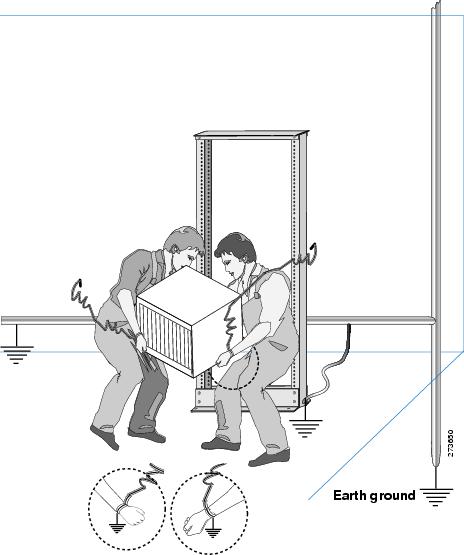
This section illustrates how to prepare yourself before removing the chassis from the sealed antistatic bag.

The figures show how to cuff the ESD strap around the wrist and the ground cord that connects the cuff to the ground. ESD wrist straps are the primary means of controlling static charge on personnel.


Note


These images are for only representation purposes. The chassis' actual appearance and size may vary.
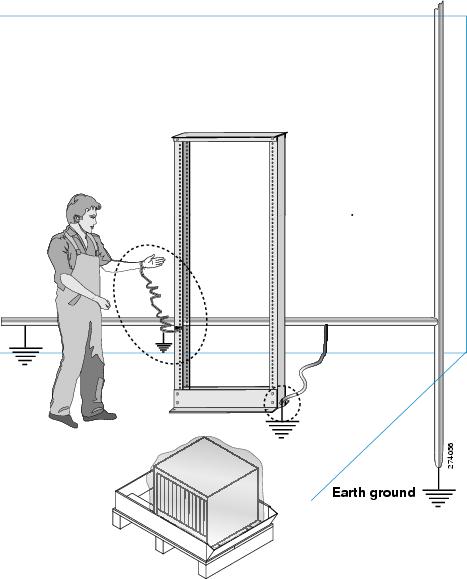
Figure 1. Wearing the ESD Strap

Figure 2. Handling the Chassis

Unpacking and Inspecting the Switch


Caution


When handling switch components, wear an ESD strap and handle modules by the carrier edges only. An ESD socket is provided on the chassis. For the ESD socket to be effective, the chassis must be grounded through the power cable, the chassis ground, or the metal-to-metal contact with a grounded rack.


Tip


Keep the shipping container in case the chassis requires shipping in the future.

Note


If you purchased Cisco support through a Cisco reseller, contact the reseller directly. If you purchased support directly from Cisco, contact Cisco Technical Support at this URL: http://www.cisco.com/c/en/us/support/web/tsd-cisco-worldwide-contacts.html


Note


The switch is thoroughly inspected before shipment. If any damage occurred during transportation or any items are missing, contact your customer representative immediately.


To inspect the shipment, follow these steps:

  1. Compare the shipment to the equipment list provided by your customer service representative and verify that you have received all items, including the following:

    • Grounding lug kit

    • Rack-mount kit

    • Preinstalled LEMs (3 units) with LEM screws tightened

    • ESD wrist strap

    • Cables and connectors

    • Any optional items ordered

  2. Check for damage and report any discrepancies or damage to your customer service representative. Have the following information ready:

    • Invoice number of shipper (see packing slip)

    • Model and serial number of the damaged unit

    • Description of damage

    • Effect of damage on the installation

  3. Check if all the power supplies and the fan trays have the expected direction of airflow. Port-side-intake airflow modules have a burgundy coloring, and port-side exhaust airflow modules have blue coloring. The airflow direction must be the same for all modules.

Installation Options

The Cisco MDS 9396T Switch can be installed using the following methods:

  • In an open EIA rack.

  • In a perforated or solid-walled EIA cabinet.

The rack-mount kit enables you to install the switch into racks of varying depths. You can use the rack-mount

kit parts to position the switch with easy access to the port connections end of the chassis and the end of the chassis with the fan and power supply modules. For instructions on how to install the rack-mount kit, see the Installing the Switch section.

Note


The EIA Shelf Bracket Kit is optional and is not provided with the switch. To order the kit, contact your switch provider.


Cisco MDS 9000 Family Telco and EIA Shelf Bracket

The optional EIA Shelf Bracket Kit (part number DS-SHELF=) can temporarily or permanently support the Cisco MDS 9396T switch during installation. Once the front rack-mount brackets are securely attached to the rack-mounting rails, the shelf bracket can be removed.

This kit supports a Cisco MDS 9396T Switch in a four-post EIA rack

Note


This optional kit is not provided with the switch; to order the kit, contact your switch supplier.

This section describes the procedure for installing a Cisco MDS 9396T switch in a rack or cabinet using the optional EIA Shelf Bracket Kit.

Shelf Installation Guidelines


Caution


If the rack is on wheels, ensure that the brakes are engaged or the rack is otherwise stabilized.


Caution


If you are installing this kit in an EIA rack, attach the shelf to all four rack-mounting posts; the EIA posts may not be thick enough to prevent flexing of shelf brackets if only two posts are used.


Before rack-mounting the chassis, ensure that the cabinet or rack meets the requirements listed in the Cabinet and Rack Requirements section

Before Installing the Shelf Brackets

Before installing the shelf brackets, inspect the contents of your kit. The following table lists the contents of the shelf bracket kit.

Quantity

Part Description

2

Slider brackets

2

Slider brackets

1

Crossbar

2

10-32 x 3/8-in. Phillips pan-head screws

16

12-24 x 3/4-in. Phillips screws

16

10-24 x 3/4-in. Phillips screws

Required Equipment
You need the following equipment for this installation:
  • Number 2 Phillips screwdriver

  • Tape measure and level (to ensure shelf brackets are level)

Installing the Shelf Bracket Kit into a Four-Post EIA Rack
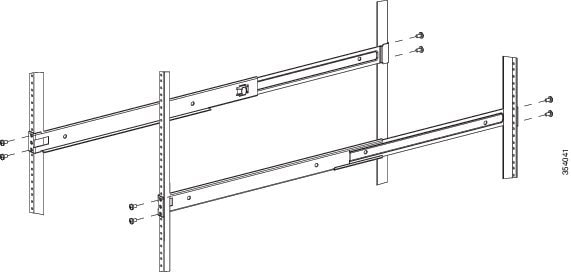
The following figure shows the installation of the shelf bracket kit into a four-post EIA rack.
Figure 3. Installing the Shelf Bracket Kit into an EIA Rack

To install the shelf brackets in an EIA rack, follow these steps:

Procedure

Step 1

Position a shelf bracket inside the rack-mounting rails as shown in the above figure. Align the screw holes at the front of the shelf bracket with the holes in the front rack-mounting rail. Then attach the shelf bracket to the front rack-mounting rail using a minimum of four 12-24 or 10-24 screws.

Note


The bottom hole of the shelf bracket should align with the bottom hole of a rack unit on the rack-mounting rail (the hole immediately above the 1/2 in. spacing).

Step 2

Repeat with the other shelf bracket.

Step 3

Verify that the shelf brackets are at the same height (using the level or tape measure as desired).

Step 4

Attach the crossbar to the shelf brackets as shown in the above figure, using the 10-32 screws.

Step 5

Insert the slider rails into the shelf brackets as shown in the above figure. Attach them to the rear rack-mounting rails using a minimum of four 12-24 or 10-24 screws.


Installing the Switch on the Shelf Brackets
This section provides general instructions for installing the switch on top of the shelf brackets.

Warning


This unit is intended for installation in restricted access areas. A restricted access area can be accessed only through the use of a special tool, lock and key, or other means of security. Statement 1017


Warning


Only trained and qualified personnel should be allowed to install, replace, or service this equipment. Statement 1030


Note


Before you install, operate, or service the system, refer to the Regulatory Compliance and Safety Information for the Cisco MDS 9000 Family for important safety information.


To install the switch on top of the shelf brackets, follow these steps:

Procedure

Step 1

Verify that the shelf brackets are level and securely attached to the rack-mounting rails, the crossbar is securely attached to the shelf brackets, and the rack is stabilized.

Step 2

Slide the switch onto the shelf brackets, ensuring that it is squarely positioned.

Step 3

Attach the switch to the rack-mounting rails.

Caution


We recommend grounding the chassis, even if the rack is already grounded. A grounding pad with two threaded M4 holes is provided on the chassis for attaching a grounding lug.

Note


The grounding lug must be NRTL listed and compatible with copper conductors. Only copper conductors (wires) must be used and the copper conductor must comply with National Electrical Code (NEC) for ampacity.


Removing the Shelf Bracket Kit (Optional)

The shelf bracket kit can be removed after the Cisco MDS 9396T switch has been installed in a four-post EIA rack, and both front rack-mount brackets and both C brackets are securely attached to the rack-mounting rails.

To remove the shelf bracket kit, follow these steps:

Procedure

Step 1

Remove the screws fastening the slider brackets to the rear rack-mounting rails, and then slide the slider brackets out of the shelf brackets.

Step 2

Remove the screws fastening the crossbar to the shelf brackets, and then remove the crossbar.

Step 3

Remove the screws fastening the shelf brackets to the front rack-mounting rails and remove the shelf brackets from the rack.


Preinstallation Guidelines

Airflow Considerations

The switch comes with fan modules and power supply units that have either port-side intake or port-side exhaust airflow for cooling the switch. If you are orienting the switch with the FC ports facing a cold aisle, make sure that the switch has a port-side intake fan and power supply modules with red colorings. If you are orienting the switch with the fan and power supply modules facing a cold aisle, make sure that the switch has port-side exhaust fan and power supply units with blue colorings. All fan modules and power-supply modules must have the same direction of airflow.

Connection Guidelines for AC-Powered Systems

To connect to the Cisco MDS 9396T switch AC power supply units to the site power source, follow these guidelines:

  • For power redundancy, each power supply should be connected to a separate power feed (at a minimum, separate branch circuits).

  • Circuits should be sized according to local and national codes.

  • The AC power receptacles that are used to power the chassis must be the grounding type. The grounding conductors that connect to the receptacles should connect to protective earth ground in the service equipment.

Installation Guidelines

Follow these guidelines when installing the Cisco MDS 9396T Switch:


Note


If the front cabinet mounting rails are not offset from the front door or bezel panel by a minimum of 3 inch (7.6 cm), and a minimum of 5 inch. (12.7 cm), respectively, and cable management brackets are installed on the front of the chassis, the chassis should be mounted rear-facing to ensure the minimum bend radius for fiber-optic cables.


Note


Jumper power cords are available for use in a cabinet.


  • Ensure the chassis is adequately grounded. If the switch is not mounted in a grounded rack, we recommend connecting both the system ground on the chassis and the power supply ground to an earth ground.

  • Ensure the site power meets the power requirements listed in the Technical Specifications section. If available, you can use an uninterrupted power supply (UPS) to protect against power failures.


Caution


Avoid UPS types that use ferro-resonant technology. These UPS types can become unstable with systems such as the Cisco MDS 9000 Family, which can have substantial current draw fluctuations because of fluctuating data traffic patterns.


  • Ensure that electrical circuits are sized according to local and national codes.

    For North America, the 300 W power supplies require a 20 A circuit. If you are using a 200 or 240 VAC power source in North America, the circuit must be protected by a two-pole circuit breaker.


Caution


To prevent loss of input power, ensure the total maximum loads on the circuits supplying power to the switch are within the electrical current ratings for circuit wiring and breakers.


  • Use the following screw torques when installing the switch:

    • Captive screws: 4 in-lb (0.45 N·m)

    • M3 screws: 4 in-lb (0.45 N·m)

    • M4 screws: 12 in-lb (1.36 N·m)

    • M6 screws: 40 in-lb (4.5 N·m)

    • 10-32 screws: 20 in-lb (2.26 N·m)

    • 12-24 screws: 30 in-lb (3.39 N·m)

Installing the Switch

This section describes how to use the rack-mount kit to install the Cisco MDS 9396T switch into a cabinet or rack that meets the requirements described in the Cabinet and Rack Requirements section.

Attaching the Bottom-Support Rails on the Rack

The switch chassis that you are installing ships with two adjustable bottom-support rails that you can attach to a four-post rack to hold the chassis. Each of these bottom-support rails has two pieces—one that slides into the other so that you can adjust them to fit racks with front and rear mounting posts that are spaced less than 36 inches (91 cm). On each bottom-support rail, the rail half that slides into the other rail includes a chassis stop that fits into the module end of the chassis. With the air intake on the port side of the chassis, you must position the bottom-support rail piece with the chassis stop on the hot aisle side of the rack.

Before you begin

  • Verify that a four-post rack or cabinet is installed.

  • If any other devices are stored in the rack or cabinet, verify that the heavier devices are installed below lighter devices and that there is at least 2 RU open to install the switch.

  • Verify that the bottom-support rails kit is included in the switch accessory kit.

  • Verify that you have 8 screws for attaching the bottom-support rails to the racks (typicallyM6 x 10 mm screws or the screws appropriate for the vertical mounting rails on the rack.

Procedure


Step 1

Look at the fan trays and power supplies installed in the chassis to determine how you must position the bottom-support rails on the rack.

  • If the modules have burgundy coloring (port-side-intake airflow), you must position the bottom-support rails so that their chassis stops are positioned in the hot aisle.

  • If the modules have blue coloring (port-side-exhaust airflow), you must position the bottom-support rails so that their chassis stops are positioned in the cold aisle.

Step 2

Separate the two sliders that make up one bottom-support rail, and position the half with the chassis stop in the hot aisle of the rack. Make sure there is at least 2 RU open above the bottom-support rails so that you can easily install the chassis.

Step 3

Use two customer-supplied screws (typically M6 x 10 mm screws) to attach the bottom-support rail half to the vertical mounting rails on the rack post. Tighten each screw to the appropriate torque setting for the screws (for M6 screws, use 40 in-lb [4.5 N·m] of torque).

Step 4

Slide the other half of the bottom-support rail onto the attached half of the rail set and use two customer supplied screws (typically M6 x 10 mm screws) to secure that portion to the vertical mounting rails on the rack. Tighten each screw to the appropriate torque setting for the screws (for M6 x 10 mm screws, use 40 in-lb [4.5 N·m] of torque).

Step 5

Repeat Steps 2 and 3 to attach the other expanding bottom-support rails to the other side of the rack.

Step 6

Check the two installed bottom support rails to be sure that both rails are level and level with each other. If they are not level, adjust the higher rail down to the level of the lower rail.


What to do next

You are ready to install two front-mount brackets on the chassis.

Attaching the Front-Mount Brackets to the Chassis

Before you begin

  • You need to attach a right-angled bracket to each side of the chassis. This bracket holds the chassis in place on a four post rack.

  • You must have a Phillips-head torque screwdriver.

Procedure


Step 1

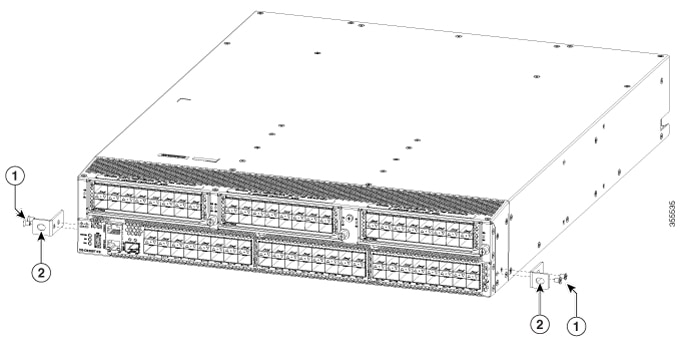
Align the two holes in one side of one of two front-mount brackets to two holes on the left or right side of the chassis (see the following figure). Be sure that the other side of the bracket is facing towards the front (port end) of the chassis.

Figure 4. Aligning and Attaching Front-Mount Brackets to the Sides of the Chassis
1 Two M4 x 6 mm screws used to fasten the bracket to the chassis. 2 Front-mount bracket with two screw holes aligned to two screw holes in the chassis and one screw hole facing the port side of the chassis.

Step 2

Use two M4 x 6 mm screws to attach the bracket to the chassis. Tighten each screw to 11 to 15 in-lb (1.2 to1.7 N·m).

Step 3

Repeat Steps 1 and 2 to attach the second front-mount bracket to the other side of the chassis.


What to do next

You are ready to mount the chassis to the four-post rack.

Installing the Switch

Before you begin

  • You need to slide the chassis onto the bottom-support rails so that the end with the fan trays and power supplies locks onto the chassis stops at the end of the rails and so that the front-mount brackets on the chassis come into contact with the front-mount rails on the rack.

  • Make sure that the four-post rack is properly installed and secured to the concrete floor.

  • Make sure that the bottom-support rails are installed so that the power supplies and fan trays will be in the appropriate aisle.

  • The color of the stripe on fan trays and the color of the latch on power supplies determines which end of the switch must be positioned in the cold aisle as follows:

    • If the modules have burgundy coloring, position the port end of the chassis in the cold aisle.

    • If the modules have blue coloring, position the fan trays and power supply end of the chassis in the cold aisle.

  • Make sure that two front-mount brackets are securely fastened to the sides of the chassis at the port end.

  • Make sure that you have two customer-supplied rack-mount screws (M6 x 10 mm or appropriate screw for the vertical mounting rails on the rack).

Procedure


Step 1

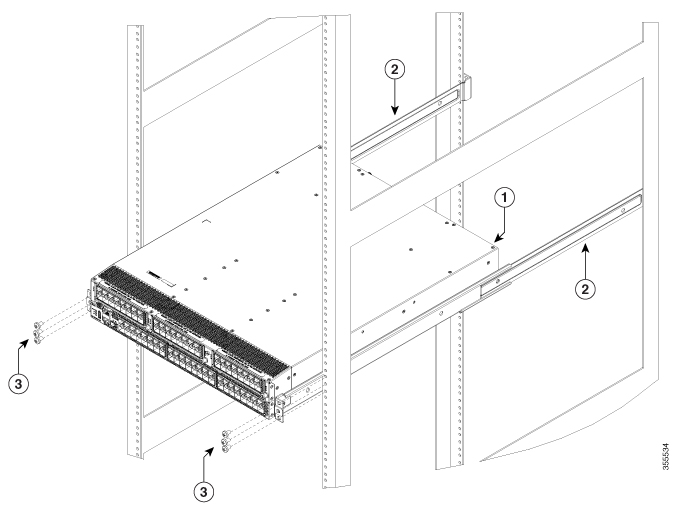
Slide the power supply and fan tray end of the chassis onto the bottom support rails that are installed on the rack. Be sure that the sides of the chassis by the fan trays and power supplies clips onto the chassis stops on the bottom support rails and the front mounting brackets come in contact with the rack (see the following figure).

If the bottom support rails are extended a long distance, they can bend outwards slightly when you install the chassis and the chassis stops at the far end of the rails might not fit into the end of the chassis. If this happens, press the side rails toward the sides of the chassis so that the chassis stops can go inside the chassis and hold it in place on the rack.
Figure 5. Sliding the Chassis onto the Bottom-Support Rails
1 Slide the fan-tray end of the chassis onto the bottom-support rails so that the chassis locks onto the chassis stops at the end of the rails. 3 Customer-supplied rack-mount screw (M6 x 10 mm screw or other appropriate screw) used to secure each side of the chassis to the rack.
2 Chassis stops for holding the chassis (installed by the hot aisle)

Step 2

Use a customer-supplied rack-mount screw (an M6 x 10 mm screw or other appropriate screw for the rack) to attach each of the two mounting brackets on the chassis to the rack and tighten each screw to the appropriate torque setting for the screw (for M6 x 10 mm screws, use 40 in-lb [4.5 N·m] of torque).


Grounding the Switch

The switch is grounded when you connect the chassis and the power supplies to the earth ground in the following ways:
  • You connect the chassis (at its grounding pad) to either the data center ground or to a fully bonded and grounded rack.

    Note


    The chassis ground connection is active even when the AC power cables are not connected to the system.


  • You connect an AC power supply to the earth ground automatically when you connect the power supply to an AC power source.

Before you begin

  • Before you can ground the chassis, you must have a connection to the earth ground for the data center building. If you installed the switch chassis into a bonded rack (see the rack manufacturer’s instructions for more information) that now has a connection to the data center earth ground, you can ground the chassis by connecting its grounding pad to the rack. Otherwise, you must connect the chassis grounding pad directly to the data center ground.

  • To connect the switch chassis to the data center ground, you need the following tools and equipment:

    • Grounding lug—A two-holed standard barrel lug that supports up to 6 AWG wire. This lug is supplied with the accessory kit.

    • Grounding screws—Two M4 x 8 mm pan-head screws. These screws are shipped with the accessory kit.

    • Grounding wire—Not supplied with the accessory kit. This wire should be sized to meet local and national installation requirements. Depending on the power supply and system, a 12 AWG to 6 AWG copper conductor is required for U.S. installations. We recommend that you use commercially available 6 AWG wire. The length of the grounding wire depends on the proximity of the switch to proper grounding facilities.

    • Number 1 Phillips head torque screwdriver.

    • Crimping tool to crimp the grounding wire to the grounding lug.

    • Wire stripping tool to remove the insulation from the grounding wire.

Procedure


Step 1

Use a wire stripping tool to remove approximately 0.75 inch (19 mm) of the covering from the end of the grounding wire.

Step 2

Insert the stripped end of the grounding wire into the open end of the grounding lug, and use a crimping tool to crimp the lug to the wire. Verify that the ground wire is securely attached to the grounding lug by attempting to pull the wire out of the crimped lug.

Step 3

Secure the grounding lug to the chassis grounding pad with two M4 screws, and tighten each screw to 11.5 to 15 in-lb (1.3 to 1.7 N·m) of torque.

Step 4

Prepare the other end of the grounding wire and connect it to an appropriate grounding point in your site to ensure an adequate earth ground for the switch. If the rack is fully bonded and grounded, connect the grounding wire as explained in the documentation provided by the vendor for the rack.


Installing and Remvoing Components


Warning


Hazardous voltage or energy is present on the backplane when the system is operating. Use caution when servicing. Statement 1034


Caution


During this procedure, wear grounding wrist straps to avoid ESD damage to the switch.


Installing and Removing AC Power Supplies

This section provides instructions for installing and removing the AC power supplies for the Cisco MDS 9396T switch.

Installing Power Supplies

To install a power supply, follow these steps:

Before you begin
  • HVAC/HVDC power supplies automatically use the same airflow direction as the installed fan modules. If the power supply that you are replacing has a different color handle than the replacement power supply, verify that it has or will have the same airflow direction as the other modules in the switch.

  • To implement n+n redundancy, each PSU must be connected to a separate power source. Otherwise, only one power source is required.

  • There must be an earth ground connection to the chassis to which you are installing the replacement module. Typically, the chassis is grounded by its metal-to-metal connection with a grounded rack. If you need to ground the chassis, see Grounding the Switch.

Procedure

Step 1

Holding the power supply unit with one hand underneath it and the other hand holding the handle, turn the power supply so that its release latch is on the right side, and align the back end of the power supply (the end with the electrical connections) to the open power supply slot. Carefully slide the power supply unit all the way into the slot until it clicks into place.

Note


If the power supply unit does not fit into the slot opening, turn the unit over and try again.

Step 2

Test the installation by trying to pull the power supply out of the slot without using the release latch.

If the power supply does not move out of place, it is secured in the slot. If the power supply moves, carefully press it all the way into the slot until it clicks in place.

Step 3

Attach the power cable to the electrical outlet on the front of the power supply.

Step 4

Make sure that the other end of the power cable is attached to the appropriate power source for the power supply. If the power source has a switch, slide it to the On position.

Note


Depending on the outlet receptacle on your power distribution unit, you might need the optional jumper cable to connect the switch to your outlet receptacle.

Step 5

Verify that the power supply is operational by making sure that the power supply LED is green. For information on what the power supply LEDs indicate, see the Switch LEDs section.


Removing Power Supplies

You can remove one faulty power supply, while the other one provides enough power to the switch.

Procedure

Step 1

Holding the plug for the power cable, pull the plug out from the power receptacle on the power supply, and verify that both the power supply LEDs are off.

Note


If you need to remove an Anderson's Saf-D-Grid power cable connector from a high voltage power supply, press the tab at the top of the connector and pull the connector out of the power supply.

Step 2

Grasp the power supply handle while pressing the release latch towards the power supply handle.

Step 3

Place your other hand under the power supply to support it while you slide it out of the chassis.

Caution


Do not touch the electrical connectors on the back side of the module and prevent anything else from coming into contact with and damaging the connectors.


Installing and Removing Fan Modules

This section provides instructions for installing and removing the fan modules for the Cisco MDS 9396T switch. You can replace one of the two fan modules even when the switch is operating so long as you perform the replacement within one minute of removing the old fan module. If you cannot perform the replacement within one minute, leave the original fan module in the chassis to maintain the designed airflow until you have the replacement fan module on hand and can perform the replacement.


Caution


If you are replacing a module during operations, be sure that the replacement fan module has the correct direction of airflow, which means that it has the same airflow direction as the other modules in the chassis. Also, be sure that the airflow direction takes in air from a cold aisle and sends it out to a hot aisle. Otherwise, the switch can overheat and shut down.

If you are changing the airflow direction of all the modules in the chassis, you must shut down the switch before replacing all the fan and power supply modules with modules using the other airflow direction. During operations, all the modules must have the same direction of airflow.


Installing a Fan Module

To install a new fan module, follow these steps:

Before you begin
  • A fan slot must be open and ready for the new fan module to be installed.

  • You must have a new fan module on hand and ready to install within one minute of removing the original fan module if the switch is operating.

  • The new fan module must have the same airflow direction as the other fan and power supply modules installed in the switch. All of these modules must have either red coloring (port-side intake airflow) or they must all have blue coloring (port-side exhaust airflow).

Procedure

Step 1

Slide the fan module into the fan module bay.

Step 2

Tighten the fan module captive screw.

Step 3

Verify that the Status LED turns on and becomes green.


Removing a Fan Module

The fan module is designed to be removed and replaced while the system is operating without presenting an electrical hazard or damaging the system.


Caution


The Cisco MDS 9000 Family has internal temperature sensors that can shut down the system if the temperature at different points within the chassis exceed certain safety thresholds. To accurately monitor the system temperature, the temperature sensors require sufficient airflow through the chassis. In the event that a fan module is removed from the chassis and the airflow is reduced, the system will bypass the temperature sensor information and shut down after five minutes to prevent undetected overheating. However, the switches will shut down sooner if the major temperature threshold is exceeded.


Note


While removing the fan module, keep your hands and fingers away from the spinning fan blades. Let the fan blades completely stop before you remove the fan module. Statement 258


To remove the existing fan module, follow these steps:

Procedure

Step 1

Locate the fan module in the back of the switch.

Step 2

Loosen the fan module captive screw.

Step 3

Grasp the fan module handle and pull it outward.

Step 4

Once the fan blades have stopped spinning, remove the fan module completely from the fan bay.