Installing the Cisco ASR 902 Router

This chapter describes how to install the Cisco ASR 902 Router.

Prerequisites

Before installing the Cisco ASR 902 Router, it is important to prepare for the installation by:

  • Preparing the site (site planning) and reviewing the installation plans or method of procedures (MOP).
  • Unpacking and inspecting the Cisco ASR 902 Router.
  • Gathering the tools and test equipment required to properly install the Cisco ASR 902 Router.

For more instructions on how to prepare for the installation of the Cisco ASR 902 Router, see Preparing for Installation.

Installing the Router in a Rack

The following sections describe how to install the Cisco ASR 902 Router in a rack. The procedures in this section apply to both horizontal and vertical mounting of the router in a rack:

Installing the Chassis Brackets

The chassis is shipped with mounting brackets that can be installed on the front or rear of the chassis. To install the brackets on the front of the chassis, perform these steps:

Procedure


Step 1

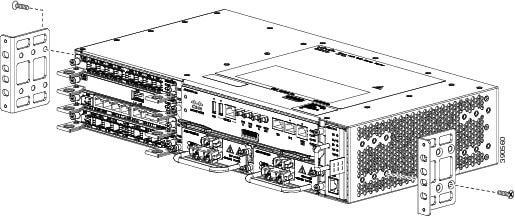
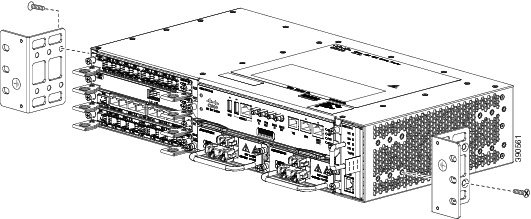
Remove the rack-mount brackets from the accessory kit and position them beside the router chassis.

The figure below shows how to attach the brackets on the Cisco ASR 902 Router for a 19-inch EIA rack.
Figure 1. Attaching Mounting Brackets for a 19-inch EIA Rack


The figure below shows how to attach the brackets on the Cisco ASR 902 Router for a 300-mm ETSI cabinet.
Figure 2. Attaching Mounting Brackets for a 300-mm ETSI Cabinet


Step 2

Position one of the brackets against the chassis side, and align the screw holes.

Step 3

Secure the bracket to the chassis with the screws removed when performing Step 1 . The recommended maximum torque is 28 in.-lb (3.16 N-m).

Step 4

Repeat Step 2 and Step 3 for the other bracket.


Installing the Router Chassis in the Rack


Note

Ensure adequate air flow when mounting the router in a rack. For more information, see the Air Flow Guidelines section.

Note

Install the cable guides before installing the router in a 19-inch EIA rack.

To install the router chassis in the equipment rack, perform these steps:

Procedure


Step 1

Position the chassis in the rack as follows:

  • If the front of the chassis (front panel) is at the front of the rack, insert the rear of the chassis between the mounting posts.
  • If the rear of the chassis is at the front of the rack, insert the front of the chassis between the mounting posts.
Step 2

Align the mounting holes in the bracket (and optional cable guide) with the mounting holes in the equipment rack.

Caution 

Do not use interface module or power supply ejector handles to lift the chassis; using these handles to lift the chassis can deform or damage the handles.

The figure below shows how to install the Cisco ASR 902 Router in a 19-inch EIA rack.

Figure 3. Attaching Mounting Brackets for a 19-inch EIA Rack


The figure below shows how to install the Cisco ASR 902 Router in a 300-mm ETSI Cabinet.

Figure 4. Installing the Chassis in a 300-mm ETSI Cabinet


Step 3

Install the 8 or 12 (4 or 6 per side) 12-24 x 3/4-inch or 10-32 x 3/4-inch screws through the holes in the bracket and into the threaded holes in the equipment rack posts.

Step 4

Use a tape measure and level to verify that the chassis is installed straight and level.


Installing the Router Chassis in the Air Plenum


Note

Ensure that the router is not installed in the Air Plenum while mounting it on the rack.

For instructions on mounting the air plenum on the rack, see Manufacturers of Equipment Used in Cisco ASR 902 Router.

Procedure


Step 1

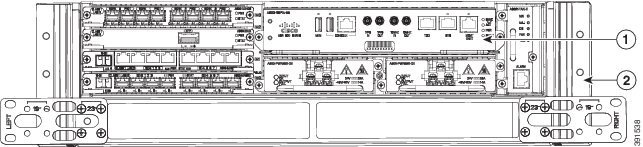
Position the chassis so that the rear of the chassis is at the front of the plenum. See the figure below .

Step 2

Slide the chassis into the plenum so that the front of the chassis is in flush with the mounting rails and brackets.

Figure 5. Cisco ASR 902 Chassis with Air Plenum


1

Cisco ASR 902 router

2

Air plenum


Attaching the Cable Guides

The Cisco ASR 902 Router supports the following cable guides:

  • A902-CABLE GUIDE-LEFT—This guide helps in routing the cables from the interface modules, thereby enabling a proper cable-bending radius. (See the figure below.)

  • A902-CABLE GUIDE-RIGHT—This guide helps in routing the cables from the power supplies and the RSP module, thereby enabling a proper cable-bending radius. (See the figure below.)


Note

If the chassis is mounted using 19-inch brackets, you must assemble the cable guides before installing the chassis on the rack.


Note

The cable guides should be assembled together. We recommend that the cable guides be installed before the chassis is installed in the air plenum.

To install a cable guide, perform these steps:


Procedure


Step 1

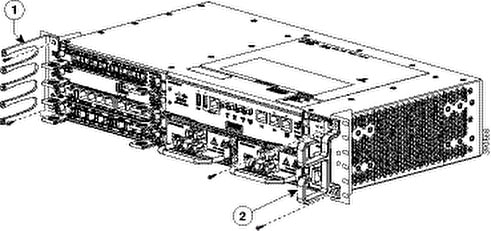
Position the cable guide-left and cable guide-right against the front of the chassis and align the four screw holes, as shown in the figure below.

Figure 6. Cable Guide Installation


Label

Component

1

Cable guide-left

2

Cable guide-right

Step 2

Secure the cable guides with the four M3.5 screws supplied with the cable kit. The recommended maximum torque is 10 in.-lb (1.12 N-m).


Installing the Chassis Ground Connection

Before you connect the power or turn on the power to the Cisco ASR 902 Router, you must provide an adequate chassis ground (earth) connection to your router.

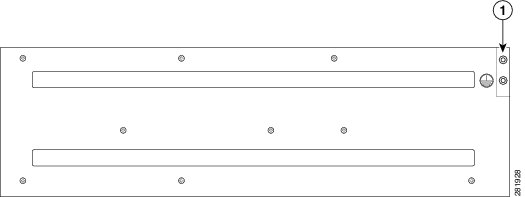
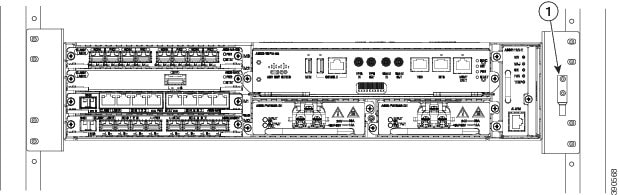
This section describes how to ground the Cisco ASR 902 Router chassis. The router provides two locations for attaching a 2-hole grounding lug according to the rack-mounting brackets you use to install the router. The Cisco ASR 902 Router supports the following rack-mounting types:

  • EIA 19-inch rack—Attach the grounding lug to the rear of the router, as shown in the figure below .
Figure 7. Attaching a Grounding Lug to the Rear of the Router


1

Grounding-lug (19-inch EIA rack)

  • 300-mm ETSI cabinet—Attach the grounding lug on the rack-mount bracket on the front of the router, as shown in the figure below .
Figure 8. Attaching a Grounding Lug to the Rack-Mount Bracket


1

Grounding lug (300 mm ETSI cabinet)

To ensure that the chassis ground connection that you provide is adequate, you need the following parts and tools:

  • Ratcheting torque screwdriver with Phillips head that exerts up to 15 in.-lb (1.69 N-m) of pressure for attaching the ground wire to the router
  • Crimping tool as specified by the ground lug manufacturer
  • 6-AWG or larger copper wire for the ground wire
  • Wire-stripping tools appropriate to the wire you are using

Caution

Before making connections to the Cisco ASR 902 Router, ensure that you disconnect the power at the circuit breaker. Otherwise, severe injury to you or damage to the router may occur.


Warning

This equipment must be grounded. Never defeat the ground conductor or operate the equipment in the absence of a suitably installed ground conductor. Contact the appropriate electrical inspection authority or an electrician if you are uncertain that suitable grounding is available. Statement 1024


Warning

Use copper conductors only. Statement 1025


Warning

When installing or replacing the unit, the ground connection must always be made first and disconnected last. Statement 1046


This unit is to be installed in a restrictive access location and must be permanently grounded to a minimum 6-AWG copper ground wire.

Perform the following procedure to ground the Cisco ASR 902 Router using a 2-hole lug and the corresponding mounting point. Most carriers require a minimum 6-AWG ground connection. Verify your carrier’s requirements for the ground connection.

Procedure


Step 1

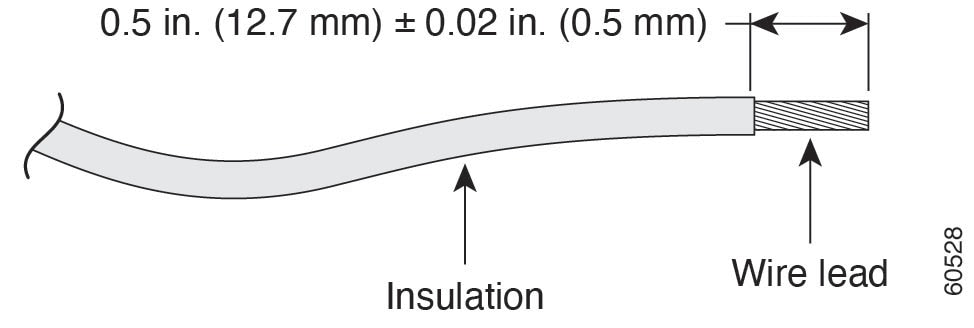
If your ground wire is insulated, use a wire-stripping tool to strip the ground wire to 0.5 inch ± 0.02 inch (12.7 mm ±0.5 mm) ( the figure below ).

Figure 9. Stripping a Ground Wire


Step 2

Slide the open end of your 2-hole ground lug over the exposed area of the ground wire.

Step 3

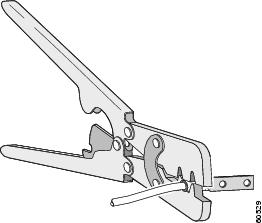
Using a crimping tool (as specified by the ground lug manufacturer), crimp the ground lug to the ground wire as shown in the figure below.

Figure 10. Crimping a Ground Lug on to the Ground Wire


Step 4

Use a Phillips head screwdriver to attach the 2-hole ground lug and wire assembly to the router with the 2 pan-head Phillips head screws. For a 19-inch EIA rack, attach the 2-hole ground lug to the rear of the router.

Step 5

Connect the other end of the ground wire to a suitable grounding point at your site.


Installing the Fan Tray

The fan tray is a modular unit that provides cooling to the Cisco ASR 902 Router. Follow these steps to install the fan tray in the chassis:

Procedure


Step 1

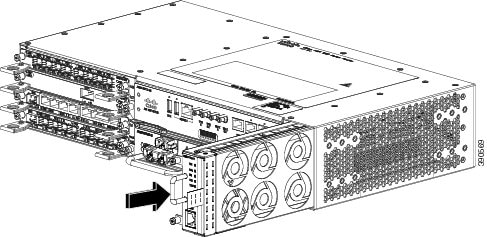
Orient the fan tray so that the captive screws are on the left side of the fan tray’s front panel. The figure below shows how to orient the fan tray.

Figure 11. Installing the Fan Tray


Step 2

Guide the fan tray into the chassis until it is fully seated.

Caution 

The fans are exposed on the left side of the fan tray. Keep your fingers, clothing, and jewelry away from the fans. Always handle the fan tray by the handle.

Note 
When installing the cabling to the RSP, we recommend that you leave a service loop of extra cabling sufficient to allow for fan tray removal.
Step 3

Secure the fan tray to the chassis using the attached captive installation screws. The recommended maximum torque is 5.5 in.-lb (.62 N-m).

This completes the procedure for installing or replacing the fan tray in a Cisco ASR 902 Router.

For information about connecting cables to the fan tray alarm port, see the Connecting the Fan Tray Alarm Port section in the Cisco ASR 902 and ASR 902U Aggregation Services Router Hardware Installation Guide. For a summary of the LEDs on the fan tray, see the LED Summary section in the Cisco ASR 902 and ASR 902U Aggregation Services Router Hardware Installation Guide. For more information about air flow guidelines, see the Air Flow Guidelinessection in the Cisco ASR 902 and ASR 902U Aggregation Services Router Hardware Installation Guide.


Installing the Dust Filter

Procedure


Step 1

Follow the steps for removing the fan tray (if installed) from the chassis. See the Removing and Replacing the Fan Tray.

Step 2

Remove the dummy cover from the fan tray. See the figure shown in the section Fan Tray (A902-FAN-E).

Step 3

Slide the dust filter onto the fan tray. See the figure shown in the section Fan Tray (A902-FAN-E).

Step 4

Insert the dummy cover on the fan tray to secure the filter within the chassis.

Step 5

Perform the steps to install the fan tray in the chassis. See Installing the Fan Tray.


Removing the Dust Filter

The dust filter must be removed for a replacement.


Note

The dust filter is a single-use component.

Dust Filter Maintenance

A periodic health check of the filter, every three months based on the level of dust in the environment, helps in avoiding over clogging of the filters and provide a better life. This product's filter is used as a single-use component. If the product is installed in a controlled environment, check and replace the filter every three months, otherwise replace the filter every month.

Procedure

Step 1

Remove the dummy cover from the fan tray.

Step 2

Remove the dust filter from the fan.

Note 
The filter can be accessed by pulling the pull tab by using fingers or pliers.
Step 3

Slide the replacement dust filter onto the fan tray

Step 4

Insert the dummy cover onto the fan tray to secure the filter within the chassis.


Removing and Replacing the Fan Tray

The fan tray supports online insertion and removal (OIR). There is no need to power down the Cisco ASR 902 Router to remove or replace the fan tray. However, there is a finite time to replace the fan tray. This time depends upon the specific RSP module used and the ambient temperature. The following table provides the time interval for replacing the fan tray. At higher ambient temperatures, the replacement time is lower.

Table 1. Fan Replacement Time

RSP Module

Replacement Time at 25°C Ambient

RSP2

5 minutes

RSP3

2 minutes


Caution

To avoid erroneous failure messages, allow at least 2 minutes for the system to reinitialize after the fan tray has been removed or replaced.


Follow these steps to remove and replace the fan tray on the Cisco ASR 902 Router:

Procedure


Step 1

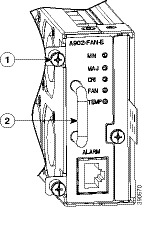
Using a No. 2 Phillips screwdriver or your fingers, loosen the captive installation screw that secures the fan tray to the chassis. The figure below shows the front of the fan tray, including the captive installation screws.

Figure 12. Detaching the Fan Tray


Label

Component

1

Captive installation screw

2

Handle

Step 2

Grasp the fan tray handle with one hand and the outside of the chassis with the other hand. the figure below shows the front of the fan tray, including the handle.

Caution 
The fans are exposed on the left side of the fan tray. Keep your fingers, clothing, and jewelry away from the fans. Always handle the fan tray by the handle.
Step 3

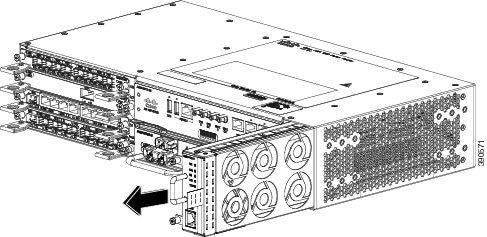
Pull the fan tray backward towards you, no more than 1 inch, to disengage it from the power receptacle on the midplane, as shown in the figure below.

Warning 

The fans might still be turning when you remove the fan assembly from the chassis. Keep fingers, screwdrivers, and other objects away from the openings in the fan assembly’s housing. Statement 263

Figure 13. Fan Tray Removal


Step 4

Wait at least 5 seconds to allow the fans to stop spinning. Then, pull the fan tray backward towards you and out of the chassis..

Note 

As the fan tray slides out of the chassis, support the bottom of the fan tray with one hand and keep your other hand on the fan tray handle.

This completes the steps for removing the fan tray from the chassis.

To install a new fan tray, follow the steps in the Installing the Fan Tray.


RSP Installation

Follow these steps pertaining to handling an RSP module in the Cisco ASR 902 Router:

Installing an RSP Module

To install an RSP module in the router chassis, perform the following steps:

Procedure


Step 1

Make sure that there is enough clearance to accommodate any equipment that will be connected to the ports on the module. If a blank module filler plate is installed in the slot in which you plan to install the module, remove the plate by removing its 2 Phillips pan-head screws.

Step 2

Fully open both the ejector levers on the new module, as shown in the figure below .

Caution 

To prevent ESD damage, handle modules by carrier edges only.

Step 3

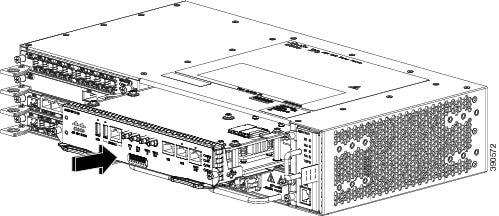
Position the module in the slot. Make sure that you align the sides of the module with the guides on each side of the slot, as shown in the figure below .

Figure 14. Cisco ASR 902 Router RSP Installation


Step 4

Carefully slide the module into the slot until the EMI gasket on the module makes contact with the module in the adjacent slot and both the ejector levers have closed to approximately 45 degrees with respect to the module faceplate.

Step 5

While pressing down, simultaneously close both the ejector levers to fully seat the module in the backplane connector. The ejector levers are fully closed when they are flush with the module faceplate.

Step 6

Tighten the two captive installation screws on the module. The recommended maximum torque is 5.5 in.-lb (.62 N-m).

Note 
Make sure that the ejector levers are fully closed before tightening the captive installation screws.
Step 7

Verify that the captive installation screws are tightened on all of the modules installed in the chassis. This step ensures that the EMI gaskets on all the modules are fully compressed in order to maximize the opening space for the new or replacement module.

Note 
If the captive installation screws are loose, the EMI gaskets on the installed modules will push adjacent modules towards the open slot, which reduces the size of the opening and makes it difficult to install the new module.
Note 
When installing the cabling to an RSP, we recommend that you leave a service loop of extra cabling sufficient to allow for fan tray removal.
Note 
Close all unused RJ-45 and USB ports on the RSP module using the appropriate dust caps to prevent dust from accumulating inside the cage. For information on dust caps, see the Installing the Dust Caps section.

Removing an RSP Module

Before you remove an RSP module from the router, you should save the current configuration using the write {host file | network | terminal} command. This saves you time when bringing the module back online.

If the module is running Cisco IOS software, save the current running configuration by entering the copy running-config startup-config command.


Warning

Hazardous voltage or energy is present on the backplane when the system is operating. Use caution when servicing. Statement 1034


Warning

Invisible laser radiation may be emitted from disconnected fibers or connectors. Do not stare into beams or view directly with optical instruments. Statement 1051


To remove an RSP module, perform the following steps:

Procedure


Step 1

Disconnect any cables attached to the ports on the module.

Step 2

Verify that the captive installation screws on all the modules in the chassis are tight. This step ensures that the space created by the removed module is maintained.

Note 
If the captive installation screws are loose, the EMI gaskets on the installed modules will push the modules towards the open slot, which in turn reduces the size of the opening and makes it difficult to remove the module.
Step 3

Loosen the two captive installation screws on the module you plan to remove from the chassis.

Step 4

Place your thumbs on the ejector levers ( the figure below ) and simultaneously rotate the ejector levers outward to unseat the module from the backplane connector.

Step 5

Grasp the front edge of the module and slide the module straight out of the slot. If the chassis has horizontal slots, place your hand under the module to support its weight as you slide it out from the slot. Do not touch the module circuitry.

Caution 

To prevent ESD damage, handle modules by the carrier edges only.

Step 6

Place the module on an antistatic mat or antistatic foam.


Interface Module Installation

The following sections describe the various tasks associated with interface module installation on the Cisco ASR 902 Router:

Installing an Interface Module


Note

On RSP-1, Slot 2 Port 0 cannot be used for traffic flow on 8X1-G copper and 8X1-G SFP interface modules. To identify Slot 2 on the Cisco ASR 902 Router, see the figure shown in the Interface Numbering section.

Procedure


Step 1

Before inserting an interface module, make sure that the chassis is grounded.

Step 2

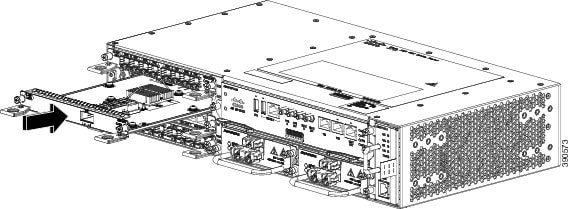
To insert the interface module, carefully align the edges of the interface module between the upper and lower edges of the router slot.

Step 3

Carefully slide the interface module into the router slot until the interface module makes contact with the backplane. The figure below shows how to install the interface module.

Figure 15. Inserting an Interface Module


Step 4

Tighten the locking thumbscrews on both sides of the interface module. The recommended maximum torque is 5.5 in.-lb (.62 N-m).

Step 5

Connect all the cables to each interface module.

Caution 

Do not use interface module or power supply ejector handles to lift the chassis; using these handles to lift the chassis can deform or damage the handles.

Note 
Close all unused SFP ports using SFP dust caps to prevent dust from accumulating inside the cage. The dust caps (Cisco part number A900-DCAP-SFP-S= (24 caps per package) or Cisco part number A900-DCAP-SFP-L= (240 caps per package)) can be ordered from Cisco. For information on dust caps, see Installing Dust Caps.
Note 
Close all unused RJ-45, SFP, XFP, and QSFP ports on the interface module using the appropriate dust caps to prevent dust from accumulating inside the cage. For information on dust caps, see Installing Dust Caps.

Removing an Interface Module

Procedure


Step 1

To remove an interface module, disconnect all the cables from each interface module.

Step 2

Loosen the locking thumbscrews on both sides of the interface module.

Step 3

Slide the interface module out of the router slot by pulling on the handles. If you are removing a blank filler plate, pull the blank filler plate completely out of the router slot using the captive screws.


Hot-Swapping an Interface Module

The Cisco ASR 902 Router provides a feature that allows you to remove and replace an interface module without powering down the router. This feature, called hot-swapping or Online Insertion and Removal (OIR), allows you to remove and replace a redundant module without disrupting router operation.


Note

The Cisco ASR 902 Router does not support hot-swapping an interface module with another module of a different type. For example, you cannot swap an SFP Gigabit Ethernet module with a copper Gigabit Ethernet module without disrupting router operation.

Note

If you perform OIR on an interface module and move the module to a different slot, the router does not retain the module configuration; you must reconfigure the interface module.

When you remove or insert a redundant module while the router is powered on and running, the router does the following:

  1. Determines if there is sufficient power for the module.
  2. Scans the backplane for configuration changes.
  3. Initializes the newly inserted module. In addition, the system notes any removed modules and places those modules in the administratively shutdown state.
  4. Places any previously configured interfaces on the module back to the state they were in when they were removed.

The router runs diagnostic tests on any new interfaces and the test results indicate the following:

  • If the tests are successful it means the router is operating normally.
  • If the new module is faulty, the router resumes normal operation, but leaves the new interfaces disabled.
  • If the diagnostic tests fail, the router stops operating, which usually indicates that the new module has a problem in the bus and should be removed.

Caution

To avoid erroneous failure messages, note the current configuration of all the interfaces before you remove or replace an interface module, and allow at least 2 minutes for the system to reinitialize after a module has been removed or replaced. This time is recommended in order to allow for synchronization between components within the interface module and for synchronization with the RSP.


Installing the Power Supply

The Cisco ASR 902 Router provides the choice of two different power supplies:

  • DC power
    • 550 W Power Supply—19.2VDC to -72VDC

The DC power supply uses 3 position terminal block-style connector with positive latching/securing and labeled connections for +24/48V, GRD, -24/48V. The terminal block connector is of suitable size to carry the appropriate AWG wire size to handle the input current of the power supply. No ON/OFF switch is provided.

    • 1200 W Power Supply—40.8VDC to -72VDC

The power supplies are hot-swappable. They are enclosed to prevent exposure to high voltages, and therefore, no power cable interlock is required. However the power supplies are automatically shut down when removed from the chassis. The power supplies are rated to deliver 975 W (~81 A) to the other FRUs in the system, and are rated for operation at 5ºC above the chassis operating temperature

  • AC power
    • 550 W Power Supply—85VAC to 264VAC
    • 1200 W Power Supply—85VAC to 264VAC

The power supplies are hot-swappable. They are enclosed to prevent exposure to high voltages, and therefore, no power cable interlock is required. However the power supplies are automatically shut down when removed from the chassis. The power supplies are rated to deliver 975 W (~81 A) to the other FRUs in the system, and are rated for operation at 5ºC above the chassis operating temperature.

The AC power supply has an IEC 320-type power receptacle and a 15 Amp service connector. You can use standard right angle power cords with the AC power supply. The power supply includes a power cord retainer. No ON/OFF switch is provided.

LEDs are also provided on each power supply to indicate the status of the input power and the health of the power supply. Each power supply also includes a board ID EEPROM which is accessible by the active RSP.

Each power supply provides a single primary input power connection. You can install dual-power supplies for redundancy.


DANGER

Read the installation instructions before connecting the system to the power source. Statement 1004


Note

Products that have an AC power connection are required to have an external surge protective device (SPD) provided as part of the building installation to comply with the Telcordia GR-1089 NEBS standard for electromagnetic compatibility and safety.

Caution

Do not use power supplies of different capacities together in the router for prolonged durations.


Caution

Do not use interface module or power supply ejector handles to lift the chassis; using these handles to lift the chassis can deform or damage the handles.


Preventing Power Loss

Use the following guidelines to prevent power loss to the router:

  • To prevent loss of input power, ensure that the total maximum load on each circuit supplying the power supplies is within the current ratings of the wiring and breakers.
  • In some systems, you can use an UPS to protect against power failures at your site. Avoid UPS types that use ferroresonant technology. These UPS types can become unstable with systems such as the Cisco ASR 902 Router, which can have substantial current-draw fluctuations due to bursty data traffic patterns.

Use the information in the DC Power Specifications to estimate the power requirements and heat dissipation of a Cisco ASR 902 Router based on a given configuration of the router. Determining power requirements is useful for planning the power distribution system needed to support the router.

Power Connection Guidelines

This section provides guidelines for connecting the Cisco ASR 902 Router power supplies to the site power source.


Warning

This equipment is intended to be grounded to comply with emission and immunity requirements. Ensure that the switch functional ground lug is connected to earth ground during normal use. Statement 1064


Warning

The plug-socket combination must be accessible at all times because it serves as the main disconnecting device. Statement 1019


Warning

This product requires short-circuit (overcurrent) protection, to be provided as part of the building installation. Install only in accordance with national and local wiring regulations. Statement 1045


Guidelines for DC-Powered Systems

Basic guidelines for DC-powered systems include the following:

  • Each chassis power supply should have its own dedicated input power source. The source must comply with the safety extra-low voltage (SELV) requirements in the UL 60950, CSA 60950, EN 60950, and IEC 60950 standards.
  • The circuit must be protected by a dedicated two-pole circuit breaker. The circuit breaker should be sized according to the power supply input rating and local or national code requirements.
  • The circuit breaker is considered the disconnect device and should be easily accessible.
  • The system ground is the power supply and chassis ground.
  • Do not connect the DC return wire to the system frame or to the system-grounding equipment.
  • Use the grounding lug to attach a wrist strap for ESD protection during servicing.

Guidelines for AC-Powered Systems

Basic guidelines for AC-powered systems include the following:

  • Each chassis power supply should have its own dedicated branch circuit.
  • The circuit breaker should be sized according to the power supply input rating and local or national code requirements.
  • The AC power receptacles used to plug in the chassis must be the grounding type. The grounding conductors that connect to the receptacles should connect to protective earth ground at the service equipment.

Installing a DC Power Supply


Note

This equipment is suitable for installation in Network Telecommunications Facilities and locations where the NEC applies. The equipment is suitable for installation as part of the Common Bonding Network (CBN).

Caution

The grounding architecture of this product is DC-isolated (DC-I) for DC-powered products. DC-powered products have a nominal operating DC voltage of 48 VDC. Minimal steady state DC operating voltage is 19.2 VDC.


Installing a DC Power Supply Module

Perform the following procedure to install a power supply module:

Procedure

Step 1

Ensure that the system (earth) ground connection has been made. For ground connection installation instructions, see the Installing the Chassis Ground Connection.

Step 2

If present, remove the blank power supply filler plate from the chassis power supply bay opening by loosening the captive installation screws.

Step 3

Verify that power to the DC circuit connected to the power supply you are installing is off. To ensure that power has been removed from the DC circuits, locate the circuit breakers for the DC circuits, switch the circuit breakers to the OFF position, and tape the circuit-breaker switches in the OFF position.

Step 4

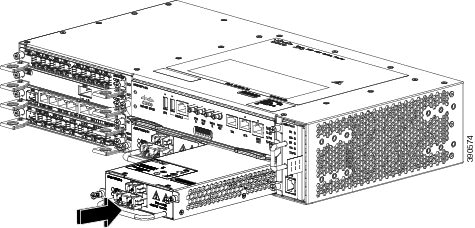
Grasp the power supply handle with one hand. Place your other hand underneath the power supply, as shown in the figure below . Slide the power supply into the power supply bay. Make sure that the power supply is fully seated in the bay.

Figure 16. Installing a DC Power Supply


Step 5

Tighten the captive installation screws of the power supply. The recommended maximum torque is 5.5 in.-lb (.62 N-m).

If you are installing a redundant DC power supply, repeat these steps for the second power source too.


Installing DC Power Supply Unit (A900-PWR550-D)

Perform the following procedure to install the terminal block.

Procedure

Step 1

Locate the terminal block plug.

Step 2

Use a wire-stripping tool to strip the ends of each of the two wires coming from the DC-input power source to 0.27 inch (6.6 mm) ± 0.02 inch (0.5 mm) and the wire for grounding. Do not strip more than 0.29 inch (7.4 mm) of insulation from the wire. Stripping more than the recommended amount of wire can leave behind exposed wire from the terminal block plug after installation.

Step 3

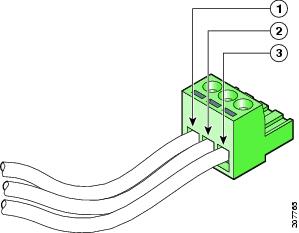
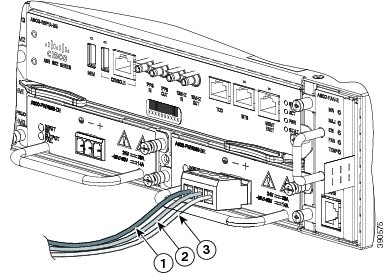
Identify the ground, positive, and negative feed positions pertaining to the terminal block connection. The recommended wiring sequence is (the figure below):

  • Ground lead wire (left)

  • Negative (-) lead wire (middle)

  • Positive (+) lead wire (right)

Figure 17. DC Power Supply with Lead Wires


Label

Component

Label

Component

1

Ground lead wire

3

Positive (+) lead wire

2

Negative (–) lead wire

Step 4

Insert the exposed wire of one of the three DC-input power source wires into the terminal block plug. Make sure that you cannot see any wire lead. Only wires with insulation should extend from the terminal block.

Caution 

Do not overtorque the plug-captive screws of the terminal block. The recommended maximum torque is from 4.425 in.-lb (.5 N-m) to 5.310 in-lb (.6 N-m).

Step 5

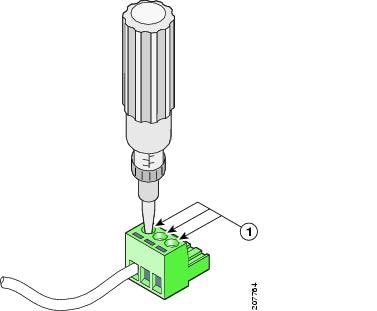
Use a ratcheting torque screwdriver to torque the terminal block plug captive screw (above the installed wire lead) from 4.425 in.-lb (.5 N-m) to 5.310 in-lb (.6 N-m), as shown in the figure below.

Figure 18. Torquing a DC Power Supply Terminal Block Plug Screw


Step 6

Repeat Step 4 through Step 5 for the remaining DC input power source wire and the ground wire. the figure below. shows that wiring is completed for a terminal block plug.

Figure 19. Inserting the DC Power Supply Terminal Block Plug into the Block Header


Caution 

Secure the wires coming in from the terminal block plug so that they cannot be disturbed by casual contact.

Step 7

Ensure that the terminal block plug is fully seated in the terminal block header on the DC power supply panel. The plug has a locking feature. You should hear a snap or click when it is installed properly.

Step 8

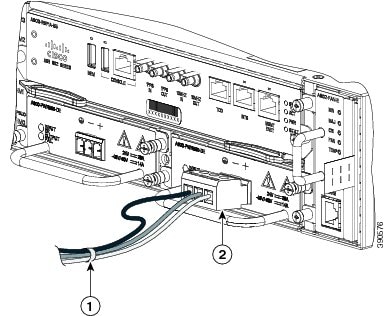
Use a tie wrap to secure the wires to the rack, so that the wires are not pulled from the terminal block plug by casual contact. Make sure the tie wrap allows for some slack in the ground wire, as shown in the figure below.

Figure 20. Complete DC Terminal Block Plug Insertion and Secure Tie Wrap


Step 9

Use a tie wrap to secure the wires to the handle. Leave a service loop on the ground wire between the handle and the connector such that it is the last to receive strain if the wires are pulled.


Installing DC Power Supply Unit (A900-PWR550-D-E and A900-PWR1200-D)

Installing DC Power Supply Unit (A900-PWR550-D-E and A900-PWR1200-D)
Before you begin
The following tools are required:
  • Cables of suitable gauge required for each type of PSU
    • 10 AWG to 16 AWG for 550 W PSU
    • 8 AWG to 10 AWG for 1200 W PSU)
  • Lugs fork-type or ring-type (Burndy, see Troubleshooting )—TP10-6 or TP10-8F (recommended)
Procedure

Step 1

If the power supply unit is already installed in the chassis, follow the steps described in Removing and Replacing a DC Power Supply to remove the power supply unit.

Step 2

Locate the T-shaped terminal block plug on the DC power supply unit. See figure “DC PSU Module (A900-PWR550-D-E) with T-Shaped Connector” in the DC Power Specifications section.

Step 3

Use a wire-stripping tool to strip the ends of each of the two wires coming from the DC-input power source to 0.27 inch (6.6 mm) ± 0.02 inch (0.5 mm) and the wire for grounding. Do not strip more than 0.29 inch (7.4 mm) of insulation from the wire. Stripping more than the recommended amount of wire can leave behind exposed wire from the terminal block after installation.

Step 4

Prepare the cables by attaching the lugs to the cables.

Step 5

Identify the ground, positive, and negative feed positions for the terminal block connection. The recommended wiring sequence is:

  1. Negative (-) lead wire (top)
  2. Ground lead wire (left)
  3. Positive (+) lead wire (right)
Step 6

Insert the lugged end of the cables to the connector and secure the cables using the captive screws.

Note 
The recommended torque for securing the captive screws is 0.7 N-m.
Step 7

Ensure that the terminal block plug is fully seated in the terminal block header on the DC power supply panel. See the Installing a DC Power Supply section for installing the power supply unit into the chassis.


Activating a DC Power Supply

Perform the following procedure to activate a DC power supply:

Procedure

Step 1

Remove the tape from the circuit-breaker switch handle, and restore power by moving the circuit-breaker switch handle to the On (|) position.

Step 2

Verify power supply operation by checking if the power supply front panel LEDs are in the following states:

  • INPUT OK LED is green

  • OUTPUT FAIL LED is red

If the LEDs indicate a power problem, see Troubleshooting section in the Cisco ASR 902 and ASR 902U Aggregation Services Router Hardware Installation Guide.

If you are installing a redundant DC power supply, ensure that each power supply is connected to a separate power source in order to prevent power loss in the event of a power failure.

If you are installing a redundant DC power supply, repeat these steps for the second power source.


Removing and Replacing a DC Power Supply

This section provides information about removing and replacing a DC power supply in the Cisco ASR 902 Router.


Note

The Cisco ASR 902 Router power supplies are hot-swappable. If you have installed redundant power supplies, you can replace a single power supply without interrupting power to the router.

Caution

To avoid erroneous failure messages, allow at least 2 minutes for the system to reinitialize after a power supply has been removed or replaced.


Warning

When you install the unit, the ground connection must always be made first and disconnected last. Statement 1046


Warning

Before performing any of the following procedures, ensure that power is removed from the DC circuit. Statement 1003


Warning

Only trained and qualified personnel should be allowed to install, replace, or service this equipment. Statement 1030


Warning

Installation of the equipment must comply with local and national electrical codes. Statement 1074


Follow these steps to remove and replace the DC power supply on the Cisco ASR 902 Router:

Procedure


Step 1

Before servicing the power supply, switch off the circuit breaker in your equipment area. As an additional precaution, tape the circuit-breaker switch in the Off position.

Step 2

Slip on the ESD-preventive wrist strap that was included in the accessory kit.

Step 3

Switch the power supply circuit-breaker switch to the Off (O) position.

Step 4

Pull the terminal block plug connector out of the terminal block head in the power supply.

Step 5

Loosen the captive screws on the DC power supply.

Step 6

Grasping the power supply handle with one hand, pull the power supply out from the chassis while supporting it with the other hand.

Step 7

Replace the DC power supply within 5 minutes. If the power supply bay is to remain empty, install a blank filler plate (Cisco part number A900-PWR-BLANK) over the opening, and secure it with captive installation screws.


Installing an AC power Supply


DANGER

This product requires short-circuit (over current) protection, to be provided as part of the building installation. Install only in accordance with national and local wiring regulations. Statement 1045


The following sections describe how to install an AC power supply in the Cisco ASR 902 Router:

Installing an AC Power Supply Module

Follow these steps to install an AC power supply module:

Procedure

Step 1

Ensure that the system (earth) ground connection has been made. For ground connection installation instructions, see the Installing the Chassis Ground Connection section.

Step 2

If necessary, remove the blank power supply filler plate from the chassis power supply bay opening, by loosening the captive installation screws.

Step 3

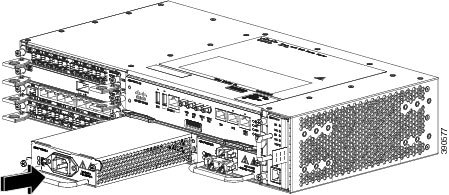
Grasp the power supply handle with one hand. Place your other hand underneath the power supply, as shown in the figure below . Slide the power supply into the power supply bay. Make sure that the power supply is fully seated in the bay.

Figure 21. Installing the AC Power Supply


Step 4

Tighten the captive installation screws of the power supply. The recommended maximum torque is 5.5 in.-lb (.62 N-m).

Warning 

Power supply captive installation screws must be tight to ensure protective grounding continuity. Statement 289


Recommended Power Cables

We recommend the following power cables for Cisco ASR 902 routers:

Table 2. Power Cable PIDs for A900-PWR550-A (550 W)

PID

Description

CAB-AC

AC POWER CORD, UNITED STATES, 125V, 10A, 2.5m, C13,NEMA, 5-15P

CAB-AC-RA

AC POWER CORD, UNITED STATES, 125V, 10A, 2.5m, RA-C13, NEMA, 5-15P

CAB-ACA

AC Power Cord (Australia), C13, AS 3112, 2.5m

CAB-ACA-RA

AC Power Cord, Australian, 10A, Right Angle

CAB-ACC

AC Power Cord (China), C13, GB15934, CCC, 2.5m

CAB-ACC-RA

AC Power Cord China, Right Angle

CAB-ACE

AC Power Cord (Europe), C13, CEE 7, 1.5M

CAB-ACE-RA

AC Power Cord Europe, Right Angle

CAB-ACI

AC Power Cord (Italy), C13, CEI 23-16, 2.5m

CAB-ACI-RA

AC Power Cord, Italian, Right Angle

CAB-ACR

AC Power Cord (Argentina), C13, EL 219 (IRAM 2073), 2.5m

CAB-ACR-RA

AC POWER CORD ARGENTINA, Right Angle

CAB-ACS

AC Power Cord (Switzerland), C13, IEC 60884-1, 2.5m

CAB-ACS-RA

AC Power Cord, Switzerland, Right Angle

CAB-ACU

AC Power Cord (UK), C13, BS 1363, 2.5m

CAB-ACU-RA

AC Power Cord UK, Right Angle

CAB-IND

AC Power Cord (India), C13

CAB-IND-RA

AC Power Cord (India), RA-C13

CAB-JPN

AC Power Cord (Japan), C13, JIS C 8303, 2.5m

CAB-JPN-RA

AC Power Cord (Japan), RA-C13, JIS C 8303, 2.5m

Activating an AC Power Supply

Follow these steps to activate an AC power supply:

Procedure

Step 1

Plug the power cord into the power supply.

Step 2

Connect the other end of the power cord to an AC-input power source.

Step 3

Verify power supply operation by checking that the power supply LEDs are in the following states:

  • INPUT OK LED is green
  • OUTPUT FAIL LED is green
Step 4

If the LEDs indicate a power problem, see Troubleshooting for troubleshooting information.

Step 5

If you are installing a redundant power supply, repeat these steps for the second power source.

Note 
If you are installing a redundant AC power supply, ensure that each power supply is connected to a separate power source in order to prevent power loss in the event of a power failure.

Removing and Replacing an AC Power Supply

This section describes how to remove and replace an AC power supply.


Note

The Cisco ASR 902 Router power supplies are hot-swappable. If you have installed redundant power supplies, you can replace a single power supply without interrupting power to the router.

Caution

To avoid erroneous failure messages, allow at least 2 minutes for the system to reinitialize after a power supply has been removed or replaced.


Warning

When you install the unit, the ground connection must always be made first and disconnected last. Statement 1046


Warning

Before performing any of the following procedures, ensure that power is removed from the DC circuit. Statement 1003


Warning

Only trained and qualified personnel should be allowed to install, replace, or service this equipment. Statement 1030


Warning

Installation of the equipment must comply with local and national electrical codes. Statement 1074


Follow these steps to remove and replace an AC power supply:

Procedure


Step 1

Disconnect the power cord from the power source. Do not touch the metal prongs on the power cord when it is still connected to the power supply.

Step 2

Remove the power cord from the power connection on the power supply. Do not touch the metal prongs embedded in the power supply.

Step 3

Loosen the captive installation screws.

Step 4

Grasp the AC power supply with one hand, and slide it part of the way out of the chassis. Place your other hand underneath the power supply, and slide it completely out of the chassis.


Installing Dust Caps

The following list provides the product IDs (PIDs) for the dust caps that are available for each port type:

  • RJ-45—A900-DCAP-RJ45-S= (24 dust caps per package) or A900-DCAP-RJ45-L= (240 caps per package)
  • SFP—A900-DCAP-SFP-S= (24 caps per package) or A900-DCAP-SFP-L= (240 caps per package)
  • USB—A900-DCAP-USB-S= (12 dust caps per package) or A900-DCAP-USB-L= (120 dust caps per package)
  • XFP/QSFP—A900-DCAP-XFP-S= (12 dust caps per package) or A900-DCAP-XFP-L= (120 dust caps per package)
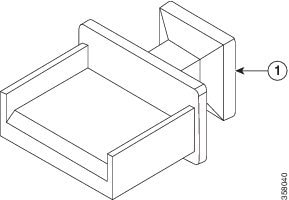
Figure 22. Dust Cap


1

Dust cap

To install the dust cap:

  1. Hold the dust cap by its handle.
  2. Insert the dust cap in to the appropriate unused ports (RJ-45, SFP, USB, or XFP/QSFP) on the chassis front panel.

Connecting a Cisco ASR 902 Router to the Network


Note

When installing the cables to the RSPs, we recommend that you leave a service loop of extra cabling for fan tray removal.

The following sections describe how to connect a Cisco ASR 902 Router to the network:

Connecting Console Cables

The following sections describe how to connect to the Cisco ASR 902 Router using console cables:

Connecting to the USB Serial Port Using Microsoft Windows

This procedure shows how to connect to the USB serial port using Microsoft Windows.


Note

Install the USB device driver before establishing a physical connection between the router and the PC, by using the USB console cable plugged into the USB serial port. Otherwise, the connection will fail. For more information, see the Installing the Cisco USB Device Driver.


Procedure

Step 1

Connect the end of the console cable with the RJ45 connector to the light blue console port on the router.

or

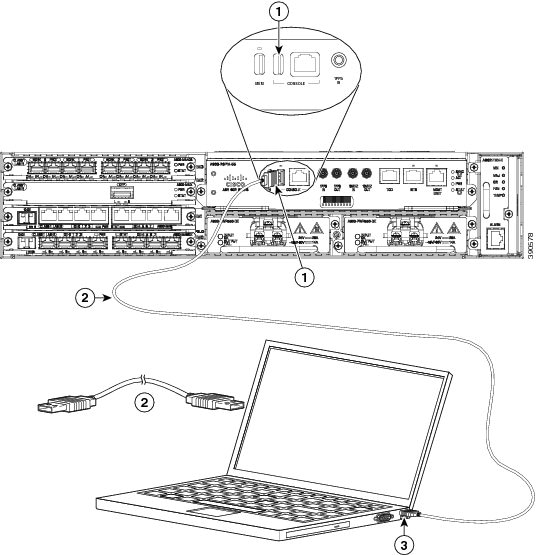
Connect a USB Type A-to-Type A cable to the USB console port, as shown in the figure below. If you are using the USB serial port for the first time on a Windows-based PC, install the USB driver now according to the instructions in the following sections:

  • Installing the Cisco USB Device Driver

  • Uninstalling the Cisco USB Device Driver

Note 

You cannot use the USB port and the EIA port concurrently. See the Connecting to the Auxiliary Port. When the USB port is used, it takes priority over the RJ45 EIA port.

Note 

The USB Type A-to-Type A cable is not included with the Cisco ASR 902 Router; it is ordered separately.

Step 2

Connect the end of the cable with the DB-9 connector (or USB Type-A) to the terminal or PC. If your terminal or PC has a console port that does not accommodate a DB-9 connector, you must provide an appropriate adapter for that port.

Step 3

To communicate with the router, start a terminal emulator application, such as Microsoft Windows HyperTerminal. This software should be configured with the following parameters:

  • 9600 baud

  • 8 data bits

  • no flow control

  • no parity

  • 1 stop-bit

Figure 23. Connecting the USB Console Cable to the Cisco ASR 902 Router


Connecting to the Console Port Using Mac OS X

This procedure describes how to connect a Mac OS X system USB port to the console using the built-in OS X terminal utility.

Procedure

Step 1

Use the Finder to choose Applications > Utilities > Terminal.

Step 2

Connect the OS X USB port to the router.

Step 3

Enter the following commands to find the OS X USB port number:

Example:

macbook:user$ cd /dev
macbook:user$ ls -ltr /dev/*usb*
crw-rw-rw-  1 root    wheel       9,  66 Apr  1 16:46 tty.usbmodem1a21 DT-macbook:dev user$
Step 4

Connect to the USB port with the following command followed by the router USB port speed:

Example:

macbook:user$ screen /dev/tty.usbmodem1a21 9600

To disconnect the OS X USB console from the terminal window, enter Ctrl-A followed by Ctrl-\


Connecting to the Console Port Using Linux

This procedure shows how to connect a Linux system USB port to the console using the built-in Linux terminal utility.

Procedure

Step 1

Open the Linux terminal window.

Step 2

Connect the Linux USB port to the router.

Step 3

Enter the following commands to find the Linux USB port number:

Example:

root@usb-suse# cd /dev
root@usb-suse /dev# ls -ltr *ACM*
crw-r--r--    1 root     root     188,   0 Jan 14 18:02 ttyACM0
root@usb-suse /dev#
Step 4

Connect to the USB port with the following command, followed by the router USB port speed:

Example:

root@usb-suse /dev# screen /dev/ttyACM0 9600

To disconnect the Linux USB console from the terminal window, enter Ctrl-A followed by : then quit.


Installing the Cisco USB Device Driver

A USB device driver must be installed the first time a Microsoft Windows-based PC is connected to the USB serial port on the router.

This procedure describes how to install the Microsoft Windows USB device driver in Microsoft Windows XP / Windows Vista / Windows 2000 / Windows 7 / Windows 8. Download the driver for your router model from the Tools and Resources Download Software site, USB Console Software category, at:

https://software.cisco.com/download/release.html?mdfid=285989306&flowid=50045&softwareid=282855122&release=3.13&relind=AVAILABLE&rellifecycle=&reltype=latest


Note

To Download the driver, you must have a valid service contract associated to your Cisco.com profile.
Procedure

Step 1

Unzip the file asr-9xx_usbconsole_drivers.zip.

Step 2

Double-click xrusbser_ver2100_installer.exe in the XR21x141x-Win-DriversOnly-Vers2.1.0.0/EXE folder. Installation Wizard GUI is displayed.

Step 3

Click Next. The InstallShield Wizard Completed window is displayed.

Step 4

Click Finish.

Step 5

Connect the USB cable to the PC and router USB console ports. Follow the on-screen instructions to complete the installation of the driver.

Step 6

XR21V1401 USB UART Device driver successfully installed message is displayed.

The USB console is ready for use.


Uninstalling the Cisco USB Device Driver

This procedure describes how to uninstall the Microsoft Windows USB device driver in Microsoft Windows XP / Windows Vista / Windows 2000 / Windows 7 / Windows 8.


Note

Disconnect the router console terminal before uninstalling the driver.
Procedure

Step 1

Choose Start > Control Panel > Add or Remove Programs (Uninstall a program).

Step 2

Scroll to Windows Driver Package - Exar corporation (xrusbser) Ports and click Remove. The Program Maintenance window is displayed.

Step 3

Click Yes to uninstall the driver.


Connecting to the Auxiliary Port

When a modem is connected to the auxiliary port, a remote user can dial in to the router and configure it. Use a light blue console cable and the DB-9-to-DB-25 connector adapter.


Note

The console cable and DB-9-to-DB-25 connector are not included with the Cisco ASR 902 Router; they can be ordered separately from Cisco.


To connect a modem to the auxiliary port on the router, follow these steps:

Procedure


Step 1

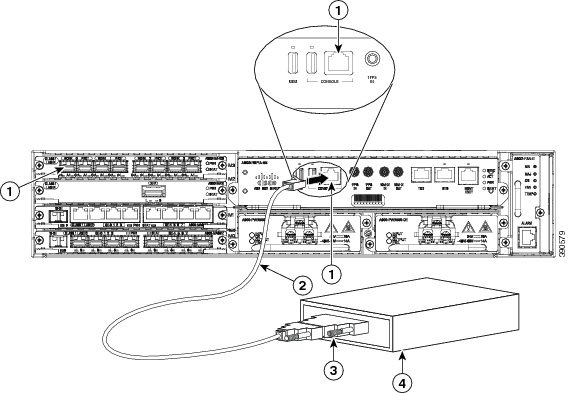
Connect the RJ45 end of the adapter cable to the black AUX port on the router, as shown in the figure below.

Figure 24. Connecting a Modem to the Cisco ASR 902 Router


Label

Component

Label

Component

1

RJ45 AUX port

3

DB-9 to DB-25 adapter

2

RJ45 to DB-9 cable

4

Modem

Step 2

Connect the DB-9 end of the console cable to the DB-9 end of the modem adapter.

Step 3

Connect the DB-25 end of the modem adapter to the modem.

Step 4

Make sure that your modem and the router auxiliary port are configured for the same transmission speed (up to 115,200 bps is supported) and for mode control with data carrier detect (DCD) and data terminal ready (DTR) operations.


Connecting a Management Ethernet Cable

When using the Ethernet Management port in the default mode (speed-auto and duplex-auto) the port operates in the auto-MDI/MDI-X mode. The port automatically provides the correct signal connectivity through the Auto-MDI/MDI-X feature. The port automatically senses a crossover or straight-through cable and adapts to it.

However, when the Ethernet Management port is configured to a fixed speed (10 or 100 Mbps) through command-line interface (CLI) commands, the port is forced to the MDI mode.

When in a fixed-speed configuration and MDI mode:

  • Use a crossover cable to connect to an MDI port
  • Use a straight-through cable to connect to an MDI-X port

Warning

To comply with the Telcordia GR-1089 NEBS standard for electromagnetic compatibility and safety, connect the Management Ethernet ports only to intra-building or unexposed wiring or cable. The intrabuilding cable must be shielded and the shield must be grounded at both ends. The intra-building port(s) of the equipment or subassembly must not be metallically connected to interfaces that connect to the OSP or its wiring. These interfaces are designed for use as intra-building interfaces only (Type 2 or Type 4 ports as described in GR-1089-CORE) and require isolation from the exposed OSP cabling. The addition of Primary Protectors is not sufficient protection in order to connect these interfaces metallically to OSP wiring. Statement


Installing and Removing SFP and XFP Modules

The Cisco ASR 902 Router supports a variety of SFP and XFP modules, including optical and Ethernet modules. For information on how to install and remove SFP and XFP modules, see the documentation for the SFP or XFP module at:

http://www.cisco.com/en/US/partner/products/hw/modules/ps5455/prod_installation_guides_list.html

For information about inspecting and cleaning fiber-optic connections, see: http://www.cisco.com/en/US/partner/tech/tk482/tk876/technologies_white_paper09186a0080254eba.shtml


Caution

We recommend that you wait for 30 seconds between the removal and insertion of an SFP on an interface module. We recommend this to allow the transceiver software to initialize and synchronize with the RSP. Changing an SFP more quickly could result in transceiver initialization issues that disable the SFP.


Connecting a USB Flash Device

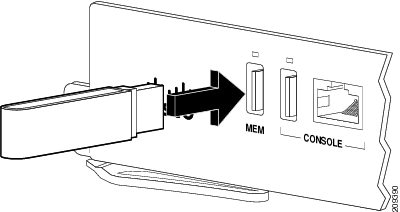
To connect a USB flash device to the Cisco ASR 902 Router, insert the memory stick in the USB port labeled MEM. The Flash memory module can be inserted only one way, and can be inserted or removed regardless of whether the router is powered up or not.

The figure below shows the USB port connector on the Cisco ASR 902 Router.

Figure 25. Cisco ASR 902 Router Flash Token Memory Stick


Removing a USB Flash Device

To remove and replace a USB flash token memory stick from and into a Cisco ASR 902 Router, follow these steps:

Procedure

Pull the memory stick from the USB port.

To replace the Cisco USB Flash memory stick, simply insert the module into the USB port labeled MEM, as shown in Figure “Cisco ASR 902 Router Flash Token Memory Stick”. The Flash memory module can be inserted only one way, and can be inserted or removed regardless of whether the router is powered up or not.

Note 
You can insert or remove the memory stick whether the router is powered on or not.

This completes the USB Flash memory installation procedure.


Connecting Timing Cables


Note

When installing the cables to the RSPs, we recommend that you leave a service loop of extra cable to enable fan tray removal.

The following sections describe how to connect timing cables to the Cisco ASR 902 Router:

Connecting a Cable to the BITS Interface

The following steps describe how to connect a cable to the router’s BITS port:

Procedure

Step 1

Confirm that the router is powered off.

Step 2

Connect one end of the cable to the BITS port using a straight-through, shielded RJ48C-to-RJ48C cable.

Step 3

Connect the other end to the BTS patch or demarcation panel at your site.

Step 4

Turn on the power to the router.

For information about the BITS port pinouts, see Troubleshooting.

Note 
Use of two BITS sources or a Y-cable is optional. Each BITS input port is routed to both the RSPs, so that the SETS device on each RSP has visibility to both the BITS inputs.
Warning 

To comply with the Telcordia GR-1089 NEBS standard for electromagnetic compatibility and safety, connect the BITS ports only to intra-building or unexposed wiring or cable. The intrabuilding cable must be shielded and the shield must be grounded at both ends. The intra-building port(s) of the equipment or subassembly must not be metallically connected to interfaces that connect to the OSP or its wiring. These interfaces are designed for use as intra-building interfaces only (Type 2 or Type 4 ports as described in GR-1089-CORE) and require isolation from the exposed OSP cabling. The addition of Primary Protectors is not sufficient protection in order to connect these interfaces metallically to OSP wiring. Statement


Connecting Cables to a GPS Interface


Note

When installing the cables to the RSP, we recommend that you leave a service loop of extra cable to enable fan tray removal.

The following sections describe how to connect cables from the Cisco ASR 902 Router to a GPS unit for input or output timing of frequency:

Connecting a Cable to the Input 10-MHz or 1-PPS Interface
Procedure

Step 1

Connect one end of a mini-coax cable to the GPS unit.

Step 2

Connect the other end of the mini-coax cable to the 10-MHz or 1-PPS port on the RSP of the Cisco ASR 902 Router.


Connecting a Cable to the Output 10-MHz or 1-PPS Interface
Procedure

Step 1

Connect one end of a mini-coax cable to the Slave unit.

Step 2

Connect the other end of the mini-coax cable to the 10-MHz or 1-PPS port on the RSP of the Cisco ASR 902 Router.


Connecting a Cable to the ToD Interface
Procedure

Step 1

Connect one end of a straight-through Ethernet cable to the GPS unit.

Step 2

Connect the other end of the straight-through Ethernet cable to the ToD or 1-PPS port on the RSP of the Cisco ASR 902 Router.

Note 
For instructions on how to configure clocking, see the Cisco ASR 900 Series Aggregation Services Routers Configuration Guide.
Warning 

To comply with the Telcordia GR-1089 NEBS standard for electromagnetic compatibility and safety, connect the ToD ports only to intra-building or unexposed wiring or cable. The intrabuilding cable must be shielded and the shield must be grounded at both ends. The intra-building port(s) of the equipment or subassembly must not be metallically connected to interfaces that connect to the OSP or its wiring. These interfaces are designed for use as intra-building interfaces only (Type 2 or Type 4 ports as described in GR-1089-CORE) and require isolation from the exposed OSP cabling. The addition of Primary Protectors is not sufficient protection in order to connect these interfaces metallically to OSP wiring.

Note 
For more information about GPS-port pinouts, see Troubleshooting.

Connecting a Cable to the GNSS Antenna Interface


Note

The GNSS module is not hot swappable.

Procedure


Step 1

Connect one end of a shielded coaxial cable to the GNSS RF IN port.

Step 2

Connect the other end of the shielded coaxial cable to the GNSS antenna after the primary protector.

Note 
The GNSS RF In port should have a primary protector installed to meet the Local Safety guidelines.

The GNSS RF In coaxial cable shield must be connected to the Facility Equipment Ground through the chassis. The chassis must have the ground wire connected to the Facility Equipment Ground.

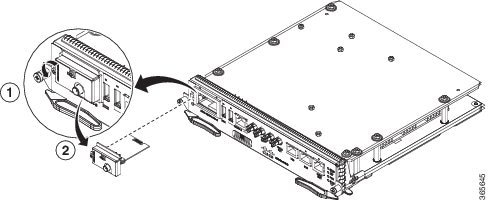
Figure 26. Installing the GNSS Module in the RSP


1

Screw on the GNSS Module

2

Inserting the GNSS Module


Connecting Ethernet Cables

The Cisco ASR 902 Router interface modules support RJ45 and Ethernet SFP ports. For instructions on how to connect cables to Ethernet SFP ports, see the Connecting Cables to SFP Modules .

The RJ45 port supports standard straight-through and crossover Category 5 unshielded twisted-pair (UTP) cables. Cisco does not supply Category 5 UTP cables; these cables are available commercially.


Warning

To comply with the Telcordia GR-1089 NEBS standard for electromagnetic compatibility and safety, connect the Gigabit Ethernet ports only to intra-building or unexposed wiring or cable. The intrabuilding cable must be shielded and the shield must be grounded at both ends. The intra-building port(s) of the equipment or subassembly must not be metallically connected to interfaces that connect to the OSP or its wiring. These interfaces are designed for use as intra-building interfaces only (Type 2 or Type 4 ports as described in GR-1089-CORE) and require isolation from the exposed OSP cabling. The addition of Primary Protectors is not sufficient protection in order to connect these interfaces metallically to OSP wiring.


Note

When installing the cables to the RSPs, we recommend that you leave a service loop of extra cable to enable fan tray removal.

Follow these steps to connect a cable to a copper Gigabit Ethernet port:

Procedure


Step 1

Confirm that the router is powered off.

Step 2

Connect one end of the cable to the Gigabit Ethernet port on the router.

Step 3

Connect the other end to the BTS patch or demarcation panel at your site.


Connecting Cables to SFP Modules

For information on connecting cables to Cisco optical and Ethernet SFP interfaces, see:

http://www.cisco.com/en/US/partner/products/hw/modules/ps5455/prod_installation_guides_list.html.

Connecting T1/E1 Cables

The physical layer interface for the Cisco ASR 902 Router T1/E1 port is a customer-installed high-density connector. The high-density connector has thumbscrews that should be screwed into the interface when the cable is installed.

The figure below shows the T1/E1 cable connector, and Figure 3-28 shows the connection between the T1/E1 interface and the patch panel.


Note

A patch panel is required in order to connect the high-density interface connector to individual T1/E1 lines.
Figure 27. T1/E1 Cable Connector

Installing the Cable Connector

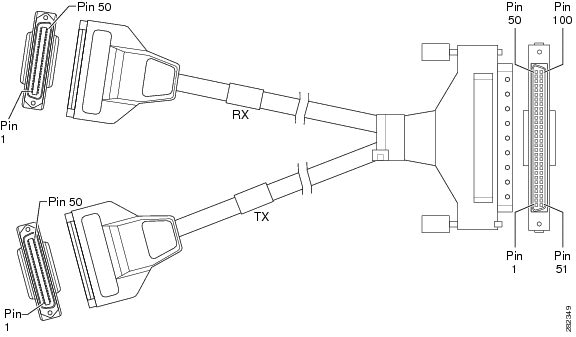
One end of the cable has a 100-pin connector that plugs into the T1/E1 interface module. Use the thumbscrews on either side of the connector to secure the cable to the interface.

The other end of the cable has two 50-pin Telco connectors that are attached to the rear of a 24-port RJ45 patch panel. Both connectors are identical: one is for Transmit (TX) and the other is for Receive (RX).

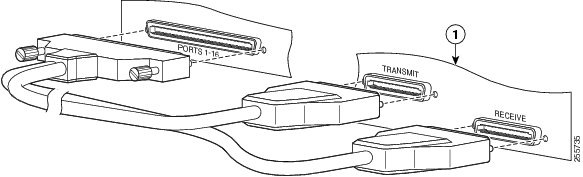
The figure below shows how the cable is connected between the T1/E1 interface module and the patch panel.

Figure 28. Cable Installation Between T1/E1 Interface and Patch Panel


Label

Interface

1

Patch panel interfaces

For information about the pinout of the cable connecting the T1/E1 interface to the rear of the patch panel, see the T1/E1 Port Pinouts.

RJ45 Cable Pinouts

T1 lines from individual subscribers are attached to RJ45 connectors on the front of the 24-port patch panel. Each RJ45 port accommodates an individual T1 subscriber line.

For information about the T1/E1 ports, see the T1/E1 Port Pinouts section.

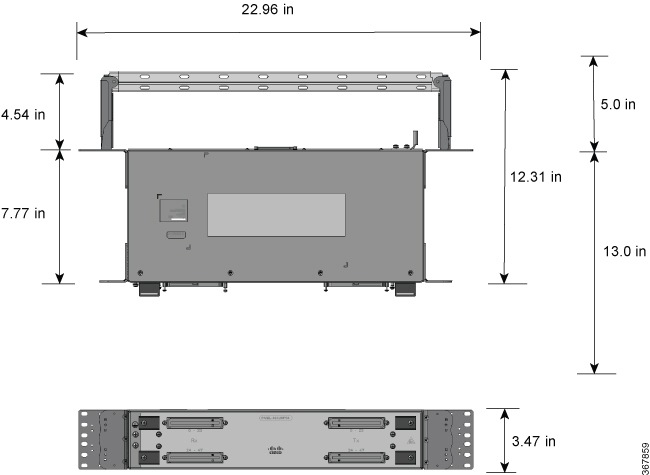
Patch Panel Dimensions

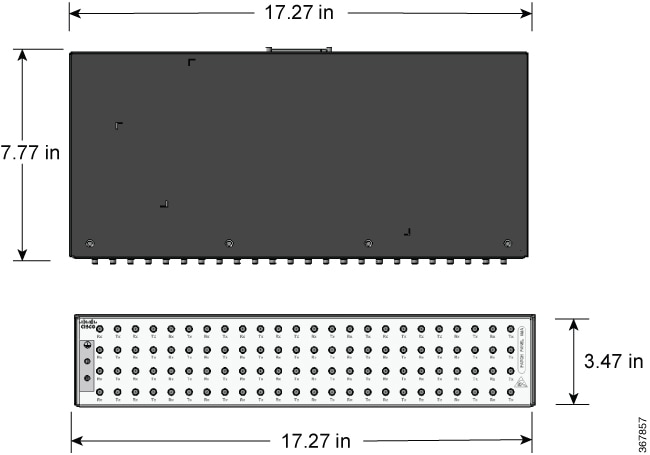
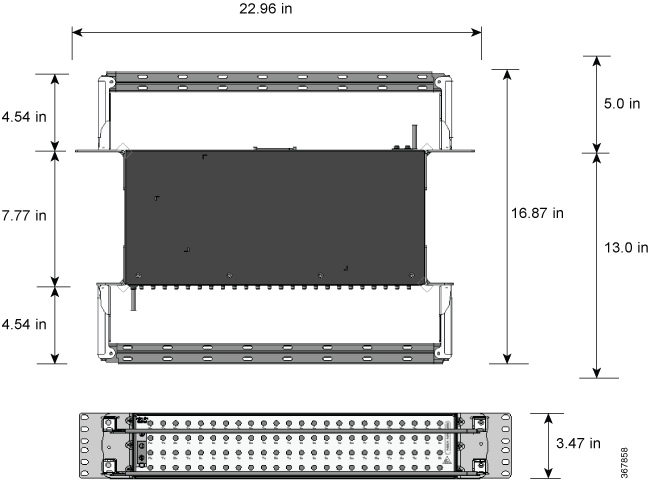
Following are the various patch panel dimensions.

Figure 29. Patch Panel Without Brackets

Figure 30. Patch Panel With Brackets

Figure 31. AMP64 Patch Panel With Brackets

Connecting Cables to the Patch Panel

If you are connecting two T1/E1 interfaces to each other, you must cable both interfaces’ patch panels together using a T1 crossover cable or a T1 straight-through cable. Use shielded cables. The type of cable you use (crossover or straight-through) depends on how the T1/E1 interfaces are cabled to their patch panels:

  • If both the T1/E1 interfaces are connected to their patch panels in the same manner (TX to Transmit and RX to Receive, or TX to Receive and RX to Transmit), use a T1 crossover cable to connect the patch panels.
  • If both the T1/E1 interfaces are connected to their patch panels in a different configuration (TX to Transmit and RX to Receive on one interface, and TX to Receive and RX to Transmit on the other interface), use a T1 straight-through cable (standard RJ45 patch cable) to connect the patch panels.

Warning

To comply with the Telcordia GR-1089 NEBS standard for electromagnetic compatibility and safety, connect the T1/E1 ports only to intra-building or unexposed wiring or cable. The intrabuilding cable must be shielded and the shield must be grounded at both ends. The intra-building port(s) of the equipment or subassembly must not be metallically connected to interfaces that connect to the OSP or its wiring. These interfaces are designed for use as intra-building interfaces only (Type 2 or Type 4 ports as described in GR-1089-CORE) and require isolation from the exposed OSP cabling. The addition of Primary Protectors is not sufficient protection in order to connect these interfaces metallically to OSP wiring.


Recommended Patch Panel

We recommend using the following T1/E1 patch panels:

The following patch panels are introduced:

  • CABLE-16T1E1—Cable for 16-Port T1/E1 Interface Module, 12 feet
  • CABLE-32T1E1—Cable for 32-Port T1/E1 Interface Module
  • PANEL-16-BNC—Breakout panel with 16 T1/E1 75-ohm BNC ports
  • PANEL-32-RJ4—Breakout panel with 32 T1/E1 100/120- ohm RJ48 ports8

Also, the following patch panels are available from Optical Cable Corporation (http://www.occfiber.com).

  • 48-port T1 RJ45 patch panel (part number DCC4884/25T1-S)
  • 16-port E1 BNC patch panel (part number DCC16BNC/25T1-S)

To order a patch panel, contact the Sales and Marketing Support staff at Optical Cable Corporation:

    • 800-622-7711 (toll-free in the U.S.A.)
    • 540-265-0690 (outside the U.S.A.)

Connecting Serial Cables

The figure below shows the supported serial connectors, and the tables below detail the supported cables with the Cisco ASR 902 Router.


Caution

The Cisco ASR 902 Router currently only supports the EIA/TIA-232 connector.


Note

The Cisco ASR 902 Router currently supports only the EIA/TIA-232 connector.
Table 3. Interface Cables for 12-in-1 Connector

Cable Type

Product Number

Length

Male/Female

Connector

V.35 DTE

CAB-SS-V35MT

10 ft.

Male

M34

V.35 DCE

CAB-SS-V35FC

10 ft.

Female

M34

EIA/TIA-232 DTE

CAB-SS-232MT

10 ft.

Male

DB-25

EIA/TIA-232 DCE

CAB-SS-232FC

10 ft.

Female

DB-25

EIA/TIA-449 DTE

CAB-SS-449MT

10 ft.

Male

DB-37

EIA/TIA-449 DCE

CAB-SS-449FC

10 ft.

Female

DB-37

X.21 DTE

CAB-SS-X21MT

10 ft.

Male

DB-15

X.21 DCE

CAB-SS-X21FC

10 ft.

Female

DB-15

EIA/TIA-530 DTE

CAB-SS-530MT

10 ft.

Male

DB-25

EIA/TIA-530 DTE

CAB-SS-530FC

10 ft.

Female

DB-25

Table 4. Interface Cables for 68-Pin Connector

Cable Type

Product Number

Length

Male/Female

Connector

4-port EIA-232 DTE

CAB-HD4-232MT

10 ft.

Male

DB-25

4-port EIA-232 DCE

CAB-HD4-232FC

10 ft.

Female

DB-25

4-port EIA-232 DTE

CAB-QUAD-ASYNC-F

10 ft.

Female

RJ-45

4-port EIA-232 DTE

CAB-QUAD-ASYNC-M

10 ft.

Male

RJ-45

4-port EIA-232 DTE

CAB-9AS-M

10 ft.

Male

DB-9

Connecting the Fan Tray Alarm Port

The fan tray includes an alarm port that maps to 2 dry contact alarm inputs.

The pins on the alarm port are passive signals, and can be configured as Normally Open (an alarm is generated when current is interrupted) or Normally Closed (an alarm is generated when a circuit is established) alarms. You can configure each alarm input as critical, major, or minor. An alarm triggers alarm LEDs and alarm messages. The relay contacts can be controlled through an appropriate third-party relay controller. The open/close configuration is an option controlled in Cisco IOS.


Warning

To comply with the Telcordia GR-1089 NEBS standard for electromagnetic compatibility and safety, connect the alarm ports only to intra-building or unexposed wiring or cable. The intrabuilding cable must be shielded and the shield must be grounded at both ends. The intra-building port(s) of the equipment or subassembly must not be metallically connected to interfaces that connect to the OSP or its wiring. These interfaces are designed for use as intra-building interfaces only (Type 2 or Type 4 ports as described in GR-1089-CORE) and require isolation from the exposed OSP cabling. The addition of Primary Protectors is not sufficient protection in order to connect these interfaces metallically to OSP wiring.


Only pins 1, 2 and 8 are available for customer use. The remaining pins are for Cisco manufacturing test, and should not be connected. Use a shielded cable for connection to this port for EMC protection. For a summary of pinouts on the alarm port see Troubleshooting.

Connecting a Cable to the Fan Tray Alarm Port

This procedure describes how to connect a cable to the Cisco ASR 902 Router fan tray port.

Procedure

Step 1

Attach an RJ45 cable to the alarm port.

Step 2

Attach the other end of the RJ45 cable to the relay controller.

For information about how to configure alarm trigger setting and map alarm inputs to critical, major, and minor alarm conditions, see the Cisco ASR 900 Series Aggregation Services Routers Configuration Guide.


Connector and Cable Specifications

For more information on cable specifications and pinouts, see Troubleshooting.