Cisco Modeling Labs OVA Installation

Prepare for an OVA File Installation

There is a number of key prerequisites that must be in place in order to successfully install Cisco Modeling Labs using an OVA file.

These prerequisites are:

  • The host must support Intel VT-x/EPT virtualization extensions, and these extensions must be enabled in the BIOS.

  • The target disk must be at least 250 GB.

  • For installations to a VM, the following hypervisors are supported:
    • VMware vSphere ESXi 5.5 Update 2 (Build 1993072) or later

    • VMware vSphere ESXi 6.0 (Build 2494585).


      Note


      Additionally, you must verify that you are using vSphere Client v5.5 Update 2 (Build 1993072) or later before deploying Cisco Modeling Labs.  Failure to use this minimum version will result in a failed deployment that returns an error stating that nested virtualization is not supported.

    Note


    The implementation of Cisco Modeling Labs within a VM is limited to the listed VMware vSphere ESXi versions. Other hypervisors such as Oracle VirtualBox, Microsoft HyperV, XenServer, etc. are not supported. Depending on network speed and target platform performance, an installation can take between 30 and 60 minutes.
Important: Check that the above requirements are in place before proceeding to the next step in the installation process. If at any time the installation appears to fail or you do not see the expected results, we recommend that you delete the virtual machine and restart the installation.

Download the Cisco Modeling Labs OVA File

You must download the Cisco Modeling Labs OVA file using the link provided in your purchase confirmation email.

The OVA files are large (~4 GB), so rather than HTTP downloads using a web browser, the use of a download manager for Mac or Windows is recommended.

An MD5 hash sum for the OVA file is provided along with the download link on the download website. You must calculate and verify that the hash sum of the downloaded OVA file matches the source file:

  • On OS X, use the command 'md5 <filename>'.
  • On Linux, use the command 'md5sum <filename>'.
  • On Windows, use Microsoft File Checksum Integrity Verifier (FCIV).
Important: Verify that the hash sum of the downloaded OVA file matches the source file before proceeding to the next step in the installation process.

Configure Security and Network Settings


Note


You must enable Intel VT in the BIOS for Cisco Modeling Labs to operate correctly.

The ESXi host must be enabled for remote access using SSH sessions. This is necessary for Cisco’s Technical Support staff to provide diagnostic and corrective assistance should the need arise.

The Cisco Modeling Labs virtual machine requires connections to five distinct virtual network port groups. The first connection is for Cisco Modeling Labs server management, and is named VM_Network, by default. Depending on the vSphere deployment policies, this port group may be assigned to the same address space as the host’s VMkernel port (placing it on the same network), or on a distinct VLAN if isolation from the ESXi management is required. The other four port groups FLAT, FLAT1, SNAT, and INT are used by Cisco Modeling Labs for external communications. These ESXi port groups must be prepared prior to initiating the installation of Cisco Modeling Labs.

The following steps illustrates the most common deployment method of Cisco Modeling Labs in a VM environment.

Before You Begin
  • Ensure that you have met the requirements as specified in the section Cisco Modeling Labs Server Requirements.
  • Ensure that you have administrator access to the VMware ESXi server in which you plan to deploy the Cisco Modeling Labs OVA in order to enable nested virtualization.
    Step 1   Log in as administrator to the VMware ESXi server using the VMware vSphere Client.
    Step 2   Click the Configuration tab.
    Step 3   Choose Software > Security Profile.
    Step 4   Click Properties to edit the properties associated with security services.
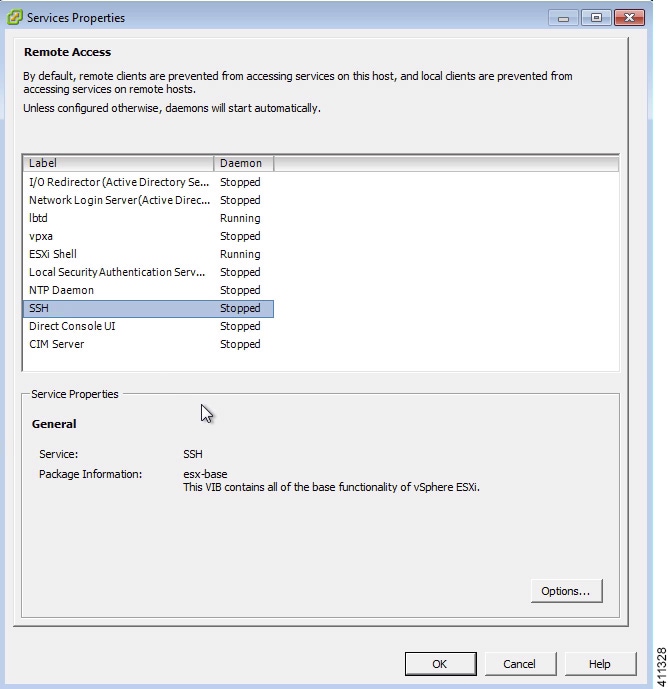
    Step 5   The Services Properties dialog box is displayed. Enable SSH access, ESXi Shell, and Direct Console UI as follows:
    1. Click Options.
    2. Click the Start and Stop with Host radio button.
    3. Click Start.
    4. Click OK.
      Figure 1. Services Properties


    Step 6   Click OK.
    Step 7   To add the four additional port groups—FLAT, FLAT1, SNAT, and INT, which are required for external Layer-2 and Layer-3 connectivity and configure network settings, choose Networking > Properties.
    Step 8   Click Add.
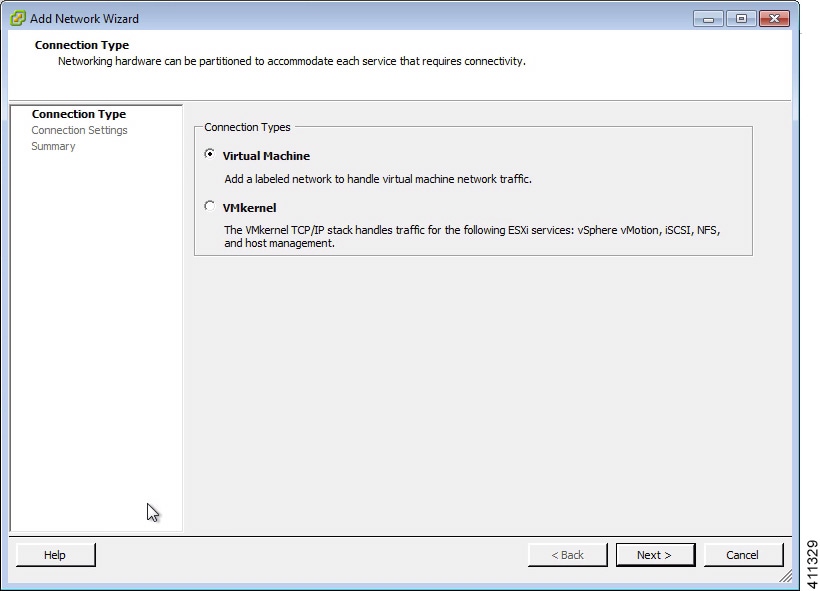
    Step 9   In the Add Network wizard, choose the Virtual Machine connection type.
    Figure 2. Connection Type


    Step 10   Click Next.
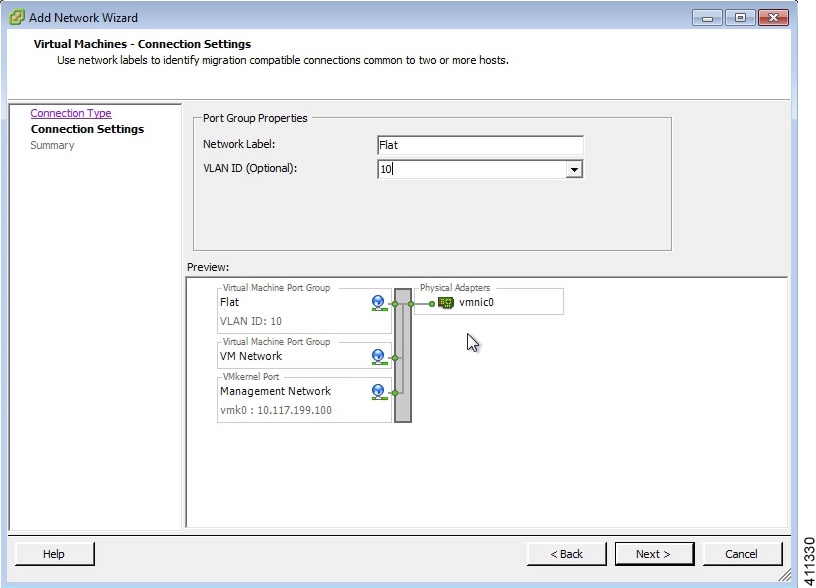
    Step 11   Under Port Group Properties, in the Network Label field, enter Flat and assign a site-relevant VLAN ID, for example, 19, in the VLAN ID field.
    Note    VLAN IDs are unique for each port group. A VLAN ID is used to identify which VLAN a packet belongs to; specifically, switches use the VLAN ID to determine which port(s), or interface(s), to send a broadcast packet to.

    Note    If you have previously installed Cisco Modeling Labs version 1.0, you will only need to add the FLAT1 and INT port groups, since FLAT and SNAT are already available.
    Figure 3. Flat Connection Settings


    Step 12   Click Next. The new port group is assigned. Ensure that the Flat port group has been created.
    Step 13   Click Finish to add the port group.
    Step 14   Repeat Step 7 through Step 13 to add the remaining port groups.
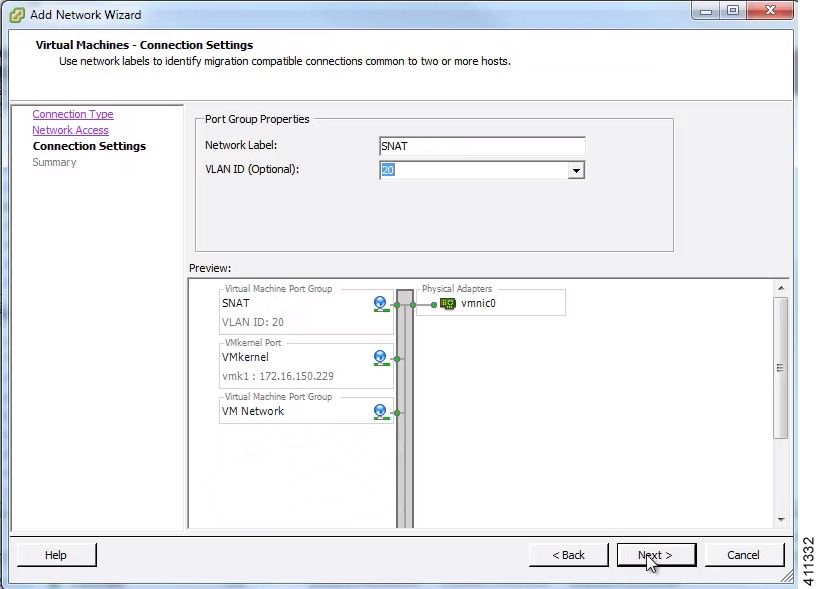
    Figure 4. SNAT Port Group Assigned


    Note   

    Ensure that the SNAT port group has been created.

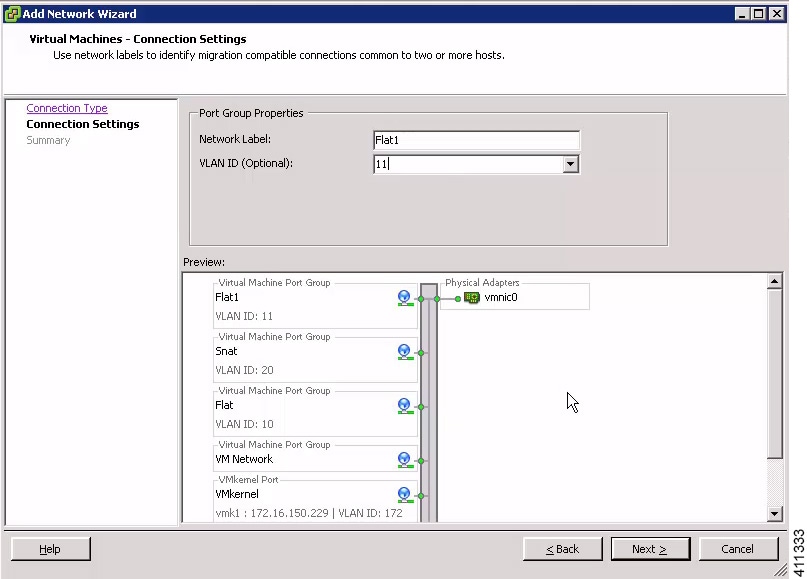
    Figure 5. Flat1 Port Group Assigned


    Note   

    Ensure that the Flat1 port group has been created.

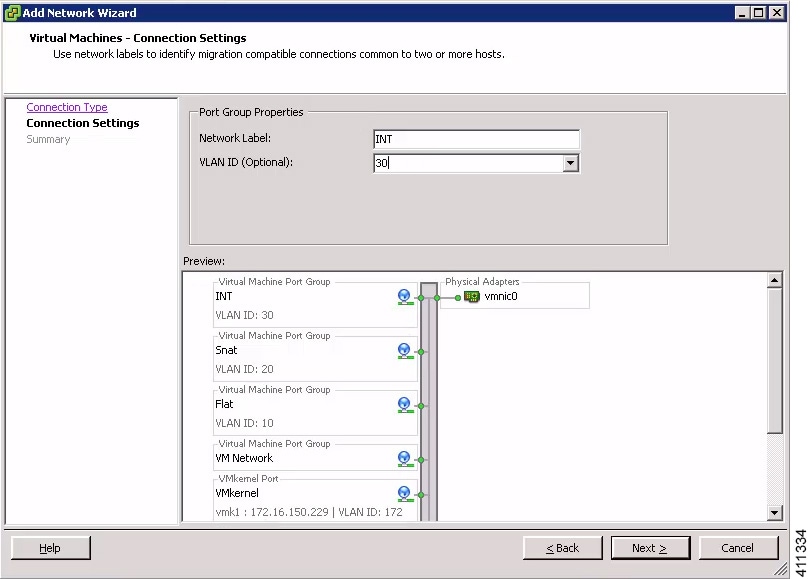
    Figure 6. INT Port Group Assigned


    Note   

    Ensure that the INT port group has been created.

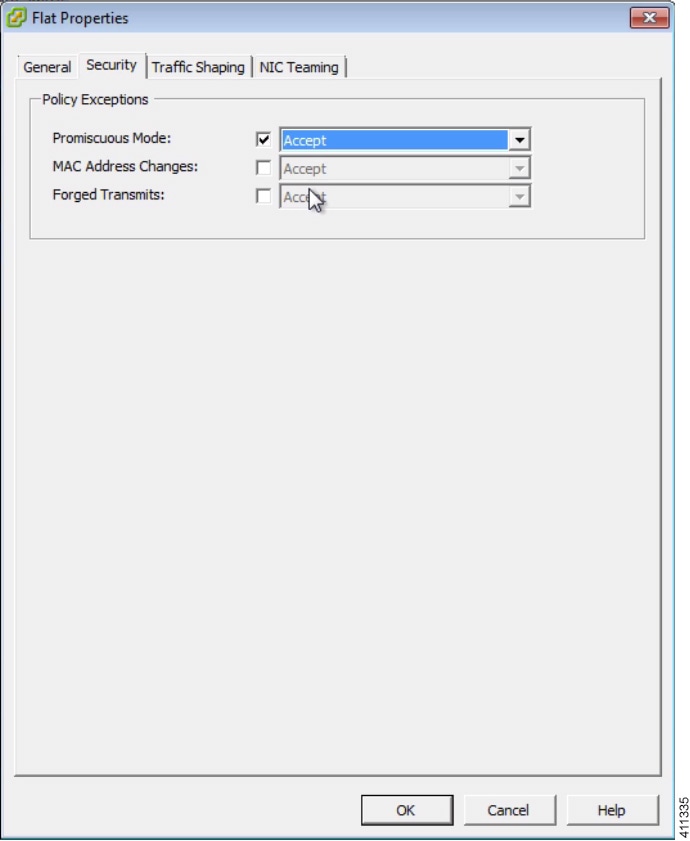
    Step 15   Configure all the port groups to allow promiscuous mode:
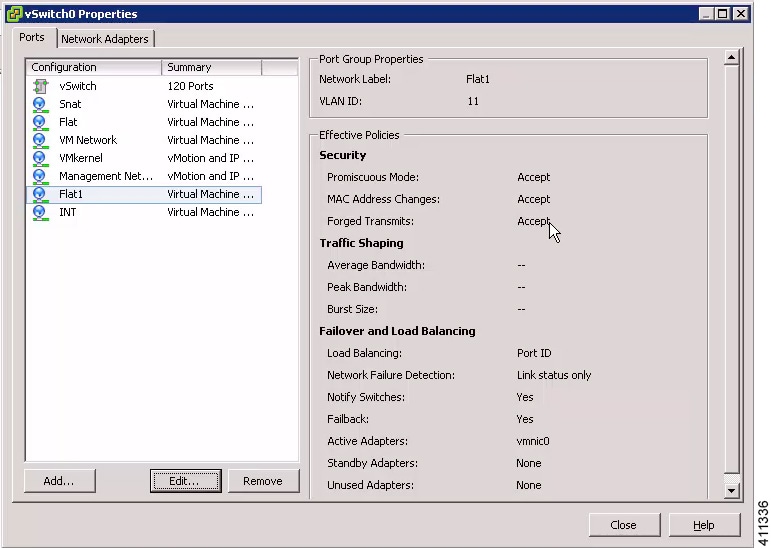
    1. Under the Configuration tab, choose Hardware > Networking and click Properties of the port group for which you want to enable promiscuous mode, for example, Flat1.
    2. Select the Flat1 port group and click Edit.
    3. Click the Security tab.
    4. Check the Promiscuous Mode check box, and from the Promiscuous Mode drop-down list, choose Accept.
      Note    Ensure that the values for MAC Address Changes and Forged Transmits are also set to their default value of Accept.
      Figure 7. Promiscuous Mode for the Flat1 Port Group


    5. Click OK.
    Note    Promiscuous mode permits traffic to flow between Cisco Modeling Labs simulated nodes and other virtual machines running on the ESXi host.

    Step 16   Repeat Step 15a through Step 15e to set the promiscuous mode for all port groups.
    Step 17   Click Close.
    Figure 8. Available Port Groups


    Important: Check that the following requirements are in place before proceeding to the next step in the installation process.
    • All five unique virtual network port-groups have been created.

    • Intel VT in the BIOS has been enabled.

    • The port group parameters Promiscuous Mode, MAC Address Changes and Forged Transmits are all set to Accept.

    • Only single VMNICs are used for the Flat, Flat1, and SNAT interfaces. NIC-teaming should not be employed for external connections.


    Deploy the Cisco Modeling Labs OVA

    Attention:

    Verify your vSphere Client. Please verify that you are using vSphere Client v5.1 Update 2 (Build 1483097) or later before deploying Cisco Modeling Labs.  Failure to use the minimum version will result in a failed deployment that will not support nested virtualization.

    Before You Begin
    • Ensure that you have configured the necessary security and network settings.

    • Ensure that you know where the OVA file resides.


      Step 1   To install the OVA, log in to the VMware ESXi server.
      Step 2   From the vSphere Client menu, choose File > Deploy OVF Template.
      Figure 9. Deploying OVA


      Step 3   Click Next.
      Step 4   In the Source screen, click Browse to navigate to the OVA package.
      Step 5   In the dialog box displayed, click Open.
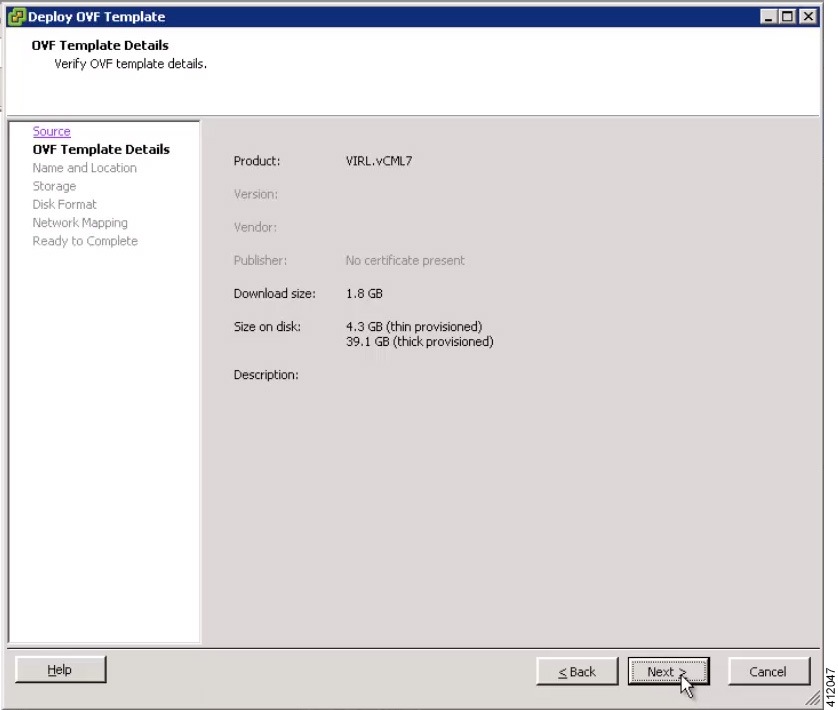
      Step 6   Click Next to review the OVA details.
      Figure 10. OVF Template Details


      Information about the OVA you are about to deploy is displayed.
      Step 7   Click Next.
      Step 8   In the Name and Location screen, confirm or provide a new name for the virtual machine, for example, Cisco Modeling Labs, and click Next.
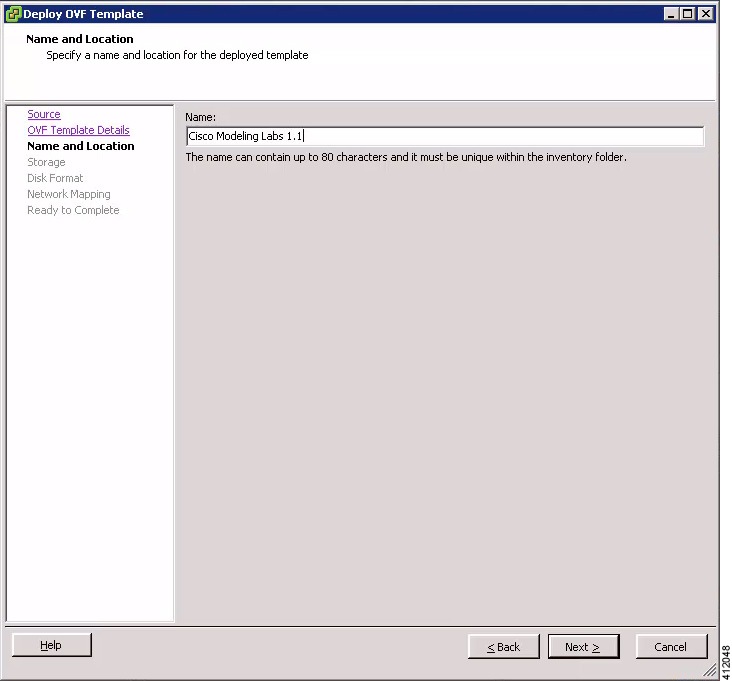
      Figure 11. Name and Location Details


      Step 9   In the Disk Format screen, confirm that the Thick Provision Lazy Zeroed radio button is selected and click Next.
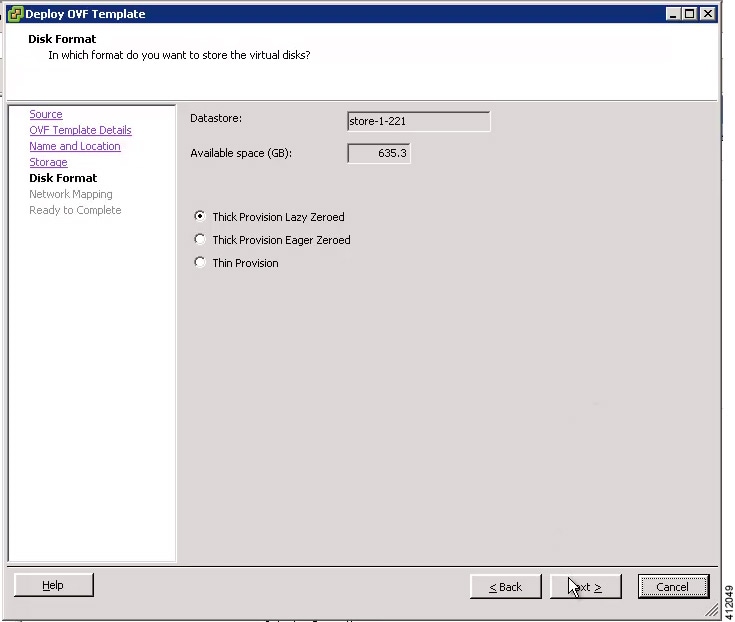
      Figure 12. Disk Format Details


      Step 10   In the Network Mapping screen, confirm the source and destination network mappings and click Next.
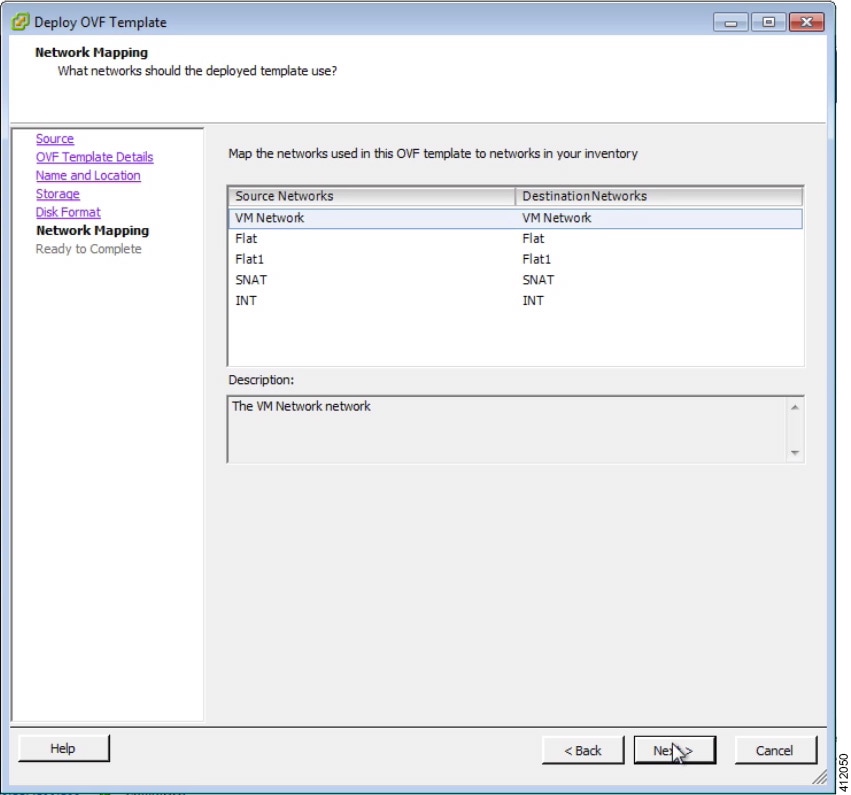
      Note    The source VM Network network in the OVA should be mapped to a valid site-relevant port-group used for virtual machine management and Internet access. The others should be mapped one-to-one to the port-groups of the same name.

      Figure 13. Network Mapping Details


      Step 11   In the Ready to Complete screen, ensure that the Power On After Deployment check box remains unchecked to allow the virtual machine settings to be updated before it is powered on.
      Step 12   Click Finish to start the OVA deployment.
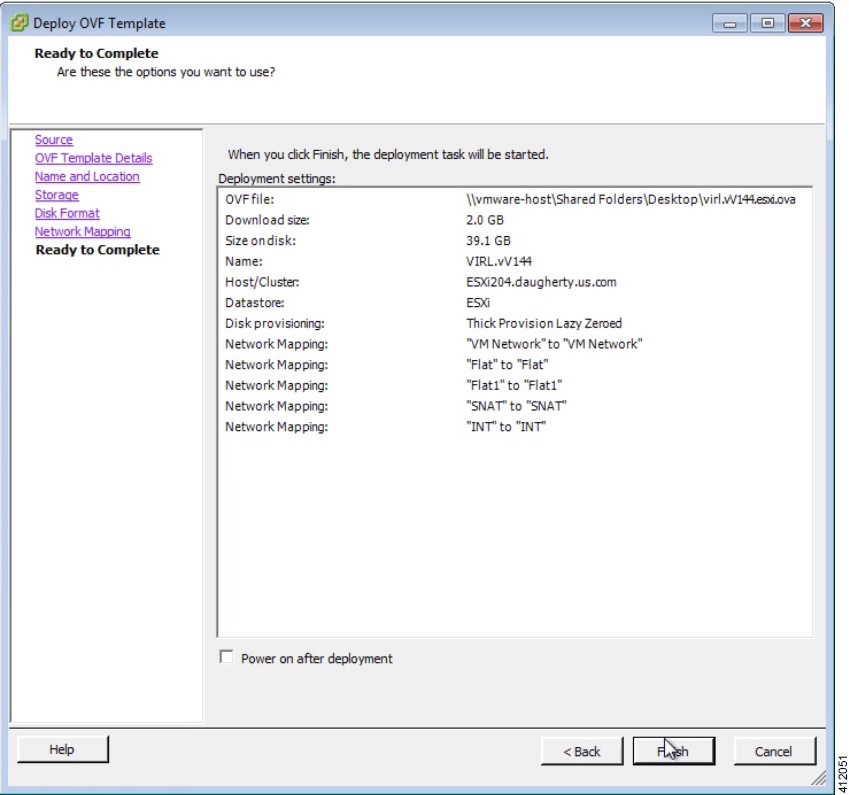
      Figure 14. Final Summary Page


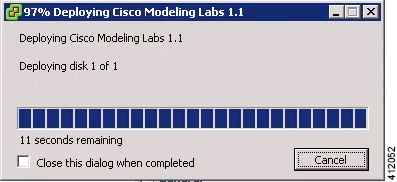
      OVA deployment starts.
      Figure 15. Deploying the OVA


      When the deployment completes, click Close.
      Important: Check that the following requirements are in place before proceeding to the next step in the installation process.
      • You have verified your version of vSphere client in use.

      • The VM network port-group is mapped to a valid site-relevant port-group used for virtual machine management and Internet access. All others are mapped one-to-one to the port-group of the same name.


      Edit the Virtual Machine Settings


        Step 1   In the vSphere client, click Edit Virtual Machine Settings. The Virtual Machine Properties dialog box is displayed.
        Step 2   Update the values for Memory and CPUs as required for your environment.
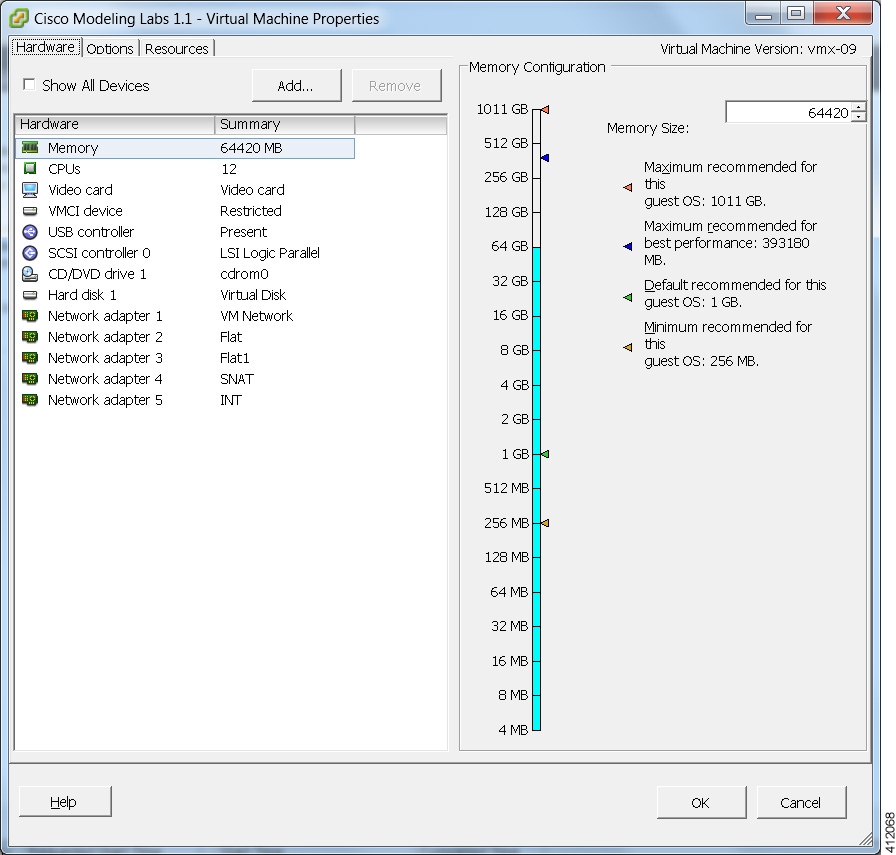
        Figure 16. Updated Virtual Machine Properties


        Step 3   In addition, confirm that the network adapters have been setup correctly.
        Step 4   Under the Options tab, ensure that the setting CPUID Mask is set to Expose Nx flag to guest as shown.
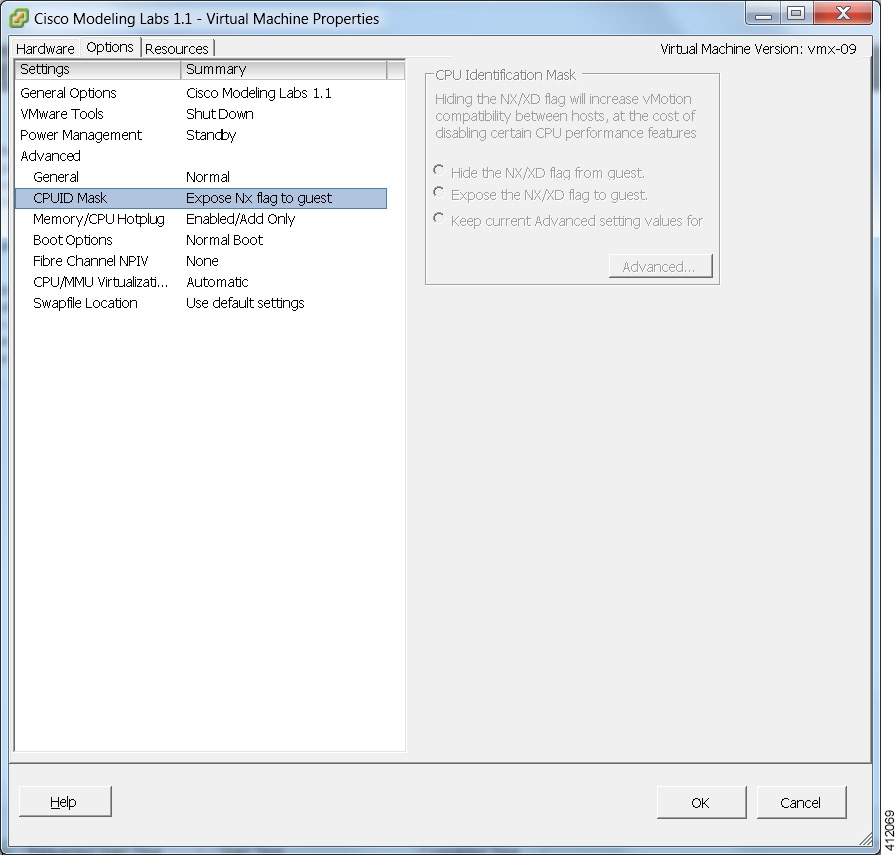
        Figure 17. CPUID Mask Setting


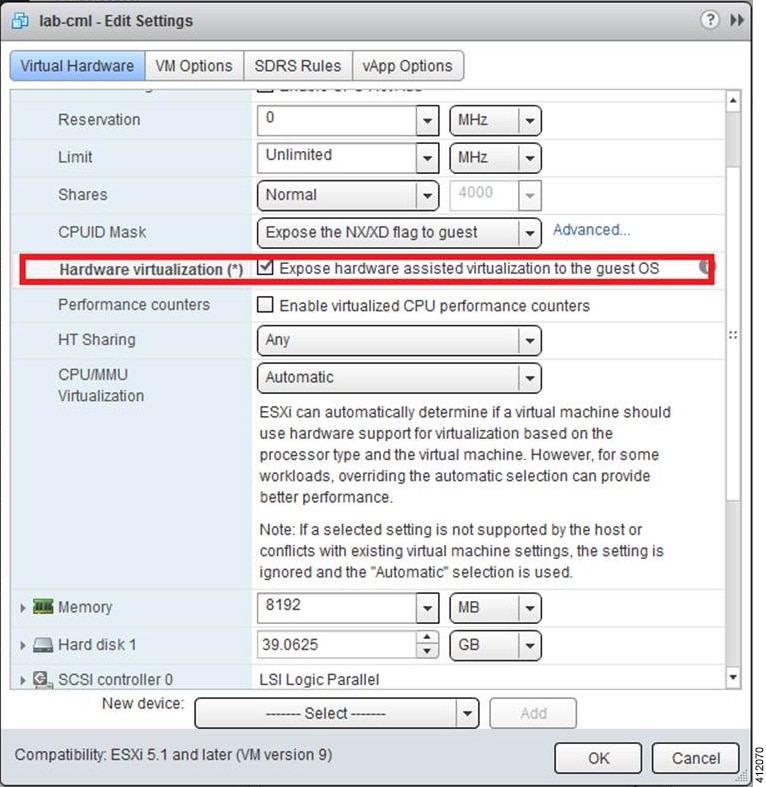
        If using the vSphere web client, under the Virtual Hardware tab, locate the Hardware Virtualization option. Ensure that CPUID Mask is set to Expose NX/XD flag to guest and that the setting Expose Hardware Assisted Virtualization to the Guest OS is enabled as shown.
        Figure 18. Enable the Hardware Virtualization Option


        Step 5   Click OK to save the changes.

        Customize the Cisco Modeling Labs Server Deployment

        Following the software installation, the Cisco Modeling Labs server must be customized for the environment within which it will operate and desired integration with existing lab/test devices. This customization includes setting the following attributes:

        • The server's system details
          • Host name and domain details

          • The management interface (Ethernet0) configuration

          • Primary and secondary DNS servers

          • NTP server

        • The interface configurations associated with external communications (Ethernet1 [Flat], Ethernet2 [Flat1], and Ethernet3 [SNAT].)

        • Application details such as ports associated with the VIRL-services, internal passwords, resource over-commit ratios, and access/download proxy details.

        In previous releases, the Cisco Modeling Labs server was customized via GUI/CLI invoked scripts using the server’s console. This release of Cisco Modeling Labs incorporates the system configuration into the User Workspace Management > CML Server > System Configuration interface accessible via a web browser session to the server’s management address.

        Note


        When deploying Cisco Modeling Labs using the OVA-formatted install file, the installed application is preconfigured to use DHCP services to acquire an IP address for the management port, Ethernet0.

        Start the Cisco Modeling Labs Server for the First Time

        On initial startup of Cisco Modeling Labs, a virtual console session is started to ascertain the assigned IP address, or to set the static addressing details to the Ethernet0 interface. Complete the following steps to start the Cisco Modeling Labs server for the first time.


          Step 1   In the vSphere client, click Power On the Virtual Machine. The virtual machine starts up.
          Step 2   Open a console window by right-clicking on Cisco Modeling Labs 1.2 and choose Open Console from the list. In the Console window, you can see the virtual machine starting up.
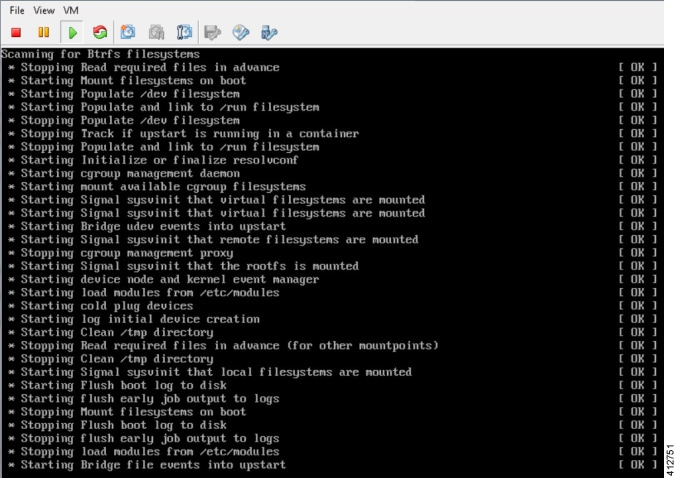
          Figure 19. Virtual Machine Starting Up


          When the virtual machine has started, the login screen is displayed.

          Step 3   Log in with the username virl and the password VIRL.
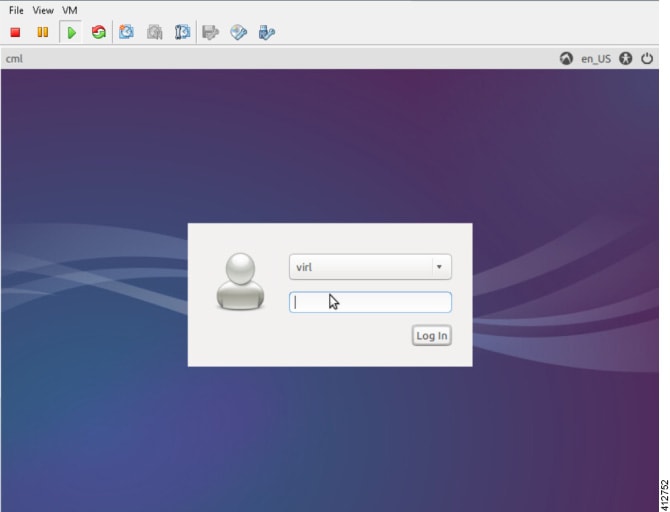
          Figure 20. Cisco Modeling Labs Server Log In


          The Cisco Modeling Labs desktop is displayed.
          Figure 21. Cisco Modeling Labs Desktop


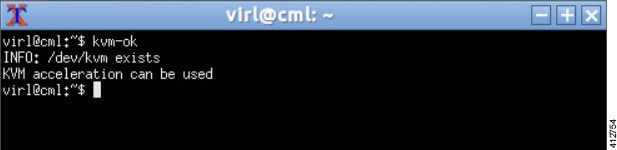
          Step 4   On the desktop, double-click the xterm icon and enter the CLI command kvm-ok in the terminal window. The response KVM acceleration can be used indicates that the nested hypervisor options have successfully employed.
          Figure 22. Run the kvm-ok Command


          Note    If KVM acceleration is not enabled, do not proceed.  Return and determine that all prerequisites were met and all prior installation steps were followed. Close this xterm window.
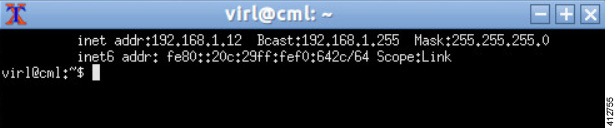
          Step 5   On the desktop, double-click the ip_address icon. This runs a script that detects configuration details applied to the Ethernet0 interface. If DHCP services are available, the resultant CLI window will indicate the acquired address assigned to Cisco Modeling Labs’ management interface. Using a browser, the reported address may be used to open a User Workspace Management session to complete the server customization. Changing Ethernet0 to a static assignment may be done within the User Workspace Management interface. If the ip-address command returns an IPv4 address, note it down and go to Step 10. If DHCP is not active on the subnet to which Cisco Modeling Labs’ Ethernet0 is connected, it is necessary to assign a static IP address before proceeding.
          Figure 23. Check the Management Interface


          Step 6   Double-click the xterm icon to open a terminal window and at the command prompt, enter cd /etc/network.
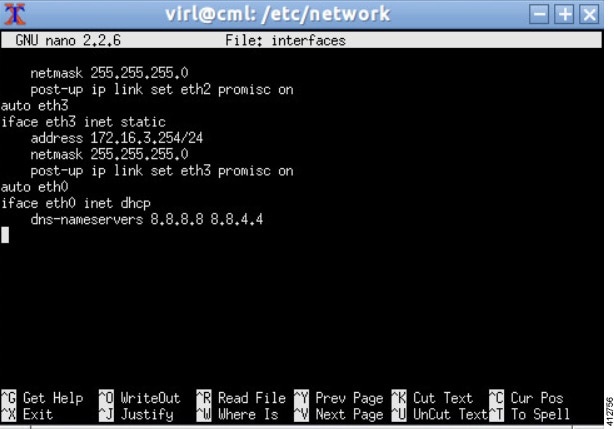
          Step 7   Enter sudo nano interfaces to edit the /etc/network/interfaces configuration file.
          Figure 24. Edit the Interfaces File


          Step 8   Scroll through the file to the configuration associated with Ethernet0 and make the following changes:
          1. Change the addressing method to static: iface eth0 inet static.
          2. Add the static IP address: address n.n.n.n.
          3. Add the network mask: netmask mmm.mmm.mmm.mmm.
          4. Add the default IP gateway: gateway g.g.g.g.
          5. Enter Ctrl-X to exit the editor. Enter Y to save the edits, then Enter to confirm overwriting the /etc/network/interfaces file.
          Step 9   Reboot the virtual machine using the sudo reboot now command.
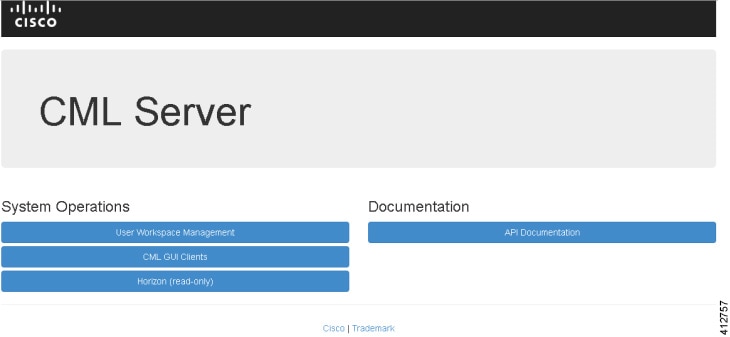
          Step 10   Once the virtual machine completes the reboot cycle, establish a browser session to the Cisco Modeling Labs server’s management interface (either the DHCP acquired address noted earlier, or the static address added to the /etc/network/interfaces file.)
          Figure 25. CML Server Main Menu


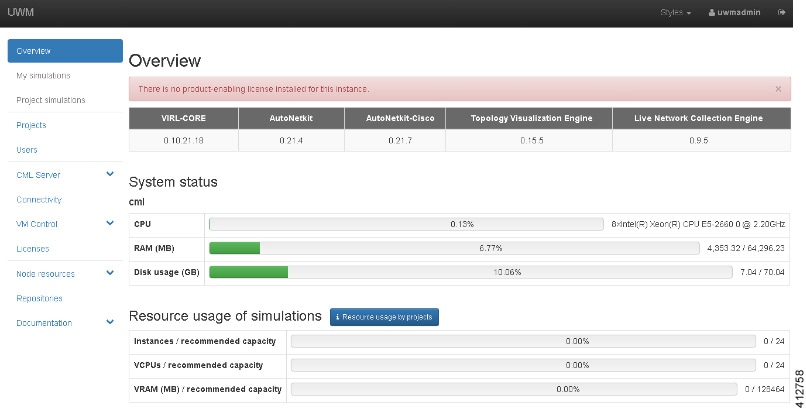
          Step 11   Click the User Workspace Management interface link. Login with the default credentials (username= uwmadmin, password=password). The User Workspace Management Overview page is displayed.
          Figure 26. User Workspace Management Overview


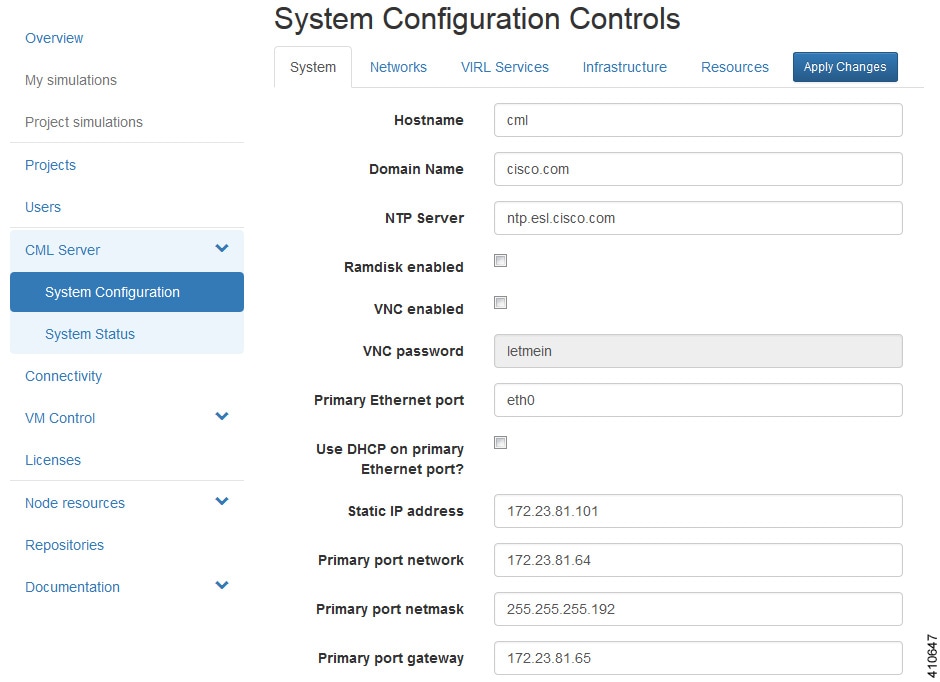
          Step 12   From the options on the left, expand the CML Server option and select System Configuration. Click System to set the system management details.
          Figure 27. System Configuration Controls


          Table 1 System Configuration Parameters

          Parameter

          Default

          Description

          Hostname

          cml

          Changing this parameter is not supported.

          Domain Name

          cml.info

          NTP Server

          pool.ntp.org

          An NTP resource is required. If behind a firewall/proxy, this parameter should point to an NTP server reachable by this device.

          Ramdisk enabled

          unchecked

          Enable this option if you have at least 16 GB free RAM, to speed up I/O operations.

          VNC enabled

          unchecked

          Use this option to start the VNC server on the host. It operates on TCP port 5901.

          VNC Password

          letmein

          Enter the password for the VNC server.

          Primary Ethernet Port

          eth0

          Enter the primary ethernet port.

          Use DHCP on Primary Ethernet port?

          checked

          When enabled, permits DHCP to configure the management interface (Ethernet0.) A static IP configuration is recommended. This parameter should be unchecked and the primary port configuration options set manually.

          Static IP address

          127.0.0.1

          Set as the desired IP address. Entries are not allowed when DHCP is enabled.

          Primary port network

          127.16.16.0

          Set as the IP network. Entries are not allowed when DHCP is enabled.

          Primary port netmask

          255.255.255.0

          Set network mask information. Entries are not allowed when DHCP is enabled.

          Primary port gateway

          127.16.16.1

          Set network gateway IP address. Entries are not allowed when DHCP is enabled.

          Primary DNS server IP address

          8.8.8.8

          Enter the primary DNS server IP address.

          Secondary DNS server IP address

          8.8.4.4

          Enter the secondary DNS server IP address. Ensure you do not set the same address as you set for the primary DNS server IP address.

          Is your system behind a proxy?

          unchecked

          Use this option if your system is behind a proxy.

          HTTP/HTTPS Proxy

          http://ymbk.example.com:80/

          Replace with the URL of the Internet Access Proxy, in the format "http://<proxy IP or name>:<port number>/".

          Step 13   Click Networks to configure the other interfaces for external communications.
          Table 2  Networks Configuration Parameters

          Parameter

          Default

          Description

          Flat Network Port

          Eth1

          Enter the Flat network port.

          Flat Network Address

          172.16.1.254/24

          Enter the Flat network address.

          Flat Network Address/Mask

          172.16.1.0/24

          Enter the Flat network address/mask.

          Flat Network Netmask

          255.255.255.0

          Enter the Flat network netmask.

          Flat Network Gateway IP Address

          172.16.1.1

          Enter the Flat network gateway IP address.

          Flat Address Pool Start Address

          172.16.1.50

          Enter the Flat address pool start address.

          Flat Address Pool End Address

          172.16.1.253

          Enter the Flat address pool end address.

          Flat Primary DNS server IP address

          8.8.8.8

          Enter the Flat primary DNS server IP address.

          Flat Secondary DNS server IP address

          8.8.4.4

          Enter the Flat secondary DNS server IP address. Ensure you do not set the same address as you set for the primary DNS server IP address.

          2nd Flat Network Enabled

          Unchecked

          Use this option if a second Flat network, Flat1, is to be enabled.

          2nd Flat Network Port

          Eth2

          Enter the name of the host's physical port used for the L2 Flat network, Flat1.

          2nd Flat Network Address

          172.16.2.254/24

          Enter the IP address for the second Flat network, Flat1.

          2nd Flat Network Address/Mask

          172.16.2.0/24

          Enter the Flat network address/mask for Flat1.

          2nd Flat Network Netmask

          255.255.255.0

          Enter the Flat network netmask for Flat1.

          2nd Flat Network Gateway IP Address

          172.16.2.1

          Enter the Flat network gateway IP address for Flat1.

          2nd Flat Address Pool Start Address

          172.16.2.50

          Enter the Flat address pool start address for Flat1.

          2nd Flat Address Pool End Address

          172.16.2.253

          Enter the Flat address pool end address for Flat1.

          2nd Flat Primary DNS server IP address

          8.8.8.8

          Enter the Flat primary DNS server IP address for Flat1.

          2nd Flat Secondary DNS server IP address

          8.8.4.4

          Enter the Flat secondary DNS server IP address for Flat1. Ensure you do not set the same address as you set for the primary DNS server IP address.

          Snat Network Port

          Eth3

          Enter the name of the host's physical port used for L3 Snat network, ext-net.

          Snat Network Address

          172.16.3.254/24

          Enter the IP address for the CML host in the L3 Snat network.

          Snat Network Address/Mask

          172.16.3.0/24

          Enter the Snat network address/mask.

          Snat Network Netmask

          255.255.255.0

          Enter the Snat network netmask.

          Snat Network Gateway IP Address

          72.16.3.1

          Enter the Snat network gateway IP address.

          Snat Address Pool Start Address

          172.16.3.50

          Enter the Snat address pool start address.

          Snat Address Pool End Address

          172.16.3.253

          Enter the Snat address pool end address.

          Snat Primary DNS server IP address

          8.8.8.8

          Enter the Snat primary DNS server IP address.

          Snat Secondary DNS server IP address

          8.8.4.4

          Enter the Snat secondary DNS server IP address. Ensure you do not set the same address as you set for the primary DNS server IP address.

          Step 14   Click VIRL Services to configure the port numbers for VIRL services.
          Table 3 VIRL Services Configuration Parameters

          Parameter

          Default

          Description

          VIRL Apache Server Port

          80

          Enter the number of the VIRL Apache server port.

          First VM Serial Console TCP Port

          17000

          Simulated VMs with serial consoles use TCP ports starting from this value.

          Last VM Serial Console TCP Port

          18000

          Simulated VMs with serial consoles use TCP ports ending with this value.

          VIRL Web Services Port

          19399

          Enter the TCP port number for the simulation engine services.

          UWM Port

          19400

          Enter the TCP port number for the User Workspace Management interface.

          AutoNetkit Webserver Port

          19401

          Enter the TCP port number for the configuration engine preview interface.

          Live Visualization Webserver Port

          19402

          Enter the TCP port number for the Live Visualization interface.

          UWM Web-SSH Port

          19403

          Enter the TCP port number for the User Workspace Management SSH web interface.

          Nova Websocket Serial Port

          19406

          Enter the TCP port number for the websocket-based serial console connections.

          Nova Websocket VNC Port

          19407

          Enter the TCP port number for the websocket-based VNC console connections.

          Step 15   Click Infrastructure to configure the other interfaces for external communications.
          Table 4 Infrastructure Configuration Parameters

          Parameter

          Default

          Description

          OpenStack Password

          password

          Enter the password for administrator access to OpenStack operations.

          MySQL Password

          password

          Enter the password for OpenStack database access.

          Guest Account Present?

          checked

          Use this option to create a default guest account.

          Docker Registry Port

          19397

          Enter the port number for the docker registry.

          Step 16   Click Resources to configure the other interfaces for external communications to meet integration requirements.
          Table 5 Resources Configuration Parameters

          Parameter

          Default

          Description

          RAM Overcommit Value

          2

          Enter a value. The value range is 1 to 4. The value format is floating, such as 2.0. Overcommiting RAM allows you to run more virtual machines in the available memory. However, running more virtual machines reduces overall performance. We recommend that you change this value in small increments since setting a high initial value may result in the system becoming unresponsive.

          Reset RAM Overcommit

          Unchecked

          Use this option to reset the RAM overcommit value to the default built-in value. The reset occurs after you have applied your changes.

          vCPU Overcommit Value

          3

          Enter a value. The value range is 1 to 30. The value format is floating, such as 2.0. Overcommiting vCPU allows you to run more virtual machines in the available CPU capacity. However, running more virtual machines reduces overall performance. We recommend that you change this value in small increments since setting a high initial value may result in the system becoming unresponsive.

          Reset vCPU Overcommit

          Unchecked

          Use this option to reset the vCPU overcommit value to the default built-in value. The reset occurs after you have applied your changes.

          Download Proxy

          Enter the proxy server for downloading files, such as images and external git repositories, from outside the local network. Leave blank if the use of a proxy is not required.

          Download Proxy Authentication

          Enter download proxy credentials in the format "<username>:<password>".

          Download Proxy Exceptions

          Provide a list all host names and/or IP addresses for image and git repository sources where the download proxy shall not be used, such as servers, on the local network.

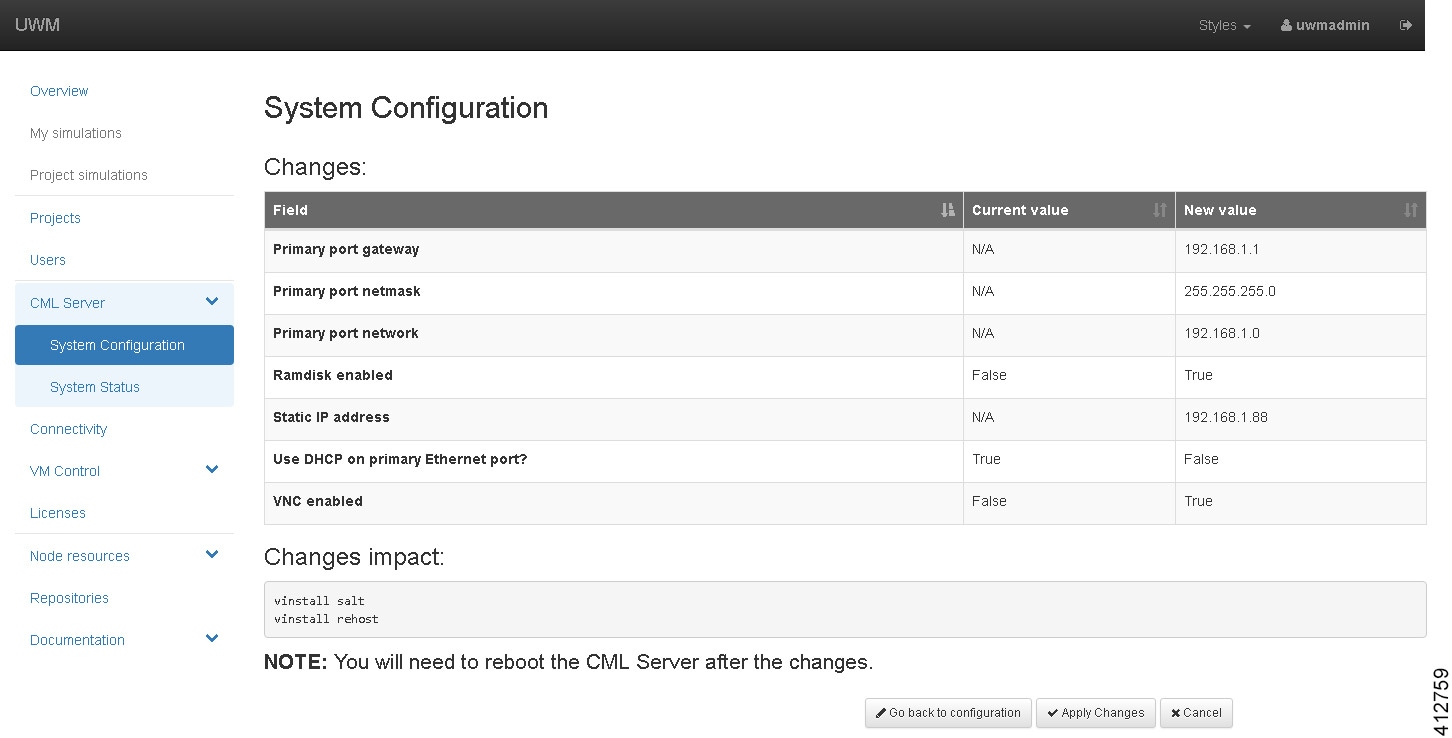
          Step 17   With all configuration options set, click Apply Changes. A summary of the changes is presented, showing the previous parameters settings and the new values being applied. Having confirmed that all changes are correct, click Apply Changes at the bottom of the page.
          Figure 28. Apply Changes Made


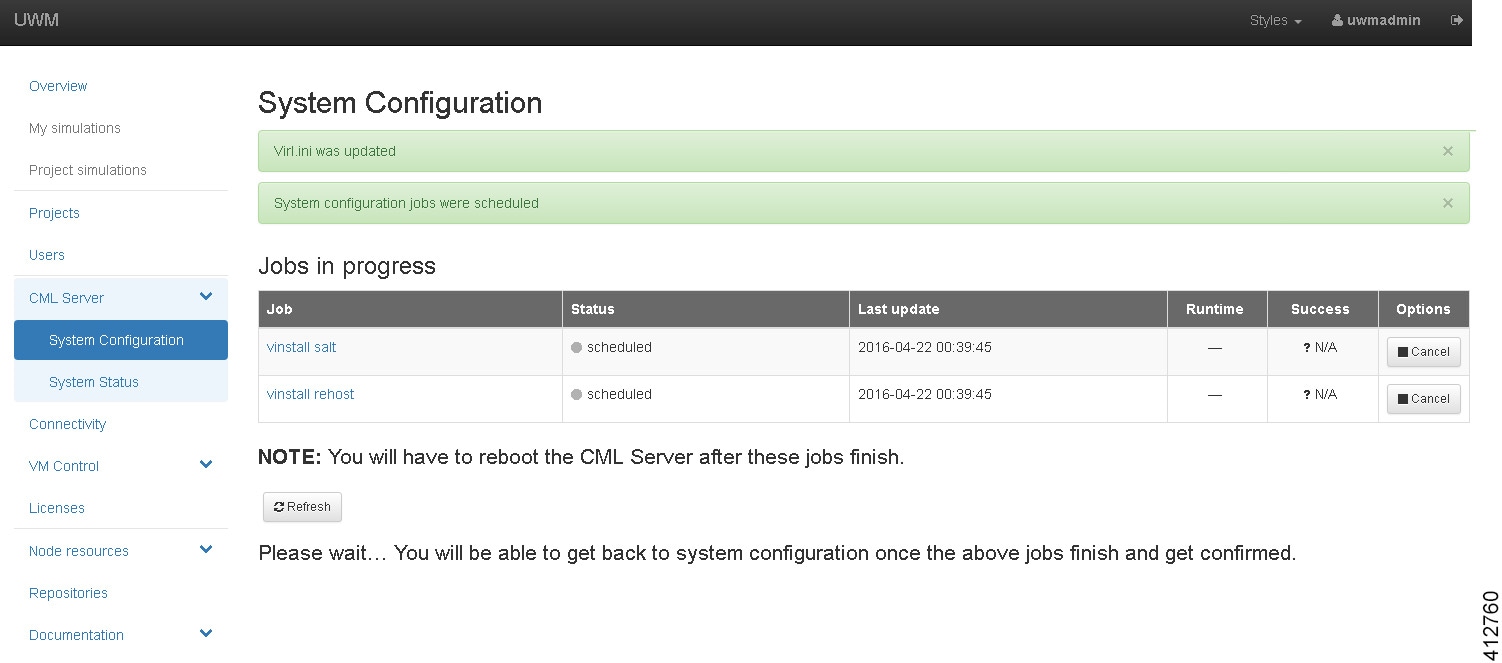
          A confirmation page verifies the configuration acceptance and schedules the listed update jobs.
          Figure 29. Confirmation of Changes Page


          Click the Refresh button to display the current status of the scheduled Jobs in progress.
          Figure 30. List of Jobs in Progress


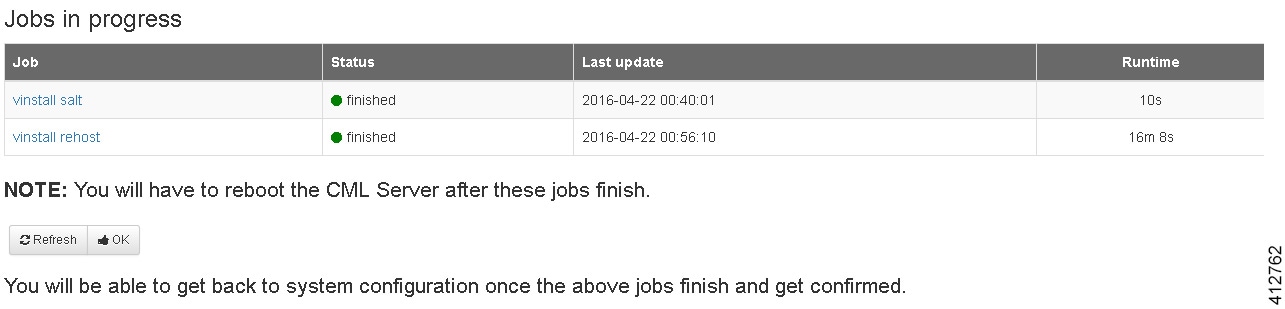
          When complete, the status updates to Finished.
          Figure 31. Jobs Completed


          Click OK to return to the System Configuration Controls page, after confirmation that all scheduled jobs were completed and cleared. At this point, the Cisco Modeling Labs server must be rebooted.
          Figure 32. List of Jobs in Progress


          Step 18   Return to the Cisco Modeling Labs virtual machine console and open an xterm window. Initiate a system reboot with the sudo reboot now command. Alternatively, double-click on the 2. REBOOT icon on the desktop. When the system reboot has completed, return to the User Workspace Management interface to confirm the custom settings.

          (Optional) Configure Static IP

          In accordance with best practices and to account for a possible lack of DHCP services, it is recommended that the eth0 interface be configured with a static IP address, as follows:


            Step 1   Start the virtual machine and log in using the username virl and the password VIRL.
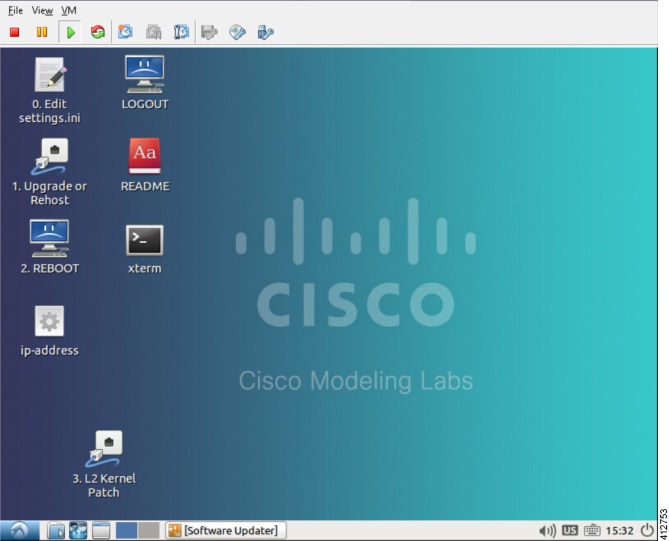
            Note    The Ubuntu Software Updater may start automatically upon login. It is safe to close the Updater and continue with the installation.

            Step 2   Click the xterm icon to open a terminal window.
            Step 3   Change to the network interfaces configuration directory: cd /etc/network
            Step 4   Open the interfaces configuration file for editing: sudo nano interfaces
            Step 5   Change the eth0 addressing method to static: iface eth0 inet static
            Step 6   Provide the static IP address: address n.n.n.n
            Step 7   Provide the static IP address netmask: netmask mmm.mmm.mmm.mmm
            Step 8   Provide the default IP gateway address: gateway g.g.g.g
            Note   

            If no default IP gateway address is provided, do not configure any DNS name-server addresses unless they are reachable on the local subnet.  Doing otherwise will lead to unpredictable behavior as various Cisco Modeling Labs services fruitlessly attempt to resolve names.

            Step 9   Provide valid reachable DNS name-server addresses: dns-nameservers a.a.a.a b.b.b.b
            Step 10   Enter Ctrl-X to exit.
            Step 11   Enter Y and Enter to confirm saving the interfaces file and exit.
            Step 12   Enter sudo reboot now to reboot the virtual machine in preparation for the remaining installation steps.

            Determine License Key Requirements

            Returning to the User Workplace Management interface shows the server’s current licensing status; the red banner indicates that there is no product licensing in place.


            To license the Cisco Modeling Labs server, complete the following steps:


              Step 1   In the left pane, click Licenses. The Licenses page is displayed.
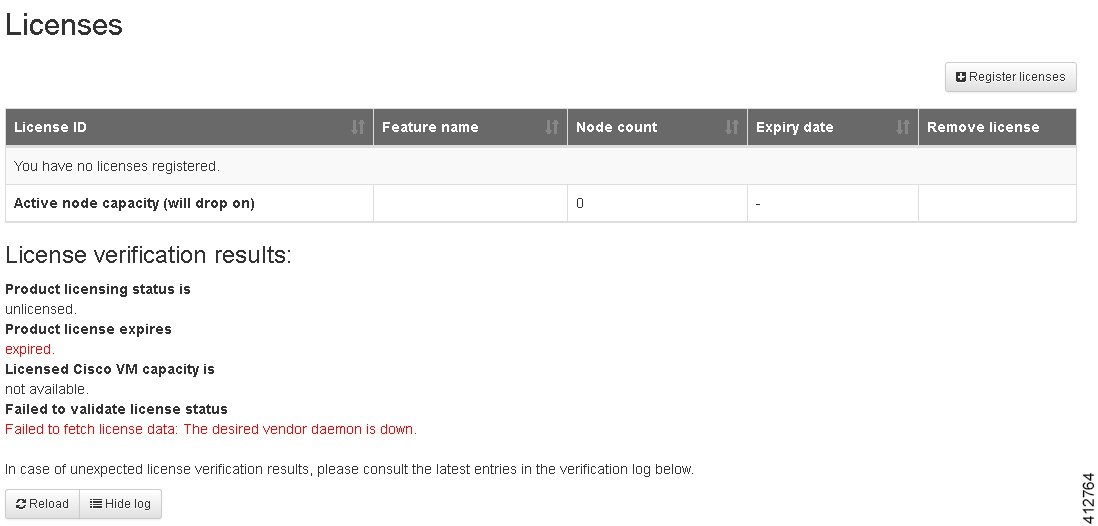
              Figure 33. Licenses Page


              Step 2   In the Licenses page, click Register Licenses.
              Step 3   Record the Host Name and Mac Address for license key registration.
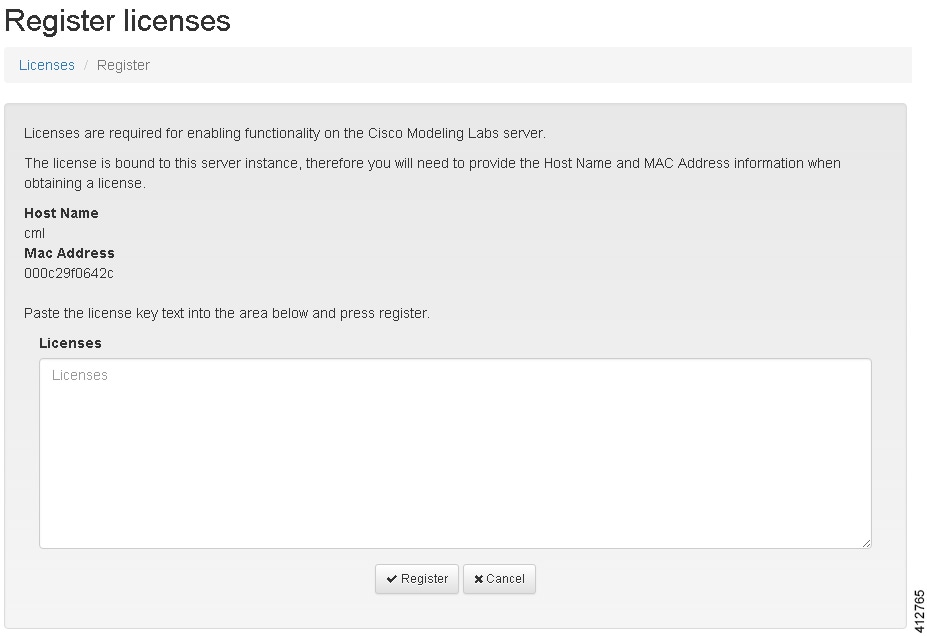
              Figure 34. Information for License Key Registration


              Use this information when completing the Register Claim Certificates instructions in the eDelivery Order Notification email to request your license key for use with the Cisco Modeling Labs server.

              Two types of licenses are available, as shown in the following table.
              Table 6 License Types
              License Type Description
              Base Subscription 15-node capacity for initial deployment.
              Capacity Subscription 10-node, 50-node, and 100-node bundles available.
              Note    You can have any number or type of licenses. Licenses are determined by the node capacity you want to deploy.

              You will receive your license key as an attachment via an email.

              Step 4   Open the attachment in a text editor and copy all of the contents.
              Step 5   Return to the Register Licenses page and paste the details into the Licenses text area.
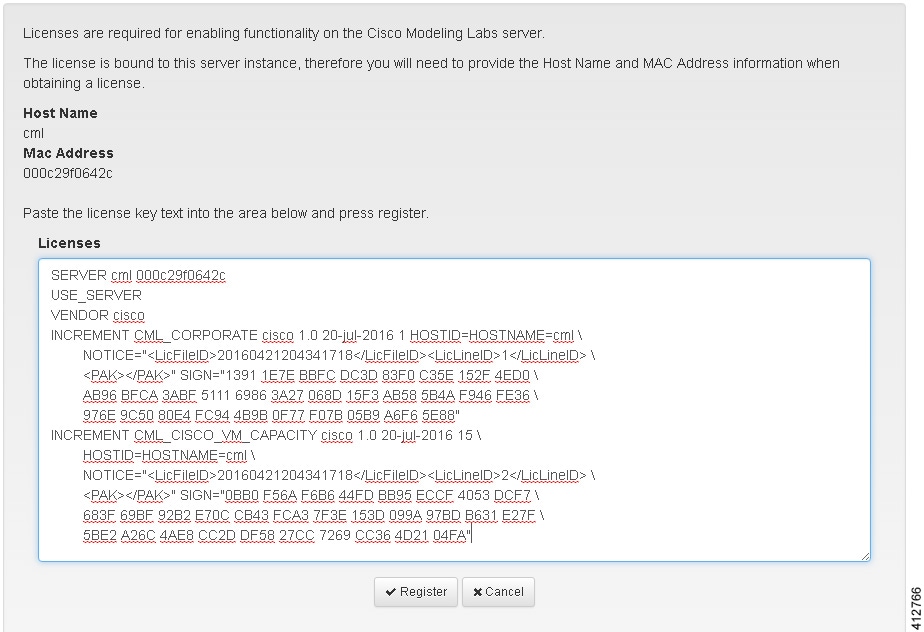
              Figure 35. License Key Details


              Step 6   Click Register to register the license key.
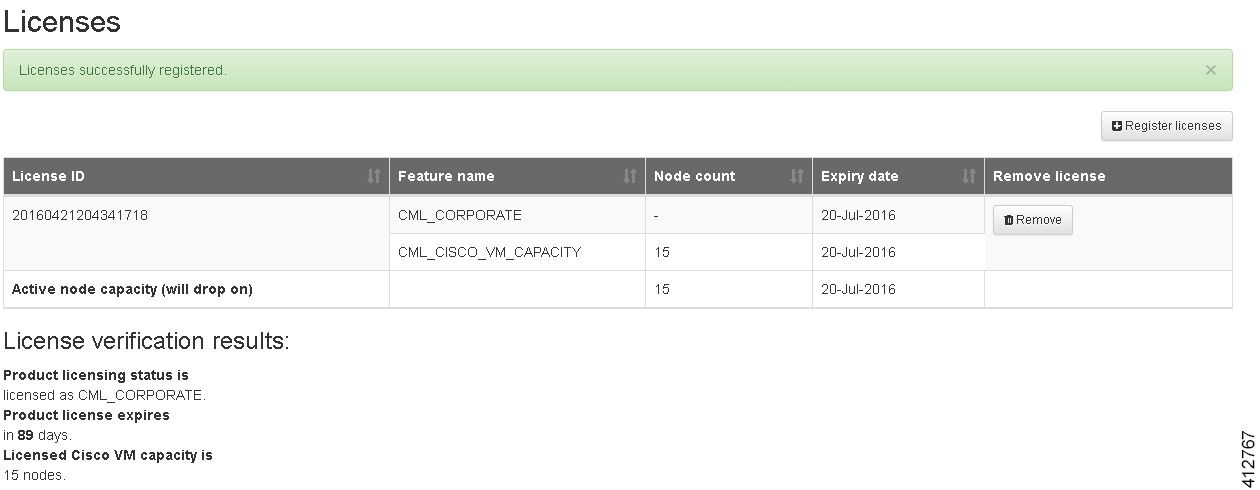
              Note   

              We recommend that you add the Base Subscription license first.

              Under Licenses, you will see the license that is added, the number of nodes permissible, and an expiry date for the license.
              Figure 36. Licenses Applied


              Step 7   Repeat Steps 4 – 6 for each license file received from the registration process. Verify that the Licenses page correctly reports the applied node count and expiration dates.
              Step 8   Click Log Out to exit the User Workspace Management interface.