Block Upload Traffic in Secure Web Appliance
Available Languages
Introduction
This document describes the process of blocking upload traffic to certain websites in the Secure Web Appliance (SWA).
Prerequisites
Requirements
Cisco recommends knowledge of these topics:
- Access To Graphic User Interface (GUI) of SWA
- Administrative Access to the SWA.
Components Used
This document is not restricted to specific software and hardware versions.
The information in this document was created from the devices in a specific lab environment. All of the devices used in this document started with a cleared (default) configuration. If your network is live, ensure that you understand the potential impact of any command.
Configuration Steps
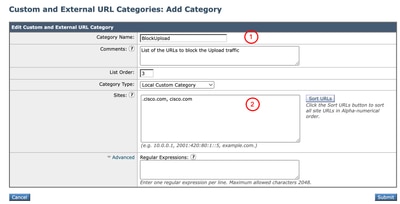
| Step 1. Create a Custom URL Category for the website. |
1.1. From the GUI Navigate to Web Security Manager and choose Custom and External URL Categories. 1.2. Click Add Category to create a new Custom URL Category. 1.3. Enter Name for the new category. 1.4. Define the domain and/or subdomains of the website that you are trying to block upload traffic (In this example is cisco.com and all its subdomains). 1.5. Submit the changes.
|
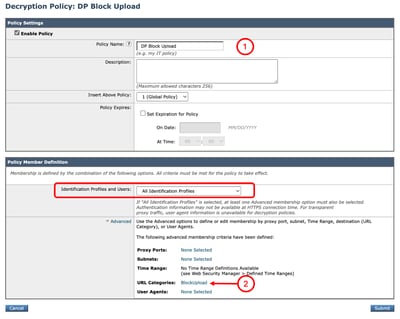
| Step 2. Decrypt the traffic for the URL |
2.1. From the GUI, Navigate to Web Security Manager and choose Decryption Policies 2.2. Click Add Policy. 2.3. Enter Name for the new policy. 2.4. (Optional) Select the Identification Profile that you need this policy applies to. 2.5. From Policy Member Definition section, Click URL Categories links to add the Custom URL Category. 2.6. Select the URL Category that was created in Step 1. 2.7. Click Submit.
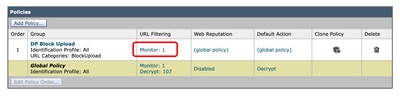
2.8. In Decryption Policies page, click the link from URL Filtering for the new policy.
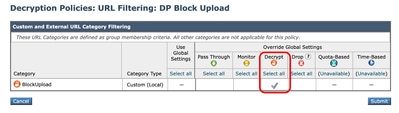
2.9. Choose Decrypt as the action for Custom URL Category. 2.10. Click Submit.
|
| Step 3. Block the Upload Traffic |
3.1. From the GUI, Navigate to Web Security Manager and choose Cisco Data Security. 3.2. Click Add Policy. 3.3. Enter Name for the new policy. 3.4. (Optional) Select the Identification Profile that you need this policy applies to. 3.5. From Policy Member Definition section, Click URL Categories links to add the Custom URL Category. 3.6. Select the URL Category that was created in Step 1. 3.7. Click Submit.
3.8. In Cisco Date Security Policy page, click the link from URL Filtering for the new policy.
3.9. Choose Block as the action for Custom URL Category. 3.10. Click Submit.
3.11. Commit changes. |
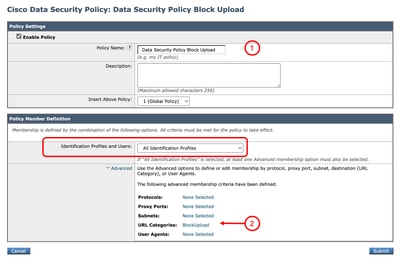
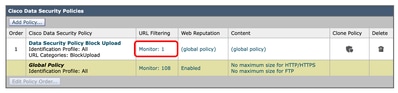
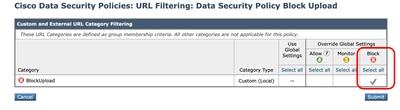
Reporting and Logs
Logs
You can view the logs related to the upload traffic from CLI by choosing idsdataloss_logs which is the default logging name for Data Security Logs.
Use these steps to access the logs:
Step 1. Log in to the CLI
Step 2. Type grep and press Enter.
Step 3. Find and type the number associated with idsdataloss_logs:
- Type: "Data Security Logs"
- Retrieval: FTP Poll and press Enter.
Step 4. (Optional) Enter the regular expression to grep you fan filter by keywords, or you can press Enter, to view all the logs
Step 5. (Optional) Do you want this search to be case insensitive? [Y]> If you select any keywords in the Step 4 you can choose the filter be case insensitive or not.
Step 6. (Optional) Do you want to search for non-matching lines? [N]> In case you need to filter all the logs except the selected keywords defined in Step 4 you can use this section, else, you can press Enter.
Step 7. (Optional) Do you want to tail the logs? [N]> If you need to view the live logs, type Y and press Enter. Otherwise, press Enter to display all the available logs.
Step 8. (Optional) Do you want to paginate the output? [N]> If you need to see the results per page, you can type Y and press Enter, else pres Enter to use the default value [N].
Reporting
You can generate Web Tracking report to view the reports of the blocked upload traffic by the Cisco Data Security policy name.
Use these steps to generate the reports:
Step 1. From the GUI, select Reporting and choose Web Tracking.
Step 2. Choose your desired Time Range.
Step 3. Click the Advanced link to search transactions using advanced criteria.
Step 4. In the Policy section, select Filter by Policy and type the name of the Cisco Data Security that was created previously.
Step 5. Click Search to review the report.
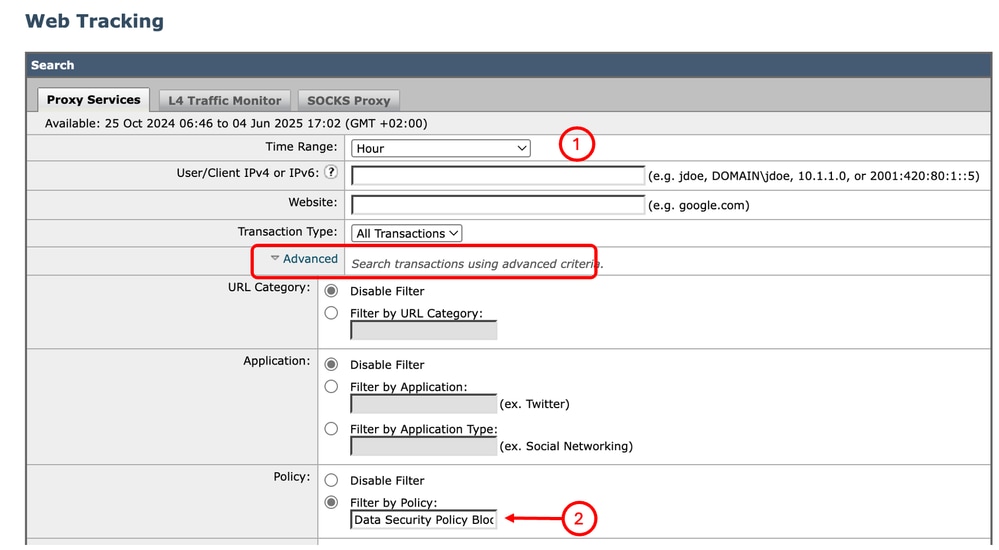 Image - Filtering the Web Tracking Reports
Related Information
- User Guide for AsyncOS 15.2 for Cisco Secure Web Appliance
- Cisco Secure Email and Web Virtual Appliance Installation Guide
- Configure Custom URL Categories in Secure Web Appliance - Cisco
-
Configure SCP Push Logs in Secure Web Appliance with Microsoft Server
-
Enable Specific YouTube Channel/Video and Block Rest of YouTube in SWA
Revision History
| Revision | Publish Date | Comments |
|---|---|---|
2.0 |
30-Jul-2026
|
Recertification |
1.0 |
11-Jun-2025
|
Initial Release |

 Feedback
Contact Cisco
- Open a Support Case

- (Requires a Cisco Service Contract)