Guest

Carrier Ethernet

Metro Ethernet Technology on Cisco Catalyst 6500 Series Switch

Technology Brief

In more than 25 years, Ethernet technology has experienced several changes, evolving from a shared-media half-duplex 10 Mbps LAN technology to a full-duplex switched 10/100/1000/10000 Mbps LAN technology, as the demand for higher networking speeds has grown. Ethernet switches, too, have evolved with advanced capabilities; notably, advanced quality of service (QoS) and security, which previously were available only for other more expensive media.

By offering cost effective bandwidth, Ethernet has made it possible for digital applications to flourish by taking advantage of a high-performance infrastructure and delivering unprecedented services. Because of its intrinsic qualities, Ethernet has been the desktop technology of choice since it emerged as the most cost effective delivery option for high-speed connectivity.
More recently, a similar trend has emerged in the metropolitan-area networks (MANs), where dark fiber allows providers to offer cost-effective high-speed Ethernet connections to business and residential customers.
MAN architectures using Ethernet technology are based on two types of network design: a classic IP-centric Layer 3 design or a pure Layer 2 design. The pure Layer 2 design is popular because of its simplicity and its "transparency" to user traffic and protocols. This is referred to as Transparent LAN Services (TLS).
In the evolution of Ethernet switching and routing in metropolitan environments, the contribution of Cisco Systems® is dependable and is marked by milestones, such as the introduction of several important metro technologies. Cisco® has summarized these milestones in Metro Solutions for Service Providers guides (for more details, see [1]).
These guides provide methodologies for building an advanced metropolitan network that takes advantage of the latest Cisco networking products and technologies.
As a cornerstone of Cisco metro solutions, the Cisco Catalyst® 6500 Series Multilayer Switch spearheads the evolution toward a highly scalable, multifaceted network architecture that can adapt easily to evolving needs by growing in flexibility and performance and by offering customers unique investment protection.
The flexibility of the Cisco Catalyst 6500 Series makes it suitable to use in any tier of a multitiered network architecture. It supports the powerful features that are oriented to the core, distribution, and access layers of a network. When deployed end-to-end in a network, the Cisco Catalyst 6500 Series provides maximum benefits and a high return on investment (ROI).

PRIMARY BENEFITS OF CISCO CATALYST 6500 SERIES SWITCH

The most flexible network device available for any metro solution is Cisco Catalyst 6500 Series Switch. Several effective reasons account for this flexibility (see Table 1).

Table 1. The Cisco Catalyst 6500 Series Switch Advantages

Feature

Description

Advanced Layer 2 Features

Productivity-Enables new services and provides better network resiliency.

Advanced QoS Capabilities

Availability of mission critical applications-Ensure the night applications and users receive the correct service levels throughout the network infrastructure.

Layer 3 through 4 Features

Scalability and protection-Allow the network to support IP services and secure information assets by preventing unauthorized access at the source.

High Availability

Productivity-High availability maximizes productivity and minimizes support costs.

Advanced Multicast Support

Productivity-Enable new innovation in voice and video applications while maximizing network efficiency.

Support for 10 GbE, Coarse and Dense Wavelength Division Multiplexing (CWDM and DWDM) Interfaces

Scalability-Maximize network bandwidth and facilitate network design.

All the benefits in Table 1 result from the sophisticated hardware and software architecture that has been the foundation of the Cisco Catalyst 6500 platform since its introduction to the market.
Some of the Cisco Catalyst 6500 Series most important features for metropolitan networks are described in the following sections.

802.1Q TUNNELING AND TLS

802.1Q tunneling* (QinQ), also known as tag stacking, allows the deployment of secure TLS by building on the standard capabilities of the IEEE 802.1Q protocol (please see reference 2) that is included on all Cisco switches. In particular, 802.1Q tunneling or tag stacking enables service providers to offer "virtual private LANs" that appear as a logical wire or pipe to their customers. Although some customers use overlapping VLAN ranges, traffic remains isolated from one customer to another customer. Point-to-point and point-to-multipoint topologies are possible and easy to deploy. With the introduction of Layer 2 Protocol Tunneling (L2PT), resilient network designs can be implemented. See the following sections for more details on L2PT.
The main advantage of 802.1Q tunneling is that it enables service providers to segregate traffic from different size (enterprise, medium, or small) customers in their infrastructure, while significantly reducing the number of VLANs required to support individual customer connections. Multiple customer VLANs can be transparently carried inside a single provider VLAN configured on a Cisco Catalyst 6500 Series without losing their unique VLAN IDs. In addition, the number of VLANs required to support 802.1Q tunnels in the service provider network can be reduced significantly, while the aggregate number of available VLANs can jump from 4096 up to a theoretical maximum of more than 16 million (= 40962). By using these Layer 2 tunnels, it is possible to deliver enterprise-scale connectivity deployed on a shared infrastructure with the same security, prioritization, reliability, and manageability of a private network.
* Supported on all Cisco Catalyst 6500 supervisors and linecards starting with Cisco Catalyst OS Release 6.1 and with Cisco IOS® Software Release 12.1(11b)EX.

NETWORK DESIGN WITHOUT CISCO IEEE 802.1Q TUNNELING

Service providers deploying TLS service networks have two main issues: VLAN overlap and VLAN transparency. Enterprise customers with VLANs transiting the service provider cloud may use ranges of VLANs that overlap with the service provider (shown in Figure 1), a situation that may cause inadvertent mixing of different customers' traffic through the Layer 2-based network infrastructure. Assigning a unique range of VLANs to each customer in the service provider network solves this problem but rapidly consumes the 4096 VLAN space supported by the 802.1Q standard.

Figure 1. Different Customers Using Overlapping VLAN Ranges

802.1Q tunneling technology addresses this limitation by using a double 802.1Q tagging scheme, allowing service providers to assign a separate VLAN to each customer without losing the original customer VLAN IDs inside the tunnel. For each service provider VLAN, up to 4096 enterprise VLANs can be encapsulated, providing better scalability of the TLS network.

NETWORK DESIGN WITH 802.1Q TUNNELING

In TLS networks, the ideal scenario to support multiple enterprise customers in the service provider environment is to have customers utilize any range of VLAN numbers while the service provider forwards the traffic independently of those VLAN IDs (transparently, that is). See Figure 2.

Figure 2. Different Customer VLANs Carried Within Service Providers L2 Tunnels

By assigning a unique VLAN number to each customer, the identity of the VLAN IDs received from customer sites can be preserved. Therefore, this mechanism builds Layer 2 tunnels inside the service provider core where traffic from different business customers is segregated and where it is marked with an appropriate tunnel ID.
802.1Q tunneling is also called tag stacking because it is a double encapsulation technique. It expands the VLAN space by adding an additional 802.1Q tag (the tunnel ID) to all previously-tagged packets when they enter the service provider infrastructure, as illustrated in Figure 3.

Figure 3. Different Customer VLANs Carried Within Service Providers Layer 2 Tunnels

The interfaces on the customer premises equipment (CPE) are configured as 802.1Q trunks (note: Inter-Switch Link [ISL] encapsulation technology is not supported), while the interfaces on provider edge switches are configured as special 802.1Q tunnel ports. Because one side of this point-to-point link is a trunk and the other is not, it is called an asymmetric link. The special tunnel port on the provider edge side is configured with a unique VLAN that the service provider assigns to the directly-attached customer. When this port receives tunnel traffic from the neighboring device, it does not follow the usual procedure of stripping the 802.1Q tags from the frame header for internal forwarding processes. Instead, it leaves the incoming 802.1Q tag intact and puts all the received 802.1Q traffic into the VLAN assigned to the tunnel port. As a result, traffic is double-tagged** as it enters the first port of the service provider infrastructure.
The CPE may be any switch capable of generating 802.1Q-encapsulated frames. Only the provider edge switches inside the service provider network need to be "tag-stacking capable." Other service provider core switches (called P switches) do not need to be aware of the double-tagging scheme, because they switch traffic based on the outermost 802.1Q tag; therefore, no special software is required on P switches.
** Traffic is logically double-tagged. In fact, a user cannot see how many tags are used inside the switch when the packets are received.

802.1Q TUNNELING TECHNOLOGY OVERVIEW

To understand the functions and operation of the 802.1Q tunneling technology, examine a packet flow to see how the feature works when a packet traverses the service provider network. Figure 4 illustrates the process. The steps are described later in the section.

Figure 4. Frame Passing Through an 802.1Q Tunnel

The following steps demonstrate how 802.1Q Tunneling works:

Step A

An Ethernet frame on a specific VLAN arrives on the provider edge switch from the CPE. The CPE switch is any switch capable of supporting 802.1Q trunks. ISL trunks are not supported because the egress frame from the CPE needs to be 802.1Q-encapsulated, as depicted below:

DA (6B)

SA (6B)

Etype (8100) (2B)

802.1Q Tag (2B)

Length/Etype (2B)

Data (46*-1500 Bytes)

FCS (4B)

Note: The minimum payload size of an 802.1Q packet is actually 42 bytes and can be used by certain 802.1Q-capable hosts. Devices sending untagged traffic must use a minimum payload size of 46.

Note: (DA = destination address, SA = source address, Etype = Ethertype, FCS = frame control sequence)

Step B

The ingress port of the provider edge does not remove any 802.1Q headers from the incoming frame; instead, it adds a second tag. In the example below, a second VLAN is assigned to a customer on the provider edge switch and, therefore, its tag (outer tag) is appended to the original tag (inner tag). ISL or 802.1Q links can carry tunneled traffic between provider edge (PE) and provider core (P) switches inside the service provider infrastructure. Below is the diagram of the frames leaving the provider edge Cisco Catalyst 6500 Series switch. Additions to the original frame are shown in blue and in boldface. If the ISL trunk encapsulation is used from provider edge to provider core devices, the result is:

ISL (26B)

DA (6B)

SA (6B)

Etype 8100* (2B)

CPE 802.1Q Tag (2B)

Length/Etype (2B)

Data (46-1500 Bytes)

FCS (4B)

Note: 0x8100 is a reserved Ethertype indicating that an 802.1Q tag follows.

If, instead of ISL, we use the 802.1Q encapsulation, the result is:***

DA (6B)

SA (6B)

Etype (8100) (2B)

PE 802.1Q Tag (2B) OUTER TAG

Etype (8100) (2B)

CPE 802.1Q Tag (2B) INNER TAG

Len/Etype (2B)

Data (46-1500 bytes)

FCS (4B)

*** When using the 802.1Q encapsulation between a provider edge and a provider core switch or between two provider edge switches, two 802.1Q tags are present in the frames leaving the ingress provider edge switch. The provider edge-assigned tag is referred to as the outer tag, and the CPE-assigned tag is referred to as the inner tag. Provider core switches forward double-tagged frames based exclusively on the outer tag.

Step C

The egress provider edge switch removes the outer 802.1Q tag before delivering traffic to the destination CPE. In this example, the outer tag is removed but the original inner tag is retained:

DA (6B)

SA (6B)

Etype (8100) (2B)

802.1Q Tag (2B)

Length/Etype (2B)

Data (46-1500 bytes)

FCS (4B)

Finally, the CPE switch removes the original tag and forwards the frame to the end host, with the following result:

DA (6B)

SA (6B)

Length/Etype (2B)

Data (46-1500 bytes)

FCS (4B)

QOS AND COS MUTATION WITH 802.1Q TUNNELING

When transiting through the service provider core, double-tagged frames always retain the inner 802.1Q tag originally imposed by the CPE device. As a result, packets appear on the switching fabric of Cisco Catalyst 6500 Series acting as provider edge (PE) or provider core (P) switches with two 802.1Q tags. This creates a byte-realignment within the frame, causing the IP header information to be unidentifiable by provider edge or provider core switches. This imposes the following conditions:

• Layer 3 and higher information within the double-tagged Layer 2 frame cannot be identified

• Tunnel traffic (e.g. between PE and P, or between P and P switches) cannot be routed or Layer 3 policed

• PE and P switches can filter tunnel traffic using only Layer 2 parameters (VLANs or Source/Destination MAC addresses). A MAC-based access list will match all types of traffic: MAC-based, IP, IPX, etc.

The inner tag's user priority bits (also known as the three bits of Class of Service [CoS]) are preserved end-to-end, from CPE to CPE. Figure 5 shows where CoS bits are located in the 802.1Q tag.

Figure 5. Position of the CoS Bits

It is always possible for the service provider to assign CoS values to the outer tag, either statically or dynamically. To mark the outer tag CoS bits statically, the network administrator assigns a default CoS value to the CPE-facing 802.1Q tunnel port. This results in one selectable CoS value per CPE-facing port.
When using a Cisco Catalyst 6500 Series Switch equipped with a Supervisor Engine 2 (or higher), it is also possible for the network administrator to dynamically assign the outer tag CoS value, based on the incoming traffic rate conformance to a bandwidth contract. To assign the outer tag dynamically, a dual-rate policer specifying a normal and an excess rate is defined. Different actions can be specified, depending on the traffic behavior. A typical scenario consists in selling a customer three classes of service: bronze, silver, and gold. First, a static CoS value (two, for example) is assigned to the CPE-facing port. When traffic conforms to the normal rate, the policer takes no action, the port sets the CoS to two in the outer tag, and traffic flows through. When traffic exceeds the normal rate but is below the excess rate, the outer tag CoS is set ("marked down") to one, and traffic is transmitted. When traffic exceeds the excess rate, the CoS is set to zero.
When using a Cisco Catalyst 6500 Series equipped with Supervisor Engine 720 and the new WS-X6700 series of line cards (or other more recent Ethernet modules), an additional function-CoS Mutation-allows the service provider's provider edge switch to inspect the CPE-assigned inner tag CoS value and use it to assign the outer tag CoS value. In this scenario, the ingress 802.1Q tunnel port would have to be configured as a trusted port (meaning that the received CoS bits will be inspected) and an ingress CoS mutation map would have to be used to specify which outer tag CoS value to use in correspondence with each inner tag CoS value.
The CoS Mutation functionality is described in Figure 6.

Figure 6. CoS Mutation on 802.1Q Tunnel Ports

The default CoS mutation map contains the identity mappings: 1 to 1, 2 to 2, 3 to 3, etc. In this configuration, the feature is sometimes informally called "copy of inner to outer CoS bits."
Starting with Cisco IOS Release 12.2(17b)SXA, in PFC3B/BXL mode, it is also possible to apply a QoS MAC ACL that includes the cos keyword and that can therefore match based on the packet's CoS value. This is particularly handy with QinQ traffic, which is treated as a non-IP protocol (i.e., "MAC") by the ACL logic: a MAC ACL using the cos keyword can be used to apply a policy to the QinQ traffic based on its outer CoS value (which can be derived from the inner CoS value on the ingress port by using the CoS mutation feature.) In addition, the vlan keyword can also be optionally enabled with the global command mac packet-classify use vlan: this keyword can be used in a MAC ACL to match traffic based on the outer VLAN number (however make sure you don't need to apply any IS-IS policy in the system, which would conflict with this feature).
In order to be able to apply the same new cos- and vlan-based filtering capabilities to both IP and non-IP traffic, it is necessary to use a new feature also available starting from the aforementioned IOS Release in PFC3B/BXL mode: Protocol-Independent MAC ACLs. This feature can be enabled on a per-vlan basis with the command mac packet-classify but it's limited to use only on Layer-2 VLANs.

L2PT

Prior to Catalyst OS Release 7.1 and Cisco IOS® Software Release 12.1(11b)EX, the 802.1Q tunneling feature did not tunnel customer-originated spanning tree bridge protocol data units (BPDUs), Cisco Discovery Protocol or VLAN Trunking Protocol (VTP) frames through the service provider cloud. Customer BPDUs were tunneled only from CPE-facing to CPE-facing port on the same provider edge switch, as shown in Figure 7.
Without protocol tunneling, Cisco Discovery Protocol and VTP PDUs are terminated at the provider edge switch; in other words, referring to Figure 7, a show cdp neighbor command performed on any CPE device would show the provider edge as a neighbor instead of another CPE. Catalyst OS Release 7.1 and Cisco IOS Software Release 12.1(11b)EX introduced L2PT, which allows customer PDUs (such as BPDUs, Cisco Discovery Protocol, and VTP frames) to be transparently carried from CPE to CPE across the service provider network creating a logical connection between the two ends.
The L2PT feature provides a scalable approach to PDU tunneling by software encapsulating the PDUs on the ingress provider edge switches and then multicasting them out, using the hardware forwarding mechanism of the switch. All P switches inside the service provider network treat these encapsulated frames as regular data packets and forward them out appropriately. The egress provider edge switch listens for these specially encapsulated frames and decapsulates them before forwarding them out of the tunnel.
The L2PT encapsulation mechanism rewrites the destination MAC address of CPE-originated PDUs. In particular, the ingress provider edge switch rewrites the destination MAC address of the PDUs received on a tunnel port with a Cisco reserved multicast MAC address (01-00-0c-cd-cd-d0). The PDU is then flooded out on the tunnel port VLAN (for example, if the 802.1Q tunnel port is in VLAN 5, the frame is flooded in VLAN 5). Figure 7 illustrates the L2PT concept with the three types of special frames.

Figure 7. With L2PT, BPDUs, Cisco Discovery Protocol, and VTP Messages Are Passed Across the Layer 2 Service Provider Network

SPANNING TREE AND L2PT

If the L2PT feature is not enabled, providing Layer 2 redundancy to customers is difficult because, by default, 802.1Q tunneling does not transport customer BPDUs between two sites across the service provider backbone. Therefore, loops are not allowed between client sites that are interconnected by 802.1Q tunneling. The only redundant design that is allowed is when the CPE switches of a client site are connected to the same provider edge in the service provider core as depicted in the figure below.

Figure 8. Redundant Layer 2 Design Without L2PT

The issue of a redundant design primarily relates to the spanning tree interaction between the enterprise and the service provider. Within the service provider cloud itself, the normal rules of spanning tree, either 802.1D or 802.1S/W, apply. The introduction of L2PT offers more flexibility to the service provider in terms of resilient network design. The service provider can offer dual homing to CPE switches as illustrated in Figure 9.

Figure 9. CPE-to-CPE Redundancy With L2PT

In Figure 9, the service provider has enabled L2PT for BPDUs on all four provider edge switches on ports 6/1, 5/1, 4/6 and 2/6. These ports are also 802.1Q tunnel ports and are all part of the same VLAN: this creates a L2 VPN between CPE#1 and CPE#2. BPDUs sent from CPE#2 (assumed to be the root for the customer VLANs) are now received by CPE#1, which in turn can block port 2/2 to break the logical loop. Without L2PT, the loop would have been undetected and traffic would have circled endlessly around the topology, paralyzing the network.
An alternative to the Spanning Tree Protocol that can be used to support redundant paths is FlexLinks, a new feature introduced in Cisco IOS Release 12.2(18)SXF. Although FlexLinks is a promising alternative for certain simple scenarios, it is still relatively new and on the Catalyst 6500 family as of this writing still lacks the so-called "FlexLinks Bi-directional Fast Convergence" enhancement.

ROOTGUARD AT THE INGRESS PROVIDER EDGE SWITCH

When L2PT is not enabled****, the spanning tree of the native***** VLAN of the CPE switch merges with the spanning-tree of the 802.1Q tunnel port VLAN of the provider edge switch, even if the native CPE switch VLAN does not match the service provider-assigned VLAN on the provider edge. BPDUs for other VLANs are simply dropped when arriving on the PE switch. This is undesirable for a service provider, because any CPE device potentially becomes the root of the service provider backbone VLAN (the VLAN of the 802.1Q tunnel port). Cisco developed Rootguard to prevent root bridge takeover.
Basic spanning tree calculations involve two fields: Bridge ID (BID) and Path Cost. A BID is a single, 8-byte field that is composed of two subfields shown below:

Bridge Priority (2 bytes)

MAC address (6 bytes)

The default bridge priority is 32,768. Cisco Catalyst 6500 Series switches choose a single root bridge per VLAN, based on the lowest BID. If the CPE switch in the tag stacking scenario has a lower MAC address and bridge priority than the provider edge switch, it becomes the spanning tree root for the service provider-assigned VLAN, resulting in a modified service provider-backbone topology.
**** With L2PT, BPDUs from the CPE switch native VLAN can no longer merge with the provider edge switch's spanning tree. In that case, Rootguard is unnecessary.
***** The native VLAN of an 802.1Q port is the VLAN which all untagged frames are assigned to.

Figure 10. Selection of an Incorrect Root Switch Outside of the Service Provider Network

Rootguard can be enabled on a per-port basis on the provider edge switch to prevent customer switches from becoming the root. If the client side attempts to take root ownership, the 802.1Q tunnel port goes into a root-inconsistent state. When the port stops receiving superior BPDUs from the CPE switch, it leaves the root-inconsistent state after a period of max_age seconds.L2PT Thresholds and Rate Limiters
To ensure that the PDUs do not flood the network, L2PT supports input per-port drop thresholds that can be configured to set a predefined level (in packets per second [pps]). PDUs to be tunneled that are above this level are dropped. This limits the total processing bandwidths that PDUs can consume.

Figure 11. Drop Thresholds for Tunneled PDUs

An input shutdown threshold can also be configured on a port and, if the volume of PDUs exceeds the shutdown threshold, the port is put into an errdisable state.
Beginning with Cisco IOS Software Release 12.2(17a)SX, L2PT has been enhanced with a global rate limiting ability. Based on a defined global threshold, any VTP, Cisco Discovery Protocol, or STP packets in excess of that threshold limit are dropped to better shield the management CPU from dangerous surges of traffic coming from a multitude of CPE devices. This capability, coupled with Supervisor Engine 720's "mls rate-limit layer-2" hardware functionality, provides a good protection of the control plane from possible overloads due to an excess of PDU traffic.

Figure 12. Global Drop Thresholds for Tunneled PDUs

VLAN TRANSLATION

Occasionally, service providers must provide an 802.1Q VLAN to their customers without being able to tunnel it through an 802.1Q tunnel. That creates a constraint on the VLAN number to use, because that VLAN is allocated globally in the service provider network and can no longer be used by another customer. To overcome this limitation, beginning with Cisco IOS Software Release 12.2(17b)SXA and with Catalyst OS Software Release 8.4, the Cisco Catalyst 6500 Series provides VLAN translation, which allows the service provider to rewrite the packet VLAN when the traffic ingresses or egresses the network, as shown in Figure 13.

Figure 13. VLAN Translation at the Ingress Point of the Service Provider Network

VLAN translation is a hardware function available on most of the port application-specific integrated circuits (ASICs) of the Cisco Catalyst 6500 Series line cards. Its support varies, depending on the type of line card in use. For more details, refer to Cisco IOS Software Release 12.2(17b)SXA's documentation [3] and release notes.
Moreover, when using the Gigabit Ethernet WAN (GE-WAN) interfaces on the OSM-2+4GE-WAN+ Optical Services Module (OSM), it is also possible to use two new types of VLAN translation: QinQ Translation (also known as double-tag to single-tag translation) and QinQ Transparent Tunneling (also known as double-tag to double-tag translation). On such interfaces, in addition to these two translations, copy of the inner CoS value to the outer CoS value as well as advanced traffic shaping policies can be applied to the QinQ frames.

DSCP AND 802.1Q TRANSPARENCY

Due to its L3 heritage, the default behavior of the Cisco Catalyst 6500 Series architecture links the traffic CoS value to a corresponding differentiated services code point (DSCP) value, which is treated as a superset of the original CoS. Most metro Ethernet solutions require that the customer DSCP value be maintained unaltered end-to-end, and only the Layer 2 CoS value be used to mark or classify the traffic within the service provider network.
First available with Cisco IOS Software Release 12.1(19)E1, the mls queuing-only feature was introduced to maintain CoS and DSCP unchanged while disabling the policy feature card (PFC) QoS functions (marking and policing). This behavior is undesirable and, starting with Cisco Catalyst OS Release 8.2 and Cisco IOS Software Release 12.2(17b)SXA on Supervisor Engine 720, a hardware-based feature called DSCP Transparency was implemented to break the linkage between CoS and DSCP, even when PFC QoS functions are enabled. Figure 14 shows the behavior of a network where the DSCP value is preserved end-to-end by using DSCP Transparency.

Figure 14. DSCP Transparency

Moreover, if the traffic has to traverse an MPLS cloud, with Optical Services Modules (OSMs) it is possible to apply a similar feature known as 802.1Q Transparency for EoMPLS (available with Cisco IOS Release 12.2(18)SXF1 or later): it allows a service provider to choose to modify the MPLS EXP bits for core-based QoS policies while leaving any customer CoS bits unaltered. The 802.1Q Transparency for EoMPLS feature causes a VLAN-based policy to affect only the IGP label (for core QoS) and leaves the VC label's EXP bits equal to the CoS bits.

OTHER NOTABLE FEATURES AND ENHANCEMENTS FOR METRO ETHERNET APPLICATIONS

With Cisco IOS Release 12.2(18)SXE a few new enhancements have been introduced: the Port Security feature has been extended to support 4096 secure MAC addresses, with or without stickiness, which can now also be learned on trunk ports, 802.1Q tunneling ports as well as Private VLAN ports. In addition, a new feature called Per port MAC Limiting has been introduced to limit the number of MAC addresses on a per-VLAN basis.
However, whereas Port Security is bound by the number of available MAC address entries in the Layer 2 table and by the processing power of the management processor, the Per-port MAC Limiting feature has generally no such constraints, although it lacks the granularity of Port Security and therefore it is not as accurate as Port Security in the purging process of the violating MAC addresses.
Another significant enhancement is represented by the Configurable Per VLAN MAC Learning (PVL, in short) feature. It can be used to disable MAC learning on two-port VLANs (which don't require address learning) and/or on VLANs that are not actively used by certain DFC modules, so as to maximize the overall utilization of the L2 forwarding table(s) in the switch's forwarding engine(s).
Noteworthy is also the introduction with Cisco IOS Release 12.2(18)SXF of the EtherChannel Min-Links feature, which allows the user to configure the minimum number of member ports that must be in the link-up state and bundled in the EtherChannel for the port channel interface to transition to or remain in the link-up state. This handy feature can be used to fail over from one EtherChannel to another in case the former falls below a minimum number of active links (i.e., below a minimum bandwidth threshold) when used in redundant configurations.

ETHERNET OVER MPLS

Ethernet over Multiprotocol Label Switching (EoMPLS) is used to transport Ethernet frames across an MPLS network along a point-to-point path.
When the edge switch receives an Ethernet packet, it is encapsulated into an MPLS packet to be transported across the network over a virtual circuit. Two labels are imposed on the original Ethernet packet; one represents the tunnel the packet is to use, and the other represents the MPLS path to forward the packet along. An overview of an EoMPLS application is shown in Figure 15.

Figure 15. EoMPLS Example

EoMPLS has four main types of transport:

• 802.1Q VLAN to 802.1Q VLAN, often referred to as VLAN mode

• Ethernet port to Ethernet port, often referred to as port mode

• 802.1Q VLAN to Ethernet port

Switched Virtual Interface (SVI)****** mode, in which both Layer 2 switching and EoMPLS tunneling are performed on the traffic

EoMPLS on Supervisor Engine 720 and Supervisor Engine 32 is supported in two different configurations:

• With PFC3B/PFC3BXL (and DFC3B/BXL, when supported) performing the EoMPLS feature. In this case any module can be the uplink to the MPLS core.*******

• With a FlexWAN or a SPA interface processor (SIP) or an optical service module (OSM) parallel express forwarding (PXF)-enabled interface as the uplink to the MPLS core performing the EoMPLS feature.

EoMPLS on Supervisor Engine 2 is supported, instead, with only a FlexWAN or an OSM PXF-enabled interface as the uplink to the MPLS core.
In an advanced metro deployment scenario, it is possible to combine the point-to-multipoint capabilities of 802.1Q tunneling with the scalability of EoMPLS (derived from its MPLS foundation) to gain the maximum benefit from the deployment of these two powerful technologies. The logical evolution of this type of design is described in the following section.
****** Switched Virtual Interface. A routed interface associated to a L2 switched VLAN.
******* However, in this case SVI mode is not supported.

VIRTUAL PRIVATE LAN SERVICE

Virtual Private LAN Service (VPLS) provides a multipoint solution for Layer 2 connectivity across an MPLS network. Although EoMPLS provides a point-to-point logical wire or "circuit" that can be terminated on a single provider edge device, VPLS provides either a full mesh or a partial mesh of connection circuits (or pseudo-wires) between all the participating provider edges, to allow all customer equipment to connect to each other as if they were attached to the same Ethernet segment.
Figure 16 illustrates the VPLS architecture.

Figure 16. VPLS Architecture

In Figure 16, the customer equipment that is attached to the provider edges by using VLANs coupled to the so-called virtual forwarding instances (VFIs). VFIs replace the virtual circuits used with regular EoMPLS and are the new abstractions for the configuration of the multipoint tunnels in VPLS.
With VPLS, broadcast, multicast, and unknown unicast traffic is handled by the provider edge switches by flooding the traffic to all pseudo-wires. To prevent loops, the provider edge switches use the split horizon algorithm; therefore, they do not send traffic back into the MPLS cloud.
Beginning with Cisco IOS Software Release 12.2(17b)SXA, Supervisor Engine 720******** supports VPLS when using WAN cards as uplinks to the MPLS core.
******** And in a subsequent release, also Supervisor Engine 2.
For information on the VPLS support on OSM and SIP modules, please refer to the online documentation available here:

http://www.cisco.com/univercd/cc/td/doc/product/core/cis7600/cfgnotes/optical/122sx/mpls.htm - wp1338226

http://www.cisco.com/univercd/cc/td/doc/product/core/cis7600/76sipspa/sipspasw/76sipssc/76ovwsip.htm

As with EoMPLS, in the most sophisticated metro deployments it is possible to combine the Layer 2 multipoint scalability and the simplicity of 802.1Q tunneling to the robustness of a multipoint MPLS core by tying 802.1Q tunneling and VPLS together in a hierarchical fashion, as shown in Figure 17.

Figure 17. Integration of 802.1Q Tunneling with VPLS

Recently, with the introduction of Cisco IOS Release 12.2(18)SXF, VPLS has been extended with the H-VPLS with MPLS Edge feature, which supports a combination of full-mesh connectivity with split-horizon (typically limited to the core where scalability concerns are lesser) and hub-and-spoke connectivity (applicable to the edge where a high number of devices can be interconnected to the core)

HARDWARE FLEXIBILITY AND SCALABILITY

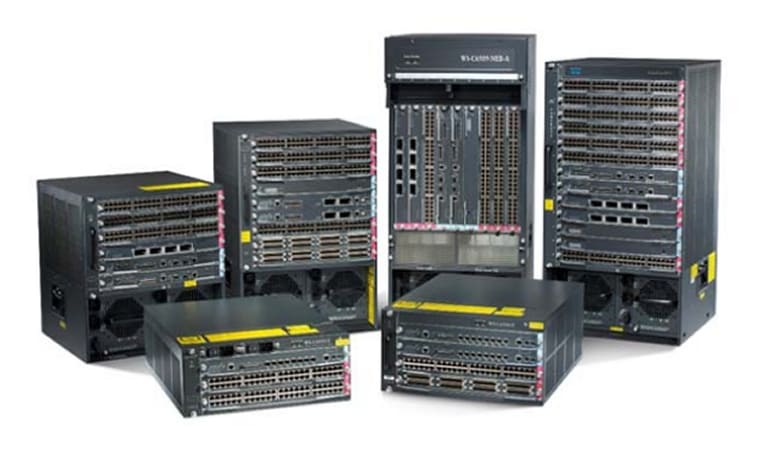
The Cisco Catalyst 6500 Series supports a wide variety of module options for business and residential service deployments. Cisco Catalyst 6500 Series switches ship in 3-slot, 6-slot, 9-slot, and 13-slot configurations and support a range of Ethernet interfaces from 10/100 Mbps to Gigabit to 10 Gigabit Ethernet with copper and fiber interfaces.
Recent additions to the already-ample portfolio of modules include the advanced 6700 series line cards, which require Supervisor Engine 720:

• Cisco Catalyst 6500 Series 4-port 10 Gigabit Ethernet Module

• Cisco Catalyst 6500 Series 24-port mixed media Gigabit Ethernet Module

• Cisco Catalyst 6500 Series 48-port mixed media Gigabit Ethernet Module

• Cisco Catalyst 6500 Series 48-port 10/100/100 Gigabit Ethernet Module

• Cisco Catalyst 6500 Series 48-port SFP-based 100BaseX Ethernet Module

These new modules support a variety of media interfaces, ranging from fixed RJ-45 connectors for Category 5 twisted-pair cables to the flexible media modules known as Small Form-Factor Pluggables (SFPs) that support 1000BASE-SX/LH/ZX, as well as coarse wavelength-division multiplexing (CDWM) transmission.
On the 10 Gigabit Ethernet side, new XenPak pluggable modules support the latest transceivers defined by the IEEE, including the 10GBASE-LR (1310-nm long-reach technology that supports distances of up to 10 kilometers [km]) and the 10GBASE-ER (1550-nm extended reach technology that supports distances of up to 40 km). Advanced ZR and DWDM XenPak optics also offer the possibility to support extended distances of up to 80 km over standard single mode fiber (SMF).
In some metro applications, a 10GBASE-ER or 10GBASE-ZR XenPak can be used for long-haul deployments in conjunction with a Cisco Erbium Doped Fiber Amplifier (EDFA) to extend the reach of a 10 Gigabit Ethernet Single Mode Fiber (SMF) link, even in excess of the standard maximum distance.
Figure 18 summarizes Cisco Catalyst 6500 Series wide range of hardware technologies for any Metro Ethernet deployment.

Figure 18. Media Options Offered by the Newest Cisco Catalyst 6500 Modules Module Series

CONCLUSION

As the premier Cisco intelligent multilayer modular switch, the Cisco Catalyst 6500 Series delivers secure, converged network services from the metro access to the WAN/MAN edge for service provider metro Ethernet deployments.
Supervisor Engine 720 is part of Cisco Catalyst 6500 Series third-generation (3G) suite of modules to continue lowering total cost of ownership (TCO) while increasing the total system bandwidth and packet-forwarding capability. A Cisco Catalyst 6500 Series switch using a Supervisor Engine 720 offers up to 410 Gigabit Ethernet ports, with a maximum throughput of 400 Mpps for IPv4 and 230 Mpps for IPv6.
Cisco Catalyst 6500 Series optimizes infrastructure utilization and maximizes ROI by using forward-thinking architecture that supports an unparalleled range of services, including data and voice integration and WAN/MAN convergence with these additional benefits:

• Maximum network uptime for higher user productivity and business resiliency

• Comprehensive network security using proven multigigabit Cisco technology

• Investment protection and long product life cycle supporting multiple generations of interfaces and packet forwarding engines

• Operational consistency allowing customers to standardize on a single platform that addresses all network deployment requirements

• Leading services integration supporting the application-aware convergence of data, voice, and video onto a single highly-manageable platform

In a metro Ethernet Layer 2 end-to-end deployment, Cisco Catalyst 6500 Series can be deployed in the metro access, aggregation, edge, and core layers of the network because of the advanced metro technologies that it supports.
Similarly, in a metro environment with a Layer 2 access connected to a Layer 3 edge and core network or in a Layer 3 end-to-end deployment, the Cisco Catalyst 6500 Series can show its full flexibility by fitting in any layer of the network.

REFERENCES

2. IEEE 802.1Q Standard, 2003 Edition-Virtual Bridged Local Area Networks, http://standards.ieee.org/reading/ieee/std/lanman/
3. IEEE P802.1Q/D11 (July 30,1998), Draft Standard for Local and Metropolitan Area Networks: Virtual Bridged Local Area Networks, http://standards.ieee.org/reading/ieee/std/lanman
5. IEEE Std 802.3ae-2002, IEEE Amendment to Carrier Sense Multiple Access with Collision Detection (CSMA/CD) Access Method and Physical Layer Specifications, http://standards.ieee.org/reading/ieee/std/lanman