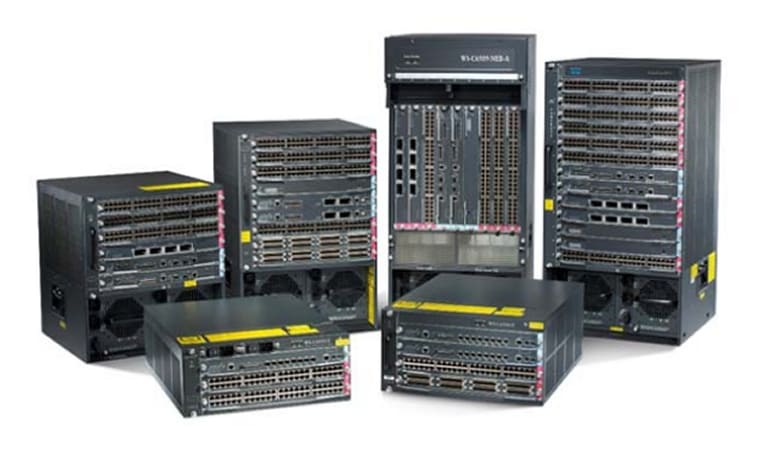
Cisco Catalyst 6500 Series Switches
| Product Type | Campus LAN Switches - Core and Distribution |
|---|---|
| Status |
End of Support
EOL Details
|
| Series Release Date | Pre-1999 |
| End-of-Sale Date | 30-OCT-2020 |
| End-of-Support Date | 31-OCT-2025 |
| Diagram | Visio Stencil (14 MB .zip file) |
|
This product is no longer supported by Cisco. Consider switching to something new: The Cisco Catalyst 9400 Series Switches offer greater speed, performance and security. View the benefits of upgrading >
|
|


- US/Canada 800-553-2447
- Worldwide Support Phone Numbers
- All Tools
 Feedback
 Feedback
-
Log in to see full product documentation.
-
Data Sheets and Product Information
- Cisco Catalyst 6500/Cisco 7600 Series Supervisor Engine 720 Data Sheet
- Cisco Catalyst 6500-E Series Chassis Data Sheet
- 6800 Series 10 Gigabit and Gigabit Ethernet Interface Modules for Cisco 6500 Series Switches Data Sheet
- Cisco Catalyst 6500 Series Supervisor Engine 2T Data Sheet
- Cisco Catalyst 6500 Series 10 Gigabit Ethernet Interface Modules Data Sheet
- Cisco Catalyst 6500 Series VPN Services Port Adapter
- Cisco 7600 Series SPA Interface Processor-400 Data Sheet
- Cisco Catalyst 6900 Series 40 Gigabit Ethernet Interface Module for Cisco Catalyst 6500 Series Switches Data Sheet
- Cisco Catalyst 6500 Series 10/100- & 10/100/1000-MBPS Ethernet Interface Modules Data Sheet
- Cisco 7600 Series/Catalyst 6500 Series Services SPA Carrier-400
- Cisco Catalyst 6500 / Cisco 7600 Series Supervisor Engine 32
- 6000-WATT AC Power Supply for the Cisco Catalyst 6500 Series Chassis
- Cisco Security Bundles
- Cisco Catalyst 6500 Series Mixed Media Gigabit Ethernet Modules
- Ethernet Services Plus Line Cards on Cisco Catalyst 6500 Series Switches Data Sheet
Data Sheets
- End-of-Sale and End-of-Life Announcement for the Cisco Catalyst 6506-E, Catalyst 6509-E, Catalyst 6509-V-E, Catalyst 6513-E, VS-S2T-10G, VS-S2T-10G-XL, Bundles & accessories
- End-of-Sale and End-of-Life Announcement for the Cisco Catalyst 6500, Cisco 7600 Series Supervisor Engine 32 and Supervisor Engine 32 Bundles
- End-of-Sale and End-of-Life Announcement for the Cisco Catalyst 6500 Series Switches (select models)
- End-of-Sale and End-of-Life Announcement for the Cisco Catalyst 6503-E, Catalyst 6504-E chassis, 4000W DC, 6000W DC Power Supplies
- End-of-Sale and End-of-Life Announcement for the Cisco Catalyst 6500 Switch Accessories
- EOS/EOL for 64MB Compact Flash for Cisco Catalyst 6500 Supervisor Engine 720/32
- End-of-Sale and End-of-Life Announcement for the Cisco Catalyst 6816 10 GE Line Card and Select Accessories
- End-of-Sale and End-of-Life Announcement for the Cisco IOS Software Release 15.3(1)SY for Cisco Catalyst 6500 Series Switches
- End-of-Sale and End-of-Life Announcement for the Cisco IOS Software Release 15.2(1)SY for Cisco Catalyst 6500 Series Switches
- End-of-Sale and End-of-Life Announcement for the Cisco Catalyst 6500/6500-E Series 1 Gigabit Ethernet Fiber and Copper Line Cards and Accessories
- End-of-Sale and End-of-Life Announcement for the Cisco IOS Software Release 15.2(2)SY for Cisco Catalyst 6500 Series Switches
- End-of-Sale and End-of-Life Announcement for the Cisco IOS Software Release 15.1(2)SY for the Cisco Catalyst 6500 Series Switches
- End-of-Sale and End-of-Life Announcement for the Select Cisco Catalyst 6800/6500 Line Cards, Power Supplies, and Accessories
- End-of-Sale and End-of-Life Announcement for the Cisco Catalyst 6500E Series Supervisor Engine 2T 10 GE Line Cards Pricing Bundle
- End-of-Sale and End-of-Life Announcement for the Cisco Catalyst 6500 Series Supervisor Engine 720-10G-3C, Select 67xx Line Cards, and Accessories
End-of-Life and End-of-Sale Notices
Log in to see available downloads.
Below are the models within the Cisco Catalyst 6500 Series Switches.
Unless specified, documentation for the Cisco Catalyst 6500 Series Switches is applicable to all models.
- Retired Models:
- Cisco Catalyst 6503-E Switch
- Cisco Catalyst 6504-E Switch
- Cisco Catalyst 6506-E Switch
- Cisco Catalyst 6509-E Switch
- Cisco Catalyst 6509-V-E Switch
- Cisco Catalyst 6513-E Switch
-