Guest

Cisco Catalyst 4500 Series Switches

Cisco Catalyst 4500 E-Series

General

Q. What is being introduced with the Cisco® Catalyst® 4500 E-Series?
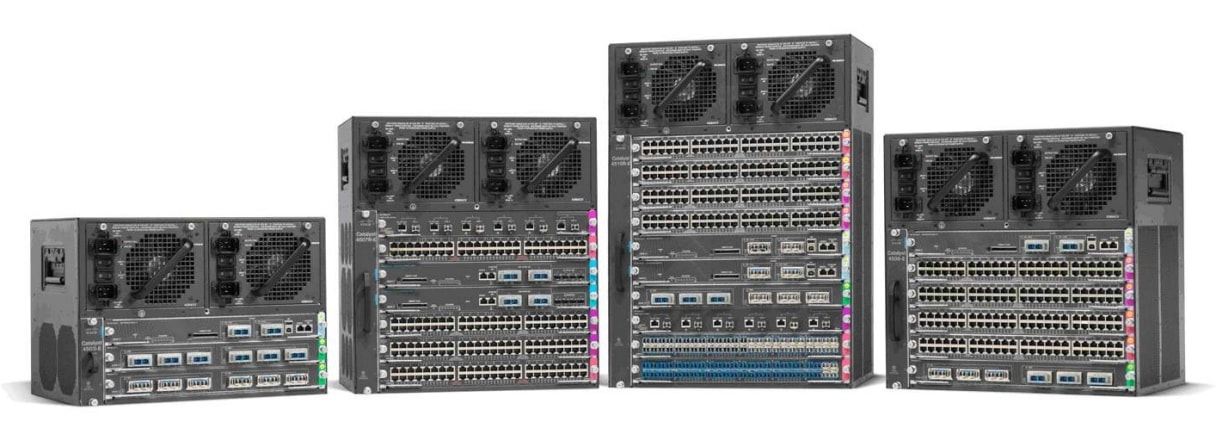
A. The Cisco Catalyst 4500 E-Series is a high-performance next-generation extension to the widely deployed modular Ethernet Cisco Catalyst 4500 Series Switches. The Cisco Catalyst 4500 E-Series extension is composed of the high-performance Cisco Catalyst 4500 Series Supervisor Engine 7-E and 6-E; E-Series line cards, and E-Series chassis.
Q. What is the primary positioning of the Cisco Catalyst 4500 E-Series?
A. The positioning is the same as the current Cisco Catalyst 4500 Series: enterprise wiring closet, small and medium-sized business (SMB) core/aggregation, and metro FTTX (Fiber To The Home, Office etc.)/aggregation.

Cisco Catalyst 4500 Series Supervisor Engine 7-E and 6-E

Q. How is the Supervisor Engine 7-E and 6-E positioned?
A. The Supervisor Engine 7-E and 6-E are positioned for the high-performance enterprise access layer, remote branch offices, and the SMB core, delivering secure, voice/video, and flexible nonstop communications. It can also be used for metro Ethernet FTTX deployments.
Q. Does the Supervisor Engine 7-E and 6-E require a cross-bar switching fabric module to drive 320 Gbps?
A. No. The Supervisor Engine 7-E uses a centralized nonblocking 848-Gbps shared memory switching architecture to achieve this performance. Same architecture applies to Supervisor Engine 6-E where 320-Gbps is achieved.
Q. How is the 320 Gbps Switching Capacity Calculated for Supervisor Engine 6-E?
A. The Supervisor 6 -E which has dual full line rate 10GbE Uplinks also supports five 24 Gbps E-Series Linecards; 3 Classis 6 Gbps Linecards and also has a 2 Gbps CPU connection for increased Control Plane performance. The sum equals 160 Gbps with the full duplex switching capacity equal to 320 Gbps.
Q. Is the Supervisor Engine 6-E software packaging of IP Base and Enterprise Services consistent with current Cisco Catalyst 4500 supervisor engines?
A. Yes.
Q. Is the Enterprise Services image required to enable IPv6 in hardware?
A. No. The IPv6 capability is provisioned in the hardware. Like IPv4, Layer 2+ IPv6, such as static routes and MultiCast Listener Discovery (MLD) snooping, provides multicast support in the IP Base image. The Enterprise Services image is required to enable Layer 3.
Q. What is the minimum software release for the Supervisor Engine 6-E and 7-E?
A. Cisco IOS® Software Release 12.2(40)SG for Supervisor Engine 6-E and Cisco IOS® Software Release 3.1.0SG for Supervisor Engine 7-E.
Q. What type of uplinks are supported on the Supervisor Engine 6-E?
A. The Supervisor Engine 6-E provides flexibility and an easy migration path to 10 Gigabit Ethernet uplinks with dual-purpose dual X2 slots that can accommodate wire-speed 10 Gigabit Ethernet optics or Cisco TwinGig converter modules, enabling Gigabit Ethernet Small Form-Factor Pluggable (SFP) optics. The TwinGig converter modules will ship standard with every Supervisor Engine 6-E (unless X2 optics are ordered).
Q. What type of 10 Gigabit Ethernet X2 optics and SFP optics are supported?
A. All currently supported optics will be supported in the Supervisor Engine 6-E. Please check the data sheet for details.
Q. In a redundant configuration, can I use all 4 10 Gigabit Ethernet Supervisor Engine 6-E uplinks at the same time?
A. Yes. This is a configurable option with 2:1 oversubscription.
Q. Can I mix and match 10 Gigabit Ethernet and SFP uplinks (using TwinGig converter module) on a Supervisor Engine 6-E?
A. Yes, for both a single and redundant supervisor engine configuration. Please refer to the Supervisor Engine 6-E data sheet for more details.
Q. Can I use the Supervisor Engine 6-E in the Cisco Catalyst non E 4500 chassis?
A. Yes. The classic Cisco Catalyst 4500 line cards will be enhanced with the Supervisor Engine 6-E features noted earlier (advanced QoS, IPv6, as well as Unicast Reverse Path Forwarding [uRPF] and other features). However, the classic line cards will continue to operate at 6 gigabits per slot.
Q. How do I take full advantage of the 320-gigabit switching capacity provided by the Supervisor Engine 6-E?
A. The Supervisor Engine 6-E,when combined with the E-Series line cards in an E-Series chassis, will enable the 24 gigabits per slot switching capacity. To take full advantage of the full 320 Gbps, you need to deploy the Supervisor Engine 6-E in a Cisco Catalyst 4510R-E.
Q. Are Nonstop Forwarding (NSF), Stateful Switchover (SSO), and In-Service Software Upgrade (ISSU) supported with redundant Supervisor Engine 6-Es?
A. Yes, these features are supported on both 7-E and 6-E using a software upgrade.
Q. Are Cisco Catalyst integrated security features and 802.1X supported?
A. Yes. 802.1x is supported on both Supervisor Engine 7-E and 6-E.
Q. Is NetFlow supported on the Supervisor Engine 6-E?
A. No. NetFlow is supported on Supervisor Engine 7-E and 7L-E.
Q. What does the Universal Serial Bus (USB) port on the Supervisor Engine support?
A. The USB port supports USB drives. This is supported on Supervisor 7-E and 7L-E only.
Q. Will there be a Layer 2 only version of the Supervisor Engine 6-E?
A. This project is currently under investigation.

Cisco Catalyst 4500 E-Series Line Cards

Q. What Cisco Catalyst 4500 E-Series line cards are being introduced?
A. There are two types of new 4500 E-Series line cards available, the 47xx and 46xx series line cards.
Four 47xx E-Series line cards, which operate at 48 gigabits per line-card slot are available. They are:

• 48-port 10/100/1000 data line card (1:1 oversubscription)

• 48-port 10/100/1000 Premium PoE line card (1:1 oversubscription)

• 48-port 10/100/1000 UPOE line card (1:1 oversubscription)

• 12-port 10 Gigabit Ethernet line card (2.5:1 oversubscription)

Four 46xx E-Series line cards, which operate at 24 gigabits per line-card slot, are available. They are:

• 48-port 10/100/1000 PoE (2:1 oversubscription)

• 48-port 10/100/1000 Premium PoE line card (2:1 oversubscription)

• 6-port 10 Gigabit Ethernet line card (2.5:1 oversubscription)

• 12 and 24 port Gigabit Ethernet line card (1:1 oversubscription)

Q. Do you have any E-Series Data only 10/100/1000 line card?
A. Yes both 47xx and 46xx series provide the data only line cards.
Q. What is the difference between the E-Series PoE and Premium PoE line card?
A. The E-Series Series PoE line card can be used as a high performance (48 and 24 Gbps per slot) data only linecard and also supports both Cisco Pre-Standard and IEEE 802.3af PoE at up to 15.4 watts per port. It also supports jumbo frames. The Catalyst 4500 E-Series "Premium" PoE line card has all of the PoE features of the E-Series PoE line card with the added capabilities to support up to 30 Watts per port. The Catalyst 4500 E-Series UPOE line card support up to 60 Watts per port and can only work with Supervisor 7-E and 7L-E.
Q. Is there a price premium for the E-Series Premium PoE line card?
A. Yes. Please refer to the Cisco Catalyst 4500 line-card data sheet for product ID and list prices.
Q. Is there a price premium for the E-Series Premium for the UPOE line card?
A. No UPOE line card is priced the same as the Premium PoE line card.
Q. What is an UPOE Splitter?
A. The UPOE Splitter is designed to support end devices that don't support PoE natively but can benefit from being powered over PoE.
Q. Are Jumbo Frames supported on classic line cards when deployed with a Supervisor Engine 6-E?
A. Jumbo Frames are supported on all nonblocking ports of classic Cisco Catalyst 4500 line cards.
Q. Are the E-Series line cards supported in non-E-Series chassis?
A. No. The classic Cisco Catalyst 4000 and 4500 chassis maximum per slot capacity is 6 gigabits per slot.
Q. Is local switching supported on the E-Series line cards?
A. No.
Q. Does the 6-port 10 Gigabit Ethernet line card support the TwinGig converter module?
A. Yes. The TwinGig converter module needs to be specifically ordered; it does not ship standard as with the Supervisor Engine 6-E.
Q. Can I mix and match 10 Gigabit Ethernet X2 optics and Gigabit Ethernet SFPs on the 10 Gigabit Ethernet line card?
A. Yes. It is done in contiguous groups of three ports. For example, the first three ports can be 10 Gigabit Ethernet X2, and the next three ports can be Gigabit Ethernet SFP, or the reverse is also possible. All ports can be either 10 Gigabit Ethernet or Gigabit Ethernet.
Q. What is the maximum Gigabit Ethernet SFP port capacity of the 10 Gigabit Ethernet line card?
A. With six TwinGig converter modules, 12 Gigabit Ethernet ports are supported at full line rate.
Q. Are there any visual differentiators between the E-Series line cards and the classic line cards?
A. Yes. The E-Series line cards will have a subtle cross-hatch pattern and a yellow circle on the right end tab, visually identifying them as E-Series line cards. This will be useful in a mixed E-Series/classic line-card configuration.

Cisco Catalyst 4500 E-Series Chassis

Q. Why are you introducing new chassis, and what are they?
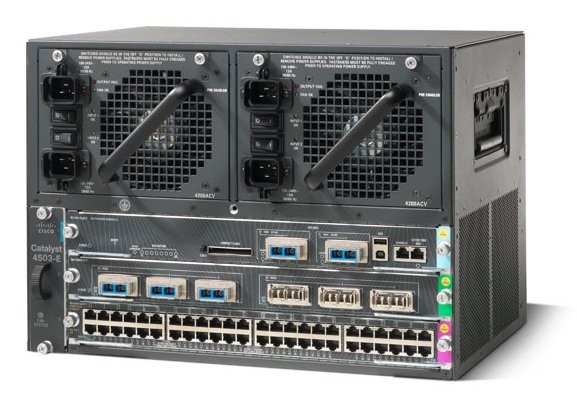
A. The Cisco Catalyst 4500 E-Series chassis provide the support for 24 gigabits per line-card slot when used with the Supervisor Engine 6-E and 48 gigabits per line-card slot when used wit the Supervisor Engine 7-E. The E-Series chassis are the Cisco Catalyst 4503-E, 4506-E, 4507R-E, and 4510R-E Switches.
Q. Will the E-Series chassis scale beyond 24 gigabits per slot in the future?
A. Yes. It currently can support 48 gigabits per slot when used with Supervisor 7-E and 7L-E.
Q. Can I use the classic Cisco Catalyst 4500 line cards in the E-Series chassis?
A. Yes. They will continue to operate at 6 gigabits per slot.
Q. Can I mix and match classic line cards with E-Series line cards?
A. Yes. This requires a Supervisor Engine 6-E to support both types of line cards.
Q. When mixing classic line cards with E-Series line cards, is there a downspeed to 6 gigabits?
A. You can mix and match with no downspeed. The E-Series line cards will operate at 48 or 24 gigabits per slot, and the classic line cards will continue to operate at 6 gigabits per slot.
Q. Can I use the Cisco Catalyst 4500 Series Supervisor Engine II-Plus, Cisco Catalyst 4500 Series Supervisor Engine II-Plus-TS, Cisco Catalyst 4500 Series Supervisor Engine II-Plus-10GE, Cisco Catalyst 4000/4500 Supervisor Engine IV, Cisco Catalyst 4500 Series Supervisor Engine II-Plus-TS, and Cisco Catalyst 4500 Series Supervisor Engine V-10GE in the E-Series chassis?
A. Yes. However, they will only support the classic line cards.
Q. Are Cisco Catalyst 4000 Supervisor Engine I or II supported in the E-Series chassis?
A. No.
Q. Can I run older versions of Cisco IOS Software with the E-Series chassis when using Supervisor Engine II-Plus to Supervisor Engine V-10GE? If not, what is the minimum Cisco IOS Software release?
A. For the Cisco Catalyst 4503-E and 4506-E, minimum Cisco IOS Software support is Release 12.2(37) SG. For the Cisco Catalyst 4507R-E and 4510R-E, minimum Cisco IOS Software is Release 12.2(40) SG.
Q. Can I use the existing Cisco Catalyst 4500 power supplies in the E-Series chassis?
A. Yes.
Q. Can I use Cisco Catalyst 4006 and 4003 power supplies in the E-Series chassis?
A. The Cisco Catalyst 4006 and 4003 power supplies only operate in a Cisco Catalyst 4006 or 4003 chassis.
Q. Are there any restrictions on line-card placement in the Cisco Catalyst 4510R-E chassis?
A. The Cisco Catalyst 4510R-E supports only classic line cards in slots 8 to 10 with the Supervisor Engine 6-E.

Miscellaneous

Q. Will the classic line cards, supervisor engines, and chassis reach end of sale?
A. The Cisco 4500 non E series have reached End-of-Sale in 2010.
Q. Why isn't Green being actively marketed on the Catalyst 4500 E-Series
A. Cisco is marketing "Green" as a higher level corporate initiative, therefore the majority of the point product Green messaging will be rolled up to the solution level.
Q. How is the Catalyst 4500 E-Series Green and can it really be powered with a bicycle?
A. The centralized architecture of the Catalyst 4500 is very power efficient due to the fact that the the majority of power consuming components reside on the supervisor engine with the line cards being very simple with relatively few components. A Catalyst 4506-E with 240 ports of 10/100/1000 consumes between 440 watts and 735 watts of +12v power depending on the supervisors and line cards used. A professional cyclist can generate and maintain roughly 400 Watts for an extended period of time and generate up to 800 watts when sprinting.