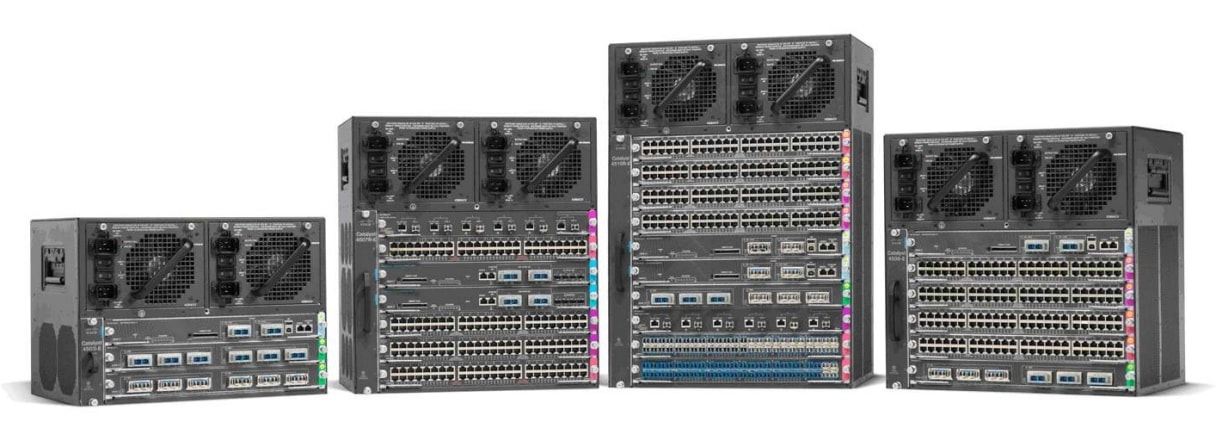
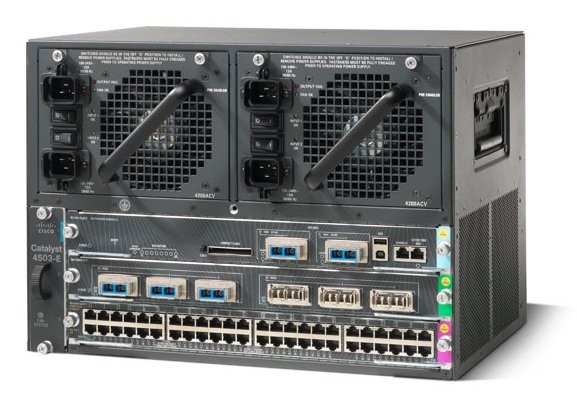
This product bulletin describes the hardware and software features supported by Cisco IOS® Software Release 12.2(40)SG for the Cisco® Catalyst® 4500 Series Supervisor Engine II-Plus, Cisco Catalyst 4500 Series Supervisor Engine II-Plus-TS, Cisco Catalyst 4500 Series Supervisor Engine II-Plus-10GE, Cisco Catalyst 4000/4500 Supervisor Engine IV, Cisco Catalyst 4000/4500 Supervisor Engine V, Cisco Catalyst 4500 Series Supervisor Engine V-10GE, and Cisco Catalyst 4500 Series Supervisor Engine 6-E. Cisco IOS Software Release 12.2(40)SG is also the first release that supports the new Cisco Catalyst 4500 E-Series featuring the new revolutionary CenterFlex technology.
Primary Release Message
The new Cisco IOS Software Release 12.2(40)SG is for all shipping Cisco Catalyst 4500 Series supervisor engines. This new release works with the new CenterFlex technology to enable granular optimization of voice, video, and data communications, delivering high centralized performance, flexibility, high availability, operational simplicity, and investment protection. The Cisco IOS Software Release 12.2(40)SG thus maximizes performance, enhances the end-user experience, and offers unprecedented control and flexibility over hardware resources.
Support for New E-Series Hardware
In addition to the classic line cards and supervisor engines, Cisco IOS Software Release 12.2(40)SG supports the next-generation high-performance E-Series Supervisor Engine 6-E with CenterFlex technology and E-Series line cards and chassis. A brief list of primary E-Series hardware supported by Cisco IOS Software Release 12.2.(40)SG is shown in Table 1.
Table 1. Supported E-Series Hardware
Product Number
Description
WS-C4503-E
Cisco Catalyst 4500 E-Series 3-Slot Chassis, fan, no ps
WS-C4506-E
Cisco Catalyst 4500 E-Series 6-Slot Chassis, fan, no ps
WS-C4507R-E
Cisco Catalyst 4500 E-Series 7-Slot Chassis, fan, no ps, Red Sup Capable
WS-C4510R-E
Cisco Catalyst 4500 E-Series 10-Slot Chassis, fan, no ps, Red Sup Capable
The following new features of the Cisco IOS Software Release 12.2(40)SG are applicable only for the new Supervisor Engine 6-E, unless otherwise stated.
The ternary content addressable memory 4 (TCAM4) is an architectural innovation that enables wire-speed forwarding performance in the new Supervisor Engine 6-E. Dynamic multi-protocol TCAM is a feature of the TCAM4 that enables wire-speed forwarding performance for IPv4, IPv6, unicast Reverse Path Forwarding (uRPF), and multicast (both IPv4 and IPv6) routes, while optimizing memory resources.
Customers who deploy a mix of IPv4 and IPv6 features in their network will benefit from the increased capacity and performance resulting from DMPT optimization. With the new dynamic multi-protocol TCAM, small number of IPv6 routes will not adversely affect the number of IPv4 routing entries. Lastly, Cisco IOS Software Release 12.2(40)SG automatically handles DMPT optimization, allowing for greater simplicity and ease of management.
Service-Aware Resource Allocation
Wire-speed security and quality-of-service (QoS) services are enabled by the TCAM4 on the new Supervisor Engine 6-E. With the previous generation of TCAMs, half of the TCAM memory space was strictly allocated for security features, with the other half allocated for QoS features. With the new TCAM4 Service Aware Resource Allocation (SARA) feature, this strict half-and-half allocation is eliminated. This allows the customer to have the ultimate flexibility of deploying service features at wire speed. For customers who exclusively use either one of the service features (security or QoS), this represents an almost twofold increase in the capacity of the classification entries. As above, Cisco IOS Software Release 12.2(40)SG automatically allocates the TCAM4 memory space for security or QoS services, resulting in simple and easy configuration of the switch.
uRPF Strict Mode
The uRPF feature mitigates problems caused by the introduction of malformed or forged (spoofed) IP source addresses into a network by discarding IP packets that lack a verifiable IP source address. uRPF deflects denial-of-service (DoS) and distributed denial-of-service (DDoS) attacks by forwarding only packets that have source addresses that are valid and consistent with the IP routing table. This helps to protect the network of the customer, the ISP, and the rest of the Internet. When using uRPF in strict mode, the packet must be received on the interface that the router would use to forward the return packet. uRPF strict mode is supported for both IPv4 and IPv6 prefixes.
IPv6 Forwarding in Hardware
IPv6 is the next-generation IP protocol, designed to solve numerous problems that the original IP version 4 has, such as address space limitations. Cisco IOS Software Release 12.2(40)SG supports hardware-based IPv6 unicast and multicast forwarding. The primary IPv6 features supported in hardware are:
• IPv6 Cisco Express Forwarding
• IPv6 hardware support for forwarding unicast and multicast traffic
• IPv6 PIM Sparse Mode
• Standard and extended ACLs
• IPv6 uRPF Strict Mode
IPv6 Forwarding in hardware is only supported on the Supervisor Engine 6-E.
Enhanced Interior Gateway Routing Protocol IPv6 Support
Customers can configure Enhanced Interior Gateway Routing Protocol (EIGRP) to route IPv6 prefixes. EIGRP configuration and protocol behavior for both IPv4 and IPv6 prefixes are similar, providing operational familiarity and continuity. EIGRP support for IPv6 will enable customers to use their existing EIGRP knowledge and processes, allowing them to deploy an IPv6 network at a low cost.
IPv6 Multicast Listener Discovery and Multicast Listener Discovery Snooping
Multicast Listener Discovery (MLD) is a protocol used by IPv6 multicast devices to discover the presence of multicast listeners (nodes wishing to receive IPv6 multicast packets) on its directly attached links and to discover which multicast packets are of interest to neighboring nodes. MLD snooping is supported in two different versions: MLD v1 and MLD v2. Network switches use MLD snooping to limit the flood of multicast traffic, causing IPv6 multicast data to be selectively forwarded to a list of ports that want to receive the data, instead of being flooded to all ports in a VLAN. This lessens the load on devices in the network, minimizing unnecessary bandwidth on links, enabling efficient distribution of IPv6 multicast data.
Gateway Load Balancing Protocol
The Gateway Load Balancing Protocol (GLBP) feature provides automatic router backup for IP hosts configured with a single default gateway on a LAN. Multiple first hop routers on the LAN combine to offer a single virtual first hop IP router while sharing the IP packet forwarding load. GLBP devices share packet-forwarding responsibilities, optimizing resource usage, thereby reducing costs. Other routers on the LAN may act as redundant GLBP routers that will become active if any of the existing forwarding routers fail. This improves the resiliency of the network and reduces administrative burden. GLBP is a feature that is applicable for the Supervisor Engine 6-E and the classic supervisor engines.
Support for TwinGig Converter Module
The Cisco TwinGig converter module offers investment protection for 10 Gigabit Ethernet switches, converting a 10 Gigabit Ethernet X2 interface into two Gigabit Ethernet Small Form-Factor Pluggable (SFP) ports. In this way, customers can initially use the switch with Gigabit Ethernet uplinks and later implement 10 Gigabit Ethernet uplinks as business demands change. The Supervisor Engine 6-E supports the TwinGig converter module.
Robust and Flexible File Management System (FAT File System)
The FAT file system is widely used to manage files on devices disks and flash. The support of the FAT file system allows one to easily remove, add, and/or transfer images to and from the flash.
Storm Control: Per-Port Multicast Suppression
A storm event occurs when a large number of broadcast and/or multicast packets inundate a network to degrade its overall performance, preventing control packets from being forwarded. The storm control feature detects and reacts to such an event so that forwarding of data and control packets is not affected. This is achieved by monitoring the number of packets received on a port. If this count exceeds a configured threshold, the feature takes action to control the flood of packets. Cisco IOS Software Release 12.2(40)SG allows suppression of broadcast and multicast traffic on a per-port basis.
Cisco Modular QoS Command-Line-Interface
Cisco Modular QoS CLI (MQC) is the framework used to implement Cisco IOS Software QoS. MQC allows the user to define a traffic class, create a traffic policy (containing the QoS feature to be applied to the traffic class), and attach the traffic policy to an interface. MQC is a cross-Cisco[[NOTE: Per Cisco style, Cisco cannot be combined with another term using a hyphen, slash, or other connector. Please rephrase "cross-Cisco."]] baseline that provides a consistent syntax and behavior of QoS features across multiple product families. Cisco IOS Software Release 12.2(40)SG complies to MQC for configuration of QoS features on the Supervisor Engine 6-E. MQC enables rapid deployment of new features and technology innovations and facilitates the management of network performance with respect to bandwidth, delay, jitter, and packet loss, enhancing the performance of mission-critical business applications. The rich and advanced QoS features that are supported as part of the Supervisor Engine 6-E are enabled using Cisco MQC.
Two-Rate Three-Color Policing
The Two-Rate Three-Color Policing feature limits the input or output transmission rate of a class of traffic based on user-defined criteria and marks or colors packets by setting the applicable differentiated services code point (DSCP) values. This feature is often configured on the interfaces at the edge of a network to limit the rate of traffic entering or leaving the network. Using this feature, traffic that conforms to user-defined criteria can be sent through the interfaces, while traffic that exceeds or violates these criteria is sent out with a decreased priority setting or even dropped.
Table 2. New Features in 12.2(40)SG-Classic Supervisors and Supervisor Engine 6-E
Enhanced Interior Gateway Routing Protocol IPv6 Support
No
Yes
IPv6 Multicast Listener Discovery Snooping
No
Yes
Gateway Load Balancing Protocol
Yes
Yes
Support for TwinGig Converter Module
No
Yes
Robust and Flexible File Management System (FAT File System)
No
Yes
Storm Control: Per-Port Multicast Suppression
No
Yes
Cisco Modular QoS Command-Line-Interface
No
Yes
Two-Rate Three-Color Policing
No
Yes
Cisco IOS Software Packaging for the Cisco Catalyst 4500 Series
A new Cisco IOS Software package for Cisco Catalyst 4500 Series Switches was introduced in Cisco IOS Software Release 12.2(25)SG. It is a new foundation for features and functionality and provides consistency across all Cisco Catalyst switches. The new Cisco IOS Software release train is designated as 12.2SG.
Prior Cisco Catalyst 4500 Series Cisco IOS Software images for the Cisco Catalyst 4500 Series Switches, formerly known as Basic Layer 3 and Enhanced Layer 3, now map to IP Base and Enterprise Services, respectively. BGP is now included in the Enterprise Services image. All currently shipping Cisco Catalyst 4500 software features based on Cisco IOS Software are supported in the IP Base image of Release 12.2(40)SG, with a few exceptions.
The IP Base image does not support enhanced routing features such as NSF/SSO, BGP, EIGRP, EIGRPv6, OSPF, OSPFv3, IS-IS, Internetwork Packet Exchange (IPX), AppleTalk, VRF-lite, and Policy-Based Routing (PBR). The IP Base image supports EIGRP-Stub for limited routing on Supervisor Engines II-Plus, II-Plus-TS, II-Plus-10GE, IV, V, V-10GE, and 6-E.
The Enterprise Services image supports all Cisco Catalyst 4500 Series software features based on Cisco IOS Software, including enhanced routing. Customers planning to enable BGP for Supervisor Engine IV, V, or V-10GE will no longer need to purchase a separate BGP license (FR-IRC4) because BGP is included in the Enterprise Services package. Table 2 shows a more detailed description of the feature differences between the IP Base and Enterprise Services (ES) images as they relate to the Cisco Catalyst 4500 Series supervisor engines.
Table 3. Feature Comparison for Cisco IOS Software Release 12.2(40)SG IP Base and Enterprise Services
Feature
Supervisor Engine II-Plus, II-Plus-TS, II-Plus-10GE: IP Base
Supervisor Engine IV: IP Base
Supervisor Engine IV: ES
Supervisor Engine V: IP Base
Supervisor Engine V: ES
Supervisor Engine V-10GE: IP Base
Supervisor Engine V-10GE: ES
Supervisor Engine 6-E: IP Base
Supervisor Engine 6-E: ES
ISSU
Yes*
Yes
Yes
Yes
Yes
Yes
Yes
1HCY08
1HCY08
Network Admission Control (NAC) v2.0
Yes
Yes
Yes
Yes
Yes
Yes
Yes
Yes
Yes
RIP and Static Route
Yes
Yes
Yes
Yes
Yes
Yes
Yes
Yes
Yes
NetFlow v1, v5, or v8
No
Yes
Yes
Yes
Yes
Yes
Yes
No
No
EIGRP
No
No
Yes
No
Yes
No
Yes
No
Yes
EIGRP-Stub
Yes
Yes
Yes
Yes
Yes
Yes
Yes
Yes
Yes
OSPF/IS-IS
No
No
Yes
No
Yes
No
Yes
No
Yes
BGP
No
No
Yes
No
Yes
No
Yes
1HCY08
1HCY08
NSF-aware
No
No
Yes
No
Yes
No
Yes
1HCY08
1HCY08
NSF-aware EIGRP-stub
Yes
Yes
Yes
Yes
Yes
Yes
Yes
1HCY08
1HCY08
NSF/SSO
No
No
Yes
No
Yes
No
Yes
1HCY08
1HCY08
SSO Aware HSRP
Yes
Yes
Yes
Yes
Yes
Yes
Yes
1HCY08
1HCY08
VRF-lite
No
No
Yes
No
Yes
No
Yes
No
Yes
AppleTalk
No
No
Yes
No
Yes
No
Yes
No
No
IPX
No
No
Yes
No
Yes
No
Yes
No
No
PBR
No
No
Yes
No
Yes
No
Yes
Future
Future
IPv6 (Hardware-based)
No
No
No
No
No
No
No
Yes
Yes
* ISSU is not supported on the Supervisor Engine II-Plus-TS.
Figure 1 displays the Cisco IOS Software Release 12.2(40)SG plan relative to the 12.2S release train and identifies the recommended migration path. Note that 12.2(40)SG will not be the base release for a new maintenance train. Currently, the Cisco Catalyst 4500 platform has two active maintenance trains: 12.2(25)EWA and 12.2(31)SGA.
Figure 1. Cisco IOS Software Release Plan for the Cisco Catalyst 4500 Series
Summary of Migration Plan:
• Customers requiring the latest Cisco Catalyst 4500 Series hardware and software features should migrate to Cisco IOS Software Release 12.2(40)SG.
• Cisco IOS Software Release 12.2(31)SGA will continue offering maintenance releases. The latest release from the 12.2(31)SGA maintenance train is 12.2(31)SGA3.
• Cisco IOS Software Release 12.2(25)EWA will continue offering maintenance releases. The latest release from the 12.2(25)EWA maintenance train is 12.2(25)EWA10.
Cisco IOS Software for Supervisor Engines II-Plus, II-Plus-TS, II-Plus-10GE, IV, V, and V-10GE (IP Base image without Crypto)
Cat4500-ipbase-mz
S45IPBK9-12240SG(=)
Cisco IOS Software for Supervisor Engines II-Plus, II-Plus-TS, II-Plus-10GE, IV, V, and V-10GE (IP Base image with Triple Data Encryption Standard [3DES])
Cat4500-ipbasek9-mz
S45ES-12240SG(=)
Cisco IOS Software for Supervisor Engines IV, V, and V-10GE (Enterprise Services image with BGP support, without Crypto)
Cat4500-entservices-mz
S45ESK9-12240SG(=)
Cisco IOS Software for Supervisor Engines IV, V, and V-10GE (Enterprise Services image with 3DES and BGP support)
Cat4500-entservicesk9-mz
S45EIPB-12240SG(=)
Cisco IOS Software for Supervisor Engine 6-E (IP Base image)
Cat4500e-ipbase-mz
S45EIPBK9-12240SG(=)
Cisco IOS Software for Supervisor Engine 6-E (IP Base image with 3DES)
Cat4500e-ipbasek9-mz
S45EES-12240SG(=)
Cisco IOS Software for Supervisor Engine 6-E (Enterprise Services image)
Cat4500e-entservices-mz
S45EESK9-12240SG(=)
Cisco IOS Software for Supervisor Engine 6-E (Enterprise Services image with 3DES)
Cat4500e-entservicesk9-mz
Table 5. Cisco Catalyst 4500 ISSU Paper Licenses (One per Chassis)
Product Number
Description
FR45-ISSU-LIC(=)
Cisco Catalyst 45xxR Series ISSU paper license. Requires dual supervisor engines.
FR45-ISSU-POE-LIC
Cisco Catalyst 45xxR Series ISSU promotional PoE paper license. Requires dual supervisor engines and at least 48-port PoE ports in a new factory-configured system.
Table 6. Cisco IOS Software Release 12.2(40)SG Hardware Support
Product Number
Description
WS-X4013+
Cisco Catalyst 4500 Series Supervisor Engine II-Plus
WS-X4013+/2
Cisco Catalyst 4500 Series Redundant Supervisor Engine II-Plus
WS-X4013+TS
Cisco Catalyst 4503 Series Supervisor Engine II-Plus-TS
WS-X4013+10GE
Cisco Catalyst 4500 Series Supervisor Engine II-Plus-10GE
WS-X4013+10GE/2
Cisco Catalyst 4500 Series Redundant Supervisor Engine II-Plus-10GE
WS-X4515
Cisco Catalyst 4500 Series Supervisor Engine IV
WS-X4515/2
Cisco Catalyst 4500 Series Redundant Supervisor Engine IV
WS-X4516
Cisco Catalyst 4500 Series Supervisor Engine V
WS-X4516/2
Cisco Catalyst 4500 Series Redundant Supervisor Engine V
WS-X4516-10GE
Cisco Catalyst 4500 Series Supervisor Engine V-10GE
WS-X4516-10GE/2
Cisco Catalyst 4500 Series Redundant Supervisor Engine V-10GE