Cisco ASR 1000 Series Embedded Services Processors Data Sheet
Available Languages
Bias-Free Language
The documentation set for this product strives to use bias-free language. For the purposes of this documentation set, bias-free is defined as language that does not imply discrimination based on age, disability, gender, racial identity, ethnic identity, sexual orientation, socioeconomic status, and intersectionality. Exceptions may be present in the documentation due to language that is hardcoded in the user interfaces of the product software, language used based on RFP documentation, or language that is used by a referenced third-party product. Learn more about how Cisco is using Inclusive Language.
The Cisco® ASR 1000 Series Embedded Services Processors (ESPs) handle all the network data-plane traffic processing tasks of Cisco ASR 1000 Series Aggregation Services Routers. These ESPs allow the activation of concurrent enhanced network services, such as cryptography, firewall, Network Address Translation (NAT), Quality of Service (QoS), NetFlow, and many others while maintaining line speeds. Figure 1 shows the Cisco ASR 1000 Series ESP 100 and ESP 200.
Cisco ASR 1000 Series Routers are placed at the WAN edge of your enterprise data center or large office, as well as in service provider Points Of Presence (POPs). The routers rely on the power of the ESPs to aggregate multiple traffic flows and network services, including encryption and traffic management, and forward them across WAN connections at line speeds. With router options that run from 2.5 to 200 Gbps, the Cisco ASR Family contains many models and licensing options to meet the speed and budget requirements of different types of organizations and various-sized locations.
The Cisco ASR 1000 ESP components of these routers accelerate service delivery using parallel processing. The ESPs are based on the Cisco Flow Processor (FP) for next-generation forwarding and queuing in silicon. They operate at 20-, 40-, 100-, and 200-Gbps data-plane forwarding throughput rates. Together, the Cisco ASR 1001-X, ASR 1001-HX, ASR 1002-HX, and ASR 1002-X Routers and 100- and 200-Gbps ESPs introduce the second generation of the Cisco FP hardware and software architecture. With FP-based ESPs at their core, ASR 1000 Routers accomplish the following:
● Handle all baseline packet routing operations, including MAC address classification, Layer 2 and Layer 3 forwarding, QoS classification, and NetFlow packet accounting
● Perform advanced services such as IP Security (IPsec) encryption, Network Address Translation (NAT), firewall, AppNav, Cisco Application Visibility and Control (AVC), Performance Routing (PfR), and Locator ID Separation Protocol (LISP); they offer diverse feature Layer 2 connectivity options such as Ethernet over MPLS (EoMPLS), Virtual Private LAN Services (VPLS), Overlay Transport Virtualization (OTV), and Virtual Extensible LAN Services (VXLAN)
The following embedded services processors are supported on the Cisco ASR 1000 Series Routers:
● Cisco ASR 1000 Series 20-Gbps Embedded Services Processor
● Cisco ASR 1000 Series 40-Gbps Embedded Services Processor
● Cisco ASR 1000 Series 100-Gbps Embedded Services Processor
● Cisco ASR 1000 Series 200-Gbps Embedded Services Processor
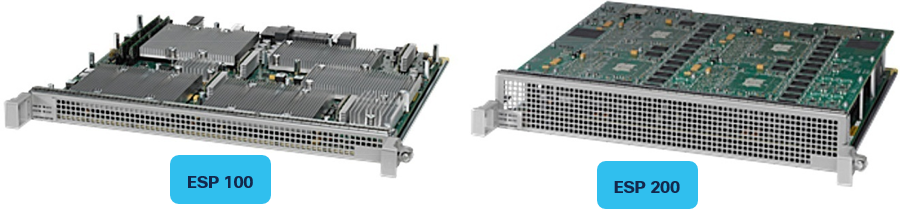
Cisco ASR 1000 Series ESP 100 and ESP 200
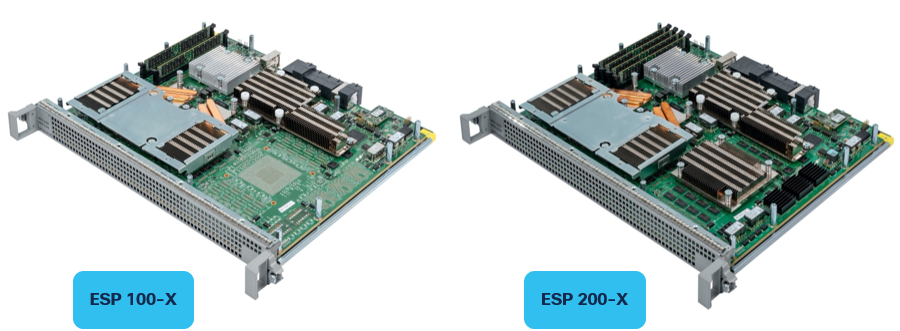
Cisco ASR 1000 Series ESP 100-X and ESP 200-X
The main engine of the ESP is the Cisco FP, the industry’s first programmable and application-aware network processor. The Cisco FP forms the overall hardware and software architecture of the ESP. It consolidates up to 256 customized packet-processor cores (900 MHz to 1.5 GHz) into a single processor. The parallel processing capability eliminates the need for additional service blades inside the router, because all processing is performed on the FP. As a result, the ESPs enable the ASR 1000s to support the following functions and features with high performance:
● Forwarding, traffic management, and services
● Large-scale parallel processing with centralized shared memory to achieve low-latency packet processing
● High-performance Deep-Packet Inspection (DPI) with full visibility into the entire Layer 2 frame, including payload
● Rapid feature development with ANSI-C software development framework
● Up to 200-Gbps system throughput and up to 130 millions of packets per second (mpps) to address WAN aggregation needs
● Hardware-assisted cryptographic performance to yield up to 78 Gbps of throughput to enable secure WAN access and compliance
● Line-speed zone-based firewall that provides up to 200 Gbps of throughput and 6-mpps firewall sessions
● DPI, Cisco IOS® Software Zone-Based Firewall Distributed Denial of Service (DDoS) detection and prevention, and control-plane protection
● Cisco Session Border Control (SBC) for terminating and interconnecting media terminations with full accounting and flow control
● Cisco Multicast Visual Quality Experience (VQE) and video Call Admission Control (CAC) for enhanced user experiences
● Hardware-accelerated traffic classification and traffic shaping with support for up to 464,000 queues
● Flexible traffic prioritization and efficient WAN bandwidth use with minimum, maximum, and excess bandwidth allocation with priority propagation
The ESPs address the following applications and use cases:
● Service provider broadband: The Cisco ASR 1000 Series Router serves as a broadband aggregation router that terminates up to 64,000 subscriber sessions (refer to specific tables to get actual scale details). It supports features such as SBC for Voice over IP (VoIP) and video services (including Cisco TelePresence® communications systems) and hardware-assisted per-user firewall for security.
● Service provider-managed Customer Premises Equipment (CPE): The Cisco ASR 1000 Router serves as a WAN aggregation router with high-density Gigabit Ethernet or WAN link aggregation and 10 Gigabit Ethernet uplink capabilities. Key benefits are Layer 2 and Layer 3 VPN functions and line-rate IP Multicast support for triple-play (data, voice, and video) deployments.
● Multimedia Provider Edge (PE): The Cisco ASR 1000 Series Router interfaces with enterprise and service provider-provisioned voice and multimedia services directly at the edge. You do not need an overlay network, network appliances, or service blades, lowering Operating Expenses (OpEx) and offering flexible deployment models. This router supports protected signaling for both voice and video services and facilitates 32,000 voice calls concurrent with up to 200 Gbps of data traffic with accounting, firewall, and call-quality features enabled.
● Enterprise WAN aggregation: At the WAN aggregation headend, the Cisco ASR 1000 Router facilitates a branch-office architecture that offers excellent investment protection with services and scale. Solution benefits consist of a multigigabit encryption rate (up to 78-Gbps IPsec cryptography throughput) and optimization of the WAN to route around brownouts in the service provider network to guarantee mission critical applications.
● Enterprise Internet gateway: As an Internet gateway, the ASR 1000 delivers multigigabit Cisco IOS Firewall capability without the need for service blades. All firewall processing occurs in silicon 2.5-, 5-, 10-, 20-, 40-, 100-, or 200-Gbps speeds. In addition, the router provides high-speed logging through Sampled NetFlow Version 9 and ongoing forwarding with baseline and firewall features enabled.
● Enterprise Intelligent WAN (IWAN): The scalable Cisco ASR 1000 Router smoothly enables the intelligent WAN architecture that allows enterprises to reduce expensive WAN costs by adopting business-class Internet as a transport while maintaining privacy, confidentiality with crypto, and regulatory compliance with a zone-based firewall.
● Enterprise Data Center Interconnect (DCI): The scalable Cisco ASR 1000 Router securely enables the interconnection of data centers to the cloud to consume services and migrate workloads to provide disaster recovery and normal data center management operations.
Platform support and compatibility
To benefit from feature-rich services of Cisco ASR 1000 Routers, Cisco IOS XE Software Release 2.4 or later is required. For the newly added Cisco ASR 1001-X Router, Cisco IOS XE Software Release 3.12 or later is required. For ESP data-plane throughput compatibilities by ASR platform, refer to Tables 1 through 8.
Table 1. Cisco ASR 1000 Series Integrated ESP in Cisco ASR 1002-HX chassis compatible hardware
| Product name |
Part number |
| Cisco ASR 1002-HX Router Chassis (ESP integrated; up to 100 Gbps through software-activated port licenses) |
ASR1002-HX |
Table 2. Cisco ASR 1000 Series Integrated ESP in the ASR 1001-HX chassis compatible hardware
| Product name |
Part number |
| Cisco ASR 1001-HX Router Chassis (ESP integrated; up to 60 Gbps through software-activated port licenses) |
ASR1001-HX |
Table 3. Cisco ASR 1000 Series Integrated ESP in Cisco ASR 1001-X chassis compatible hardware
| Product name |
Part number |
| Cisco ASR 1001-X Router Chassis (ESP integrated; upgradable from 2.5-Gbps to 20-Gbps via software activated license) |
ASR1001-X |
Table 4. Cisco ASR 1000 Series Integrated ESP in Cisco ASR 1002-X chassis compatible hardware
| Product name |
Part number |
| Cisco ASR 1002-X Router Chassis* (ESP integrated; upgradable from 5-Gbps to 36-Gbps via software activated license) |
ASR1002-X |
Table 5. Cisco ASR 1000 Series 20-Gbps ESP (ASR1000-ESP20) compatible hardware
| Product name |
Part number |
| Cisco ASR 1004 Router Chassis |
ASR1004 |
| Cisco ASR 1006 Router Chassis* |
ASR1006 |
| Cisco ASR 1000 Route Processor 1, 4GB DRAM |
ASR1000-RP1 |
| Cisco ASR 1000 Route Processor 2, 8GB DRAM |
ASR1000-RP2 |
| Cisco ASR 1000 SPA Interface Processor 40 |
ASR1000-SIP10 |
Table 6. Cisco ASR 1000 Series 40-Gbps ESP (ASR1000-ESP40) compatible hardware
| Product name |
Part number |
| Cisco ASR 1004 Router Chassis |
ASR1004 |
| Cisco ASR 1006 Router Chassis* |
ASR1006 |
| Cisco ASR 1006-X Router Chassis* |
ASR1006-X |
| Cisco ASR 1009-X Router Chassis* |
ASR1009-X |
| Cisco ASR 1013 Router Chassis* |
ASR1013 |
| Cisco ASR 1000 Route Processor 2 |
ASR1000-RP2 |
| Cisco ASR 1000 Route Processor 3 |
ASR1000-RP3 |
| Cisco ASR 1000 SPA Interface Processor 10 |
ASR1000-SIP10 |
| Cisco ASR 1000 SPA Interface Processor 40 |
ASR1000-SIP40 |
| Cisco ASR 1000 Fixed Ethernet Line Card, 6x10GE |
ASR1000-6TGE |
| Cisco ASR 1000 Fixed Ethernet Line Card, 2x10GE + 20x1GE |
ASR1000-2T + 20X1GE |
| Cisco ASR1000-X 1100W AC Power Supply |
ASR1000X-AC-1100W |
| Cisco ASR1000-X 950W DC Power Supply |
ASR1000X-DC-950W |
Table 7. Cisco ASR 1000 Series 100-Gbps ESP (ASR1000-ESP100) compatible hardware
| Product name |
Part number |
| Cisco ASR 1006 Router Chassis* |
ASR1006 |
| Cisco ASR 1006-X Router Chassis* |
ASR1006-X |
| Cisco ASR 1009-X Router Chassis* |
ASR1009-X |
| Cisco ASR 1013 Router Chassis* |
ASR1013 |
| Cisco ASR 1000 Route Processor 2 |
ASR1000-RP2 |
| Cisco ASR 1000 Route Processor 3 |
ASR1000-RP3 |
| Cisco ASR 1000 SPA Interface Processor 10 |
ASR1000-SIP10 |
| Cisco ASR 1000 SPA Interface Processor 40 |
ASR1000-SIP40 |
| Cisco ASR 1000 Fixed Ethernet Line Card, 6x10GE |
ASR1000-6TGE |
| Cisco ASR 1000 Fixed Ethernet Line Card, 2x10GE + 20x1GE |
ASR1000-2T+20X1GE |
| Cisco ASR 1000 Ethernet Line Card, 100G Modular Interface Processor |
ASR1000-MIP100 |
| Cisco ASR 1000 1x100GE Ethernet Port Adapter |
EPA-1X100GE |
| Cisco ASR 1000 1x100GE Ethernet Port Adapter (QSFP) |
EPA-QSFP-1X100GE |
| Cisco ASR 1000 1x40GE e-Delivery Port License for EPA-1X40GE |
L-FLA1-EPA-1X40GE |
| Cisco ASR 1000 2x40GE Ethernet Port Adapter (breakout cable) |
EPA-CPAK-2X40GE |
| Cisco ASR 1000 10x10GE Ethernet Port Adapter |
EPA-10X1GE |
| Cisco ASR 1000 18x1GE Ethernet Port Adapter |
EPA-18X1GE |
| Cisco ASR1000 1600w AC Power Supply |
ASR1013/06-PWR-AC |
| Cisco ASR1000 1600w DC Power Supply |
ASR1013/06-PWR-DC |
| Cisco ASR1000-X 1100W AC Power Supply |
ASR1000X-AC-1100W |
| Cisco ASR1000-X 950W DC Power Supply |
ASR1000X-DC-950W |
Table 8. Cisco ASR 1000 Series 200-Gbps ESP (ASR1000-ESP200) compatible hardware
| Product name |
Part number |
| Cisco ASR 1009-X Router Chassis* |
ASR1009-X |
| Cisco ASR 1013 Router Chassis* |
ASR1013 |
| Cisco ASR 1000 Route Processor 2, 8GB DRAM |
ASR1000-RP2 |
| Cisco ASR 1000 Route Processor 3 |
ASR1000-RP3 |
| Cisco ASR 1000 SPA Interface Processor 40 |
ASR1000-SIP40 |
| Cisco ASR 1000 Fixed Ethernet Line Card, 6x10GE |
ASR1000-6TGE |
| Cisco ASR 1000 Fixed Ethernet Line Card, 2x10GE + 20x1GE |
ASR1000-2T+20X1GE |
| Cisco ASR 1000 Ethernet Line Card, 100G Modular Interface Processor |
ASR1000-MIP100 |
| Cisco ASR 1000 1x100GE Ethernet Port Adapter |
EPA-1X100GE |
| Cisco ASR 1000 1x100GE Ethernet Port Adapter (QSFP) |
EPA-QSFP-1X100GE |
| Cisco ASR 1000 2x40GE Ethernet Port Adapter (Native QSFP) |
EPA-2X40GE |
| Cisco ASR 1000 1x40GE Ethernet Port Adapter (2 physical QSFP ports – optional license to enable 2nd port) |
EPA-1X40GE |
| Cisco ASR 1000 2x40GE Ethernet Port Adapter (breakout cable) |
EPA-CPAK-2X40GE |
| Cisco ASR 1000 10x10GE Ethernet Port Adapter |
EPA-10X1GE |
| Cisco ASR 1000 18x1GE Ethernet Port Adapter |
EPA-18X1GE |
| Cisco ASR1000 1600w AC Power Supply |
ASR1013/06-PWR-AC |
| Cisco ASR1000 1600w DC Power Supply |
ASR1013/06-PWR-DC |
| Cisco ASR1000-X 1100W AC Power Supply |
ASR1000X-AC-1100W |
| Cisco ASR1000-X 950W DC Power Supply |
ASR1000X-DC-950W |
Table 9. Cisco ASR 1000 Series 100-Gbps ESP (ASR1000-ESP100-X) compatible hardware
| Product name |
Part number |
| Cisco ASR 1006-X Router Chassis* |
ASR1006-X |
| Cisco ASR 1009-X Router Chassis* |
ASR1009-X |
| Cisco ASR 1013 Router Chassis* |
ASR1013 |
| Cisco ASR 1000 Route Processor 3 |
ASR1000-RP3 |
| Cisco ASR 1000 SPA Interface Processor 40 |
ASR1000-SIP40 |
| Cisco ASR 1000 Fixed Ethernet Line Card, 6x10GE |
ASR1000-6TGE |
| Cisco ASR 1000 Fixed Ethernet Line Card, 2x10GE + 20x1GE |
ASR1000-2T+20X1GE |
| Cisco ASR 1000 Ethernet Line Card, 100G Modular Interface Processor |
ASR1000-MIP100 |
| Cisco ASR 1000 1x100GE Ethernet Port Adapter |
EPA-1X100GE |
| Cisco ASR 1000 1x100GE Ethernet Port Adapter (QSFP) |
EPA-QSFP-1X100GE |
| Cisco ASR 1000 1x40GE e-Delivery Port License for EPA-1X40GE |
L-FLA1-EPA-1X40GE |
| Cisco ASR 1000 2x40GE Ethernet Port Adapter (Native QSFP) |
EPA-2X40GE |
| Cisco ASR 1000 2x40GE Ethernet Port Adapter (breakout cable) |
EPA-CPAK-2X40GE |
| Cisco ASR 1000 10x10GE Ethernet Port Adapter |
EPA-10X1GE |
| Cisco ASR 1000 18x1GE Ethernet Port Adapter |
EPA-18X1GE |
| Cisco ASR1000 1600w AC Power Supply |
ASR1013/06-PWR-AC |
| Cisco ASR1000 1600w DC Power Supply |
ASR1013/06-PWR-DC |
| Cisco ASR1000-X 1100W AC Power Supply |
ASR1000X-AC-1100W |
| Cisco ASR1000-X 950W DC Power Supply |
ASR1000X-DC-950W |
Table 10. Cisco ASR 1000 Series 200-Gbps ESP (ASR1000-ESP200-X) compatible hardware
| Product name |
Part number |
| Cisco ASR 1006-X Router Chassis* |
ASR1006-X |
| Cisco ASR 1009-X Router Chassis* |
ASR1009-X |
| Cisco ASR 1000 Route Processor 3 |
ASR1000-RP3 |
| Cisco ASR 1000 SPA Interface Processor 40 |
ASR1000-SIP40 |
| Cisco ASR 1000 Fixed Ethernet Line Card, 6x10GE |
ASR1000-6TGE |
| Cisco ASR 1000 Fixed Ethernet Line Card, 2x10GE + 20x1GE |
ASR1000-2T+20X1GE |
| Cisco ASR 1000 Ethernet Line Card, 100G Modular Interface Processor |
ASR1000-MIP100 |
| Cisco ASR 1000 1x100GE Ethernet Port Adapter |
EPA-1X100GE |
| Cisco ASR 1000 1x100GE Ethernet Port Adapter (QSFP) |
EPA-QSFP-1X100GE |
| Cisco ASR 1000 2x40GE Ethernet Port Adapter (Native QSFP) |
EPA-2X40GE |
| Cisco ASR 1000 1x40GE Ethernet Port Adapter (2 physical QSFP ports – optional license to enable 2nd port) |
EPA-1X40GE |
| Cisco ASR 1000 2x40GE Ethernet Port Adapter (Native QSFP) |
EPA-2X40GE |
| Cisco ASR 1000 2x40GE Ethernet Port Adapter (breakout cable) |
EPA-CPAK-2X40GE |
| Cisco ASR 1000 10x10GE Ethernet Port Adapter |
EPA-10X1GE |
| Cisco ASR 1000 18x1GE Ethernet Port Adapter |
EPA-18X1GE |
| Cisco ASR1000 1600w AC Power Supply |
ASR1013/06-PWR-AC |
| Cisco ASR1000 1600w DC Power Supply |
ASR1013/06-PWR-DC |
| Cisco ASR1000-X 1100W AC Power Supply |
ASR1000X-AC-1100W |
| Cisco ASR1000-X 950W DC Power Supply |
ASR1000X-DC-950W |
Table 11. Cisco ASR 1000 Series 200-Gbps ESP (ASR1000-ESP200-X) compatible hardware
| Product name |
Part number |
| Cisco ASR 1006-X Router Chassis* |
ASR1006-X |
| Cisco ASR 1009-X Router Chassis* |
ASR1009-X |
| Cisco ASR 1000 Route Processor 3 |
ASR1000-RP3 |
| Cisco ASR 1000 SPA Interface Processor 40 |
ASR1000-SIP40 |
| Cisco ASR 1000 Fixed Ethernet Line Card, 6x10GE |
ASR1000-6TGE |
| Cisco ASR 1000 Fixed Ethernet Line Card, 2x10GE + 20x1GE |
ASR1000-2T+20X1GE |
| Cisco ASR 1000 Ethernet Line Card, 100G Modular Interface Processor |
ASR1000-MIP100 |
| Cisco ASR 1000 1x100GE Ethernet Port Adapter |
EPA-1X100GE |
| Cisco ASR 1000 1x100GE Ethernet Port Adapter (QSFP) |
EPA-QSFP-1X100GE |
| Cisco ASR 1000 1x40GE e-Delivery Port License for EPA-1X40GE |
L-FLA1-EPA-1X40GE |
| Cisco ASR 1000 2x40GE Ethernet Port Adapter (breakout cable) |
EPA-CPAK-2X40GE |
| Cisco ASR 1000 10x10GE Ethernet Port Adapter |
EPA-10X1GE |
| Cisco ASR 1000 18x1GE Ethernet Port Adapter |
EPA-18X1GE |
| Cisco ASR1000-X 1100W AC Power Supply |
ASR1000X-AC-1100W |
| Cisco ASR1000-X 950W DC Power Supply |
ASR1000X-DC-950W |
Tables 12 through 16 list specifications of all ESPs in the ASR 1000 Series product family.
Table 12. Specifications of integrated ESP module in Cisco ASR 1002-HX chassis
| Feature |
Specification |
||||
| Product compatibility |
The ESP module is integrated in the Cisco ASR 1002-HX chassis. |
||||
| Software compatibility |
Cisco IOS XE Software Release 16.2.S or later is required (minimum software release for the integrated ESP module in the Cisco ASR 1002-HX chassis). |
||||
| Protocols |
Refer to Cisco IOS XE Software Release 3.16S (or later) protocol support. |
||||
| Connectivity |
Refer to the Cisco ASR 1000 Series EPA data sheet |
||||
| Memory |
4-GB Cisco FP Resource Memory, 80-Mb Ternary Content Addressable Memory (TCAM), and 1-GB packet buffet memory; the integrated ESP shares the same control memory on the route processor |
||||
| Reliability and availability |
Software redundancy support: Yes Hardware redundancy support: No Support for Online Insertion and Removal (OIR) Support for Nonstop Forwarding (NSF) and Stateful Switchover (SSO) |
||||
| MIBs |
RFC 2737 compliant |
||||
| Network management |
Network management through Cisco ASR 1000 Series Route Processor:
● Telnet (Command-Line Interface [CLI])
● Console port (through the CLI)
● Simple Network Management Protocol (SNMP) (RFC 2665)
|
||||
| Status LED descriptions |
No |
LED Label |
LED |
Color-State |
Behavior Description |
| - |
PWR |
Power |
Solid green |
All power rails are within specifications |
|
| Off |
Off, the route is in standby mode |
||||
| - |
STAT |
System status |
Solid green |
Cisco IOS Software has successfully booted |
|
| - |
- |
- |
Yellow |
BOOT ROMmon has successfully loaded |
|
| Red |
System failure; on power up, turned off by software |
||||
| Physical dimensions |
Not applicable: The ESP module is integrated in the Cisco ASR 1002-HX chassis. |
||||
| Power |
Not applicable: The ESP module is integrated in the Cisco ASR 1002-HX chassis. |
||||
| Approvals and compliance |
Same as for Cisco ASR 1002-HX chassis because the ESP module is integrated in the chassis |
||||
| Environmental |
Same as for Cisco ASR 1002-HX chassis because the ESP module is integrated in the chassis |
||||
Table 13. Specifications of integrated ESP module in the Cisco ASR 1001-HX chassis
| Feature |
Specification |
||||
| Product compatibility |
The ESP module is integrated in the ASR 1001-HX chassis. |
||||
| Software compatibility |
Cisco IOS XE Software Release 16.3.S or later is required (minimum software release for the integrated ESP module in the ASR 1001-HX chassis). |
||||
| Protocols |
Refer to Cisco IOS XE Software Release 3.16S (or later) protocol support. |
||||
| Connectivity |
Refer to the ASR 1000 Series EPA data sheet |
||||
| Memory |
4-GB Cisco FP Resource Memory, 40-Mb ternary content addressable memory (TCAM), and 512-MB packet buffet memory; the integrated ESP shares the same control memory on the route processor |
||||
| Reliability and availability |
Software redundancy support: Yes Hardware redundancy support: No Support for Online Insertion and Removal (OIR) Support for Nonstop Forwarding (NSF) and Stateful Switchover (SSO) |
||||
| MIBs |
RFC 2737 compliant |
||||
| Network management |
Network management through the ASR 1000 Series Route Processor:
● Telnet (Command-Line Interface [CLI])
● Console port (through the CLI)
● Simple Network Management Protocol (SNMP) (RFC 2665)
|
||||
| Status LED descriptions |
No |
LED Label |
LED |
Color-State |
Behavior Description |
| - |
PWR |
Power |
Solid green |
All power rails are within specifications |
|
| Off |
Off, the route is in standby mode |
||||
| - |
STAT |
System status |
Solid green |
Cisco IOS Software has successfully booted |
|
| - |
- |
- |
Yellow |
BOOT ROMmon has successfully loaded |
|
| Red |
System failure; on power up, turned off by software |
||||
| Physical dimensions |
Not applicable: The ESP module is integrated in the ASR 1001-HX chassis. |
||||
| Power |
Not applicable: The ESP module is integrated in the ASR 1001-HX chassis. |
||||
| Approvals and compliance |
Same as for ASR 1001-HX chassis because the ESP module is integrated in the chassis |
||||
| Environmental |
Same as for ASR 1001-HX chassis because the ESP module is integrated in the chassis |
||||
Table 14. Specifications of Integrated ESP module in Cisco ASR 1001-X chassis
| Feature |
Specification |
|||
| Product compatibility |
The ESP module is integrated in the Cisco ASR 1001-X chassis. |
|||
| Software compatibility |
Cisco IOS XE Software Release 3.12.0S or later |
|||
| Protocols |
Refer to Cisco IOS XE Software Release 3.12.0S (or later) protocol support. |
|||
| Connectivity |
Refer to Cisco ASR 1000 Series SIP data sheet for SPA support. The SIP is integrated in the Cisco ASR 1001-X chassis. |
|||
| Memory |
4-GB shared Cisco FP Resource Memory, 10-Mb TCAM; the integrated ESP shares the same control memory on the route processor |
|||
| Reliability and availability |
Software redundancy support: Yes Hardware redundancy support: No Support for OIR Support for NSF and SSO |
|||
| MIBs |
RFC 2737 compliant |
|||
| Network management |
Network management through Cisco ASR 1000 Series Route Processor:
● Telnet (CLI)
● Console port (through the CLI)
● SNMP (RFC 2665)
|
|||
| Status LED descriptions |
LED Label |
LED |
Color-State |
Behavior Description |
| PWR |
Power |
Solid green |
All power rails are within specifications |
|
| Off |
Off, the route is in standby mode |
|||
| STAT |
System status |
Solid green |
Cisco IOS Software has successfully booted |
|
|
|
|
Yellow |
BOOT ROMmon has successfully loaded |
|
|
|
|
Red |
System failure; on power up, turned off by software |
|
| Physical dimensions |
Not applicable: The ESP module is integrated in the Cisco ASR 1001-X chassis. |
|||
| Power |
Not applicable: The ESP module is integrated in the Cisco ASR 1001-X chassis. |
|||
| Approvals and compliance |
Same as for other ESP modules |
|||
| Environmental |
Same as for other ESP modules |
|||
Table 15. Specifications of Cisco ASR 1000 Series 5-, 10-, 10-N-, 20-, 40-, 100-, and 200-Gbps ESP, ESP100-X and ESP200-X modules
| Feature |
Specification |
||||
| Product compatibility |
For 2.5- and 5-Gbps integrated Cisco ASR 1000 ESP: Cisco ASR 1001 Router chassis only For 5-Gbps Cisco ASR 1000 ESP: Cisco ASR 1002 Router chassis only For 10-Gbps Cisco ASR 1000 ESP: Cisco ASR 1002, ASR 1004, and ASR 1006 Router chassis For 10-N-Gbps Cisco ASR 1000 ESP: Cisco ASR 1002, ASR 1004, and ASR 1006 Router chassis For 20-Gbps Cisco ASR 1000 ESP: Cisco ASR 1004 and ASR 1006 Router chassis For 40-Gbps Cisco ASR 1000 ESP: Cisco ASR 1004, ASR 1006, ASR 1006-X, ASR 1009-X and ASR 1013 Router chassis For 100-Gbps Cisco ASR 1000 ESP: Cisco ASR 1006, ASR 1006-X, ASR 1009-X and ASR 1013 Router chassis; requires the Cisco ASR 1000 1600W AC or DC Power Supply (ASR1013/06-PWR-AC or ASR1013/06-PWR-DC, respectively) For 200-Gbps Cisco ASR 1000 ESP: ASR 1009-X Cisco ASR 1013 Router chassis only For 100-Gbps Cisco ASR 1000 ESP-X: ASR 1006-X, ASR 1009-X and ASR 1013 Router chassis only For 200-Gbps Cisco ASR 1000 ESP-X: ASR 1006-X and ASR 1009-X Router chassis only |
||||
| Software compatibility |
Cisco IOS XE Software Release 2.1 (minimum software release for 5- and 10-Gbps ESPs) Cisco IOS XE Software Release 2.2 or later (minimum software release for 20-Gbps ESP) Cisco IOS XE Software Release 3.1.0S or later (minimum software release for 40-Mbps ESP) Cisco IOS XE Software Release 3.2.0S or later (minimum) software release for 40-Gbps ESP support on Cisco ASR 1004 Cisco IOS XE Software Release 3.2.0S or later (minimum software release for 2.5- and 5-Gbps integrated ESP support on Cisco ASR 1001) Cisco IOS XE Software Release 3.7.1S or later (minimum) software release for 100-Gbps ESP support Cisco IOS XE Software Release 3.10.0S or later (minimum) software release for 200-Gbps ESP support Cisco IOS XE Software Release 17.2.1r (minimum) or later software release for 100-Gbps ESP-X support Cisco IOS XE Software Release 17.2.1r (minimum) or later software release for 200-Gbps ESP-X support |
||||
| Protocols |
Refer to Cisco IOS XE Software Releases 2.1, 2.2, 3.1.0S, and 3.1.0S (or later) protocol support |
||||
| Connectivity |
Refer to Cisco ASR 1000 Series SIP data sheet for SPA support |
||||
| Memory |
For 2.5- and 5-Gbps integrated ESP in Cisco ASR 1001: 256-MB Cisco FP, 1-GB DRAM, 5-Mb TCAM, and 64-MB packet buffer memory For 5-Gbps Cisco ASR 1000 ESP: 256-MB Cisco FP, 1-GB DRAM, 5-Mb TCAM, and 64-MB packet buffer memory For 10-Gbps Cisco ASR 1000 ESP: 512-MB Cisco FP, 2-GB DRAM, 10-Mb TCAM, and 128 MB packet buffer memory For 10-N-Gbps Cisco ASR 1000 ESP: 512-MB Cisco FP, 2-GB DRAM, 10-Mb TCAM, and 128 MB packet buffer memory For 20-Gbps Cisco ASR 1000 ESP: 1-GB Cisco FP, 4-GB DRAM, 40-Mb TCAM, and 256-MB packet buffer memory For 40-Gbps Cisco ASR 1000 ESP: 1-GB Cisco FP, 8-GB DRAM, 40-Mb TCAM, and 256-MB packet buffer memory For 100-Gbps Cisco ASR 1000 ESP: 4-GB Cisco FP, 16-GB DRAM, 80-Mb TCAM, and 1-GB packet buffer memory For 200-Gbps Cisco ASR 1000 ESP: 8-GB Cisco FP, 32-GB DRAM, 2x80-Mb TCAM, and 2-GB packet buffer memory For 100-Gbps Cisco ASR 1000 ESP-X: 32-GB Cisco FP, 16-GB DRAM, 80-Mb TCAM, and 1.4-GB packet buffer memory For 200-Gbps Cisco ASR 1000 ESP-X: 64-GB Cisco FP, 32-GB DRAM, 2x80-Mb TCAM, and 2.8-GB packet buffer memory |
||||
| Reliability and availability |
For 10-, 10-N-, 20-, 40-, 100-, and 200-Gbps Cisco ASR 1000 ESPs: High-availability 1 + 1 redundancy in dual ESP configuration in combination with Cisco ASR 1006, ASR 1006-X, ASR 1009-X or ASR 1013 Router chassis Support for OIR Support for NSF and SSO Support for In-Service Software Upgrade (ISSU) with Cisco ASR 1006, ASR 1006-X, ASR 1009-X and ASR 1013 in combination with dual route processors and dual ESPs |
||||
| MIBs |
RFC 2737 compliant |
||||
| Network management |
Network management through Cisco ASR 1000 Series Route Processor:
● Telnet (CLI)
● Console port (through the CLI)
● SNMP (RFC 2665)
|
||||
| Status LED descriptions |
No |
LED Label |
LED |
Color-State |
Behavior Description |
| - |
PWR |
Power |
Solid green |
All power rails are within specifications |
|
| Off |
Off, the route is in standby mode |
||||
| - |
STAT |
System status |
Solid green |
Cisco IOS Software has successfully booted |
|
| - |
- |
- |
Yellow |
BOOT ROMmon has successfully loaded |
|
| - |
- |
- |
Red |
System failure; on power up, turned off by software |
|
| - |
ACTV |
Activity |
Green |
Lit when this is the active route processor |
|
| - |
STBY |
Standby |
Yellow |
Lit when this is the standby route processor |
|
| Physical dimensions |
For 10-, 10-N-, 20-, 40-, and 100-Gbps Cisco ASR 1000 ESPs: 0.92 x 16.7 x 14.19 in. (0.023 x 0.428 x 0.369m) For 200-Gbps Cisco ASR 1000 ESP: 2.44 x 16.7 x 14.19 in. (0.062 x 0.428 x 0.369m) |
||||
| Power |
For 5-, 10-, and 10-N-Gbps Cisco ASR 1000 ESPs: 188W maximum (typical: 140W) For 20-Gbps Cisco ASR 1000 ESP: 230W maximum (typical: 150W) For 40-Gbps Cisco ASR 1000 ESP: 267W maximum (typical: 227W) For 100-Gbps Cisco ASR 1000 ESP: 350W maximum (typical: 250W) For 200-Gbps Cisco ASR 1000 ESP: 625W maximum (typical: 450W) For 100-Gbps (100-X) Cisco ASR 1000 ESP: 415W maximum (typical: 285W) For 200-Gbps (200-X) Cisco ASR 1000 ESP: 550W maximum (typical: 390W) |
||||
| Approvals and compliance |
Safety
● UL60950 and CAN/CSA-C22.2 No. 60950. Information technology equipment
● AS/NZS 60950
● IEC/EN 60950 Information technology equipment
● 73/23/EEC
Electromagnetic Emissions Certification
● AS/NZ 3548: 1995 (including AMD I + II) Class A
● EN55022: 1998 Class A
● CISPR 22: 1997
● EN55022: 1994 (including AMD I + II)
● 47 CFR Part 15: 2000 (FCC) Class A
● VCCI V-3/01.4 Class A
● CNS-13438: 1997 Class A
● GR1089: 1997 (including Rev. 1: 1999)
Immunity
● EN300386: 2000-TNE EMC requirements; product family standard; high priority of service; central office and non-central office locations
● EN50082-1: 1992/1997
● EN50082-2: 1995-Generic Immunity Standard, Heavy Industrial
● CISPR24: 1997
● EN55024: 1998-Generic ITE immunity standard
● EN61000-4-2: 1995 + AMD I + II ESD, Level 4/8 kV contact, 15 kV air
● IEC-1000-4-3: 1995 + AMD 1-Radiated Immunity, 10 V/m
● IEC-1000-4-4: 1995-Electrical Fast Transients, Level 4/4 kV/B
● IEC-1000-4-5: 1995 + AMD 1-DC Surge-Class 3; AC Surge-Class 4
● EN61000-4-6: 1996 + AMD 1-RF conducted immunity, 10V rms
● EN61000-4-11: 1995-Voltage Dips and Sags
● ETS300 132-2: 1996 + corrigendum, December 1996
● GR1089:1997 (including Rev1: 1999)
Network Equipment Building Standards The module meets the following Networking Equipment Building Standards (NEBS):
● GR-1089-CORE
● GR-63-CORE
● European Telecommunication Standards Institute (ETSI)
● ETSI 300 386-1 - Levels for equipment with a "high priority of service" that is installed in "locations other than telecommunication centers"
● ETSI 300 386-2:1997 - Levels for equipment with a "high priority of service" that is installed in "locations other than telecommunication centers"
● ETSI 300 132-2: December 1994 - Power supply interfaces at the input to telecommunications equipment Sections 4.8 and 4.9
|
||||
| Environmental |
Storage temperature: -38 to 150°F (-40 to 70°C) Operating temperature, nominal: 41 to 104°F (5 to 40°C) Operating temperature, short-term: 23 to 131°F (-5 to 55°C) Storage Relative Humidity (RH): 5 to 95% RH Operating humidity, nominal: 5 to 85% RH Operating humidity, short-term: 5 to 90% RH Operating altitude: -60 to 4000m (up to 2000m conforms to IEC/EN/UL/CSA 60950 requirements) |
||||
Table 16. Specifications of Integrated ESP module in Cisco ASR 1002-X chassis
| Feature |
Specification |
|||
| Product compatibility |
The ESP module is integrated in the Cisco ASR 1002-X chassis. |
|||
| Software compatibility |
Cisco IOS XE Software Release 3.7.0S or later |
|||
| Protocols |
Refer to Cisco IOS XE Software Release 3.7.0S (or later) protocol support |
|||
| Connectivity |
Refer to Cisco ASR 1000 Series SIP data sheet for SPA support. The SIP is integrated in the Cisco ASR 1002-X chassis |
|||
| Memory |
1-GB Cisco FP Resource Memory, 40-Mb TCAM, and 512-MB packet buffet memory. The integrated ESP shares the same control memory on the route processor |
|||
| Reliability and availability |
Software redundancy support: Yes Hardware redundancy support: No Support for OIR Support for NSF and SSO |
|||
| MIBs |
RFC 2737 compliant |
|||
| Network management |
Network management through Cisco ASR 1000 Series Route Processor:
● Telnet (CLI)
● Console port (through the CLI)
● SNMP (RFC 2665)
|
|||
| Status LED descriptions |
LED Label |
LED |
Color-State |
Behavior Description |
| PWR |
Power |
Solid green |
All power rails are within specifications |
|
| Off |
Off, the route is in standby mode |
|||
| STAT |
System status |
Solid green |
Cisco IOS Software has successfully booted |
|
| - |
- |
Yellow |
BOOT ROMmon has successfully loaded |
|
| - |
- |
Red |
System failure; on power up, turned off by software |
|
| Physical dimensions |
Not applicable: The ESP module is integrated in the Cisco ASR 1002-X chassis. |
|||
| Power |
Not applicable: The ESP module is integrated in the Cisco ASR 1002-X chassis. |
|||
| Approvals and compliance |
Same as for other ESP modules |
|||
| Environmental |
Same as for other ESP modules |
|||
Table 17 details the system requirements of the ASR 1000 ESPs.
Table 17. System requirements
| System |
Requirement |
| Hardware |
2.5- and 5-Gbps ESPs integrated in Cisco ASR 1001 chassis; default performance is 2.5 Gbps and can be upgraded to 5 Gbps with a license through software activation 2.5-Gbps ESP integrated in Cisco ASR 1002-F chassis 5-, 10-, 20-, and 36-Gbps ESPs integrated in Cisco ASR 1002-X chassis; default performance is 5 Gbps and can be upgraded to 10, 20, or 36 Gbps with a license through software activation For 5-Gbps Cisco ASR 1000 ESP: Cisco ASR 1002 Router chassis only For 10- and 10-N-Gbps Cisco ASR 1000 ESPs: Cisco ASR 1002 Router chassis or Cisco ASR 1004 Router chassis with one instance of Cisco ASR 1000 Series Route Processor and one instance of Cisco ASR 1000 Series SPA Interface Processor or Cisco ASR 1006 Router chassis with at least one instance of Cisco ASR 1000 Series Route Processor and one instance of Cisco ASR 1000 Series SPA Interface Processor For 20-Gbps Cisco ASR 1000 ESP: Cisco ASR 1004 Router chassis with one instance of Cisco ASR 1000 Series Route Processor and one instance of Cisco ASR 1000 Series SPA Interface Processor or Cisco ASR 1006 Router chassis with at least one instance of Cisco ASR 1000 Series Route Processor and one instance of Cisco ASR 1000 Series SPA Interface Processor For 40-Gbps Cisco ASR 1000 ESP: Cisco ASR 1006 Router chassis with at least one instance of Cisco ASR 1000 Series Route Processor and one instance of Cisco ASR 1000 Series SPA Interface Processor or Cisco ASR 1004 Router chassis with at least one instance of Cisco ASR 1000 Series Route Processor and one instance of Cisco ASR 1000 Series SPA Interface Processor or Cisco ASR 1013 Router chassis with at least one instance of Cisco ASR 1000 Series Route Processor and one instance of Cisco ASR 1000 Series SPA Interface Processor or Cisco ASR 1006-X Router chassis with at least one instance of Cisco ASR 1000 Series Route Processor and one instance of Cisco ASR 1000 Series SPA Interface Processor or Cisco ASR 1000 Ethernet Line Card or Cisco ASR 1009-X Router chassis with at least one instance of Cisco ASR 1000 Series Route Processor and one instance of Cisco ASR 1000 Series SPA Interface Processor or Cisco ASR 1000 Ethernet Line Card For 100-Gbps Cisco ASR 1000 ESP: Cisco ASR 1006 Router chassis with at least one instance of Cisco ASR 1000 Series Route Processor and one instance of Cisco ASR 1000 Series SPA Interface Processor or Cisco ASR 1013 Router chassis with at least one instance of Cisco ASR 1000 Series Route Processor and one instance of Cisco ASR 1000 Series SPA Interface Processor or Cisco ASR 1000 Ethernet Line Card or Cisco ASR 1006-X Router chassis with at least one instance of Cisco ASR 1000 Series Route Processor or Cisco ASR 1000 Ethernet Line Card or Cisco ASR 1009-X Router chassis with at least one instance of Cisco ASR 1000 Series Route Processor For 200-Gbps Cisco ASR 1000 ESP: Cisco ASR 1013 Router chassis with at least one instance of Cisco ASR 1000 Series Route Processor and one instance of Cisco ASR 1000 Series SPA Interface Processor or Cisco ASR 1000 Ethernet Line Card or Cisco ASR 1009-X Router chassis with at least one instance of Cisco ASR 1000 Series Route Processor and one instance of Cisco ASR 1000 Series SPA Interface Processor or Cisco ASR 1000 Ethernet Line Card |
| Software |
Cisco IOS XE Software Release 2.1 (for 5- and 10-Gbps ESPs only) or later (10-N- and 20-Gbps ESPs: Release 2.2 or later) Cisco IOS XE Software Release 2.4 (for 2.5-Gbps ESP integrated in the Cisco ASR 1002-F chassis) Cisco IOS XE Software Release 3.1.0S (for 40-Gbps ESP) or later Cisco IOS XE Software Release 3.2.0S (for 40-Gbps ESP support on Cisco ASR 1004) or later Cisco IOS XE Software Release 3.2.0S (for integrated ESP in Cisco ASR 1001 chassis) or later Cisco IOS XE Software Release 3.7.0S (for integrated ESP in Cisco ASR 1002-X chassis) or later Cisco IOS XE Software Release 3.7.1S or later for 100-Gbps ESP Cisco IOS XE Software Release 3.10.0S or later for 200-Gbps ESP Cisco IOS XE Software Release 16.2.1S or later for ASR 1002-HX ESP Cisco IOS XE Software Release 16.3.1S or later for ASR 1001-HX ESP |
Performance and Scaling
All performance numbers are based on the RFC-2544 test methodology.
Table 18 lists the performance and scaling features offered by the ASR 1002-HX chassis with an integrated ESP module.
Table 18. Cisco ASR 1002-HX with integrated ESP module
| Feature |
Specification |
| Performance |
|
| Up to 78 Mpps |
Variable forwarding performance, depending on features configured |
| Bandwidth |
|
| Up to 39 Gbps |
For plain IPsec encryption (1400-byte packets) |
| Scaling |
|
| Access control |
Up to 4,000 unique ACLs and 400,000 IPv4 ACEs per system |
| Broadband |
Up to 58,000 sessions and 16,000 L2TP tunnels |
| IP |
Up to:
● 3,500,000 IPv4 or 3,000,000 IPv6 routes
Multicast: 64,000 routes and 44,000 groups |
| QoS |
Flexible number of queues per system:
● Up to 232,000 queues
● Three levels of hierarchy
● Two LLQ queues per policy, with up to 4,000 policies
8-kbps policing and queuing granularity <100-microsecond latency for high-priority applications |
| Real-time traffic |
Up to 4,000 CRTP sessions |
| Security |
Up to:
● IPSec tunnel protection: 8,000 tunnels
● Firewall: 6,000,000 sessions and 220,000 sessions-per-sec setup rate
● NAT: 6,000,000 sessions and 300,000 sessions-per-sec setup rate
● Carrier-Grade NAT: 12,000,000 sessions
|
| L3VPN |
Up to 8,000 VRF instances |
| GRE |
Up to 4,000 tunnels |
| Cisco Unified Border Element (SP Edition) |
Up to 64,000 sessions (each session represents a complete voice call with 14 SIP messages per call; that is, two call legs on the SBC consisting of two media legs for a bidirectional media flow and seven SIP messages per call leg) |
Table 19 lists the performance and scaling features offered by the ASR 1001-HX chassis with an integrated ESP module.
Table 19. Cisco ASR 1001-HX with integrated ESP module
| Feature |
Specification |
| Performance |
|
| Up to 43 Mpps |
Variable forwarding performance, depending on the features configured |
| Bandwidth |
|
| Up to 19 Gbps |
For plain IPsec encryption (1400-byte packets) |
| Scaling |
|
| Access control |
Up to 4000 unique ACLs and 120,000 IPv4 ACEs per system |
| Broadband |
Up to 29,000 sessions and 16,000 L2TP tunnels |
| IP |
Up to:
● 1,000,000 IPv4 or 1,000,000 IPv6 routes with 8-GB memory
● 3,500,000 IPv4 or 3,000,000 IPv6 routes with 16-GB memory
Multicast: 64,000 routes and 4000 groups |
| QoS |
Flexible number of queues per system:
● Up to 116,000 queues
● Three levels of hierarchy
● Two LLQ queues per policy, with up to 4,000 policies
8-kbps policing and queuing granularity Less than 100-microsecond latency for high-priority applications |
| Real-time traffic |
Up to 2000 CRTP sessions |
| Security |
Up to:
● IPSec tunnel protection: 8000 tunnels
● Firewall: 2,000,000 sessions
● NAT: 2,000,000 sessions
● Carrier-Grade NAT: 4,000,000 sessions
● 200,000 sessions-per-sec setup rate
|
| L3VPN |
Up to 4000 VRF instances |
| GRE |
Up to 4000 tunnels |
| Cisco Unified Border Element (Enterprise Edition) |
Up to 10,000 sessions (each session represents a complete voice call with 14 SIP messages per call; that is, two call legs on the SBC consisting of two media legs for a bidirectional media flow and seven SIP messages per call leg) |
Table 20 lists the performance and scaling features offered by the ASR 1001-HX chassis with an integrated ESP module.
Table 20. Cisco ASR 1001-HX with integrated ESP module
| Feature |
Specification |
| Performance |
|
| Up to 43 Mpps |
Variable forwarding performance, depending on the features configured |
| Bandwidth |
|
| Up to 19 Gbps |
For plain IPsec encryption (1400-byte packets) |
| Scaling |
|
| Access control |
Up to 4000 unique ACLs and 120,000 IPv4 ACEs per system |
| Broadband |
Up to 29,000 sessions and 16,000 L2TP tunnels |
| IP |
Up to:
● 1,000,000 IPv4 or 1,000,000 IPv6 routes with 8-GB memory
● 3,500,000 IPv4 or 3,000,000 IPv6 routes with 16-GB memory
Multicast: 64,000 routes and 4000 groups |
| QoS |
Flexible number of queues per system:
● Up to 116,000 queues
● Three levels of hierarchy
● Two LLQ queues per policy, with up to 4,000 policies
8-kbps policing and queuing granularity Less than 100-microsecond latency for high-priority applications |
| Real-time traffic |
Up to 2000 CRTP sessions |
| Security |
Up to:
● IPSec tunnel protection: 8000 tunnels
● Firewall: 2,000,000 sessions
● NAT: 2,000,000 sessions
● Carrier-Grade NAT: 4,000,000 sessions
● 200,000 sessions-per-sec setup rate
|
| L3VPN |
Up to 4000 VRF instances |
| GRE |
Up to 4000 tunnels |
| Cisco Unified Border Element (Enterprise Edition) |
Up to 10,000 sessions (each session represents a complete voice call with 14 SIP messages per call; that is, two call legs on the SBC consisting of two media legs for a bidirectional media flow and seven SIP messages per call leg) |
Table 21 lists the performance and scaling features offered by the Cisco ASR 1001-X chassis with an integrated ESP module.
Table 21. Cisco ASR 1001-X with Integrated ESP module and 8-GB memory
| Feature |
Specification |
| Performance |
|
| Up to 19 Mpps |
Variable forwarding performance, depending on features configured |
| Up to 6.7 Mpps |
For the combination of the following commonly used features: IPv4 forwarding, ACL, QoS, and URPF |
| Bandwidth |
|
| Up to 8 Gbps |
For plain IPsec encryption (1400-byte packets) |
| Scaling |
|
| Access control |
Up to 4,000 unique ACLs and 50,000 IPv4 ACEs per system |
| Broadband |
Up to 8,000 sessions and 8,000 L2TP tunnels |
| IP |
Up to:
● 1,000,000 IPv4 or 1,000,000 IPv6 routes with 8-GB memory
● 3,500,000 IPv4 or 3,000,000 IPv6 routes with 16-GB memory
Multicast: 100,000 routes and 4,000 groups |
| QoS |
Flexible number of queues per system:
● Up to 16,000 queues
● Three levels of hierarchy
● Two Low-Latency Queuing (LLQ) queues per policy, with up to 1,000 policies
<100-microsecond latency for high-priority applications |
| Real-time traffic |
Up to 2,000 Compressed Real-Time Transport Protocol (CRTP) sessions |
| Security |
Up to:
● IPSec tunnel protection: 4,000 tunnels
● Firewall: 2,000,000 sessions
● NAT: 2,000,000 sessions
● Carrier-Grade NAT: 2,000,000 sessions
● Firewall and NAT: 2,000,000 sessions
|
| Layer 3 VPN (L3VPN) |
Up to 8,000 VRF instances |
| GRE |
Up to 4,000 tunnels |
| Cisco Unified Border Element (Enterprise Edition) |
Up to 10,000 sessions (each session represents a complete voice call with 14 Session Initiation Protocol [SIP] messages per call; that is, two call legs on the SBC consisting of two media legs for a bidirectional media flow and seven SIP messages per call leg) |
Table 22 lists the performance and scaling features offered by the Cisco ASR 1002-X chassis with an integrated ESP module.
Table 22. Cisco ASR 1002-X with Integrated 36-Gbps ESP module and 8-GB memory
| Feature |
Specification |
| Performance |
|
| Up to 34 Mpps |
Variable forwarding performance, depending on features configured |
| Bandwidth |
|
| Up to 4 Gbps |
For plain IPsec encryption (1400-byte packets) |
| Scaling |
|
| Access control |
Up to 4,000 unique ACLs and 120,000 IPv4 ACEs per system |
| Broadband |
Up to 29,000 sessions and 16,000 L2TP tunnels |
| IP |
Up to:
● 500,000 IPv4 or 500,000 IPv6 routes with 4-GB memory
● 1,000,000 IPv4 or 1,000,000 IPv6 routes with 8-GB memory
● 3,500,000 IPv4 or 3,000,000 IPv6 routes with 16-GB memory
Multicast: 64,000 routes and 4,000 groups |
| QoS |
Flexible number of queues per system:
● Up to 116,000 queues
● Three levels of hierarchy
● Two LLQ queues per policy, with up to 4,000 policies
8-kbps policing and queuing granularity <100-microsecond latency for high-priority applications |
| Real-time traffic |
Up to 2,000 CRTP sessions |
| Security |
Up to:
● IPSec tunnel protection: 8,000 tunnels
● Firewall: 2,000,000 sessions
● NAT: 2,000,000 sessions
● Carrier-Grade NAT: 4,000,000 sessions
● 200,000 sessions-per-sec setup rate
|
| L3VPN |
Up to 4,000 VRF instances |
| GRE |
Up to 4,000 tunnels |
| Cisco Unified Border Element (Enterprise Edition) |
Up to 10,000 sessions (each session represents a complete voice call with 14 SIP messages per call; that is, two call legs on the SBC consisting of two media legs for a bidirectional media flow and seven SIP messages per call leg) |
Table 23 lists the performance and scaling features offered by the Cisco ASR 1000 Series 20-Gbps ESP module.
Table 23. Cisco ASR 1000 Series 20-Gbps ESP performance and scaling
| Feature |
Specification |
| Performance |
|
| Up to 25 Mpps |
Variable forwarding performance, depending on features configured |
| Bandwidth |
|
| Up to 9.2 Gbps |
For plain IPsec encryption (1400-byte packets) |
| Scaling |
|
| Access control |
Up to 4,000 unique ACLs and 100,000 IPv4 ACEs per system |
| Broadband |
Up to 32,000 sessions and 16,000 L2TP tunnels |
| IP |
Up to:
● 4,000,000 IPv4 or 4,000,000 IPv6 routes
Multicast: 100,000 routes and 4,000 groups |
| QoS |
Flexible number of queues per system:
● Up to 128,000 queues
● Three levels of hierarchy
● Two LLQ queues per policy, with up to 4,000 policies
8-kbps policing and queuing granularity <100-microsecond latency for high-priority applications |
| Real-time traffic |
Up to 4,000 CRTP sessions |
| Security |
Up to:
● IPSec tunnel protection: 8,000 tunnels
● Firewall or NAT: 2,000,000 sessions and 200,000 sessions-per-sec setup rate
● Carrier-Grade NAT: 4,000,000 sessions
|
| L3VPN |
Up to 8,000 VRF instances |
| GRE |
Up to 4,000 tunnels |
| Cisco Unified Border Element (SP Edition) |
Up to 64,000 sessions (each session represents a complete voice call with 14 SIP messages per call; that is, two call legs on the SBC consisting of two media legs for a bidirectional media flow and seven SIP messages per call leg) |
Table 24 lists the performance and scaling features offered by the Cisco ASR 1000 Series 40-Gbps ESP module.
Table 24. Cisco ASR 1000 Series 40-Gbps ESP performance and scaling
| Feature |
Specification |
| Performance |
|
| Up to 25 Mpps |
Variable forwarding performance, depending on features configured |
| Bandwidth |
|
| Up to 12.9 Gbps |
For plain IPsec encryption (1400-byte packets) |
| Scaling |
|
| Access control |
Up to 4,000 unique ACLs and 100,000 IPv4 ACEs per system |
| Broadband |
Up to 64,000 sessions and 16,000 L2TP tunnels |
| IP |
Up to:
● 4,000,000 IPv4 or 4,000,000 IPv6 routes
Multicast: 100,000 routes and 4,000 groups |
| QoS |
Flexible number of queues per system:
● Up to 128,000 queues
● Three levels of hierarchy
● Two LLQ queues per policy, with up to 4,000 policies
8-kbps policing and queuing granularity <100-microsecond latency for high-priority applications |
| Real-time traffic |
Up to 4,000 CRTP sessions |
| Security |
Up to:
● IPSec tunnel protection: 8,000 tunnels
● Firewall or NAT: 2,000,000 sessions and 200,000 sessions-per-sec setup rate
● Carrier-Grade NAT: 4,000,000 sessions
|
| L3VPN |
Up to 8,000 VRF instances |
| GRE |
Up to 4,000 tunnels |
| Cisco Unified Border Element (SP Edition) |
Up to 64,000 sessions (each session represents a complete voice call with 14 SIP messages per call; that is, two call legs on the SBC consisting of two media legs for a bidirectional media flow and seven SIP messages per call leg) |
Table 25 lists the performance and scaling features offered by the Cisco ASR 1000 Series 100-Gbps ESP module.
Table 25. Cisco ASR 1000 Series 100-Gbps ESP performance and scaling
| Feature |
Specification |
| Performance |
|
| Up to 80 Mpps |
Variable forwarding performance, depending on features configured |
| Bandwidth |
|
| Up to 29 Gbps |
For plain IPsec encryption (1400-byte packets) |
| Scaling |
|
| Access control |
Up to 4,000 unique ACLs and 400,000 IPv4 ACEs per system |
| Broadband |
Up to 58,000 sessions and 16,000 L2TP tunnels |
| IP |
Up to:
● 4,000,000 IPv4 or 4,000,000 IPv6 routes
Multicast: 100,000 routes and 44,000 groups |
| QoS |
Flexible number of queues per system:
● Up to 232,000 queues
● Three levels of hierarchy
● Two LLQ queues per policy, with up to 4,000 policies
8-kbps policing and queuing granularity <100-microsecond latency for high-priority applications |
| Real-time traffic |
Up to 4,000 CRTP sessions |
| Security |
Up to:
● IPSec tunnel protection: 8,000 tunnels
● Firewall: 6,000,000 sessions and 220,000 sessions-per-sec setup rate
● NAT: 8,000,000 sessions and 300,000 sessions-per-sec setup rate
● Carrier-Grade NAT: 12,000,000 sessions
|
| L3VPN |
Up to 8,000 VRF instances |
| GRE |
Up to 4,000 tunnels |
| Cisco Unified Border Element (SP Edition) |
Up to 64,000 sessions (each session represents a complete voice call with 14 SIP messages per call; that is, two call legs on the SBC consisting of two media legs for a bidirectional media flow and seven SIP messages per call leg) |
Table 26 lists the performance and scaling features offered by the Cisco ASR 1000 Series 200-Gbps ESP module.
Table 26. Cisco ASR 1000 Series 200-Gbps ESP performance and scaling
| Feature |
Specification |
| Performance |
|
| Up to 152 Mpps |
Variable forwarding performance, depending on features configured |
| Bandwidth |
|
| Up to 70 Gbps |
For plain IPsec encryption (1400-byte packets) For GETVPN, more than one GDOI group |
| Scaling |
|
| Access control |
Up to 4,000 unique ACLs and 400,000 IPv4 ACEs per system |
| Broadband |
Up to 58,000 sessions and 16,000 L2TP tunnels |
| IP |
Up to:
● 4,000,000 IPv4 or 4,000,000 IPv6 routes
Multicast: 100,000 routes and 44,000 groups |
| QoS |
Flexible number of queues per system:
● Up to 464,000 queues
● Three levels of hierarchy
● Two LLQ queues per policy, with up to 4,000 policies
8-kbps policing and queuing granularity <100-microsecond latency for high-priority applications |
| Real-time traffic |
Up to 4,000 CRTP sessions |
| Security |
Up to:
● IPSec tunnel protection: 8000 tunnels
● Firewall: 6,000,000 sessions and 220,000 sessions-per-sec setup rate
● NAT: 8,000,000 sessions and 300,000 sessions-per-sec setup rate
● Carrier-Grade NAT: 24,000,000 sessions
|
| L3VPN |
Up to 8,000 VRF instances |
| GRE |
Up to 4,000 tunnels |
| Cisco Unified Border Element (SP Edition) |
Up to 64,000 sessions (each session represents a complete voice call with 14 SIP messages per call; that is, two call legs on the SBC consisting of two media legs for a bidirectional media flow and seven SIP messages per call leg) |
Table 27. Cisco ASR 1000 Series 100-Gbps ESP performance and scaling (ASR1000-ESP100-X)
| Feature |
Specification |
| Performance |
|
| Up to 80 Mpps |
Variable forwarding performance, depending on features configured |
| Bandwidth |
|
| Up to 133 Gbps |
For plain IPsec encryption (1400-byte packets) |
| Scaling |
|
| Access control |
Up to 4,000 unique ACLs and 380,000 IPv4 ACEs per system |
| Broadband |
Up to 58,000 sessions and 16,000 L2TP tunnels IMPORTANT NOTE: Please reach out to business unit to review and validate customer deployment profile prior to finalization |
| IP |
Up to:
● 4,000,000 IPv4 or 4,000,000 IPv6 routes
Multicast: 100,000 routes and 44,000 groups |
| QoS |
Flexible number of queues per system:
● Up to 232,000 queues
● Three levels of hierarchy
● Two LLQ queues per policy, with up to 4,000 policies
8-kbps policing and queuing granularity <100-microsecond latency for high-priority applications |
| Real-time traffic |
Up to 4,000 CRTP sessions |
| Security |
Up to:
● IPSec tunnel protection: 8,000 tunnels
● Firewall: 16,000,000 sessions
● NAT: 16,000,000 sessions and 100,000 sessions-per-sec setup rate
● Carrier-Grade NAT: 32,000,000 sessions
|
| L3VPN |
Up to 8,000 VRF instances |
| GRE |
Up to 4,000 tunnels |
| Cisco Unified Border Element (SP Edition) |
Up to 64,000 sessions (each session represents a complete voice call with 14 SIP messages per call; that is, two call legs on the SBC consisting of two media legs for a bidirectional media flow and seven SIP messages per call leg) |
Table 28 lists the performance and scaling features offered by the Cisco ASR 1000 Series 200-Gbps ESP module (ASR1000-ESP200-X)
Table 28. Cisco ASR 1000 Series 200-Gbps ESP performance and scaling (ASR1000-ESP200-X)
| Feature |
Specification |
| Performance |
|
| Up to 152 Mpps |
Variable forwarding performance, depending on features configured |
| Bandwidth |
|
| Up to 183 Gbps |
For plain IPsec encryption (1400-byte packets) |
| Scaling |
|
| Access control |
Up to 4,000 unique ACLs and 400,000 IPv4 ACEs per system |
| Broadband |
Up to 58,000 sessions and 16,000 L2TP tunnels IMPORTANT NOTE: Please reach out to business unit to review and validate customer deployment profile prior to finalization |
| IP |
Up to:
● 4,000,000 IPv4 or 4,000,000 IPv6 routes w/ 16GB RP2 and RP3
● 8,500,000 IPv4 or 7,500,000 IPv6 routes w/ 32GB RP3
Multicast: 100,000 routes and 44,000 groups |
| QoS |
Flexible number of queues per system:
● Up to 464,000 queues
● Three levels of hierarchy
● Two LLQ queues per policy, with up to 4,000 policies
8-kbps policing and queuing granularity <100-microsecond latency for high-priority applications |
| Real-time traffic |
Up to 4,000 CRTP sessions |
| Security |
Up to:
● IPSec tunnel protection: 8000 tunnels
● Firewall: 32,000,000 sessions
● NAT: 32,000,000 sessions and 78,000 sessions-per-sec setup rate
● Carrier-Grade NAT: 52,000,000 sessions
|
| L3VPN |
Up to 8,000 VRF instances |
| GRE |
Up to 4,000 tunnels |
| Cisco Unified Border Element (SP Edition) |
Up to 64,000 sessions (each session represents a complete voice call with 14 SIP messages per call; that is, two call legs on the SBC consisting of two media legs for a bidirectional media flow and seven SIP messages per call leg) |
Please refer to the Cisco ASR 1000 Series Routing Processor data sheet for a list of software features and benefits applicable to broadband, service provider edge, and enterprise deployments.
Table 29 gives ordering information for the Cisco ASR 1000 Series ESPs.
Table 29. Ordering information
| Product name |
Part number |
| Cisco ASR 1000 Embedded Services Processor 20Gbps |
ASR1000-ESP20 |
| Cisco ASR 1000 Embedded Services Processor 40Gbps |
ASR1000-ESP40 |
| Cisco ASR 1000 Embedded Services Processor 100Gbps |
ASR1000-ESP100 |
| Cisco ASR 1000 Embedded Services Processor 200Gbps |
ASR1000-ESP200 |
| Cisco ASR 1000 Embedded Services Processor 100Gbps |
ASR1000-ESP100-X |
| Cisco ASR 1000 Embedded Services Processor 200Gbps |
ASR1000-ESP200-X |
For the ordering guide, download the complete ASR 1000 Series Ordering Guide.
Cisco offers a wide range of services programs to accelerate customer success. These innovative services programs are delivered through a unique combination of people, processes, tools, and partners, resulting in high levels of customer satisfaction. Cisco Services can help you protect your network investment, optimize network operations, and prepare your network for new applications to extend network intelligence and the power of your business. For more information about Cisco Services, refer to Cisco Technical Support Services or Cisco Advanced Services.
Find warranty information by searching the Cisco warranty finder at
https://www.cisco-servicefinder.com/WarrantyFinder.aspx.
Flexible payment solutions to help you achieve your objectives
Cisco Capital makes it easier to get the right technology to achieve your objectives, enable business transformation and help you stay competitive. We can help you reduce the total cost of ownership, conserve capital, and accelerate growth. In more than 100 countries, our flexible payment solutions can help you acquire hardware, software, services and complementary third-party equipment in easy, predictable payments. Learn more.
For more information about the Cisco ASR 1000 Series or the ESPs, visit https://www.cisco.com/go/asr1000 or contact your local Cisco account representative.
| New or revised topic |
Described In |
Date |
| Revised Product Performance Specification |
Replaced product capability session count:
● ASR1002-HX NAT: 4,000,000 sessions à 6,000,000 sessions
● ESP100 NAT: 4,000,000 sessions à 8,000,000 sessions
● ESP200 NAT: 4,000,000 sessions à 8,000,000 sessions
● ESP200 CGN: 12,000,000 sessions à 24,000,000 sessions
|
1/25/19 |