Cisco CRS 16-Slot Single-Shelf System Data Sheet
Available Languages
The Cisco® Carrier Routing System (CRS) offers industry-leading performance, advanced services intelligence, environmentally conscious design, and system longevity. The Cisco CRS is powered by a chipset architecture based on multidimensional engineering and Cisco IOS® XR Software, a unique self-healing, distributed operating system.
Packet-based data communications are being replaced by video and interactive multimedia transported on the Next-Generation Network (NGN) in multiple directions. This new traffic strains the architectural foundations of both public and private networks serving businesses and consumers. As part of a media-aware Cisco Next Generation Network, the Cisco CRS delivers highly reliable operations and scales easily from numerous single-chassis form factors to a massive multichassis system. The Cisco CRS also referred to as the CRS-1, CRS-3, and CRS-X is a system that is both forward and backward compatible, built for investment protection and designed to provide industry-leading efficiencies in scaling, energy use, cooling, and rack-space resources, while providing intelligent and comprehensive service bandwidth capacity.
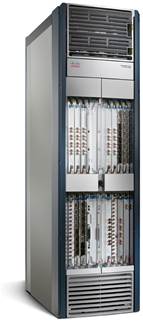
The Cisco CRS 16-Slot Single-Shelf System (Figure 1) offers many advantages:
● The system is powered by a chipset architecture engineered for the Cisco CRS Router Family, which provides higher bandwidth than competing products, without compromising service performance. The Cisco CRS chipset is based on multidimensional engineering that includes several functional components working in tandem throughout the platform.
● The system uses Cisco IOS XR Software, designed for always-on operation. Cisco IOS XR Software is the only fully modular, fully distributed internetwork operating system using a memory-protected, microkernel-based architecture and control-plane distribution that allows the system to scale.
● This single-shelf system is fully compatible with existing and future components of the Cisco CRS Family, such as router processors and line cards.
● The fully redundant carrier-class configuration supports in-service upgrades from 40 Gbps per slot and 140 Gbps per slot to 400 Gbps per slot, when available, and from a single-chassis to a multichassis system.
● Integrated technology includes IP and Multiprotocol Label Switching (MPLS) routing, IP over dense wavelength-division multiplexing (IPoDWDM), network virtualization with secure domain routers (SDRs), fabric multicast replication, fabric quality of service (QoS), Cisco NetFlow accounting, and Carrier-Grade IPv6 (CGv6) to provide an outstanding quality of experience (QoE) at the lowest possible total cost of ownership (TCO).
● The system can also scale with back-to back system capability, connecting two Cisco CRS 16-Slot Chassis directly, using switch fabric cards and optical cables to form a single logical system.
Product Specifications
There are two versions of the Cisco CRS 16-Slot System, the Cisco CRS-16/S and CRS-16/S-B chassis. Table 1 gives specifications for both versions of the Cisco CRS-16/S and CRS-16/S-B chassis.
Table 1. Cisco CRS-16/S and CRS-16/S-B Product Specifications
|
|
CRS-16/S-B CRS |
CRS-16/S CRS |
| Feature |
Description |
Description |
| Compatibility |
Compatible with all current Cisco CRS Family modular services cards (MSCs), forwarding processors, physical layer interface modules (PLIMs), route processors, and fabric cards |
Compatible with all current Cisco CRS Family modular services cards (MSCs), forwarding processors, interface modules (PLIMs), route processors, and fabric cards |
| Back-to-Back Capability |
Yes |
Yes |
| Multichassis Capability |
Yes |
Yes |
| Software compatibility |
Cisco IOS XR Software Release 4.0.3. or later |
Cisco IOS XR Software Release 4.0.0 or later * Cisco IOS XR Software Release 3.1. or later for legacy Cisco CRS chassis |
| Protocols |
Cisco Discovery Protocol
● IPv4 and IPv6 addressing
● Internet Control Message Protocol (ICMP)
● Layer 3 routing protocols, including Border Gateway Protocol Version 4 (BGPv4), Open Shortest Path First Version 2 (OSPFv2), OSPFv3, and Intermediate System-to-Intermediate System (IS-IS) Protocol
Multicast forwarding with support for source-based and shared distribution trees and the following protocols:
● Protocol Independent Multicast sparse mode (PIM-SM)
● Bidirectional PIM (Bidir-PIM)
● PIM source-specific mode (PIM SSM)
● Automatic route processing (AutoRP)
● Internet Group Management Protocol (IGMP) Versions 1,2, and 3
● Multiprotocol BGP (MBGP)
● Multicast Source Discovery Protocol (MSDP)
Multiprotocol Label Switching (MPLS):
● MPLS Label Distribution Protocol (LDP)
● Resource Reservation Protocol (RSVP)
● DiffServ-Aware Traffic Engineering (TE)
MPLS Traffic Engineering control plane (RFCs 2702 and 2430) Route Policy Language (RPL) Management:
● Simple Network Management Protocol (SNMP)
● Programmatic interfaces (XML)
Security
● Message Digest Algorithm (MD5)
● IP Security (IPsec) Protocol
● Secure Shell Protocol Version 2 (SSHv2)
● Secure FTP (SFTP)
● Secure Sockets Layer (SSL)
● Packet over SONET/SDH (PoS)
● RFC 1619/2615, Point-to-Point Protocol (PPP) over SONET/SDH
● RFC 1662, PPP in High-Level Data Link Control (HDLC)-like framing
● RFC 2615, PPP over SONET/SDH
● HDLC
|
Cisco Discovery Protocol
● IPv4 and IPv6 addressing
● Internet Control Message Protocol (ICMP)
● Layer 3 routing protocols, including Border Gateway Protocol Version 4 (BGPv4), Open Shortest Path First Version 2 (OSPFv2), OSPFv3, and Intermediate System-to-Intermediate System (IS-IS) Protocol
Multicast forwarding with support for source-based and shared distribution trees and the following protocols:
● Protocol Independent Multicast sparse mode (PIM-SM)
● Bidirectional PIM (Bidir-PIM)
● PIM source-specific mode (PIM SSM)
● Automatic route processing (AutoRP)
● Internet Group Management Protocol (IGMP) Versions
1, 2, and 3
● Multiprotocol BGP (MBGP)
● Multicast Source Discovery Protocol (MSDP)
Multiprotocol Label Switching (MPLS):
● MPLS Label Distribution Protocol (LDP)
● Resource Reservation Protocol (RSVP)
● DiffServ-Aware Traffic Engineering (TE)
MPLS Traffic Engineering control plane (RFCs 2702 and 2430) Route Policy Language (RPL) Management:
● Simple Network Management Protocol (SNMP)
● Programmatic interfaces (XML)
Security:
● Message Digest Algorithm (MD5)
● IP Security (IPsec) Protocol
● Secure Shell Protocol Version 2 (SSHv2)
● Secure FTP (SFTP)
● Secure Sockets Layer (SSL)
● Packet over SONET/SDH (PoS)
● RFC 1619/2615, Point-to-Point Protocol (PPP) over SONET/SDH
● RFC 1662, PPP in High-Level Data Link Control (HDLC)-like framing
● RFC 2615, PPP over SONET/SDH
● HDLC
|
| Components |
Each Cisco CRS enhanced16-slot line card chassis includes:
● Two route processors
● Two fan controllers
● Eight fabric cards
● Two power shelves (either DC or AC)
● Two alarm cards
● Two fan trays
● One fan filter
● Line cards
|
Each Cisco CRS 16-slot line card chassis includes:
● Two route processors
● Two fan controllers
● Eight fabric cards
● Two power shelves (either DC or AC)
● Two alarm cards
● Two fan trays
● One fan filter
● Line cards
|
| Line cards, ports, and slots |
● 1-port OC-768c/STM-256c packet over SONET (PoS)
● 4-port OC-192c/STM-64c PoS/Dynamic Packet Transport (DPT)
● 16-port OC-48c/STM-16 PoS/DPT
● 8-port 10 Gigabit Ethernet (GE)
● 4-port 10 GE
● 42-port 1 GE
● 1-port OC-768c/STM-256c Tunable WDMPoS
● 4-port 10 GE tunable WDMPHY
● 14-port 10 GE LAN/WAN PHY
● 20-port 10 GE LAN/WAN PHY
● 1-Port 100 Gigabit Ethernet Interface Module
● Cisco CRS-1-SIP-800 Carrier Card
● 2- and 4-port OC-3c/STM-1c PoS shared port adapters (SPAs)
● 1-port, 2-port, and 4-port OC-48c/STM-16c PoS/RPR SPA
● 1-port OC-192c/STM-64c PoS/RPR SPA
● 1-port 10 GE SPA
● 2-port and 4-port Clear Channel T3/E3 SPAs
● 2-port, 4-port, and 8-port OC-12c/STM-4 PoS SPAs
● 2-port, 5-port, 8-port, and 10-port GE SPAs
● 1-port 10 GE LAN/WAN-PHY SPA
● 20-port GE flexible interface module
● 2-port 10 GE WAN/LAN-PHY flexible interface module
● Flexible SPA and 6-port 10GE PLIM
● 2-Port 40 GE LAN/OTN Interface Module
● 4-Port 40 GE LAN/OTN Interface Module
● 1-Port 100 Gigabit Ethernet Coherent DWDM Interface Module
● 40x10 Gigabit Ethernet Interface Module
● 4-Port 100GE LAN/OTN Interface Module
|
● 1-port OC-768c/STM-256c packet over SONET (=PoS)=
● 4-port OC-192c/STM-64c PoS/Dynamic Packet Transport (DPT)
● 16-port OC-48c/STM-16 PoS/DPT
● 8-port 10 Gigabit Ethernet (GE)
● 4-port 10 GE
● 42-port 1 GE
● 1-port OC-768c/STM-256c Tunable WDMPoS
● 4-port 10 GE tunable WDMPHY
● 14-port 10 GE LAN/WAN PHY
● 20-port 10 GE LAN/WAN PHY
● 1-Port 100 Gigabit Ethernet Interface Module
● Cisco CRS-1-SIP-800 Carrier Card
● 2- and 4-port OC-3c/STM-1c PoS shared port adapters (SPAs)
● 1-port, 2-port, and 4-port OC-48c/STM-16c PoS/RPR SPA
● 1-port OC-192c/STM-64c PoS/RPR SPA
● 1-port 10 GE SPA
● 2-port and 4-port Clear Channel T3/E3 SPAs
● 2-port, 4-port, and 8-port OC-12c/STM-4 PoS SPAs
● 2-port, 5-port, 8-port, and 10-port GE SPAs
● 1-port 10 GE LAN/WAN-PHY SPA
● 20-port GE flexible interface module
● 2-port 10 GE WAN/LAN-PHY flexible interface module
● Flexible SPA and 6-port 10GE PLIM
● 2-Port 40 GE LAN/OTN Interface Module
● 4-Port 40 GE LAN/OTN Interface Module
● 1-Port 100 Gigabit Ethernet Coherent DWDM Interface Module 6-port 10GE PLIM
● 40x10 Gigabit Ethernet Interface Module
● 4-Port 100GE LAN/OTN Interface Module
|
| Fabric Cards |
CRS-16-FC/S CRS-16-140FC/S CRS-16-FC140/M CRS-16-FC400/S CRS-16-FC400/M |
CRS-16-FC/S CRS-16-140FC/S CRS-16-FC140/M CRS-16-FC400/S CRS-16-FC400/M * Note: Legacy chassis is limited to 200G on |
| Connectivity |
PoS, WDM, DPT, T3/E3, 100 GE, 10 GE, 1 GE |
PoS, WDM, DPT, T3/E3, 100 GE, 10 GE, 1 GE |
| Features and functions |
IP features:
● IPv4 unicast services
● IPv6 unicast services
● IPv4/IPv6 ECMP
● IPv4/IPv6 load balancing
Forwarding features:
● Access control lists (ACLs and xACLs)
● Quality of service and class of service (QoS/CoS) using Modular QoS CLI (MQC)
● IP packet classification/marking
● Queuing (both ingress and egress)
● Policing (both ingress and egress)
● Diagnostic and network management support
Optical features:
● Line-rate 42.8 Gbps ±4.6 ppm
● Duplex LC faceplate optical connector
● Full C-band tunable laser
● Configurable Tx optical power (-19 dBm to +1 dBm)
● Tx and Rx optical power monitoring
● Optical power monitoring accuracy ±2 dB
IPv4 multicast features:
● Multicast Reverse Path Forwarding (RPF)
● Multicast Nonstop Forwarding (NSF)
● Multicast Forwarding Information Base (MFIB)
MPLS features:
● MPLS forwarding
● MPLS load balancing
● UNI
● LMP
Security features:
● Control packet policing
● Dynamic control plane protection
● GTSM RFC 3682 (formally BTSH)
|
IP features:
● IPv4 unicast services
● IPv6 unicast services
● IPv4/IPv6 ECMP
● IPv4/IPv6 load balancing
Forwarding features:
● Access control lists (ACLs and xACLs)
● Quality of service and class of service (QoS/CoS) using Modular QoS CLI (MQC)
● IP packet classification/marking
● Queuing (both ingress and egress)
● Policing (both ingress and egress)
● Diagnostic and network management support
Optical features:
● Line-rate 42.8 Gbps ±4.6 ppm
● Duplex LC faceplate optical connector
● Full C-band tunable laser
● Configurable Tx optical power (-19 dBm to +1 dBm)
● Tx and Rx optical power monitoring
● Optical power monitoring accuracy ±2 dB
IPv4 multicast features:
● Multicast Reverse Path Forwarding (RPF)
● Multicast Nonstop Forwarding (NSF)
● Multicast Forwarding Information Base (MFIB)
MPLS features:
● MPLS forwarding
● MPLS load balancing
● UNI
● LMP
Security features:
● Control packet policing
● Dynamic control plane protection
● GTSM RFC 3682 (formally BTSH)
|
| Reliability and availability |
System redundancy:
● Power shelf redundancy 1:1
● Fan tray redundancy 1:1
● Fan controller redundancy 1:1
● Alarm card redundancy 1:1
● Route processor redundancy 1:1
● Fabric card redundancy 1:8
Software features:
● NSF using graceful restart for IS-IS, OSPF, BGP, LDP, and RSVP
● SONET automatic protection switching (APS) 1:1
● Line-card online insertion and removal (OIR) support
● Fabric card OIR support
● Out of resource management
● Process restartability
● MPLS Fast Reroute (FRR)
Hot Standby Router Protocol and Virtual Router Redundancy Protocol (HSRP/VRRP) |
System redundancy:
● Power shelf redundancy 1:1
● Fan tray redundancy 1:1
● Fan controller redundancy 1:1
● Alarm card redundancy 1:1
● Route processor redundancy 1:1
● Fabric card redundancy 1:8
Software features:
● NSF using graceful restart for IS-IS, OSPF, BGP, LDP, and RSVP
● SONET automatic protection switching (APS) 1:1
● Line-card online insertion and removal (OIR) support
● Fabric card OIR support
● Out of resource management
● Process restartability
● MPLS Fast Reroute (FRR)
Hot Standby Router Protocol and Virtual Router Redundancy Protocol (HSRP/VRRP) |
| MIBs |
SNMP framework support:
● SNMPv1
● SNMPv2c
● SNMPv3
● MIB II, including interface extensions (RFC 1213)
● SNMP-FRAMEWORK-MIB
● SNMP-TARGET-MIB
● SNMP-NOTIFICATION-MIB
● SNMP-USM-MIB
● SNMP-VACM-MIB
System management:
● CISCO- BULK-FILE-MIB
● CISCO-CONFIG-COPY-MIB
● CISCO-CONFIG-MAN-MIB
● CISCO-FLASH-MIB
● CISCO-MEMORY-POOL-MIB
● Cisco FTP Client MIB
● Cisco Process MIB
● Cisco Syslog MIB
● CISCO-SYSTEM-MIB
● CISCO-CDP-MIB
● IF-MIB (RFC 2233/RFC 2863)
Quality of service (QoS):
● MQC-MIB (Cisco Class-Based QoS MIB)
● CISCO-PING-MIB
Fabric:
● CISCO-Fabric-HFR-MIB
● CISCO-Fabric-Mcast-MIB
● CISCO-Fabric-Mcast-Appl-MIB
Routing protocols:
● BGP4-MIB Version 1
● OSPFv1-MIB (RFC 1253)
● CISCO-IETF-IP-FORWARDING-MIB
● IP-MIB (was RFC 2011-MIB)
● TCP-MIB (RFC 2012)
● UDP-MIB
● CISCO-HSRP-EXT-MIB
● CISCO-HSRP-MIB
Traps:
● RFC 1157
● Authentication
● Linkup
● Linkdown
● Coldstart
● Warmstart
|
SNMP framework support:
● SNMPv1
● SNMPv2c
● SNMPv3
● MIB II, including interface extensions (RFC 1213)
● SNMP-FRAMEWORK-MIB
● SNMP-TARGET-MIB
● SNMP-NOTIFICATION-MIB
● SNMP-USM-MIB
● SNMP-VACM-MIB
System management:
● CISCO- BULK-FILE-MIB
● CISCO-CONFIG-COPY-MIB
● CISCO-CONFIG-MAN-MIB
● CISCO-FLASH-MIB
● CISCO-MEMORY-POOL-MIB
● Cisco FTP Client MIB
● Cisco Process MIB
● Cisco Syslog MIB
● CISCO-SYSTEM-MIB
● CISCO-CDP-MIB
● IF-MIB (RFC 2233/RFC 2863)
Quality of service (QoS):
● MQC-MIB (Cisco Class-Based QoS MIB)
● CISCO-PING-MIB
Chassis:
● ENTITY-MIB (RFC 2737)
● CISCO-entity-asset-MIB
● CISCO-entity-sensor-MIB
● CISCO-FRU-MIB (Cisco-Entity-FRU-Control-MIB)
Fabric:
● CISCO-Fabric-HFR-MIB
● CISCO-Fabric-Mcast-MIB
● CISCO-Fabric-Mcast-Appl-MIB
Routing protocols:
● BGP4-MIB Version 1
● OSPFv1-MIB (RFC 1253)
● CISCO-IETF-IP-FORWARDING-MIB
● IP-MIB (was RFC 2011-MIB)
● TCP-MIB (RFC 2012)
● UDP-MIB
● CISCO-HSRP-EXT-MIB
● CISCO-HSRP-MIB
Traps:
● RFC 1157
● Authentication
● Linkup
● Linkdown
● Coldstart
● Warmstart
|
Network management |
● Enhanced command-line interface (CLI)
● Extensible Markup Language (XML) interface
● Cisco Craft Works Interface (CWI)
● Simple Network Management Protocol (SNMP) and MIB support
● Cisco Active Network Abstraction (ANA)
|
● Enhanced command-line interface (CLI)
● Extensible Markup Language (XML) interface
● Cisco Craft Works Interface (CWI)
● Simple Network Management Protocol (SNMP) and MIB support
● Cisco Active Network Abstraction (ANA)
|
| Programmatic interfaces |
● XML schema support
|
● XML schema support
|
| Physical dimensions |
Chassis height:
● 84 in. (213.36 cm)
Chassis width:
● 23.6 in. (59.944 cm)
Chassis depth:
● 36 in. (91.44 cm)
● 39.718 in. (100.844 cm), including cable-management system and front cover
Weight:
● 839 lb (380 kg) as shipped, chassis only with built-in rack and fan trays installed
● 908 lb (411 kg) chassis only as shipped, including power shelves, without power modules, and with built-in rack
● 1495 lb (678 kg) chassis fully configured, using all card slots, power shelves, and cosmetics, and with built-in rack
|
Chassis height:
● 84 in. (213.36 cm)
Chassis width:
● 23.6 in. (59.944 cm)
Chassis depth:
● 36 in. (91.44 cm)
● 39.718 in. (100.844 cm), including cable-management system and front cover
Weight:
● 939 lb (425 kg) as shipped, chassis only with built-in rack and fan trays installed
● 1008 lb (457 kg) chassis only as shipped, including power shelves, without power modules, and with built-in rack
● 1595 lb (723 kg) chassis fully configured, using all card slots, power shelves, and cosmetics, and with built-in rack
|
| Power |
● Chassis power supply maximum output capacity: 16.8 kW for both DC power supply and 18 kW AC power supply
|
● Chassis power supply maximum output capacity: 16.8 kW for both DC power supply and 18 kW AC power supply
|
| Environmental conditions |
Storage temperature: -40 to 70°C (-40 to 158°F) Operating temperature:
● Normal: 5 to 40°C (41 to 104°F)
● Short term: -5 to 50°C (23 to 122°F)
Relative humidity:
● Normal: 5 to 85%
● Short-term: 5 to 90% but not to exceed 0.024 kg water per kg of dry air
● Short-term refers to a period of not more than 96 consecutive hours and a total of not more than 15 days in 1 year. (This refers to a total of 360 hours in any given year, but no more than 15 occurrences during that 1-year period.)
|
Storage temperature: -40 to 70°C (-40 to 158°F) Operating temperature:
● Normal: 5 to 40°C (41 to 104°F)
● Short term: -5 to 50°C (23 to 122°F)
Relative humidity:
● Normal: 5 to 85%
● Short-term: 5 to 90% but not to exceed 0.024 kg water per kg of dry air
● Short-term refers to a period of not more than 96 consecutive hours and a total of not more than 15 days in 1 year (a total of 360 hours in any given year, but no more than 15 occurrences during that 1-year period).
|
System Capacity
Table 2 shows the system capacity of the Cisco CRS 16-Slot Single-Shelf System.
Table 2. System Capacity for Cisco CRS 16-Slot Single-Shelf System
| Number of Interface Slots |
Maximum Capacity per Slot |
Total Capacity |
| 16 |
400 Gbps per slot ingress and 400 Gbps per slot egress |
12.8 Tbps per single-shelf system |
Ordering Information
To place an order, visit the Cisco Ordering homepage and refer to Table 3 for ordering information.
Table 3. Ordering Information
| Product Part Number |
Product Name |
| CRS-16/S |
Cisco CRS 16-Slot Single-Shelf System |
| CRS-16/S-B |
Cisco CRS 16-Slot Single-Shelf System Enhanced |
Cisco Services
Cisco Services make networks, applications, and the people who use them work better together.
Today, the network is a strategic platform in a world that demands better integration between people, information, and ideas. The network works better when services, together with products, create solutions aligned with business needs and opportunities.
The unique Cisco Lifecycle approach to services defines the requisite activities at each phase of the network lifecycle to help ensure service excellence. With a collaborative delivery methodology that joins the forces of Cisco, our skilled network of partners, and our customers, we achieve the best results.
For More Information
For more information about the Cisco CRS 16-Slot Single-Shelf System, the Cisco CRS, and other available interfaces, contact your local account representative or visit Cisco at: http://www.cisco.com/go/crs.
For more information about the Cisco CRS Multichassis System, refer to the Cisco CRS Multichassis System data sheet.
 Feedback