Feedback
|
Table Of Contents
Upgrading or Downgrading the Software
Catalyst 6500 Series Requirements
Cisco 7600 Series Requirements
Resolved Caveats in Software Release 3.2.(26)
Resolved Caveats in Software Release 3.2.(25)
Resolved Caveats in Software Release 3.2.(24)
Resolved Caveats in Software Release 3.2.(23)
Resolved Caveats in Software Release 3.2.(22)
Resolved Caveats in Software Release 3.2.(21)
Resolved Caveats in Software Release 3.2(20)
Resolved Caveats in Software Release 3.2(19)
Resolved Caveats in Software Release 3.2(18)
Resolved Caveats in Software Release 3.2(17)
Resolved Caveats in Software Release 3.2(16)
Resolved Caveats in Software Release 3.2(14)
Resolved Caveats in Software Release 3.2(13)
Resolved Caveats in Software Release 3.2(12)
Resolved Caveats in Software Release 3.2(11)
Resolved Caveats in Software Release 3.2(10)
Resolved Caveats in Software Release 3.2(9)
Resolved Caveats in Software Release 3.2(8)
Resolved Caveats in Software Release 3.2(7)
Resolved Caveats in Software Release 3.2(6)
Resolved Caveats in Software Release 3.2(5)
Resolved Caveats in Software Release 3.2(4)
Resolved Caveats in Software Release 3.2(3)
Resolved Caveats in Software Release 3.2(2)
Obtaining Documentation and Submitting a Service Request
Release Notes for the Catalyst 6500 Series and Cisco 7600 Series Firewall Services Module, Software Release 3.2(x)
March 2013This document contains release information for the following FWSM releases: 3.2(1) through 3.2(25).
Note
Release 3.2(15) is no longer available. See the "Important Notes" section for more information.
This document includes the following sections:
•
Upgrading or Downgrading the Software
•
Obtaining Documentation and Submitting a Service Request
Important Notes
•
Release 3.2(15) included a caveat fix (CSCsz35702) that caused the FWSM to hang for some customers (CSCte48563) when using identity NAT. 3.2(16) is identical to 3.2(15) except that caveat CSCsz35702 remains in an open state to avoid caveat CSCte48563. Caveat CSCsz35702 was resolved in Release 3.2(17).
•
You must install maintenance software Release 2.1(2) or later before you upgrade to FWSM Release 3.2. See the Upgrading the Catalyst 6500 Series Switch and Cisco 7600 Series Router Firewall Services Module from Release 2.x to Release 3.1 for detailed information about upgrading to 2.1(2).
•
For traffic that passes through the control-plane path, such as packets that require Layer 7 inspection or management traffic, the FWSM sets the maximum number of out-of-order packets that can be queued for a TCP connection to 2 packets, which is not user-configurable. All other TCP normalization features that are supported on the PIX and ASA platforms are not enabled for FWSM.
•
You can disable the limited TCP normalization support for FWSM using the no control-point tcp-normalizer command.
•
When you log in to the system execution space from the switch in multiple context mode, the System Execution Space Authentication feature in FWSM Release 3.2(1) lets you use authentication using a AAA server or local database. Previously, the only method of authentication available was to use the login password defined in the system configuration. The new authentication method is enabled by the aaa authentication telnet console command in the admin context. If you upgrade to Release 3.2, and have this command already in the admin context configuration, then authentication for the system execution space is enabled using the specified server or local database, even if you did not intend to enable it. To use the login password instead, you must remove the aaa authentication telnet console command in the admin context.
Upgrading or Downgrading the Software
See the Upgrading the Catalyst 6500 Series Switch and Cisco 7600 Series Router Firewall Services Module from Release 2.x to Release 3.1 for detailed information about upgrading to Release 3.2. Although the guide discusses upgrading to Release 3.1, the procedures also apply to upgrading to Release 3.2. You do not have to upgrade from 2.3 to 3.1 first, and then upgrade to 3.2; you can upgrade directly from 2.3 to 3.2.
Downgrading from a 3.2(x) image to a 3.1(x) image is supported when there are no 3.2(x) features configured. If the BGP stub license is activated, then downgrading to 3.1(1) through 3.1(7) will reset the activation key (3.1(8) and later is not affected). For example, if your activation key also includes a 50-context license, then resetting the key sets the license to the default 2 contexts.
Starting with Release 3.2(1), the vendor name in the url-server command changed from n2h2 to smartfilter. Due to this change, if you downgrade a 3.2 or later image that has the url-server vendor smartfilter command to a 3.1 image, then the 3.1 image rejects the url-server command. You will have to re-enter the url-server command using the n2h2 keyword.
Chassis System Requirements
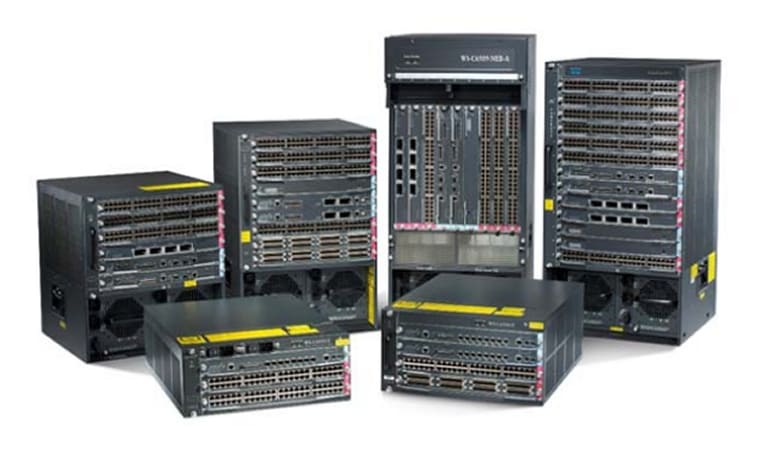
You can install the FWSM in the Catalyst 6500 series switches or the Cisco 7600 series routers. The configuration of both series is identical, and the series are referred to generically in this guide as the "switch." The switch includes a switch (the supervisor engine) as well as a router (the MSFC 2).
The switch supports Cisco IOS software on both the switch supervisor engine and the integrated MSFC router.
Note
The Catalyst operating system software is not supported.
The FWSM does not support a direct connection to a switch WAN port because WAN ports do not use static VLANs. However, the WAN port can connect to the MSFC, which can connect to the FWSM.
The FWSM runs its own operating system.
This section includes the following topics:
•
Catalyst 6500 Series Requirements
•
Cisco 7600 Series Requirements
Catalyst 6500 Series Requirements
Table 1 shows the supervisor engine version and software.
Table 1 Support for FWSM 3.2 on the Catalyst 6500
Supervisor Engines1 Cisco IOS15.1(1)SY and higher
720-10GE
15.1(1)SY and higher
720
15.1(1)SY and higher
SUP2T
15.0(1)SY and higher
720-10GE
15.0(1)SY and higher
720
15.0(1)SY and higher
SUP2T
12.2(33)SXJ and higher
720-10GE
12.2(33)SXJ and higher
720
12.2(33)SXJ and higher
32
12.2(18)SXF and higher
720, 32
12.2(18)SXF2 and higher
2, 720, 32
12.2(33)SXI and higher
720-10GE
12.2(33)SXI and higher
720, 32
12.2(18)ZYA
32-PISA
12.2(18)SXF4
720, 32
Cisco IOS Software Modularity12.2(18)SXF4
720, 32
1 The FWSM does not support the supervisor 1 or 1A.
Cisco 7600 Series Requirements
Table 2 shows the supervisor engine version and software.
Table 2 Support for FWSM 3.2 on the Cisco 7600
Supervisor Engines1 Cisco IOS12.2(33)SRD6
720-3C-1GE (No PISA integration, no Route Health Injection, no Virtual Switching system)
12.2(33)SRA
720, 32
12.2(33)SRB
720, 32
12.2(33)SRC
720, 32, 720-1GE
12.2(33)SRD
720, 32, 720-1GE
1 The FWSM does not support the supervisor 1 or 1A.
Management Support
The FWSM supports the following management methods:
•
Cisco ASDM—Software Release 5.2F supports FWSM software release 3.2(x) features. ASDM is a browser-based configuration tool that resides on the FWSM. The system administrator can configure multiple security contexts. If desired, individual context administrators can configure only their contexts.
•
Command-line interface (CLI)—Access the CLI by sessioning from the switch or by connecting to the FWSM over the network using Telnet or SSH. The FWSM does not have its own external console port.
New Features
Table 3 lists the new features for Version 3.2(1).
Note
No new features were added in subsequent maintenance releases.
Software License Information
The FWSM supports the following licensed features:
•
Multiple security contexts. The FWSM supports two virtual contexts plus one admin context for a total of three security contexts without a license. For more than three contexts, obtain one of the following licenses:
–
20
–
50
–
100
–
250
•
BGP stub support.
•
GTP/GPRS support.
Limitations and Restrictions
See the following limitations and restrictions on the FWSM:
•
The following features are not supported when you use TCP state bypass:
–
Application inspection—Application inspection requires both inbound and outbound traffic to go through the same FWSM, so application inspection is not supported with TCP state bypass.
–
AAA authenticated sessions—When a user authenticates with one FWSM, traffic returning via the other FWSM will be denied because the user did not authenticate with that FWSM.
•
Multiple context mode does not support most dynamic routing protocols. BGP stub mode is supported. Security contexts support only static routes or BGP stub mode. You cannot enable OSPF or RIP in multiple context mode.
•
Transparent firewall mode supports a maximum of eight interface pairs per context; however, when multiple bridge-group interfaces exist in a single context, inspection may not work properly. We recommend that you create a separate context for traffic that requires inspection.
•
For transparent firewall mode, you must configure a management IP address per interface pair.
•
The outbound connections (from a higher security interface to a lower security interface) from an interface that is shared between the contexts can only be classified and directed through the correct context if you configure a static translation for the destination IP address. This limitation makes cascading contexts unsupported, because configuring the static translations for all the outside hosts is not feasible.
•
The CPU-intensive commands, such as copy running-config startup-config (the same as the write memory command), might affect system performance, including reducing the successful rate of inspection and AAA connections. When a CPU-intensive action completes, the FWSM might produce a burst of traffic to catch up. If you limit the resource rates for a context, the burst might unexpectedly reach the maximum rate. We recommend using these commands during low traffic periods. Other CPU-intensive actions include the show arp command, polling the FWSM with SNMP, loading a large configuration, and compiling a large access list.
•
For ICMP traffic to pass through the FWSM when the don't fragment (DF) bit is set, be sure to enable ICMP application inspection. When ICMP inspection is disabled, the FWSM NATs the packet and then checks the MTU. If the MTU is exceeded and the DF bit is enabled, the FWSM should send an ICMP unreach packet back to the sender. But because the packet was already NATted, the FWSM no longer has the source IP address, so it drops the packet. (CSCsk61721)
•
If you configure the set connection timeout tcp and set connection timeout idle commands for the same class, then the idle command (which sets the timeout for all types of connections) is used instead of the tcp command (which sets the timeout for TCP connections only) when the class map does not specifically match TCP traffic. If the class map matches an access list that specifies TCP traffic explicitly, then the tcp command is used instead of the idle command for TCP traffic; other traffic that matches the access list uses the idle command. The following example creates an access list with an ACE that specifically matches TCP traffic. Therefore, TCP traffic uses the tcp command, while UDP and ICMP traffic uses the idle command.
access-list ip_traffic extended permit tcp any anyaccess-list ip_traffic extended permit udp any anyaccess-list ip_traffic extended permit icmp any anyclass-map c1match access-list ip_trafficpolicy-map p1class c1set connection timeout idle 3:0:0set connection timeout tcp 2:0:0service-policy p1 globalThe following example has an access list that matches all IP traffic, and it does not specifically match TCP traffic. Therefore, even though the tcp command is present in the configuration, it is ignored in favor of the idle command for all traffic, including TCP traffic.
access-list ip_traffic extended permit ip any anyclass-map c1match access-list ip_trafficpolicy-map p1class c1set connection timeout idle 3:0:0set connection timeout tcp 2:0:0service-policy p1 global(CSCsk57385)
•
The FWSM processes virtual Telnet connections after you remove the virtual telnet command. You need to reload the FWSM after you remove the virtual telnet command to avoid the following situation.
After you remove the virtual telnet command, the FWSM processes virtual Telnet connections as through the box connections and thinks there is a host on the inside with the virtual IP address. Because AAA is configured for through the box connections, a uauth is created. Once a uauth is created, the connection is forwarded to the specific IP address. Because no hosts are available at this IP address, the connection is closed. However, the uauth remains and all connections through the box go through until the uauth times out. You cannot clear a uauth if the FWSM sees an invalid host. It needs to be done via an access-list to check the connections going through the box. (CSCsl08082)
•
Do not configure both the timeout uauth 0 command and the aaa authentication clear-conn command; if you do so, you cannot open any connections through the FWSM because the connection immediately closes when AAA succeeds. This happens every time you try to open a connection (because the FWSM is not caching uauth entries).
•
During URL filtering at high rates, the HTTP connection to the server through the FWSM might not complete correctly in some scenarios with the TCP normalizer enabled and URL filtering enabled. To solve this issue, enter the url-block block 16 command in multiple mode or the url-block block 128 command in single mode. (CSCsj00658)
Open Caveats
This section contains open caveats in the latest maintenance release.
If you are running an older release, and you need to determine the open caveats for your release, then add the caveats in this section to the resolved caveats from later releases. For example, if you are running Release 3.2(4), then you need to add the caveats in this section to the resolved caveats from 3.2(5) and later to determine the complete list of open caveats.
•
CSCei76209
The show mroute output is missing interfaces in the OIF list after it switches to the shortest path tree (s,g). The show mfib output shows this correctly.
Workaround: None.
•
CSCsi03512
You cannot ping across the FWSM after entering the [no] fabric sw-mode force bus command on the switch. This happens when switching mode is toggled on a Catalyst 6500 with supervisor 720 from Truncated mode to Bus mode and back to Truncated mode.
Workaround: Reload the Catalyst 6500 switch.
•
CSCsj04940
When configuring the nameif command in single transparent mode, portmap_index: unable to locate fixup message. Message is seen only in Transparent mode.
Workaround: None.
•
CSCsj98260
Under extreme traffic conditions, the FWSM crashes with continuous GTP V1 PDP context creation and delete requests.
Workaround: None.
•
CSCsk06328
When you configure the virtual http host warning command, the FWSM displays the wrong URL on the client browser.
Workaround: None.
•
CSCsk82919
If you use more than 70 dynamic access lists for a single user, the 71st dynamic access list or beyond may not load in the access list, and unpredictable behavior may occur; for example, you might not be able to FTP to the server.
Workaround: Limit dynamic access lists to 70 or below per user.
•
CSCsm66165
When an FWSM is participating in a PIM multicast network, and the FWSM has been configured to only register certain groups with the PIM RP via an access list, registration for groups might fail even through registration should be allowed. For example, the pim rp-address command is used in conjunction with an access list similar to the following:
access-list pim1 standard permit 209.165.200.224 255.255.255.224access-list pim1 standard permit 209.165.201.0 255.255.255.224access-list pim1 standard deny 209.165.202.128 255.255.255.224pim rp-address 192.168.33.43 pim1This configuration should only allow the groups associated with the 209.165.200.224/27 and 209.165.201.0/27 networks to register with the RP. However, the FWSM might fail to register these groups with the RP.
Workaround: Remove the acl argument from the pim rp-address command. This will allow the FWSM to register all groups with the RP.
•
CSCso46878
An extra xlate (between the wrong interfaces) gets created when using static policy NAT and the no nat-control command. This seems to occur when the policy NAT access list overlaps with a network on another interface.
Workaround: If applicable, use static NAT without an access list, and filter with an access-group.
•
CSCsq11637
In transparent mode, when a user initiates an inbound Telnet connection, the user is prompted for the AAA username and password. After the user enters the correct AAA username and password, the Telnet sever login and password should be prompted. But is not prompted and the session times out. After the connection times out, the uauth session is still in the table. If you try to Telnet again, the connection succeeds. So, only the Telnet used to create the uauth session fails. This issue is seen when the configuration has the following:
a.
Transparent mode AAA authentication on the outside interface for inbound traffic from outside to inside.
b.
A static NAT statement present of the form static (inside,outside) (notice it should be (inside,outside) not (outside,inside)).
c.
The static NAT statement is not identity static NAT (where the real and mapped IP address of the inside host are the same).
Workaround: Avoid non-identity static NAT of the form static (inside,outside) A B on the inside interface. If the nat-control command is enabled, either configure identity static NAT or NAT exemption on the inside interface. Or simply reconnect with Telnet after the uauth session is created.
•
CSCsv50778
If you configure policy NAT using an access list that is inactive, and then change the memory partition of the context using the allocate acl-partition command, then the traffic starts using the policy NAT having an inactive access list to create xlates. You can also see that the hitcnt of the access lists start incrementing when it is still in an inactive state.
Workaround: Reload the FWSM.
•
CSCsw36835
When you share an outside interface among multiple contexts, and a host in context 1 connects to a host in context 2 using UDP, then if you clear the connection in one of the contexts (for example, using clear local-host or clear xlate), then any subsequent UDP connections between the two hosts fail.
Workaround: Clear the connection in both contexts.
•
CSCsw51353
When you change the memory partition of a context, then all access lists that have the log keyword specified stop generating logs.
Workaround: Delete and reconfigure the access lists with the log keyword.
•
CSCsw83232
Communication between H.323 endpoints might fail after a short amount of time (around 30 seconds) or might fail to be established at all. Note: 3.2(1) is not affected.
Workaround: Disable TCp normalization using the no control-point tcp-normalizer command.
•
CSCsx79204
When PPTP connections are passed through the FWSM, if the PPTP inspection is enabled on the FWSM, then two GRE connections will be dynamically built by the inspection engine. These GRE connections will timeout after 2 minutes of inactivity even if the configuration on the FWSM specifies they should not time out at 2 minutes.
The following example enables PPTP inspection and an idle timeout of 24 hours:
access-list pptp extended permit gre any anyclass-map pptpmatch access-list pptppolicy-map global_policyclass-map pptpset connection timeout idle 24:00:00Workaround: Disable the PPTP inspection, and explicitly allow the GRE traffic through the FWSM. If NAT is used, the inside hosts using PPTP must be statically NATted through the FWSM.
•
CSCsy17449
Entering the write net command within a context might unexpectedly reload the FWSM causing you to see the following:
NP Hard Debug: NP1 thread 15 hit PC 0x597fLCBAWorkaround: None.
•
CSCsy74687
You might experience an unexpected reload in Thread Name: doorbell_poll or Syslog_entry.
Workaround: None.
•
CSCsz74961
FWSM might log incorrect system messages for DNS traffic which are then denied in an ACL. This occurs only when DNS is enabled.
Workaround: None.
•
CSCsz81503
Multicast bi-directional forwarding fails due to an incorrect forwarding entry. The results can be seen when you use the show np 3 mroute command. This problem can be seen when using OSPF in redundant FWSM environments, where the FWSM is between the multicast source and the routing protocol.
Workaround: Use the clear ospf process command.
•
CSCsz82463
FWSM is not correctly parsing the RTSP setup messages and opens a connection stream on the wrong port.
Workaround: None.
•
CSCta28599
In certain instances when setting up failover, FWSM may crash and reload due to a problem with Thread Name: fover_health_monitoring_thread entry.
Workaround: None.
•
CSCtc23265
After a failover of the FWSM, active H.323 connections through the FWSM might be disconnected. After the connection is re-established it should work fine. This occurs when H.323 inspection is enabled, and a failover takes place while the H.323 connections are active through the FWSM. For example, if a call is made from one H.323 endpoint to another, and the FWSM fails over while the call is active.
Workaround: If NAT is not being performed by the FWSM, disable the H.323 inspection and permit all necessary connectivity between the H.323 endpoints explicitly via the access-lists on the FWSM.
•
CSCte02257
A SIP call might not work when SIP inspection is enabled.
Workaround: None.
Resolved Caveats
This section contains resolved caveats in each maintenance release and includes the following topics:
•
Resolved Caveats in Software Release 3.2.(26)
•
Resolved Caveats in Software Release 3.2.(25)
•
Resolved Caveats in Software Release 3.2.(24)
•
Resolved Caveats in Software Release 3.2.(23))
•
Resolved Caveats in Software Release 3.2.(22)
•
Resolved Caveats in Software Release 3.2.(21)
•
Resolved Caveats in Software Release 3.2(20)
•
Resolved Caveats in Software Release 3.2(19)
•
Resolved Caveats in Software Release 3.2(18)
•
Resolved Caveats in Software Release 3.2(17)
•
Resolved Caveats in Software Release 3.2(16)
•
Resolved Caveats in Software Release 3.2(14)
•
Resolved Caveats in Software Release 3.2(13)
•
Resolved Caveats in Software Release 3.2(12)
•
Resolved Caveats in Software Release 3.2(11)
•
Resolved Caveats in Software Release 3.2(10)
•
Resolved Caveats in Software Release 3.2(9)
•
Resolved Caveats in Software Release 3.2(8)
•
Resolved Caveats in Software Release 3.2(7)
•
Resolved Caveats in Software Release 3.2(6)
•
Resolved Caveats in Software Release 3.2(5)
•
Resolved Caveats in Software Release 3.2(4)
•
Resolved Caveats in Software Release 3.2(3)
•
Resolved Caveats in Software Release 3.2(2)
Resolved Caveats in Software Release 3.2.(26)
The following caveats were resolved in Release 3.2(26) and were not previously documented. If you are a registered Cisco.com user, you can view more information about the caveat using the Bug Toolkit at the following website:
Resolved Caveats in Software Release 3.2.(25)
The following caveat was resolved in Release 3.2(25) and was not previously documented. If you are a registered Cisco.com user, you can view more information about the caveat using the Bug Toolkit at the following website:
Resolved Caveats in Software Release 3.2.(24)
The following caveat was resolved in Release 3.2(24) and was not previously documented. If you are a registered Cisco.com user, you can view more information about the caveat using the Bug Toolkit at the following website:
Resolved Caveats in Software Release 3.2.(23)
The following caveat was resolved in Release 3.2(23) and was not previously documented. If you are a registered Cisco.com user, you can view more information about the caveat using the Bug Toolkit at the following website:
Table 7 Resolved Caveat in Release 3.2(23)
Caveat DescriptionCSCtu97367
Crash when processing multicast traffic
Resolved Caveats in Software Release 3.2.(22)
The following caveats were resolved in Release 3.2(22) and were not previously documented. If you are a registered Cisco.com user, you can view more information about the caveats using the Bug Toolkit at the following website:
Resolved Caveats in Software Release 3.2.(21)
The following caveats were resolved in Release 3.2(21) and were not previously documented. If you are a registered Cisco.com user, you can view more information about the caveats using the Bug Toolkit at the following website:
Resolved Caveats in Software Release 3.2(20)
The following caveats were resolved in Release 3.2(20) and were not previously documented. If you are a registered Cisco.com user, you can view more information about the caveats using the Bug Toolkit at the following website:
•
CSCtk61424 — OpenSSL Ciphersuite Downgrade and J-PAKE Issues
Symptom:
The device may be affected by an OpenSSL vulnerabilities described in CVE-2010-4180 and CVE-2010-4252.
Conditions:
Device configured with any feature that uses SSL.
Workaround:
Not available
PSIRT Evaluation:
The Cisco PSIRT has assigned this bug the following CVSS version 2 score. The Base and Temporal CVSS scores as of the time of evaluation are 5.1/3.8:
https://intellishield.cisco.com/security/alertmanager/cvssCalculator.do?dispatch=1&version=2&vector=AV:N/AC:L/Au:N/C:C/I:C/A:C/E:H/RL:U/RC:C
CVE IDs CVE-2010-4180 and CVE-2010-4252 have been assigned to document this issue.
Additional information on Cisco's security vulnerability policy can be found at the following URL:
http://www.cisco.com/en/US/products/products_security_vulnerability_policy.html
•
CSCtl21186 — Cmd authorization fails for certain commands on fallback to LOCAL db
Symptom:
Certain commands like 'show running-config', 'show interface' are allowed to be executed by users with lower privilege-level when fallback has occurred.
Conditions:
1. Fallback to LOCAL is configured
2. All FWSM commands are assigned their default privilege levels in LOCAL db.
3. Users with lower privilege-level than 15 login into privileged-exec mode and execute 'show running-config' or 'show interface' commands, and some config commands.
Workaround:
none.
PSIRT Evaluation:
The Cisco PSIRT has assigned this bug the following CVSS version 2
score. The Base and Temporal CVSS scores as of the time of evaluation are 6.0/5.0:
https://intellishield.cisco.com/security/alertmanager/cvssCalculator.do?dispatch=1&version=2&vector=AV:L/AC:H/Au:S/C:C/I:C/A:C/E:F/RL:OF/RC:C
CVE ID CSCtl94142 has been assigned to document this issue.
Additional information on Cisco's security vulnerability policy can be found at the following URL:
http://www.cisco.com/en/US/products/products_security_vulnerability_policy.html
•
CSCtl84952 — SCCP inspection DoS vulnerability
A vulnerability exists in the Cisco Firewall Services Module (FWSM) for Cisco Catalyst 6500 Series Switches and Cisco 7600 Series Routers that may cause the Cisco FWSM to reload after processing a malformed Skinny Client Control Protocol (SCCP) message. Devices are affected when SCCP inspection is enabled.
Cisco has released free software updates that address this vulnerability.
This advisory is posted at
http://tools.cisco.com/security/center/content/CiscoSecurityAdvisory/cisco-sa-20110223-fwsm
Note: Cisco ASA 5500 Series Adaptive Security Appliances are affected by the vulnerability described in this advisory. A separate Cisco Security Advisory has been published to disclose this and other vulnerabilities that affect the Cisco ASA 5500 Series Adaptive Security Appliances. The advisory is available at
http://tools.cisco.com/security/center/content/CiscoSecurityAdvisory/cisco-sa-20110223-asa
Resolved Caveats in Software Release 3.2(19)
The caveats listed in Table 10 were resolved in software release 3.2(19) and were not previously documented. If you are a registered cisco.com user, view more information about each caveat using the Bug Toolkit at the following URL:
http://www.cisco.com/support/bugtools
Resolved Caveats in Software Release 3.2(18)
The caveats listed in Table 11 were resolved in software Release 3.2(18) and were not previously documented. If you are a registered Cisco.com user, view more information about each caveat using the Bug Toolkit at the following website:
http://www.cisco.com/support/bugtools
Resolved Caveats in Software Release 3.2(17)
This section contains resolved caveats in software Release 3.2(17).
•
CSCsz35702
When the FWSM is configured for PAT with failover, and you force a failover, then the portmap translation fails (syslog message 305006 appears).
Workaround: None.
The caveats listed in Table 12 were resolved in software Release 3.2(17) and were not previously documented. If you are a registered Cisco.com user, view more information about each caveat using the Bug Toolkit at the following website:
http://www.cisco.com/support/bugtools
Resolved Caveats in Software Release 3.2(16)
This section contains resolved caveats in software Release 3.2(16).
•
CSCtc02363
The RTSP inspection incorrectly translates IP addresses inside the URL in RTSP OPTIONS and DESCRIBE headers.
Workaround: None.
•
CSCtb88893
In transparent mode when using failover, the broadcast ARP request from the standby unit is being passed through by the active FWSM. This causes a MAC address change on the switch, and as a result, keepalives between the FWSMs are failing. You might see the following syslog messages:
FWSM-1-105005: (Primary) Lost Failover communications with mate on interface trusted2030
FWSM-1-105008: (Primary) Testing Interface trusted100
FWSM-1-105009: (Primary) Testing on interface trusted100 Passed
Also, traces indicate that hellos are being missed between the active and standby FWSM.
Workaround: None.
•
CSCtb18847
When using the established command, all traffic stops passing through the FWSM, and failover does not occur. When viewing the output of the show np pc command at separate times, note that the threads in the third column (NP3) will not change.
Workaround: Remove the established commands.
The caveats listed in Table 13 were resolved in software Release 3.2(16), and were not previously documented. If you are a registered Cisco.com user, view more information about each caveat using the Bug Toolkit at the following website:
http://www.cisco.com/support/bugtools
Resolved Caveats in Software Release 3.2(14)
This section contains resolved caveats in software Release 3.2(14).
•
CSCta49185
When FWSM is in multi-context mode and the wr standby command is run in user context mode on Active unit, the configuration is not the same as the configuration on the standby unit. Additionally, the snmp-server enable traps snmp authentication linkup linkdown coldstart configuration appears on both the Active and Standby units.
Workaround: None.
The caveats listed in Table 14 were resolved in software Release 3.2(14), and were not previously documented. If you are a registered Cisco.com user, view more information about each caveat using the Bug Toolkit at the following website:
http://www.cisco.com/support/bugtools
Resolved Caveats in Software Release 3.2(13)
This section contains resolved caveats in software Release 3.2(13).
•
CSCsy35054
When receiving a gratuitous ARP, the FWSM may not update all existing connections with the new MAC address.
Workaround: Enter the clear local-host command for the affected host to clear out the old MAC address; the client must re-establish any connections to that host.
•
CSCsz20693
The FWSM unexpectedly reloads with a high RTSP traffic load when RTSP inspection is enabled. This occurs with a large amount of RTSP traffic, around 42K connections/sec including RTSP traffic through the box. This software reload is not seen with a single RTSP connection.
Workaround: Disable RTSP inspection or reduce the amount of traffic.
•
CSCsz23283
When snmpwalk is issued to the FWSM, the FWSM may respond TCP-MIB in non-lexicographical order.
Workaround: Run snmpwalk with the -Cc option.
•
CSCsz60413
The FWSM unexpectedly reloads when you enter the show failover history command when the FWSM has frequent failover state changes.
Workaround: Do not enter the show failover history command in the above circumstances.
The caveats listed in Table 15 were resolved in software Release 3.2(13), and were not previously documented. If you are a registered Cisco.com user, view more information about each caveat using the Bug Toolkit at the following website:
http://www.cisco.com/support/bugtools
Resolved Caveats in Software Release 3.2(12)
This section contains resolved caveats in software Release 3.2(12).
•
CSCsy29192—This caveat is open in Release 3.2.11 and later. This issue does not affect earlier releases.
When using failover, HTTP connections are not being replicated properly to the standby unit. The connections are being replicated in a half-open state.
Workaround: None.
•
CSCsr68825
When using failover, the standby FWSM may send the RST for some TCP connections. This is a rare situation that may occur either during the manual switchover, or during the transient conditions (the preemption is taking place, and so on).
Workaround: None.
•
CSCsy00911
If you enable SMTP logging using the logging mail command, the amount of free memory on the FWSM gradually decreases with no changes in traffic load.
Workaround: Disable SMTP logging or reload the FWSM periodically.
•
CSCsy03439
The FWSM in failover scenario does not send the coldstart SNMP trap.
Workaround: None.
The caveats listed in Table 16 were resolved in software Release 3.2(12), and were not previously documented. If you are a registered Cisco.com user, view more information about each caveat using the Bug Toolkit at the following website:
http://www.cisco.com/support/bugtools
Resolved Caveats in Software Release 3.2(11)
This section contains resolved caveats in software Release 3.2(11).
•
CSCsv14944
Crash in Thread Name: doorbell_poll, 0x3cec in NP1 or NP2.
Workaround: None.
•
CSCsv42245
HTTP traffic fails for ASR topology with Active/Active failover.
Workaround: None.
•
CSCsv99839
H.323 inspection fails to open pinholes for voice or video traffic of VCON MXM management software Version 4.7 used with VCON Version 8.0 clients.
Workaround: Downgrade the VCON MXM manager to 4.51 and the clients to 7.x.
•
CSCsw40164
When failover interfaces are configured before any other VLAN interface, then for SNMP, the failover interfaces are included in ipAddrtable .1.3.6.1.2.1.2.2.1.2, but not in .1.3.6.1.2.1.4.20.1.2. This causes the indices for these two subtrees to be off by the number of failover interfaces configured.
Workaround: Remove the failover configuration and re-add it each time you add a new VLAN interface. This will cause the indices for the failover interfaces to be last and will not influence the index of any other interface.
•
CSCsw46905
If you use Active/Active failover, during configuration replication, the active firewall might crash and hang.
Workaround: Reload the active FWSM from the switch is needed using the hw-module module slot reset command.
•
CSCsv31759
When you enable ICMP inspection for an interface, it automatically gets enabled for the global policy.
Workaround: Manually disable ICMP inspection for the global policy.
•
CSCsv84314
The FWSM may crash in Thread Name: doorbell_poll.
Workaround: None.
The caveats listed in Table 17 were resolved in software Release 3.2(11), and were not previously documented. If you are a registered Cisco.com user, view more information about each caveat using the Bug Toolkit at the following website:
http://www.cisco.com/support/bugtools
Resolved Caveats in Software Release 3.2(10)
This section contains resolved caveats in software Release 3.2(10).
•
CSCsv41010
When SIP inspection is enabled, the FWSM crashes at thread name udp_sip.
Workaround: Disable SIP inspection.
•
CSCsv54515
For connections like FTP, the data channel SYN is not adjusted if the sysopt connection tcp window-scale and tcp-sack options are configured.
Workaround: None.
The caveats listed in Table 18 were resolved in software Release 3.2(10), and were not previously documented. If you are a registered Cisco.com user, view more information about each caveat using the Bug Toolkit at the following website:
http://www.cisco.com/support/bugtools
Resolved Caveats in Software Release 3.2(9)
This section contains resolved caveats in software Release 3.2(9).
•
CSCsr11396
URL filtering stop when the url-server command is configured on either an inside or DMZ interface and application inspection is enabled in an interface-specific service policy.
Workaround: Enable application inspection in the global service policy.
All traffic fails through the context after changing the acl-partition of the context.
•
CSCsr55215
The auth-prompt reject invalid-credentials command does not work. If a user gives the wrong username and password, the prompt is not displayed.
Workaround: Configure the reject prompt using the auth-prompt reject prompt command instead.
•
CSCsr91871
When you have an SGSN context request/response inspected by the FWSM with a size above 32 bytes and a "next extension header type" of 0x00, then you see the following syslog message:
GTPv1 packet parsing error from inside:10.1.2.3/2123 to outside:10.2.2.3/2123, TEID: 0x00000000, Reason:Workaround: Use the permit error parameter for the GTP inspection so that these packets are not dropped.
•
CSCsr93090
When there is a heavy load of accounting and authentications being performed, you might see a high CPU condition.
Workaround: The issue is slightly improved if you add the AAA round-robin scheduling feature to the FWSM.
•
CSCsr93879
GTP identification request/response packets are dropped by the FWSM, which generates the following syslog message:
%FWSM-3-324001: GTPv1 packet parsing error from inside:10.2.3.4/2123 to outside:10.3.4.5/2123, TEID: 0x00000000, Reason:Workaround: Use the permit error parameter for the GTP inspection so that these packets are not dropped.
•
CSCsr93911
When you configure the FWSM to inspect GTP traffic in a context where you switch from GTPv0 and GTPv1, then an update PDP context request with TEID = 0x00000000 will be dropped by the FWSM with the following syslog message:
%FWSM-3-324001: GTPv1 packet parsing error from inside:10.2.3.4/2123 to outside:10.3.4.5/2123, TEID: 0x00000000, Reason:Workaround: Use the permit error parameter for the GTP inspection so that these packets are not dropped.
•
CSCsr93953
When you enable FTP inspection, the packets on the data channel do not pass through the FWSM after the 3-way hand shake was done correctly. This can occur when the MTU on the involved interfaces is lower than the default (1500); also, when IP packets are sent on the FTP data channel that are bigger than the MTU of one of the involved interfaces.
Workaround: Increase the MTU of the interfaces up to the limit (1500). Have the client and the server configure the size of IP packets to be lower than the lowest MTU of the interfaces.
•
CSCsr94408
The FWSM stops forwarding traffic due to a NP (Network Processor) being stuck. If you use failover, both units will report to be active. In the output of the show tech command or the show np 1/2 stats command, the following message can be seen:
ERROR: np_logger_query request for FP Stats failedThe show np block output will show thresholds hit massively and the show np pc output will show threads stuck on network processors.
See the following sample output from the show np pc and show np block commands:
hostname# show np pcTHREAD:PC(NP1/NP2/NP3)0:0000/6f4f/0000 1:0000/6f4f/0000 2:0000/6522/0000 3:0000/6522/00004:0000/6f4f/0000 5:0000/40da/0000 6:0000/3e99/0000 7:0000/6c1c/00008:0000/6f4f/0000 9:0000/6f4f/0000 10:0000/40da/0000 11:0000/40da/000012:0000/6f4f/0000 13:0000/40da/0000 14:0000/6f4f/0000 15:0000/40d8/000016:0000/6f4f/0000 17:0000/6522/0000 18:0000/40da/0000 19:0000/6f4f/000020:0000/3e99/0000 21:0000/3e99/0000 22:0000/3e99/0000 23:0000/6f4f/000024:0000/6f4f/0000 25:0000/4a84/0000 26:0000/40da/0000 27:0000/6f4f/000028:0000/3e99/0000 29:0000/6f4d/0000 30:0000/6f4f/0000 31:0000/6f4d/0000hostname# show np blockMAX FREE THRESH_0 THRESH_1 THRESH_2NP1 (ingress) 32768 112 298078 2107651 33106766(egress) 521206 521206 0 0 0NP2 (ingress) 32768 112 3467122 1266051 12020896(egress) 521206 113554 0 0 0NP3 (ingress) 32768 32768 0 446820 1702936(egress) 521206 521206 0 0 0Workaround: Regularly verify the show np block output to see if thresholds are not hit. If they are hit, consider routing some traffic outside of the FWSM.
•
CSCsu03780
When you clear the uauth session using the clear uauth command, or after the uauth timer expires, all existing connections using the uauth get teared down. This problem occurs if the uauth was created using the aaa authentication include ip command.
Workaround: Avoid using the aaa authentication include command; use the aaa authentication match command instead. For example:
access-list aaa permit ip source destaaa authentication match aaa interface server•
CSCsu04081
The aaa accounting include command does not accept udp as one of the options.
Workaround: Use the aaa accounting match command instead.
The caveats listed in Table 19 were resolved in software Release 3.2(9), and were not previously documented. If you are a registered Cisco.com user, view more information about each caveat using the Bug Toolkit at the following website:
http://www.cisco.com/support/bugtools
Resolved Caveats in Software Release 3.2(8)
This section contains resolved caveats in software Release 3.2(8).
•
CSCso25009
Performing a capture on the FWSM egress interface might show corrupted packets. This effect does not impact real traffic going through the FWSM.
Workaround: None.
•
CSCsq84306
SQL*net inspection modifies the HOST field of the redirect packet. The original content is replaced by the source IP address of the packet.
Workaround: Disable SQL*net inspection.
•
CSCsq45659
For IPSec flows (ESP), the destination MAC address might be rewritten with the MAC address of the old gateway after the packet is processed by the FWSM. This only affects FWSM in transparent mode after a route change on adjacent routers/MSFC.
Workaround: Clear connections for affected hosts using the clear conn local ip_address command or the clear conn global ip_address command.
•
CSCsq66164
Syslog message 106101 (number of cached deny flows) is generated constantly even though the number of deny flows has not reached the limit. This occurs when you have different time intervals set on ACEs.
Workaround: None
•
CSCsq11512
A Telnet connection is not affected by the TCP state bypass feature when a class map access list with a time range goes from active to inactive.
Workaround: In the class map, remove the match access-list command and use match any instead or, if the match access-list command is required, disable the set connection advanced-options tcp-state-bypass command and re-configure it again after the access list becomes active.
•
CSCsr11102
If the access list commit mode is set to manual-commit when you change the memory partition to which a context is assigned (the acl-partition command), then all subsequent traffic which was permitted and passing earlier now gets denied; syslog message 106023 is sent.
Workaround: Make sure the commit mode is set to auto-commit (the access-list mode auto-commit command) before changing the acl-partition command for a context.
If the issue has already appeared, then either change the mode to auto-commit and again change the acl-partition command; or clear the complete configuration of the context by entering the clear configure all command inside the context.
•
CSCsr11384
URL filtering stops for same-security level traffic when the url-server command is configured on either an inside or DMZ interface and application inspection is enabled either globally or on an interface.
Workaround: Disable application inspection.
The caveats listed in Table 20 were resolved in software Release 3.2(8), and were not previously documented. If you are a registered Cisco.com user, view more information about each caveat using the Bug Toolkit at the following website:
http://www.cisco.com/support/bugtools
Resolved Caveats in Software Release 3.2(7)
This section contains resolved caveats in software Release 3.2(7).
•
CSCsm69869
When an outside NAT rule is configured on the FWSM and NAT control is enabled, inbound traffic not matching that rule is being silently dropped.
Workaround: There are two options for getting around this. If possible, disable NAT control by entering the no nat-control command. If there are a limited number of networks on the outside coming in, a static outside NAT rule can be configured for those specific networks. For example:
static (outside,inside) 192.168.10.0 192.168.10.0 netmask 255.255.255.0•
CSCso10574
The FWSM might crash after upgrading to 3.2(4) or later, when multicast routing is enabled.
Workaround: Disable multicast routing before upgrading.
•
CSCso22765
FWSM gives an error and discards the configuration when overlapping static commands are configured. For example:
static (inside,outside) tcp 192.168.1.100 www 192.168.2.100 www netmask 255.255.255.255static (dmz,outside) 192.168.1.100 192.168.3.100 netmask 255.255.255.255Workaround: None.
•
CSCso38838
In rare circumstances, traffic matching a static policy NAT statement may fail with a "no translation group found" syslog message even though it matches the policy access list.
Workaround: Try redefining the policy access list with a different access list name and applying that to the static command.
The caveats listed in Table 21 were resolved in software Release 3.2(7), and were not previously documented. If you are a registered Cisco.com user, view more information about each caveat using the Bug Toolkit at the following website:
http://www.cisco.com/support/bugtools
Resolved Caveats in Software Release 3.2(6)
This section contains resolved caveats in software Release 3.2(6).
•
CSCsg74035
Under certain circumstances, the administrator may not be able to remove the aaa authentication match command using the no aaa authentication match command to remove it from configuration.
Workaround: Issue "clear configure aaa" to remove all AAA related configuration and re-configure again the required configuration.
•
CSCsl76823
FWSMs shipping directly from manufacturing are being shipped with a crashinfo file pre-loaded on the compact flash card. This crashinfo file was not created by the FWSM itself. Instead, it was generated by the FWSM that was used to make the master copy of the compact flash card that is then used to image all new FWSMs. This issue is completely cosmetic and has no impact to the FWSM itself. How to detect: Examine the output of crash file using the show crashinfo command. If all the following conditions are true, then you are affected.
1.
The crash occurred in the Thread named "BGP Router."
For Example: BGP Router (Old pc 0x00112b34 ebp 0x00000000)
2.
Following the traceback, the show version output (which is contained in the crashinfo file) displays version 3.2(0)0
For example: FWSM Firewall Version 3.2(0)0
3.
The same show version output indicates the FWSM serial number is SAD0649033Y. This Serial Number is not the actual Serial Number of the FWSM.
Workaround: Enter the clear crashinfo command to remove the incorrect crashinfo file from flash.
•
CSCsm42519
Under rare circumstances when you configure AAA for network access using a RADIUS server, the FWSM might crash due to processing of authentication requests through the FWSM.
Workaround: None.
The caveats listed in Table 22 were resolved in software Release 3.2(6), and were not previously documented. If you are a registered Cisco.com user, view more information about each caveat using the Bug Toolkit at the following website:
http://www.cisco.com/support/bugtools
Resolved Caveats in Software Release 3.2(5)
This section contains resolved caveats in software Release 3.2(5).
•
CSCsj04022
When a user tries to configure class maps containing large access lists and then tries to apply them to policy maps, access list compilation occurs. During compilation, the access list memory space might get exhausted due to FWSM hardware limitations. For example:
hostname(config)# class-map test3hostname(config-cmap)# match access-list 50000hostname(config-cmap)# policy-map global_policyhostname(config-pmap)# class test3hostname(config-pmap-c)# inspect dnsMemory for compiling access rules exhausted, aborting the current compilation and continuing to use the existing access rules.On the FWSM, compiled access lists are stored in the Network Processor (NP) memory. The error message generated above actually reports about the exhaustion of access list node objects on the NP. The following command shows the nodes in use:
hostname(config)# show np 3 acl stats----------------------------ACL Tree Statistics----------------------------Rule count : 8274Bit nodes (PSCB's): 14180Leaf nodes : 14173Total nodes : 28353 (max 28356) <-- it's close to the limitLeaf chains : 6394Total stored rules: 16457Max rules in leaf : 5Node depth : 23----------------------------Access list node memory objects consumed during an unsuccessful access list compilation are expected to be released when the compilation is aborted, but they are not. Thus, the access list node counter is increasing after every unsuccessful compilation attempt. This memory is never released on the NP, preventing the user from configuring and applying new access lists in the system.
Workaround: Do not configure access lists that might reach FWSM limits during compilation. The only way to release leaked access list memory after an aborted compilation is to reload the FWSM.
•
CSCsj12745
The aaa authentication clear-conn command does not clear inbound ssh/telnet connection after uauth timer is expired. This problem happens when, client from outside first gets authenticated with Virtual telnet/SSH to Virtual telnet/SSH ip address on FWSM and then initiates the successful telnet/ssh session to inside host. The FWSM is configured with the aaa authentication include telnet/ssh outside command.
Workaround: User can use the aaa authentication include tcp/0 outside command for authentication.
•
CSCsj97975
With the maximum number of ACEs configured in a context when a nameif command is entered, access list Memory exhaustion messages are seen on the FWSM console.
Workaround: Remove the nameif command, then remove some ACEs before re-entering the nameif command.
•
CSCsk71833
If you remove a nameif command, the match interface command in an OSPF route map shows as "match interface OSPF Unknown Type" instead of removing the match interface statement.
Workaround: Manually remove the match interface command.
•
CSCsl08131
If you configure the virtual ssh command as well as a static command for the virtual SSH IP address, then when an SSH login or logout is done to the virtual SSH IP address, it is not reflected in the uauth entry. Further, when uauth entry for the particular user is not present, then during the login authentication the following message is displayed:
[root@Linux ~]# ssh -l username virtual_SSH_IP_AddrLOGIN Authentication <<<< LOGINusername@virtual_SSH_IP_Addr's password:Logout Successful <<<< LOGOUTConnection closed by virtual_SSH_IP_Addr[root@Linux ~]#If the uauth entry for the user is already present, then following message is displayed during the Logout authentication:
[root@Linux ~]# ssh -l username virtual_SSH_IP_AddrLOGOUt Authentication <<<< LOGOUTusername<@virtual_SSH_IP_Addr's password:Authentication Successful <<<< LOGINConnection closed by virtual_SSH_IP_Addr[root@Linux ~]#Workaround: Use virtual SSH without a static NAT statement.
•
CSCsl08177
When virtual Telnet and virtual SSH are both configured at the same IP address, virtual Telnet works fine, but virtual SSH stops working.
Workaround: Configure the virtual ssh and virtual telnet commands at different IP addresses on the FWSM.
The caveats listed in Table 23 were resolved in software Release 3.2(5), and were not previously documented. If you are a registered Cisco.com user, view more information about each caveat using the Bug Toolkit at the following website:
http://www.cisco.com/support/bugtools
Resolved Caveats in Software Release 3.2(4)
This section contains resolved caveats in software Release 3.2(4).
•
CSCsj01533
With a 32-character password, authentication fails for SSH V1. This is seen with SSH V1 only and not with SSH V2. Authentication fails for a 32-character password only. Authentication works up to 31 characters.
Workaround: Either use SSH V2 or use a password up to 31 character long.
•
CSCsj97085
Command authorization using TACACS+ fails for show running-config nat and show running-config static commands.
Workaround: Use the show running-config | include nat and show running-config | include static commands, if show running-config is permitted.
•
CSCsl05935
After configuring the FWSM with a very basic configuration and SNMP-related commands, occasionally the show perfmon detailed command shows huge values for Connections in the last 1 minute.
Workaround: None.
The caveats listed in Table 24 were resolved in software Release 3.2(4), and were not previously documented. If you are a registered Cisco.com user, view more information about each caveat using the Bug Toolkit at the following website:
http://www.cisco.com/support/bugtools
Resolved Caveats in Software Release 3.2(3)
This section contains resolved caveats in software Release 3.2(3).
•
CSCsi03932
dACLSs downloaded from RADIUS server with uauth sessions are unable to remove from the system with uauth session timeout/deletion and even with the clear config access-list command.
Workaround: None.
•
CSCsi85092
Sometimes the "Authentication successful" window does not get displayed. The issue is seen only when the credentials are entered after the syslog "%FWSM-5-109012: Authen Session End: user '', sid 24, elapsed 30 seconds" gets displayed. This syslog gets displayed when the pending xlate for the HTTP connection is freed after 30 seconds.
Workaround: None.
•
CSCsj87817
After failover, active connections associated with uauth are not cleared when the uauth timer expires.
Workaround: Enter the clear conn command to clear the connections.
•
CSCsj90829
When trying to authenticate a single user using 4001 dynamic access lists, the active FWSM fails over to the standby unit.
Workaround: Reduce the number of dynamic access lists for the user.
•
CSCsj97107
When using command authorization using TACACS+, a user connected to the FWSM can enter into privileged EXEC mode only one time. If the user exits privileged EXEC mode and tries to re-enter privileged EXEC mode (using the disable command and then the enable command), command authorization fails because the username sent to the TACACS+ server is not the correct username.
Workaround: Close the Telnet session with the FWSM and re-establish a new session.
•
CSCsk01392
If you enable URL filtering, HTTP inspection, and DCERPC inspection, and a client uses outlook web access (OWA), the FWSM crashes.
Workaround: Disable URL filtering.
•
CSCsk06306
When you configure the virtual http command, and a user logs in with a non-existent username and no password, then the FWSM shows a LOGIN successful message, even though the login was not successful.
Workaround: None.
The caveats listed in Table 25 were resolved in software Release 3.2(3), and were not previously documented. If you are a registered Cisco.com user, view more information about each caveat using the Bug Toolkit at the following website:
http://www.cisco.com/support/bugtools
Resolved Caveats in Software Release 3.2(2)
This section contains resolved caveats in software Release 3.2(2).
•
CSCsh97363
FWSM will crash while downloading a DACL with 64 or more aces when debug radius is enabled.
Workaround: Turn off "debug radius".
•
CSCsj17064
Unable to remove resource rule configuration using the clear config all command. This condition is seen when trying to remove the resource rule command using the clear config all command.
Workaround: Use the clear config resource rule command or the no resource rule command.
The caveats listed in Table 26 were resolved in software Release 3.2(2), and were not previously documented. If you are a registered Cisco.com user, view more information about each caveat using the Bug Toolkit at the following website:
http://www.cisco.com/support/bugtools
Related Documentation
See the following sections for related documentation:
Hardware Documents
See the following related hardware documentation:
•
Catalyst 6500 Series Switch and Cisco 7600 Series Router Firewall Services Module Installation Note
•
Catalyst 6500 Series Switch Installation Guide
•
Catalyst 6500 Series Switch Module Installation Guide
Software Documents
See the following related software documentation:
•
Catalyst 6500 Series Switch and Cisco 7600 Series Router Firewall Services Module Configuration Guide
•
Catalyst 6500 Series Switch and Cisco 7600 Series Router Firewall Services Module Command Reference
•
Catalyst 6500 Series Switch and Cisco 7600 Series Router Firewall Services Module Logging Configuration and System Log Messages
•
Upgrading the Catalyst 6500 Series Switch and Cisco 7600 Series Router Firewall Services Module from Release 2.x to Release 3.1
•
Catalyst 6500 Series Cisco IOS Software Configuration Guide
•
Catalyst 6500 Series Cisco IOS Command Reference
Obtaining Documentation and Submitting a Service Request
For information on obtaining documentation, submitting a service request, and gathering additional information, see the monthly What's New in Cisco Product Documentation, which also lists all new and revised Cisco technical documentation, at:
http://www.cisco.com/en/US/docs/general/whatsnew/whatsnew.html
Subscribe to the What's New in Cisco Product Documentation as a Really Simple Syndication (RSS) feed and set content to be delivered directly to your desktop using a reader application. The RSS feeds are a free service and Cisco currently supports RSS Version 2.0.
This document is to be used in conjunction with the documents listed in the "Related Documentation" section.
Cisco and the Cisco logo are trademarks or registered trademarks of Cisco and/or its affiliates in the U.S. and other countries. To view a list of Cisco trademarks, go to this URL: www.cisco.com/go/trademarks. Third-party trademarks mentioned are the property of their respective owners. The use of the word partner does not imply a partnership relationship between Cisco and any other company. (1110R)
Any Internet Protocol (IP) addresses used in this document are not intended to be actual addresses. Any examples, command display output, and figures included in the document are shown for illustrative purposes only. Any use of actual IP addresses in illustrative content is unintentional and coincidental.
©2012 Cisco Systems, Inc. All rights reserved.
Feedback