
when tasks are performed by AI agents vs. humans

in AI token consumption

will be AI inference by 2035
AI traffic differs from web traffic

2x longer flow duration
AI inference flows last twice as long as regular web transactions. AI generates content token by token, resulting in longer, sustained connections that increase pressure on flow-aware network security systems like firewalls and intrusion detection.

10x larger median flow rate for web vs. AI traffic
AI inference flows have smoother, sustained throughput rather than bursty delivery. The token-by-token generation process acts like a traffic shaper, with median flow rates 10x larger for regular web transactions compared to AI inference flows.

9% upstream-heavy flows
AI inference introduces significantly more upstream traffic due to large, context-rich prompts. Approximately 9% of AI flows carry more upstream than downstream traffic versus only 0.5% for typical web traffic. This trend will intensify with agentic AI.

4x traffic growth in eight months
Real-world service provider data shows AI inference traffic growing 4x over just eight months. While AI traffic is still small in absolute terms, sustained high growth rates will make it a relevant portion of all traffic by 2035.
Enterprise agentic AI will impact wide area networks in new ways
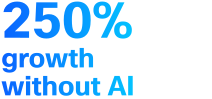
In the absence of agentic AI, enterprise traffic would be expected to grow by about 250% over the 2026 to 2035 period, driven by digital transformation and cloud adoption.

With agentic AI adoption, enterprise traffic growth could reach 9x by 2035, driven by autonomous task execution and inference-heavy workflows. AI agents act as network "power users," operating at software speed.

By 2027, 80% of executives believe their company’s competitive survival will depend on agentic AI, according to a 2026 Cisco Omdia report, representing a fundamental shift in how traffic is generated and distributed.
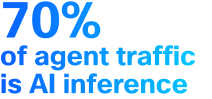
In AI agent workflows, approximately 70% of traffic is AI inference. The connectivity between agent logic and AI models is the agent's "spinal cord"—a critical dependency whose degradation directly impairs the agent’s ability to operate.
Consumer AI adoption is driving internet-wide growth




The path to 2035: AI's growing impact on wide area network traffic

25% of traffic by 2035
AI inference traffic will grow from negligible today to 25% of total network traffic by 2035. This transformation will occur primarily between 2029 and 2032, when agentic AI adoption is projected to experience its most pronounced increase, with compound annual growth rate (CAGR) for traffic around 25% during that period.

Critical infrastructure planning needed
AI will not just increase traffic volume—it will change WAN traffic shape, symmetry, duration, and criticality. AI inference paths will become strategic network assets, requiring higher resilience, greater observability, and differentiated treatment, including quality of service (QoS) and path security.
"AI agents act as network 'power users', operating at software speed rather than human speed. The connectivity between agent logic and AI models is the agent's spinal cord—a critical dependency forging new paths of communication."
—Cisco AI Network Traffic Research Team, 2026
