What is backhaul in networking?

While network perception often centers on endpoint devices, the critical infrastructure resides within the transport layer. Backhaul serves as the essential architecture bridging local access points and the core network.

By facilitating the high-speed transmission of data traffic, this foundational infrastructure ensures the performance, scalability, and reliability required to sustain modern telecommunications and enterprise-level connectivity across diverse digital ecosystems.

Hello, how can I help?
Ask Cisco
Expand the window to see more details and enjoy a clearer chat!

What is backhaul and why it matters

In networking, backhaul refers to the part of the network that moves traffic from access networks to the core.

You can think of a backhaul as a highway of sorts connecting local roads to broader transportation infrastructure. While local roads “move” traffic from individual houses and businesses, highways enable that traffic to reach major destinations near and far.

Similarly, access networks connect users and devices to the network while backhaul takes the traffic toward the core.

Backhaul typically consists of:

  1. Transport links, which carry traffic between nodes
  2. Aggregation points, which collect traffic from multiple access points
  3. Gateways, which connect different parts of the network

To illustrate what this looks like in the real world, backhaul can connect a mobile base station to a carrier’s core network. It can also connect Wi-Fi mesh nodes to each other and connect office branches to a company’s broader enterprise network.

How network backhaul works

The backhaul lives between the network’s access layer and its core, moving traffic in both directions.

When a device connects to an access network — like a smartphone connecting to a cell tower or a laptop connecting to a Wi-Fi access point in a cafe — the traffic is aggregated with similar traffic from other users and devices. The backhaul network takes this consolidated data back to the core.

From there, traffic is routed to its ultimate destination: an internet service, cloud application, data center, different network, or another user. The process works in reverse, too. The core sends traffic through the backhaul network to the appropriate access point when data flows back to the user.

Since the backhaul can potentially carry tons of traffic coming from any number of users and devices, its capacity can have a huge impact on network performance.

When designing a network, key considerations include latency, throughput, jitter, and quality of service (QoS), particularly for applications with strict service-level requirements.

Even high-capacity access networks can run into congestion issues if the backhaul connection can’t handle the traffic it generates.

Backhaul uses a variety of networking protocols and signaling mechanisms to carry traffic. At a high level, these protocols help establish connections, route traffic, manage QoS, and ensure reliable communication across the network.

To ensure optimal performance, network operators need to ensure backhaul links can accommodate existing traffic while also thinking about scaling in the future.

With mobile traffic alone growing 23% between Q2 2025 and Q2 2026 — now exceeding 220 exabytes — it’s imperative to design networks that can handle ever-increasing data volumes.

Types of backhaul technologies

When it comes to building backhaul networks, operators can choose from several different technologies. Key considerations include capacity, distance, latency, geography, and cost. Typically, these options fall into wired, wireless, and hybrid approaches.

1. Wired options

Fiber optics is commonly used for high-capacity backhaul since light can carry large volumes of data over long distances with low latency.

It’s particularly well-suited to networks with high or rapidly scaling traffic demands. That said, running brand-new fiber where none already exists can be expensive and time-consuming.

Ethernet is another wired option for backhaul. It provides a familiar, scalable way to move traffic over fiber and other physical media.

2. Wireless options

In scenarios where deploying a wired connection proves difficult or impractical, operators can turn to wireless backhaul solutions.

Microwave links, for example, use point-to-point connections to carry traffic between network sites. This flexibility is commonly used for mobile backhaul. While microwave links can be deployed quickly, they usually require a clear line of sight between endpoints.

Millimeter-wave links run on higher frequencies and can support high capacity over shorter distances, making them useful for dense networks or shorter distances.

Operators can also turn to satellite backhaul solutions, which can extend connectivity to remote areas that lack infrastructure.

3. Hybrid approaches and transport topologies

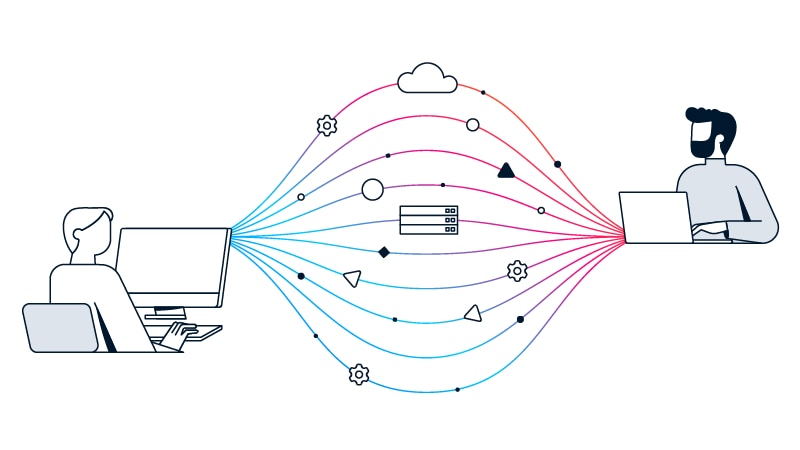
For many networks, it makes sense to combine multiple technologies instead of relying on a single backhaul approach. For example, a remote site might use a microwave link to connect to an aggregation point, which then sends traffic to the core using fiber optics.

Backhaul connections can also be designed using different topologies. A point-to-point setup, for example, connects two sites directly, while a point-to-multipoint setup connects multiple sites to one central location.

Operators can also use ring topologies, which provide an alternative path for traffic if one connection fails, or mesh topologies, which create multiple paths between network nodes.
Design and planning considerations

Choosing backhaul technologies and topologies is only part of designing a reliable and performant network. Operators also need to understand how the network will perform as traffic grows, how it can be secured and managed, and whether the solution will fit into their budget.

1. Scalability, redundancy, and resilience strategies

All operators need to plan for scalability, redundancy, and resilience. By prioritizing capacity planning, operators can ensure backhaul links can accommodate current traffic needs as well as future growth.

Operators can also increase redundancy using diverse routing techniques, which provide alternate paths traffic can take in the event a link fails.

By incorporating failover mechanisms into the architecture, they can automatically redirect traffic when connections or components become unavailable, improving resilience.

2. Security and management

In today’s age of high-profile and costly data breaches, operators must secure their networks. Encryption is useful for protecting data as it travels across backhaul links.

Using network segmentation, operators can isolate traffic and keep it apart, limiting the impact of a security incident. Operators can also use monitoring and performance analytics to identify congestion, outages, and other issues, addressing them before they damage the user experience.

3. Cost factors and deployment constraints

The most expertly designed network in the world doesn’t help you if it’s too expensive or impractical for your use case.

For example, while fiber is a great option, deployments might require construction, permits, and land — easy if you have them or can get them, impossible if you don’t or can’t.

In addition to upfront expenses, operators also need to plan for ongoing operational costs, including maintenance, power, equipment, and management.

Trends, use cases, and future directions

As networks evolve, backhaul requirements are changing alongside them.

The rollout of 5G, for example, is increasing demands for more bandwidth. Edge computing adds another consideration by moving processing and data closer to users and devices, reducing the distance traffic needs to travel.

Backhaul also plays an important role outside of mobile networks. Enterprise and campus networks use it to connect branch offices and locations through SD-WAN and aggregate traffic from an increasing number of IoT devices.

These applications can create diverse traffic patterns, which makes flexibility in network architecture even more important.

At the same time, backhaul is becoming more software-driven. Software enables operators to exert more control over how traffic moves across a network.

What’s more, automation can help monitor performance and make adjustments automatically as conditions change. Operators are also leveraging virtualized network functions to reduce reliance on dedicated hardware, further increasing flexibility.

Backhaul remains a critical part of network architecture, playing a central role in moving data between the access layer and the core.

As networks become faster and even more demanding, operators must be able to scale and effectively manage backhaul to ensure they can deliver reliable connectivity today and into the future.

Commonly asked questions about network backhaul

Backhaul is the intermediate transport layer that facilitates data transmission between local access networks and the core network, serving as the essential infrastructure backbone for modern connectivity.

While access networks connect individual users and devices to the system, backhaul aggregates this traffic and transports it to the core network, ensuring it reaches its ultimate destination, such as a data center or cloud application.

Operators utilize a mix of wired solutions (e.g., fiber optics, Ethernet) and wireless options (e.g., microwave, millimeter-wave, satellite) to build backhaul, often opting for hybrid approaches to balance capacity, cost, and geography.

As data traffic grows, insufficient backhaul capacity can create bottlenecks, leading to increased latency, jitter, and network congestion that degrade the overall user experience, regardless of access speed.

With the rise of 5G, IoT, and edge computing, backhaul is shifting toward software-defined, automated, and virtualized architectures, providing the flexibility and scalability required to manage increasing data volumes efficiently.


Related topics

Ultra-Reliable Wireless Backhaul

URWB is a wireless technology that delivers near-zero latency (<10ms) and uninterrupted handoffs.

What is Ethernet?

Ethernet technology helps network-connected devices follow a set of rules to communicate.

What is SD-WAN?

SD-WAN is a software-defined approach to managing a wide-area network, or WAN.

What is network architecture?

Network architecture is the way network devices and services are organized to connect clients.

Advantages of a wireless network

Wireless networks increase accessibility for end-users and can help you to extend your network.

What is a wireless network?

A wireless network allows devices to stay connected to the network without being tethered by wires.