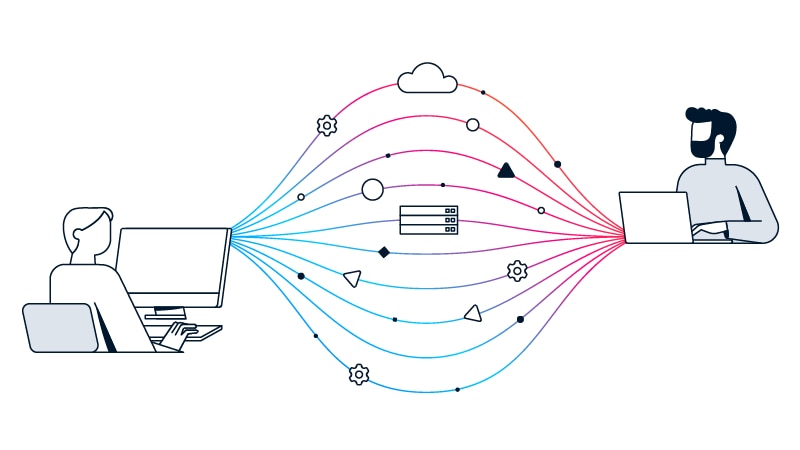
Illustration of two people using computers connected through cloud, server, and data flow icons

What is coherent optics?

Data is growing at an unprecedented rate, and the networks that must transmit that data need to keep pace. 

To move more data at higher speeds over longer distances, network operators and enterprises are increasingly turning to coherent optics, a technology that uses the properties of light to increase data transmission capacity over existing fiber infrastructure.

Cisco optics
Hello, how can I help?
Ask Cisco
Expand the window to see more details and enjoy a clearer chat!

How does coherent optics work?

Unlike traditional optical networks, which primarily rely on the intensity of a light signal to transmit information, coherent optics work by using multiple properties of light to carry data, including its amplitude, phase, and polarization. As a result, optical systems can encode more information into each signal and then recover that information at the receiving end.

A laser creates a light signal, which is then modulated, or changed in specific ways, to encode and carry data through a fiber optic network. Coherent systems can use advanced modulation formats, including QPSK and QAM, to send data more efficiently.

As the signal travels through the network, it can become distorted by dispersion and other obstacles. At the receiving end, a coherent detector is used to capture more information from signals than traditional detection methods allow. 

At the same time, a local oscillator acts as a reference, helping the receiver read the data carried by the light signals.

The system then uses digital signal processing (DSP) to analyze the received signal and reconstruct the original data. Together, the laser, modulator, receiver, and DSP work to send and recover data across the network. 

As organizations and operators increasingly move toward 400G and 800G connections, coherent optics are becoming an increasingly foundational technology to support data transmission at scale. 

As a result, it’s no surprise that the market for coherent optics is expected to reach $36.2 billion by 2035, up from $18.1 billion in 2025.

Types of systems and modules

Coherent optics can be used in different types of systems and modules. The choice depends on how much data a network needs to carry, how far the information needs to travel, and how the optics are integrated into the network equipment.

1. Embedded coherent optics

Embedded coherent optics are built directly into networking equipment, such as integrated line cards within larger transport systems. By combining lasers, electronics, and DSP, they can transmit and receive coherent signals. 

Such systems are often used by telecom companies and other network operators who need to carry large amounts of data over larger geographies.

2. Pluggable coherent transceivers

Pluggable coherent transceivers package these technologies into smaller modules that can be plugged into existing network equipment. 

While pluggables like 400ZR and 800ZR are designed to support high-speed connections over shorter distances (e.g., between data centers in the same city), ZR+ solutions can support longer distances (e.g., between data centers across different regions). 

Coherent systems can also support multiple wavelengths using dense wavelength-division multiplexing (DWDM), allowing networks to carry more data over a single fiber.

These systems can also work with network control and management tools, giving operators granular control over how their networks use available bandwidth.

Where coherent optics are used and why it matters

As data traffic continues to grow and businesses and end users increasingly expect lightning-fast transmission speeds, coherent optics are commonly deployed as connections between data centers and long-distance telecom networks. 

These systems enable network operators to increase capacity without having to build entirely new fiber networks — helping to unlock more value from existing infrastructure.

Three key use cases for coherent optics include data center interconnects, metro and regional networks, and long-distance networks.

1. Data center interconnects

One of the most common uses for coherent optics is found in data center interconnects. Cloud providers and hyperscalers often need to move large amounts of data between different data centers. 

Coherent pluggables enable data center operators to provide high-speed connections between different facilities while leveraging existing network equipment.

2. Metro and regional networks

Metro and regional networks use coherent optics to connect data centers, network hubs, and other sites across cities and regions. This enables operators to increase network capacity as traffic grows without having to replace any infrastructure.

3. Long-distance networks

Long-distance networks use coherent technology to move large volumes of data between cities, regions, and countries. By sending a larger amount of data over existing fiber, coherent optics help operators get more value from the infrastructure they’ve already built.

Beyond higher capacity and longer reach, coherent optics can also improve spectral efficiency, or the amount of data a network can transmit over a specific fiber spectrum. This enables operators to make better use of the fiber they already have. 

Additionally, they can also be programmed for different speeds, distances, and network conditions, providing more flexibility.

Coherent optics matter because they give network operators the ability to increase network capacity without adding new fiber. Networks face increasing demands due to a confluence of factors — including AI, streaming video, cloud computing, and data-heavy applications. 

This makes smarter use of existing fiber in a practical, cost-effective way for organizations to keep up without having to constantly build new infrastructure.

Coherent optics: Design and operation basics

Deploying coherent optics requires careful planning. When choosing equipment and designing connections, operators need to maintain signal quality across the network while also accounting for signal loss, distortion, latency, and error rates. 

Modern coherent systems also support automation through network monitoring and software controls. These tools allow operators to monitor network performance, identify potential problems, and fine-tune appropriate settings. 

Add it all up, and coherent optics not only provide more capacity and longer reach but also gives operators more control and flexibility in how networks are managed.

Looking ahead

Data demands will only continue to grow as we move further into the future. In turn, coherent optics will continue to proliferate.

Faster speeds, more data transmission lanes, and smaller modules will enable networks to carry even more data while using less space and power.

As the technology evolves, open standards and software advances can make it cheaper and easier to deploy. As a result, coherent optics are poised to play an important role in connectivity for many years to come.

Common questions about coherent optics

Coherent optics are a technology that uses different properties of light, including its amplitude, polarization, and phase, to transmit data over long distances. By carrying more data in each light signal, coherent optics help networks move more data at higher speeds.

Coherent optics encode data into light signals and send them through fiber optic networks. At the receiving end, a coherent detector reads the signals while digital signal processing (DSP) helps resolve any distortion and reconstruct the original data.

Coherent optics are primarily used to move large amounts of data over fiber optic networks. Common use cases include connecting data centers, expanding metro or regional networks, and sending data over long distances across cities, regions, and countries.

While traditional optics use the strength of a light signal to carry data, coherent optics uses more information, including the signal’s phase and polarization. This enables the technology to carry more information in a signal while sending data over longer distances.


Related topics

What is PON?

Passive optical networking (PON) provides ethernet connectivity using passive optical splitting.

What is routed optical networking?

RON converges IP and optical layers using coherent optics and simplified DWDM systems.

What is a GPU?

A GPU is a specialized electronic circuit designed to accelerate image and visual data processing.

What is data center modernization?

Strategic initiative to transition aging IT environments into agile, high-performance ecosystems.

What is a LAN?

A local area network (LAN) is a collection of devices connected together in one physical location.

What is an AI data center?

AI data centers are specialized facilities with vast computational power to handle complex workloads

Significantly lower your CapEx, OpEx, and energy consumption

Discover the economic benefits of Cisco Routed Optical Networking for DCI, metro, and long-haul applications.