
Sports, Media, and Entertainment

How a world-class tennis tournament aced its IT transformation

A lean IT team simplifies digital operations, transforming physical security, crowd management, and fan experiences for 285,000 attendees with Cisco cloud-managed networking. 

A major sporting event wins big with fan experiences


See how the Cincinnati Open swapped decades-old legacy infrastructure with a 100% cloud-managed network that delivers enterprise-grade performance, resilience, and simplicity at scale. 

The Cincinnati Open

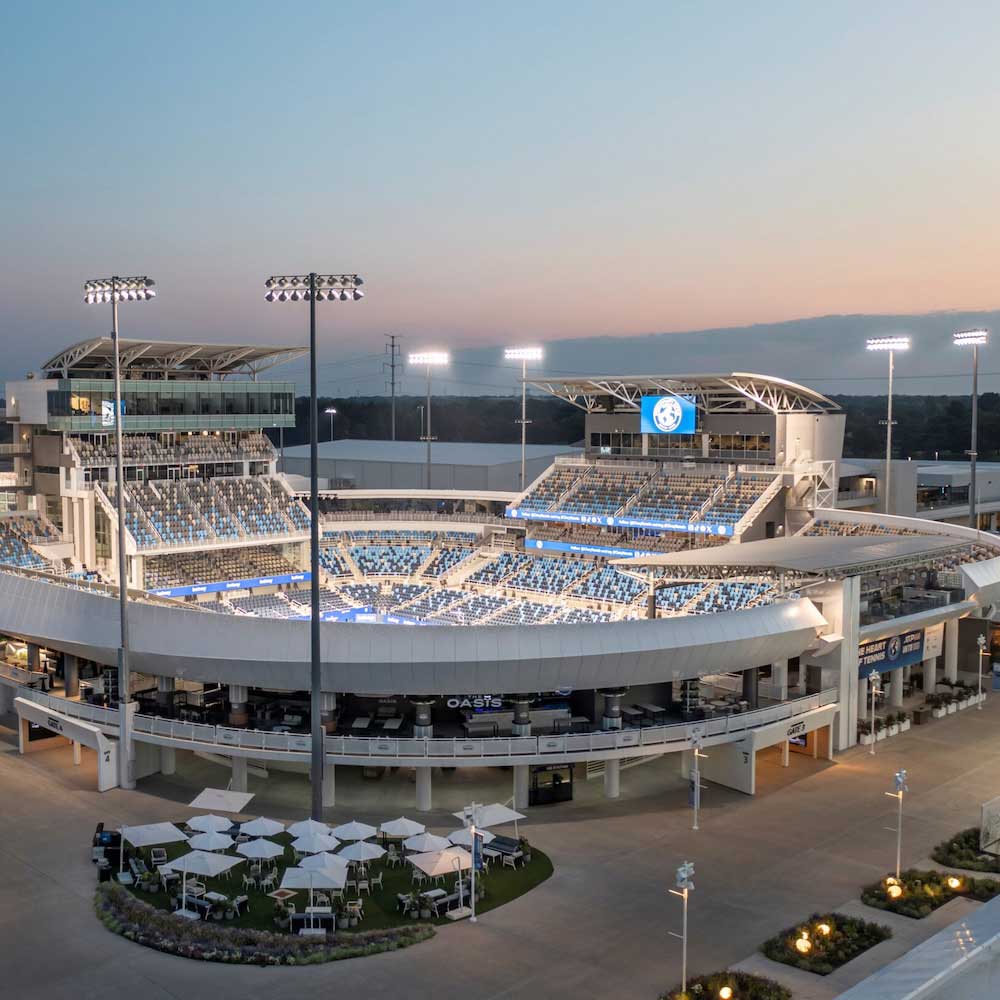
The Cincinnati Open is one of the most prestigious stops in tennis during the summer season leading into the year’s final Grand Slam, the US Open. Each August, the Ohio event welcomes the world's best players and 285,000+ fans.

Challenges

When the Cincinnati Open set out to double their world-class tennis venue from 20 to 40 acres in 11 months—with only four months for technology deployment—they had several critical challenges to overcome: 
 

  • Scale and speed: A $260 million venue transformation required a complete infrastructure rebuild across 40 acres with a fixed tournament deadline—leaving no room for delays or missteps. 
  • Surging demand: Tournament traffic surges from 100 Mbps in the off-season to sustained peaks of 2+ Gbps, serving 10,000-14,000 concurrent users across a rapidly expanded campus. 
  • Lean IT resources: A core IT team of just a few people was responsible for deploying and managing enterprise-grade infrastructure across a 40-acre world-class sporting venue. 
  • Legacy infrastructure: Decades-old on-premises networking and physical security infrastructure required a complete removal—demanding a clean-slate rebuild with no margin for error and a hard go-live date. 
  • Operational complexity: Supporting players, broadcasters, media, fans, and mission-critical partners simultaneously required seamless connectivity, reliability, and real-time operational visibility. 


Solutions

By deploying a 100% cloud-managed network built on Cisco wireless and Catalyst, the Cincinnati Open achieved a resilient, intelligent, and high-performance infrastructure that delivers:
 
  • Simplified operations: A fully cloud-managed foundation built on Cisco wireless and Catalyst eliminates operational complexity—delivering enterprise-grade performance and resilience across the 40-acre facility. 
  • Rapid deployment at scale: Going virtual and footprint-free was easy to manage and scale from day one, enabling a complete venue deployment in just four months and a future of effortless expansion.
  • Intelligent fan connectivity: 320 wireless access points and 100 Catalyst switches deliver seamless, high-density connectivity for thousands of simultaneous users across every corner of the expanded venue.
  • Real-time operational intelligence: Integrated analytics tools provide real-time crowd occupancy data within 1–2% accuracy—improving staffing, concessions, parking, and fan experience decisions across the entire venue.
  • Lean IT team; enterprise scale: A single cloud-managed platform enabled a small distributed team, supported by MSP partner Emerge, to manage enterprise-scale operations with confidence from anywhere.


Outcomes

Full venue deployment in four months

A cloud-first approach eliminates on-premises complexity, enabling a complete 40-acre venue to be built in an unprecedented timeframe. 

Highest-rated Wi-Fi on both tours

Seamless, high-density connectivity supports 10,000-14,000 concurrent users at sustained throughput of 2+ Gbps throughout the tournament.

Real-time crowd insights

Live occupancy data transforms decision-making for staffing, concessions, parking, and fan experience across the entire venue.

Enterprise scale. Lean Team.

A cloud-managed platform empowers a small team of people to deliver and maintain a world-class venue experience with confidence.

An ambitious transformation with no time for faults

Five days after the final match of the 2024 Cincinnati Open, construction crews moved in. What followed was one of the most ambitious venue transformations in professional sports history—a $260 million rebuild that doubled the size of the Lindner Family Tennis Center in Mason, Ohio, from 20 to 40 acres with a hard deadline that could not be moved. 

The world's top-ranked tennis players, 285,000 fans, and 89 million broadcast viewers across 187 countries would arrive in August 2025, ready or not.

Their traditional, heavily manual networking approach could no longer sustain the pace and scale of these events, so decades of legacy on-premises infrastructure was removed entirely. In came 40 miles of underground conduit, 17 miles of fiber, 320 Cisco wireless access points, 100 Catalyst 9300-M switches, and 175 Cisco smart cameras—all deployed across a rapidly expanding construction site in just four months. 

Complexity was not an option, and with a high-stakes timeline, neither was failure.

The solution? A 100% cloud-managed architecture built on Cisco Meraki and Catalyst. This virtual, footprint-free approach enabled the team to deploy, configure, and expand the network in phases—saving weeks, if not months, in deployment time.

For Principal Technical Architect Robert Nichols, the cloud-first decision was not just a technical choice, it was the only path forward. "There was no way we could pull this off with legacy systems," Nichols explains. "We needed a platform that could be deployed fast, managed simply, and scaled without adding headcount."


A lean team serving up enterprise scale

Managing an enterprise-grade network across a venue this size is a massive undertaking for any IT organization. The Cincinnati Open faced an even greater challenge—a small distributed team managing infrastructure for events of this caliber and year-round operations.

For a team with limited resources, the right technology was everything. It needed to simplify operations, secure every user and device, and deliver at scale.

The Cisco cloud-managed network platform was built for exactly this. The Meraki dashboard centralizes visibility and management of the entire infrastructure—Catalyst switches, wireless access points, smart cameras, and security appliances—in one place, empowering their small distributed team to monitor, troubleshoot, and optimize everything from anywhere. One dashboard provides total control.

Underpinning it all, Catalyst 9300-M switches provide the high-performance, resilient backbone that keeps every access point, smart camera, and endpoint connected at enterprise grade.

The Cincinnati Open is already tapping into Cisco AgenticOps capabilities. With Cisco AI-Enhanced Radio Resource Management (AI-RRM), the network auto-optimizes across the expanded campus during non-peak hours, ensuring minimal network disruption. When something does need human attention, enhanced end-to-end visibility enables the team to spot and resolve issues quickly. 

With this new infrastructure in place, they are well positioned to unlock even greater levels of autonomous network intelligence—including Experience Metrics, AI PCAP, and AI Config Recommendations—as their needs evolve. 

Even at peak capacity, the network never misses a beat. Three Meraki MX450 security appliances—including a split high-availability pair across two main distribution frame (MDF) locations—ensure full redundancy, while advanced threat protection, intrusion detection, and content filtering keep the network secure across every session, user, and device. A dedicated unit separates public Wi-Fi from mission-critical systems for consistent performance.

To ensure smooth operations and extend their reach, Nichols partnered with Emerge, a managed service provider, to create a hybrid model that blends in-house expertise with outside support, leveraging the cloud to co-manage the network seamlessly from anywhere.

The outcome? A purpose-built architecture that scales from 100 Mbps sustained throughput in the off season to 7 Gbps at peak demand, supporting 10,000 to 14,000 users simultaneously. 

For business IT leaders navigating the challenge of doing more with less, the Cincinnati Open is a compelling proof point that the right platform makes all the difference.

Winning player, fan, and media experiences

Delivering a world-class experience across a newly doubled 40-acre venue meant tackling two critical challenges: seamless, high-density wireless connectivity for thousands of simultaneous users and real-time operational visibility to make smarter decisions—all while the event is in full swing.

Cisco cloud-managed networking tackles both simultaneously. With 320 Cisco wireless access points blanketing the expanded campus, the Cincinnati Open earned the highest-rated Wi-Fi environment from both the ATP and WTA tours—a distinction that resonates far beyond fan connectivity.

Players and their entourages, who travel with multiple devices for match preparation, performance analytics, and communication, rated the network experience among the best they encounter on tour. Media teams—who rely on fast, reliable uploads—experienced the fastest social media performance ever recorded at the event. 

Content flew from capture to publish in just 28 seconds—a record for the contract photographer, who provides similar services for the Olympics, NFL and other sporting venues. A reflection of the powerful network foundation.

Digital ticketing, near-field communication (NFC)-based suite access, reliable point-of-sale transactions, and multicast-enabled video walls and audio systems all run flawlessly on the same resilient network backbone—powering every fan touchpoint from entry to exit. 

Behind the scenes, integrated analytics and access control tools unlock a level of venue intelligence that simply was not possible before—and fans feel it. "Fans may not notice the systems themselves," Nichols observes, "but they absolutely notice the absence of friction—short lines, reliable service, and better access to information."

The home court advantage: A connected ecosystem 

A modern sports venue is only as powerful as its network ecosystem. For the Cincinnati Open, the Cisco Meraki cloud-managed, API-friendly network platform serves as the connective tissue for a carefully selected set of Cisco Networking technology partners—each chosen to enhance the fan and player experience while simplifying operations.

Venue management at the Cincinnati Open reaches a new level with purpose-built Cisco smart cameras working in tandem across the expanded campus. The MV84X delivers the coverage of four cameras in a single unit—housing four independent 5MP sensors using only one cable to deploy—no on-site network video recorder required. The MV93 fisheye delivers blind spot coverage while generating real-time analytics. 

The real power is in what the camera analytics make possible. The MV93 conducts people-counting and area occupancy analytics natively on the Cisco Meraki dashboard. These camera feeds also integrate seamlessly with ecosystem partners—powering real-time crowd analytics and informing concession stocking, crowd flow management, and wait time visibility across the venue.

  • WaitTime: Integrated with the Cisco network, WaitTime provides real-time occupancy data within 1-2% accuracy. By anonymously tracking ingress and egress patterns, the Cincinnati Open gains precise visibility into how crowds move throughout the day—enabling proactive decisions about concession stocking, staffing allocation, parking management, and crowd flow between day and night sessions.
  • Genea: Managing access control across player zones through a cloud-based, hardware-agnostic platform integrated directly via API, Genea gives the Cincinnati Open electronic door locks with RFID and NFC reader support—providing players with seamless, convenient access throughout the tournament and automated after-hours workflows that let players come and go on their own terms.
  • GoZone: Integrated seamlessly with the Cisco network, GoZone delivers a frictionless fan onboarding experience for Cincinnati Open attendees—and the ability to leverage real-time fan surveys down the road for a continuous loop of insight that further elevates the experience.

What makes these apps uniquely powerful is the common foundation beneath it all—every partner platform connects through the Cisco cloud-managed infrastructure, giving the IT team a single, unified view of the entire environment.  

Less complexity, faster resolution, and a more intelligent venue—all delivered by a small but mighty distributed team. 

Match point: Built for now, ready for what's next 

Every IT leader faces the same question: how do you build for today without locking yourself into yesterday?

The answer? One platform that supports peak tournament demand and year-round venue operations—the Cincinnati Open Sporting Club—with tennis, pickleball, padel, dining, and community programming.

After evaluating multiple vendors, Nichols chose Cisco—not just for the technology, but for the flexibility and responsiveness that kept the project on track when it mattered most. Built on Meraki and Catalyst, the platform is inherently scalable—enabling the organization to expand capabilities and integrate new technologies without replacing core infrastructure. 

The proof is already emerging. Lessons learned at the Cincinnati Open are being applied at the related Credit One Charleston Open, also running on Meraki, enabling cross-training, operational continuity, and faster expansion across properties.

Looking ahead, Nichols sees artificial intelligence and agentic applications as the next frontier—from smarter fan engagement and real-time wayfinding to predictive concession management and automated operational workflows. The Cincinnati Open is well positioned to embrace these capabilities as they mature.

The results validate the approach. In 2025, the Cincinnati Open was named ATP Masters 1000 and WTA 1000 Tournament of the Year for the first time in event history—a recognition that reflects not just the quality of the tennis, but the seamless, world-class experience delivered to every player, fan, and media partner who walked through the gates. They were also named a finalist for Sports Business Journal's Facility of the Year.

For a lean IT team that rebuilt a network infrastructure in just four months, it's a fitting reward for an extraordinary achievement.


Partner Spotlight

Emerge

Emerge

Emerge is a cloud-first MSP specializing in designing, deploying, and managing modern, scalable network infrastructure. 

Genea

Genea

Genea provides cloud-based access control that automates credentialing globally and integrates directly with the Meraki Vision portal.

WaitTime

WaitTime

WaitTime Technology identifies, quantifies, and notifies real-time crowd conditions in large scale venues.

GoZone

GoZone

Capture and analyze visitor traffic, heat mapping, and dwell times for actionable insights into new and returning visitors with GoZone.

More for you

Technology has changed how we live and work.

Leading organizations are innovating with Cisco solutions to connect, secure, and transform.

Organizations like yours rely on Cisco

Each industry has its own challenges that require tailored solutions.

You are a changemaker, innovator, and discoverer.

We want to help you share your story. Learn more about how you can build your organization's profile—and your own—as you expand your network.


Next steps

Next-gen Wi-Fi built to scale

Equip your IT team with secure, high-performance wireless solutions built for the demands of AI.

Experience the dashboard first-hand

Get hands-on with next-gen Cisco wireless, switching, routing, cameras, sensors, and more in your own environment.