Unified CCE Reference Designs

Introduction to the Reference Designs


Note

The first four chapters of this book are for anyone who wants to get familiar with the three contact center enterprise solutions:

  • Packaged Contact Center Enterprise

  • Cisco Hosted Collaboration Solution for Contact Center

  • Unified Contact Center Enterprise

For information about design considerations and guidelines specific to Packaged CCE, see the remaining chapters.

The Contact Center Enterprise Reference Designs are a set of Cisco validated designs of our contact center enterprise solutions. The Reference Designs define the technologies and topologies that fit the needs for most deployments. The Reference Designs focus on simplifying the contact center enterprise solution design. They provide complete contact center functionality based on components that are strategic to Cisco.

We have defined the Reference Designs in the following table to cover most contact center needs:

Table 1. Reference Design Use by Contact Center Enterprise Solution

Reference Design

Packaged CCE

Cisco HCS for Contact Center

Unified CCE

2000 Agents

Yes

Yes

Yes

4000 Agents

Yes

Yes

Yes

12000 Agents

Yes

Yes

Yes

24000 Agents

No

Yes

Yes

Contact Director

No

No

Yes

If your solution exceeds the configuration limits for a particular Reference Design, use a Reference Design with higher limits. For example, if your 2000-agent deployment requires 350 active reporting users, use the 4000 Agent Reference Design for your solution.

Reference Designs and Deployment Types

The Contact Center Enterprise Reference Designs are mapped to specific contact center solutions through deployment types. Deployment types are system codes that impose system limits and apply congestion control.

This table maps the Reference Designs and Non-Reference Designs with the deployment type that you use for each.

Table 2. Deployment Type Usage by Reference Design

Reference Design

Packaged CCE

Cisco HCS for Contact Center

Unified CCE

Label

Label

Label

2000 Agent

Packaged CCE: 2000 Agents

HCS-CC: 2000 Agents

UCCE: 2000 Agents

UCCE: 4000 Agents1

4000 Agent

Packaged CCE: 4000 Agents

HCS-CC: 4000 Agents

UCCE: 4000 Agents

12000 Agent

Packaged CCE: 12000 Agents

HCS-CC: 12000 Agents

UCCE: 12000 Agents

24000 Agent

NA

HCS-CC: 24000 Agents

UCCE: 24000 Agents Router/Logger

Contact Director

NA

NA

Contact Director

Non-Reference Designs

Avaya PG and ICM-to-ICM Gateway

Packaged CCE: 4000 Agents

Packaged CCE: 12000 Agents

NA

ICM Rogger

ICM Router/Logger

UCCE: 8000 Agents Router/Logger

Lab Only Designs

Packaged CCE: Lab Mode

NA

UCCE: Progger (Lab Only)

1 For now, Unified CCE 2000 Agent designs use the UCCE: 4000 Agents deployment type. But, you use the 2000 Agent Reference Design OVA and server layout.

Note

After a Packaged CCE deployment is initialized, you cannot switch to another deployment type.


Benefits of a Reference Design Solution

Contact centers offer more possibilities with each new generation of software and hardware. New technology can make previously preferred methods obsolete for current contact centers. We created the Contact Center Enterprise Reference Designs to simplify your design choices and speed the development of your contact center. We expect that most new contact centers can use the Reference Designs to meet their needs.

By following the Reference Designs, you can:

  • Guide your customers' expectations by presenting clear options.

  • Streamline your design process with standard models.

  • Avoid using components and features that are near the end of their lifecycle.

  • Find powerful and efficient replacements for obsolete features.

  • Align your designs with Cisco's vision of our future contact center developments.

  • Enjoy quicker and easier approval processes.

Specifications for a Reference Design Solution

The Reference Designs define our vision of the functionality that most contact centers use. The Reference Designs consist of:

  • Core components—Components that make up every contact center:

    • Ingress, Egress, and VXML Gateways

    • Unified Customer Voice Portal (Unified CVP)

    • Unified Contact Center Enterprise (Unified CCE)

    • Cisco Virtualized Voice Browser (VVB)

    • Unified Communications Manager (Unified CM)

    • Cisco Finesse

    • Cisco Unified Intelligence Center

  • Optional Cisco components—Components that add functionality that not every contact center needs.

    • Cisco Remote Expert

    • SocialMiner

    • Cisco Unified SIP Proxy

    • Enterprise Chat and Email

    • Cisco IdS

  • Optional third-party components—Third-party components that you can add to provide other features.

    • Load balancers

    • Recording

    • Speech servers - ASR/TTS

    • Wallboards

    • Workforce management

  • Integrated features—These features do not require you to add an optional solution component to enable them. But, these features can require configuration in multiple solution components to activate them. They can affect your solution sizing and might have specific design considerations.

  • Call flows—Standard contact handling and routing methods.

    • Inbound Calls:

      • New calls from a carrier

      • New internal calls

    • Supplementary services

      • Hold and resume

      • Transfers and conferences

      • Refer transfers

      • Network transfers

      • Requery and survivability

  • Topologies—Standard layouts for your contact center components:

    • Centralized

    • Distributed

    • Global


Note

In general, you cannot use the ICM-to-ICM Gateway in Reference Designs. Only the Contact Director Reference Design allows you to use that gateway.


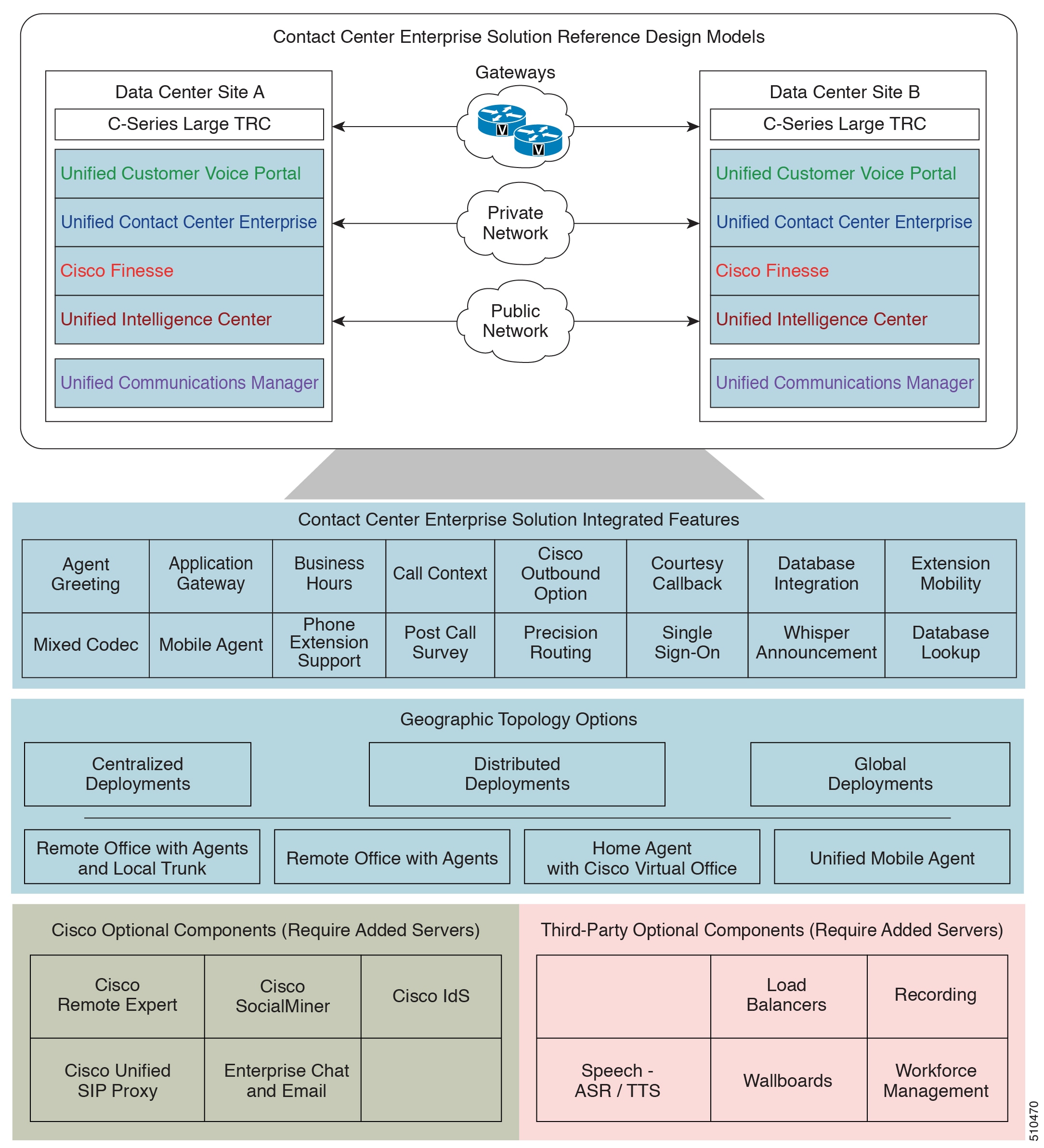
This figure encapsulates the basic requirements of a Reference Design-compliant deployment:

Figure 1. Contact Center Enterprise Components and Features

Contact Center Enterprise Reference Designs

The following sections describe the Contact Center Enterprise Reference Designs.

The Reference Designs show the layout of the core components on Cisco UCS B200 and C240 M4 and C240 M5SX Tested Reference Configuration servers which are referred to as the Reference Design servers here interchangeably.


Note

For more details on supported servers for the Reference Designs, see the Cisco Collaboration Virtualization page for your solution at http://www.cisco.com/c/dam/en/us/td/docs/voice_ip_comm/uc_system/virtualization/cisco-collaboration-virtualization.html.


The following notes apply to all the Reference Designs:

  • Contact Center Enterprise solutions use vCPU oversubscription.

  • The standard PG VM includes an Agent (Unified CM) PG, a VRU PG, and an MR PG. Unified CCE and Cisco HCS for Contact Center allow you to add more PGs and their peripherals onto this base layout.

  • The CVP Reporting Server is an optional component. You can deploy more external CVP Reporting servers based on your deployment type.

  • For information on the data source allocation of the components in the Reference Design layouts, see the Cisco Packaged Contact Center Enterprise Installation and Upgrade Guide at https://www.cisco.com/c/en/us/support/customer-collaboration/packaged-contact-center-enterprise/products-installation-guides-list.html

  • The Reference Design layouts in this section do not show off-box components like SocialMiner.

Virtual Machines Resource Provisioning Policy


Note

The previously used Oversubscription policy is a part of the Virtual Machine (VM) Resource Provisioning Policy.


The Unified CCE Reference Designs support the virtual machine vCPU oversubscription of the physical CPU cores on a server. For the purposes of oversubscription, the hyper-thread cores do not count as physical cores. Whether or not you use oversubscription, use the VM Resource Provisioning policy. This policy limits the total available CPU MHz and the memory of a server that the host-resident VMs can consume.

Apply the VM Resource Provisioning policy when:

  • You provision a Reference Design server for optional and third-party components that are not given a reference VM layout.

  • You use UCS servers.

  • You upgrade an existing solution and do not migrate to a Reference Design VM layout.


Note

Apply the VM Resource Provisioning policy on a per-server basis. This policy does not apply to the Reference Design VM layouts. Your solution can contain servers that use the Reference Design VM layouts and other VM layouts that use the VM Resource Provisioning policy rules.


The application of the VM Resource Provisioning policy requires meeting the following conditions:

  • You can use up to two vCPUs for every physical core on each server.

  • You can use up to 65% of the total available CPU MHz on each server.

  • You can use up to 80% of the total available memory on each server.

For more information on virtualization and specification-based server policies, see the Cisco Collaboration Virtualization at http://www.cisco.com/c/dam/en/us/td/docs/voice_ip_comm/uc_system/virtualization/cisco-collaboration-virtualization.html.


Note

The Virtual Machine Placement Tool does not currently allow you to oversubscribe. This limitation is only an issue with the tool. You can oversubscribe within the limits that are provided here.


2000 Agent Reference Designs

All contact center enterprise solutions support the 2000 Agent Reference design on the Cisco UCS C240 M5SX and the Cisco HX220c-M5SX Large TRC servers.

  • In this Reference Design, Cisco Unified Intelligence Center, Live Data, and the Identity Service for Single Sign-On are coresident on a single VM. In the larger Reference Designs, they reside in separate VMs.

  • You can optionally deploy the Unified Communications Manager Publisher and Subscribers on separate servers, instead of deploying them as shown in the 2000 Agent Reference Design layout. You should dedicate two of the subscribers to Unified CCE. All devices on these subscribers must be SIP.

    In 2000 Agent Reference Designs, a coresident Unified CM can support a maximum of 2000 phones. This includes your phones for all types of agents, whether contact center agents or back-office workers. If your solution requires more than 2000 phones, use a Unified CM on a separate server instead.

  • In the global deployment topology, each remote site can have its own Unified CM cluster. A remote site cannot include a Cisco Unified Intelligence Center server.

  • In Packaged CCE global deployments, you cannot create a remote site without PG VMs.

  • You can deploy optional AW-HDS-DDS per site on external servers for longer data retention.

  • In 2000 Agent Reference Designs, you can deploy ECE Data Server on-box for up to 400 agents. Deploy ECE off-box for up to 1500 agents.

    You can also deploy the ECE Data Server on a separate server.

  • Deploy the ECE Web Server on an external server. You can place that server either in the same data center as the ECE Data Server or in a DMZ if customer chat interactions require that.


Note

Adding more disks is not permitted in the Packaged CCE 2000 agent deployment. Any changes to the number of disks will result in a VM validation error.


Support on the Cisco UCS C240 M5SX Large TRC Server


Important

If you plan to upgrade to 12.x on Cisco UCS C240 M4SX servers, deploy Unified CM and ECE HA VMs on external servers.


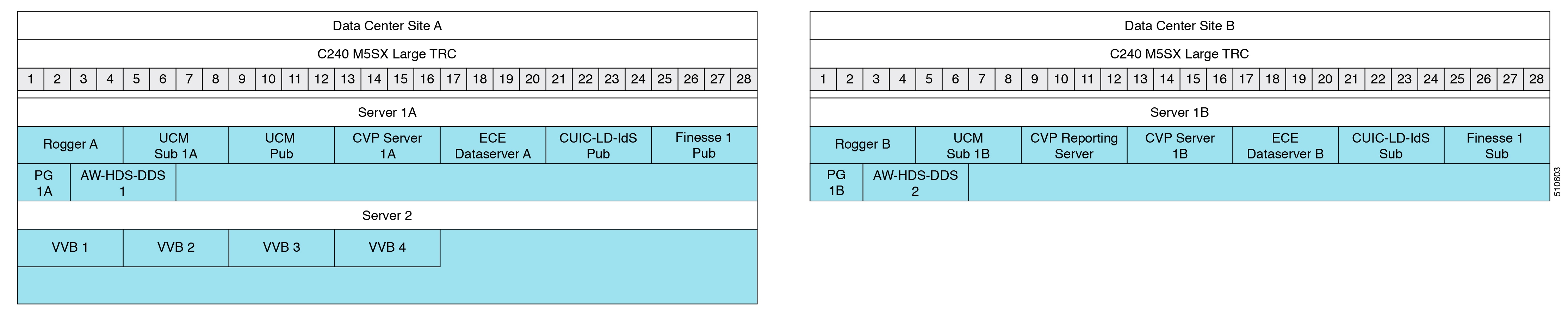
The following figure shows the base layout of the components in a 2000 Agent Reference Design on Cisco UCS C240 M5SX Large TRC server.

Figure 2. 2000 Agent Reference Design Model

This table lists the specifications for VMs.

Table 3. VM Specifications for 2000 Agent Reference Design

VM

vCPU

MHz

vRAM

vDisk 1

vDisk 2

vDisk 3

Rogger

4

5000

6

80

150

Unified CM

4

7200

8

110

Unified CVP Server

4

3000

12

250

Unified CVP Reporting Server

4

1800

6

80

438

ECE Dataserver2

4

4000

20

80

50

300

CUIC-LD-IdS

4

5500

16

200

AW-HDS-DDS

4

5000

16

80

750

PG

2

4000

6

80

Finesse

4

5000

10

146

VVB

4

9000

10

146

2 For the latest VM specifications, see the row for 400 agents in the Virtualization for Enterprise Chat and Email page at https://www.cisco.com/c/dam/en/us/td/docs/voice_ip_comm/uc_system/virtualization/virtualization-enterprise-chat-email.html.
Table 4. Total VM Requirements for 2000 Agent Reference Design

Server

vCPU

MHz

vRAM

vDisk

Data Center Site A

34

45900

102

2386

Data Center Site B

30

40500

100

2648

Server 2

16

36000

40

584

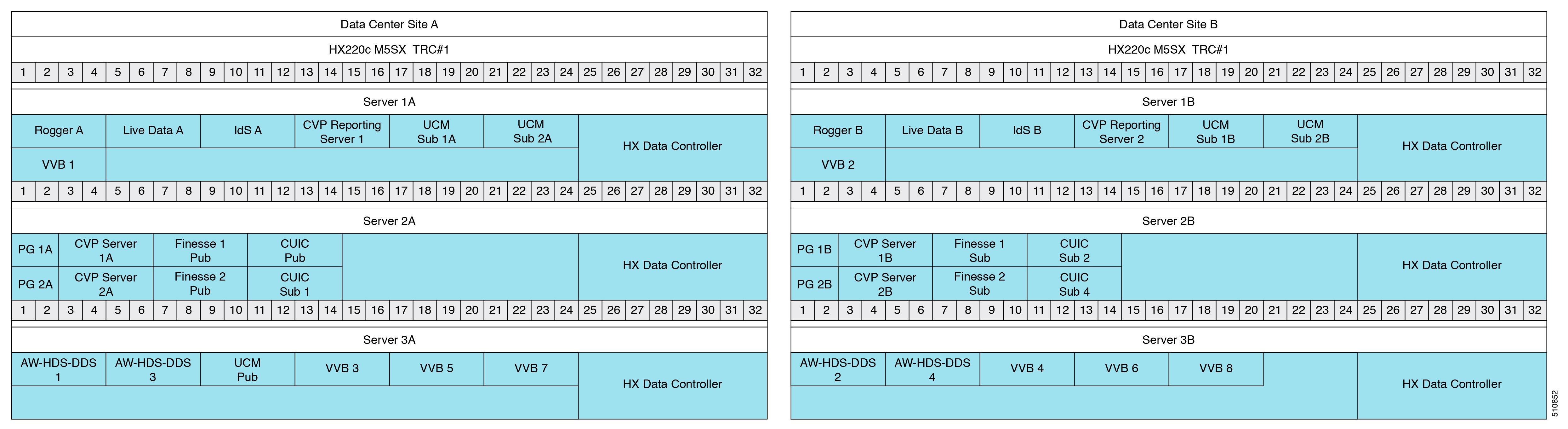
Support on the Cisco HyperFlex HX220c M5 TRC Server

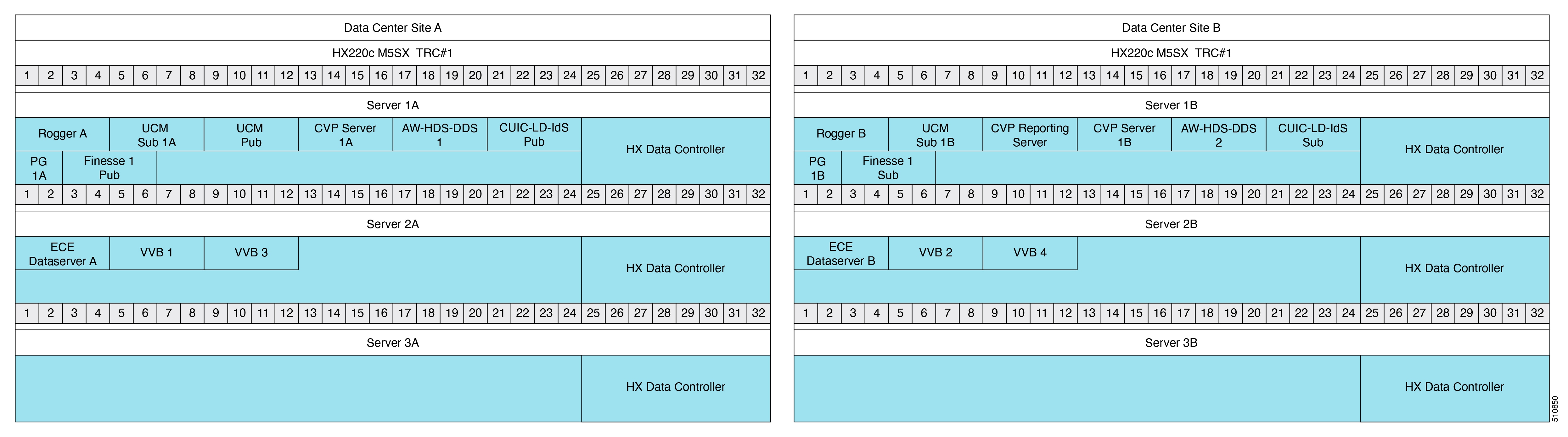
This figure shows the base layout of the components in a 2000 Agent Reference Design on Cisco HyperFlex HX220c M5 TRC servers.

This table lists the specifications for VMs.

Table 5. VM Specifications for 2000 Agent Reference Design

VM

vCPU

MHz

vRAM

vDisk 1

vDisk 2

vDisk 3

HX Data Controller

16

10800

48

Rogger

4

5000

6

80

150

Unified CM

4

7200

8

110

Unified CVP Server

4

3000

12

250

Unified CVP Reporting Server

4

1800

6

80

438

ECE Dataserver 3

4

4000

20

80

50

300

CUIC-LD-IdS

4

5500

16

200

AW-HDS-DDS

4

5000

16

80

750

PG

2

4000

6

80

Finesse

4

5000

10

146

VVB

4

9000

10

146

3 For the latest VM specifications, see the row for 400 agents in the Virtualization for Enterprise Chat and Email page at https://www.cisco.com/c/dam/en/us/td/docs/voice_ip_comm/uc_system/virtualization/virtualization-enterprise-chat-email.html.
Table 6. Total VM Requirements for 2000 Agent Reference Design

Server

vCPU

MHz

vRAM

vDisk

Data Center Site 1A

46

52700

130

1956

Data Center Site 1B

46

47300

128

2364

Data Center Site 2A

28

32800

88

722

Data Center Site 2B

28

32800

88

722

4000 Agent Reference Designs

All contact center enterprise solutions support the 4000 Agent Reference design on the Cisco UCS C240 M5SX TRC and Cisco HyperFlex HX220c M5 TRC servers.

This model adds servers to scale up from the 2000 Agent Reference Design.


Note

You can only deploy two AW-HDS-DDS per data center site in the 4000 Agent Reference Design. In larger solutions, you use a combination of HDS-DDS and AW-HDS.


Support on the Cisco UCS C240 M5SX TRC Server


Important

If you plan to upgrade to 12.x on Cisco UCS C240 M4SX servers, make the following changes to your servers and VM layouts:

  • Deploy Unified CM and ECE HA VMs on external servers.

  • Add 16 GB of physical RAM to each server that hosts Unified CVP call and VXML servers.

  • Increase the memory reservations for the Unified CVP VMs to 12 GB.


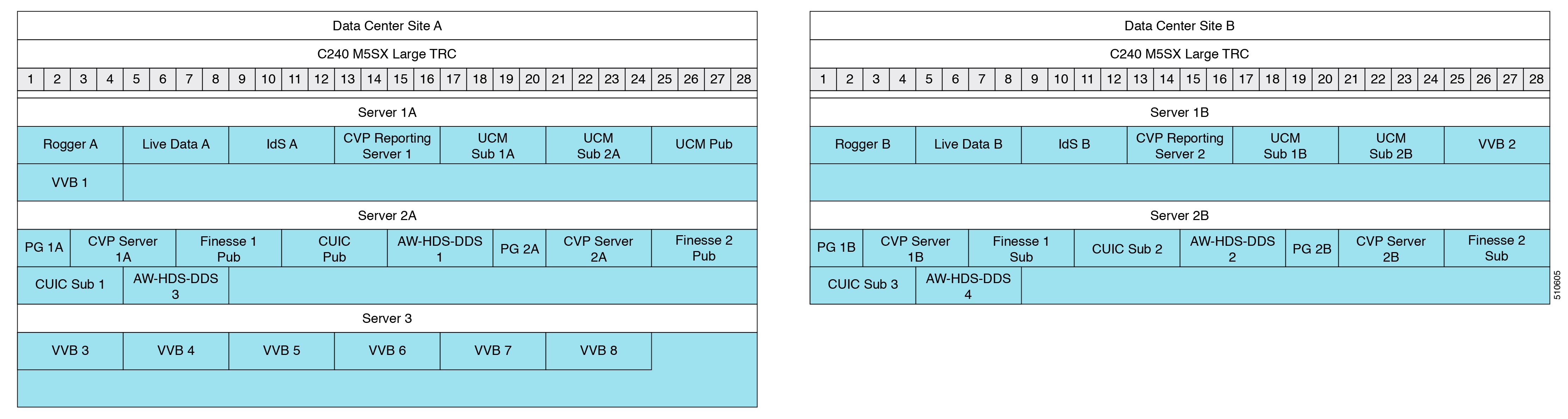
This figure shows the base layout of the components in a 4000 Agent Reference Design on Cisco UCS C240 M5SX TRC server.

Figure 3. 4000 Agent Reference Design Model

This table lists the specifications for VMs.

Table 7. VM Specifications for 4000 Agent Reference Design

VM

vCPU

MHz

vRAM

vDisk 1

vDisk 2

Rogger

4

5000

6

80

150

Live Data

4

5500

30

146

IdS

4

1500

10

146

Unified CVP Reporting Server

4

1800

6

80

438

Unified CM

4

7200

8

110

PG

2

4000

6

80

Unified CVP Server

4

3000

12

250

Finesse

4

5000

10

146

Unified Intelligence Center

4

3600

16

200

AW-HDS-DDS

4

5000

16

80

750

VVB

4

9000

10

146

Table 8. Total VM Requirements for 4000 Agent Reference Design

Server

vCPU

MHz

vRAM

vDisk

Data Center Site A - Server 1A

32

44400

86

1516

Data Center Site B - Server 1B

28

37200

78

1406

Data Center Site A - Server 2A

36

45000

120

2762

Data Center Site B - Server 2B

36

45000

120

2762

Server 3

24

54000

60

876

Support on the Cisco HyperFlex HX220c M5 TRC Server

This figure shows the base layout of the components in a 4000 Agent Reference Design on Cisco HyperFlex HX220c M5 TRC servers.

Figure 4. 4000 Agent Reference Design Model

This table lists the specifications for VMs.

Table 9. VM Specifications for 4000 Agent Reference Design

VM

vCPU

MHz

vRAM

vDisk 1

vDisk 2

HX Data Controller

16

10800

48

Rogger

4

5000

6

80

150

Live Data

4

5500

24

146

IdS

4

1500

10

146

Unified CVP Reporting Server

4

1800

6

80

438

Unified CM

4

7200

8

110

PG

2

4000

6

80

Unified CVP Server

4

3000

12

250

Finesse

4

5000

10

146

Unified Intelligence Center

4

3600

16

200

AW-HDS-DDS

4

5000

16

80

750

VVB

4

9000

10

146

Table 10. Total VM Requirements for 4000 Agent Reference Design

Server

vCPU

MHz

vRAM

vDisk

Data Center Site A - Server 1A

44

48000

120

1406

Data Center Site B - Server 1B

44

48000

120

1406

Data Center Site A - Server 2A

48

50800

152

1932

Data Center Site B - Server 2B

48

50800

152

1932

Data Center Site A - Server 3A

24

44200

70

1958

Data Center Site B - Server 3B

20

37000

62

1848

12000 Agent Reference Designs

This Reference Design for a contact center enterprise solution supports 12000 agents on the Cisco UCS C240 M5SX Large TRC servers and Cisco HyperFlex HX220c M5 TRC servers.

This model adds servers to scale up from the 4000 Agent Reference Design.

Support on the Cisco UCS C240 M5SX Large TRC server

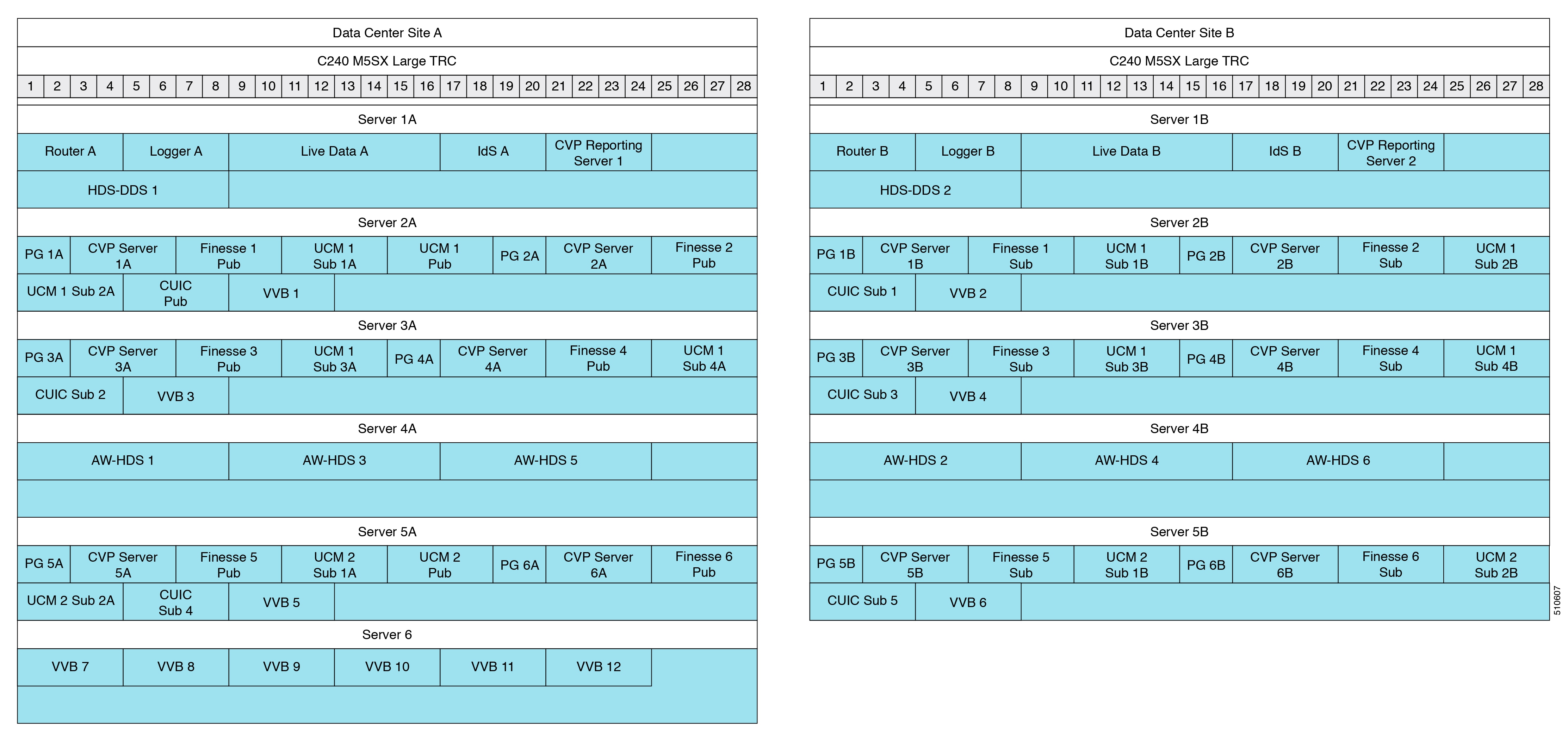
The following figure shows the base layout of the components in a 12000 Agent Reference Design on Cisco UCS C240 M5SX Large TRC server.

Figure 5. 12000 Agent Reference Design Model

Note

If you upgrade a 12000 Agent Reference Design from release 11.6 to 12.x on C240 M4 servers, use the base layout of the components in a 12000 Agent Reference Design on Cisco C240 M4 Tested Reference Configuration servers. For details, see the Solution Design Guide, Release 11.6 for the Contact Center Enterprise solution.


This table lists the specifications for VMs.

Table 11. VM Specifications for 12000 Agent Reference Design

VM

vCPU

MHz

vRAM

vDisk 1

vDisk 2

Router

4

4000

8

80

Logger

4

6000

8

80

500

Live Data

8

16500

30

146

IdS

4

1500

10

146

Unified CVP Reporting Server

4

1800

6

80

438

HDS-DDS

8

17500

16

80

500

AW-HDS

8

17500

16

80

500

PG

2

4000

6

80

Unified CVP Server

4

3000

12

250

Finesse

4

5000

10

146

Unified CM

4

7200

8

110

Unified Intelligence Center

4

3600

16

200

VVB

4

9000

10

146

Table 12. Total VM Requirements for 12000 Agent Reference Design

Server

vCPU

MHz

vRAM

vDisk

Data Center Site A - Server 1A

32

47300

78

2050

Data Center Site B - Server 1B

32

47300

78

2050

Data Center Site A - Server 2A

40

60100

106

1628

Data Center Site B - Server 2B

36

52900

98

1518

Data Center Site A - Server 3A

36

52900

98

1518

Data Center Site B - Server 3B

36

52900

98

1518

Data Center Site A - Server 4A

24

52500

48

1740

Data Center Site B - Server 4B

24

52500

48

1740

Data Center Site A - Server 5A

40

60100

106

1628

Data Center Site B - Server 5B

36

52900

98

1518

Server 6

24

54000

60

876

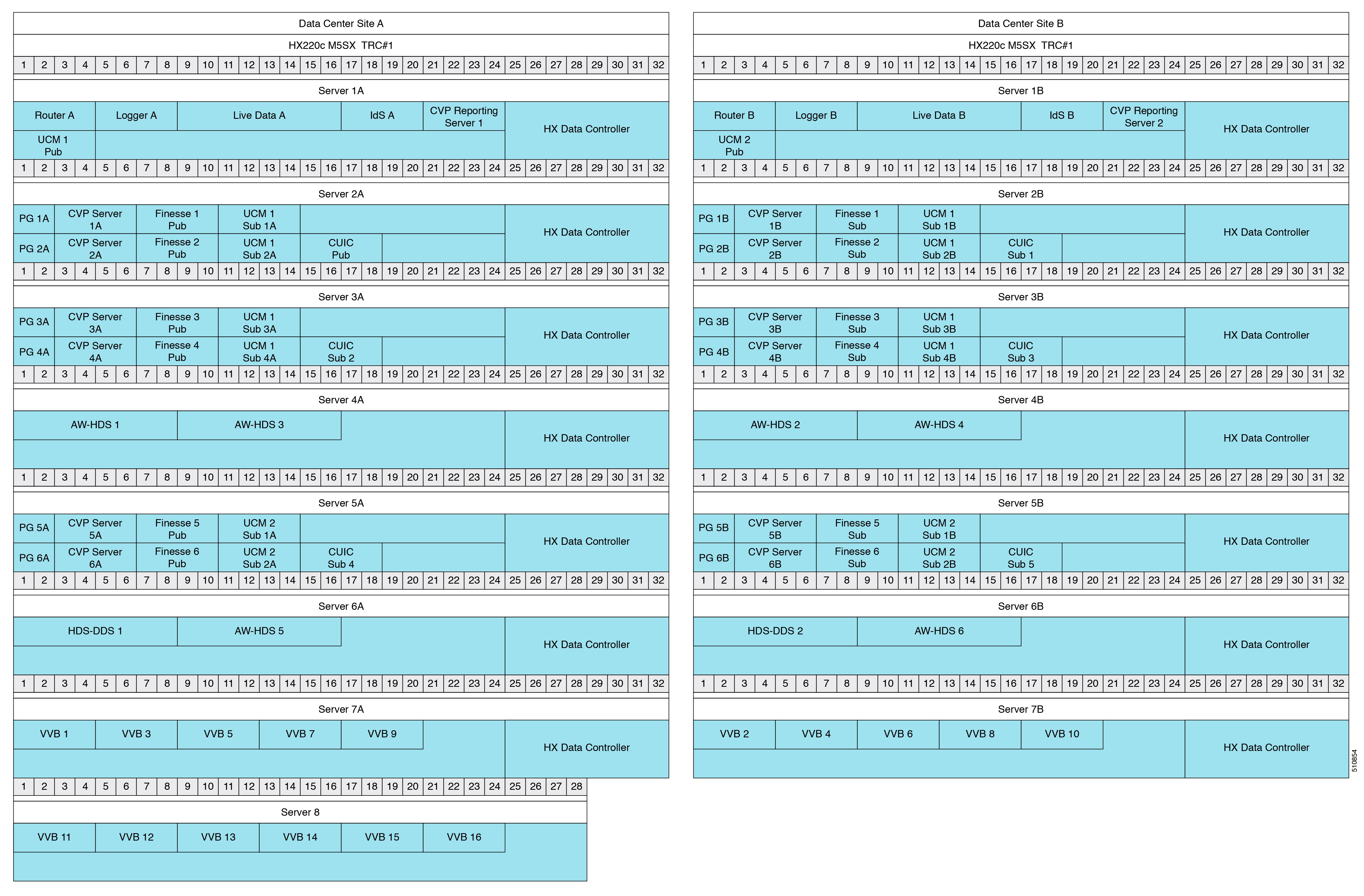
Support on the Cisco HyperFlex HX220c M5 TRC Server

This figure shows the base layout of the components in a 12000 Agent Reference Design on Cisco HyperFlex HX220c M5 TRC servers.

This table lists the specifications for VMs.

Table 13. VM Specifications for 12000 Agent Reference Design

VM

vCPU

MHz

vRAM

vDisk 1

vDisk2

HX Data Controller

16

10800

48

Router

4

4000

8

80

Logger

4

6000

8

80

500

Live Data

8

16500

24

146

IdS

4

1500

10

146

Unified CVP Reporting Server

4

1800

6

80

438

HDS-DDS

8

17500

16

80

420

AW-HDS

8

17500

16

80

500

PG

2

4000

6

80

Unified CVP Server

4

3000

12

250

Finesse

4

5000

10

146

Unified CM

4

7200

8

110

Unified Intelligence Center

4

3600

16

200

VVB

4

9000

10

146

Table 14. Total VM Requirements for 12000 Agent Reference Design

Server

vCPU

MHz

vRAM

vDisk

Data Center Site A - Server 1A

44

47800

112

1580

Data Center Site B - Server 1B

44

47800

112

1580

Data Center Site A - Server 2A

48

54700

136

1372

Data Center Site B - Server 2B

48

54700

136

1372

Data Center Site A - Server 3A

48

54700

136

1372

Data Center Site B - Server 3B

48

54700

136

1372

Data Center Site A - Server 4A

32

45800

80

1160

Data Center Site B - Server 4B

32

45800

80

1160

Data Center Site A - Server 5A

48

54700

136

1372

Data Center Site B - Server 5B

48

54700

136

1372

Data Center Site A - Server 6A

32

45800

80

1080

Data Center Site B - Server 6B

32

45800

80

1080

Data Center Site B - Server 7A

36

55800

98

730

Data Center Site B - Server 7B

36

55800

98

730

Server 8

24

54000

60

876

Reporting Users in the 12000 Agent Reference Design Model

AW-HDS 3, AW-HDS 4, AW-HDS 5, and AW-HDS 6 in Servers 4A and 4B, are optional to support more than 400 reporting users. Servers 5A and 5B are optional to support more than 8000 agents. Servers 6A and 6B are optional to support more than 400 reporting users.

This Reference Design supports a maximum of six CUIC VMs and six AW-HDS VMs, three VMs on each site. This limit can accommodate a maximum of 1200 reporting users. If one site shuts down, the remaining site can only support 600 reporting users on its three nodes.

Topologies for Reference Designs

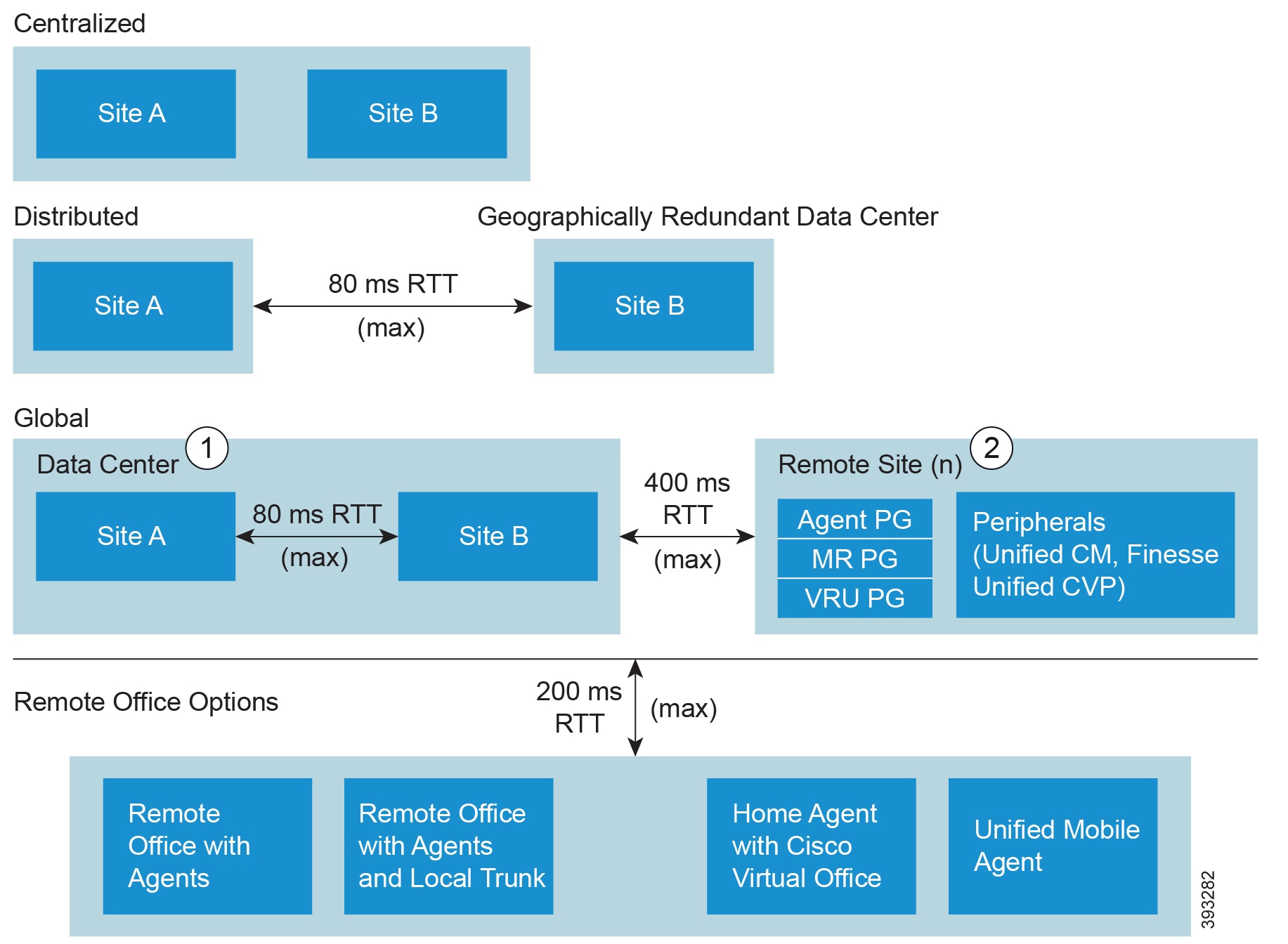
The Contact Center Enterprise Reference Designs also define the allowed topologies for your deployment. The deployment topology consists of where you install the VMs for your data center and how your agents connect to the data center. This figure shows the basic topologies that you can use in a Reference Design.

Figure 6. Reference Design Topologies
  1. The Main Site can use either a Centralized or a Distributed topology.

  2. A Remote Site can be geographically colocated with the Main Site.

The Reference Designs allow the following topologies:

Topology

Description

Centralized

You host both sites of the redundant components in the same physical data center. Even when they are on the same LAN, the maximum round-trip time between the two sites is 80 ms. The data center includes the core contact center components and Unified CM.

Distributed

You host each site of the redundant components in a different geographical location. Distributed sites allow you to keep running on the other site if one site fails. You can also handle routing without sending a contact to a site in a different geographical region. The maximum round-trip time between the two sites is 80 ms.

Global

You have a centralized or distributed main site. You also have a remote site that is generally in a different geographical location. The remote site gives you local access in that geographic region. The remote site allows you to handle your global work load without creating another contact center instance.

The remote site requires a separate Unified CM cluster and a separate Cisco Finesse cluster if the RTT from the data center is greater than 80 ms. The maximum round-trip time between the main site and remote sites is 400 ms.

Note 

A remote site cannot include a Cisco Unified Intelligence Center server.

This topology fits the outsourcer model where the outsourcer has a separate peripheral gateway and a corresponding peripheral.

Note 

Starting in Release 11.6, Packaged CCE supports this topology.

The Reference Designs allow the following methods for connecting your agents to a site:

Remote Office Topology

Description

Remote Office with Agents

A contact center office with agent workstations that connects to a site through a WAN router. The voice termination is at the site. All contacts go through the site first and then to the agents.

Remote Office with Agents and Local Trunk

A contact center office with a connection to the local PSTN. Contacts come in on the local trunk and the local gateway passes them to the data center for routing.

Home Agent with Broadband - Cisco Virtual Office (CVO)

An agent at a remote location with a VPN connection to a site. The agent has a Cisco IP Phone and a Cisco Finesse desktop. The agent can optionally use a Cisco Virtual Office (CVO) router for a permanent VPN connection.

Unified Mobile Agent

An agent who uses a PSTN phone.


Note

The maximum allowed round-trip time between any remote office and the data center is 200 ms.