- Preface
- Using the Cisco TelePresence System Administration
- Device Information
- Configuring the Cisco TelePresence System
- Troubleshooting the CTS 500
- Troubleshooting the CTS 500-32 and CTS 500-37
- Troubleshooting the CTS 1000
- Troubleshooting the CTS 1100
- Troubleshooting the CTS 1300
- Troubleshooting the TX1300 47
- Troubleshooting the CTS 3000 and CTS 3200
- Troubleshooting the CTS 3010 and CTS 3210
- Monitoring the Cisco TelePresence System
- Satellite Licenses for the Cisco TelePresence System
- Glossary
- Index
Monitoring the Cisco TelePresence System
Contents
This chapter contains the following sections:
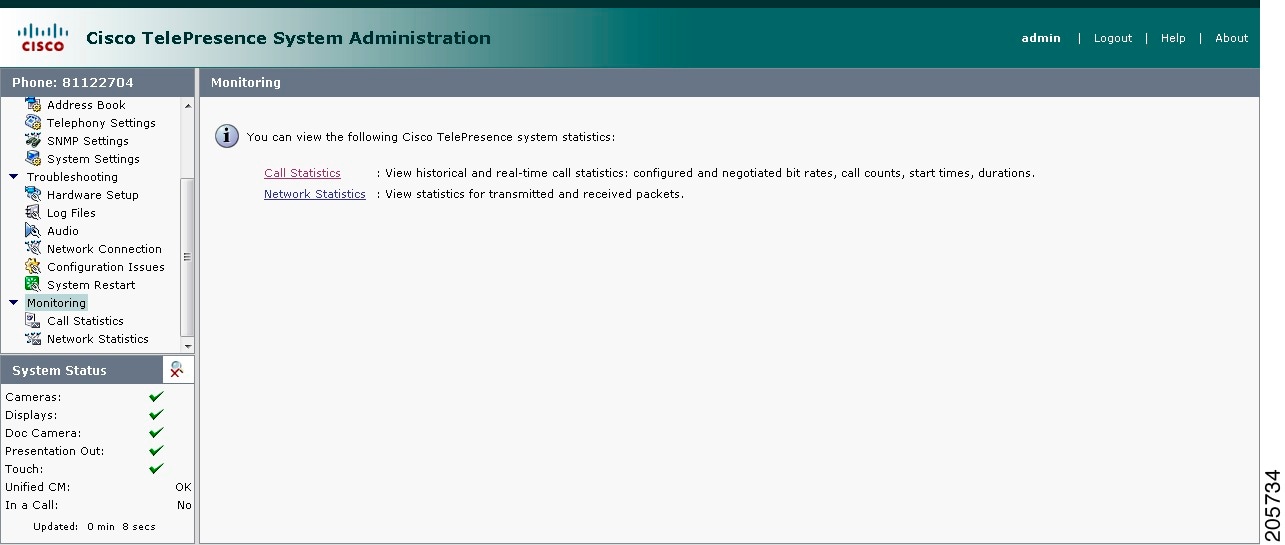
Table 12-1 shows the tools that are available in the Monitoring window:
Figure 12-1 Monitoring Window
Call Statistics
Use the Call Statistics window to view audio and video statistics collected by the codecs. The reports include descriptions to help you understand the type of information that is being collected.
To view call statistics:
Step 1  Choose Monitoring > Call Statistics.
You can view the following Cisco TelePresence system statistics:
•Real Time Call Statistics—Lists details of an in-progress call, including the following:
–Connection status
–Registered to Unified CM
–Local meeting number
•Audio/Video Call—Lists details about the audio and video of an in-progress call, including the following:
–Call Start Time
–Call Duration
–Call Type
–Remote meeting number
–Call State
–Actual Bit Rate
–Negotiated Bit Rate
•Historical Call Statistics (not including current call, if any)—Lists historical information about calls including the following:
–Call Statistics Clear Time
–Last Call Start Time
–Last Call Duration
–Number of Calls Since System Setup
–Time in Calls Since System Setup (seconds)
–Number of Calls Since Last Reboot
–Time in Calls Since Last Reboot (seconds)
–Registered to Cisco Unified Communications Manager
–Configured Bit Rate
Step 2 For more specific audio and video statistics, click the check-box next to the following selections.:
•Audio/Video Call: Audio Stream Statistics
•Audio/Video Call: Video Stream Statistics
•Audio-Only Call: Stream Statistics
Audio/Video Call: Audio Stream Statistics
a. Click once to select. Additional statistics fields appear.
b. Click once to de-select. Additional fields are hidden.
See Figure 12-2.
Audio/Video Call: Video Stream Statistics
a. Click once to select. Additional statistics fields appear.
b. Click once to de-select. Additional fields are hidden.
Audio-Only Call: Stream Statistics
a. Click once to select. Additional statistics fields appear.
b. Click once to de-select. Additional fields are hidden.
Statistics are listed in columns labeled as if you were looking at the front of the system sitting at the conference table. For example, on a CTS 3000 or CTS 3200, the labels indicate statistics from the left, center, and right codecs (and presentation codec, if installed), and from auxiliary devices (when connected).
When you select one of the choices above, additional statistics fields appear with the following status information listed, as shown in Figure 12-2:
•Local
•Remote
•Average Latency (Call)
•Average Latency (Period)
Figure 12-2 Audio/Video Call: Audio Stream Statistics
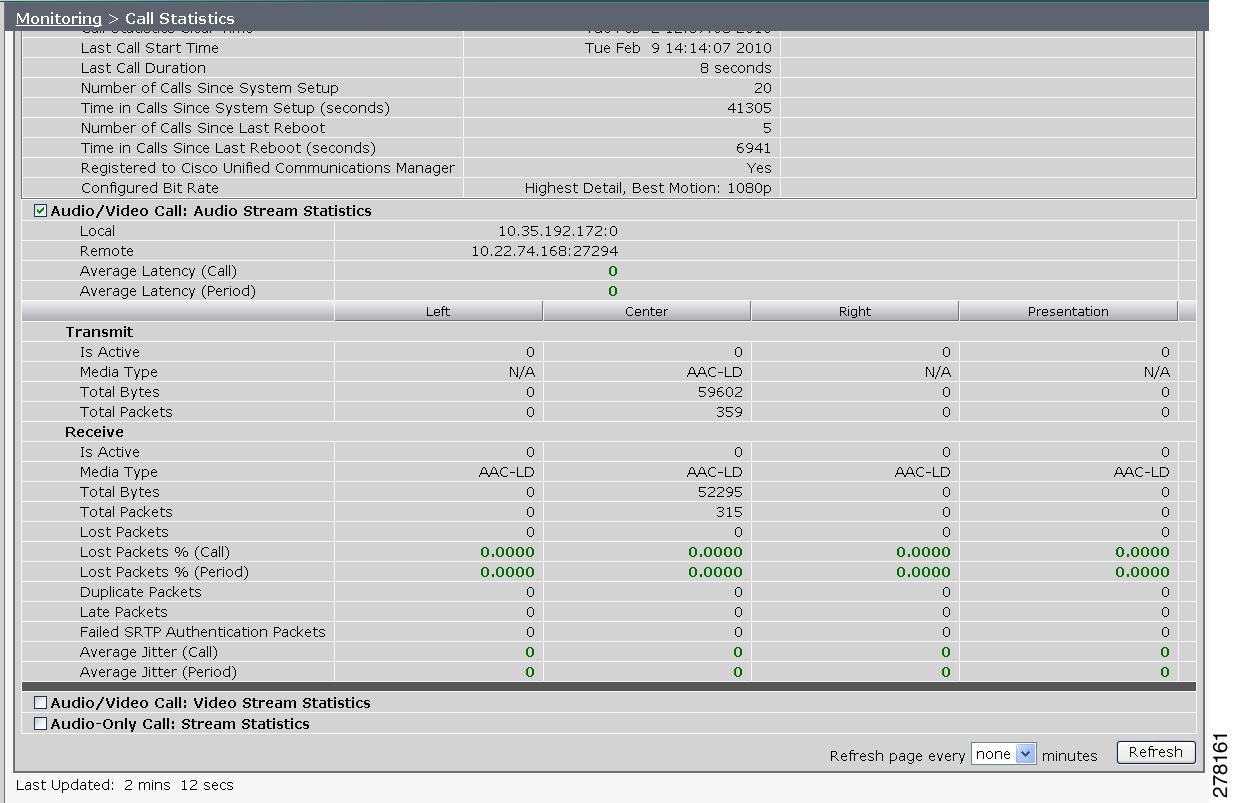
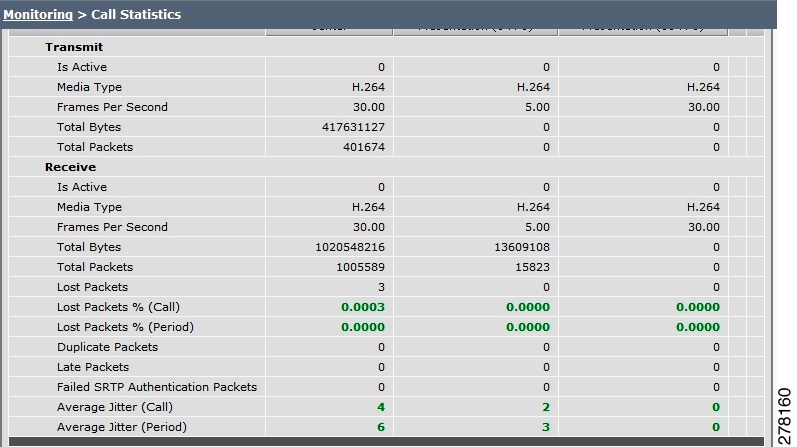
Additional statistics are listed for the following, as shown in Figure 12-3:
Transmit
•Is Active
•Media Type
•Total Bytes
•Total Packets
Receive
•Is Active
•Media Type
•Total Bytes
•Total Packets
•Lost Packets
•Lost Packets % (Call)
•Lost Packets % (Period)
•Duplicate Packets
•Late Packets
•Failed SRTP Authentication Packets
•Average Jitter (Call) (see jitter call)
•Average Jitter (Period) (see jitter period)

Note For more information about jitter and packet loss, see the Understanding Jitter and Packet Loss Reporting section of the Cisco TelePresence System Message Guide on Cisco.com.
Figure 12-3 Call Statistics - Transmit and Receive
Step 3 Set an interval for updating these reports by choosing the time from the Refresh drop-down menu. Choices, in minutes, include the following:
•None (default)
•1
•2
•5
•10
•13
•60
Step 4 Click Refresh to update the statistics immediately.
Network Statistics
Use Network Statistics to view packet transmission statistics collected from the network. Statistics are listed in columns labeled as if you were looking at the back of the system. For example, on a CTS 3000 or CTS 3200, the labels would indicate statistics from the left, center, and right codecs.
To monitor network statistics:
Step 1 Choose Monitoring > Network Statistics. Statistics for your system appear, as shown in Figure 12-4.
Figure 12-4 Network Statistics Window
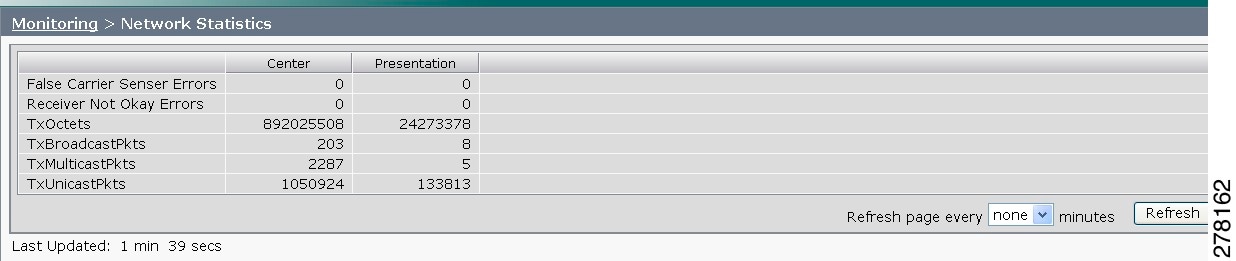
Step 2 Look for error counters that have been incremented since the last time you viewed these statistics. Statistic types include the following:
•False Carrier Sensor Errors
•Receiver Not Okay Errors
•Number of TxOctets
•Number of TxBroadcastPkts
•Number of TxMulticastPkts
•Number of TxUnicastPkts
Step 3 Set an interval for updating these reports by choosing the time from the Refresh drop-down menu. Choices, in minutes, include the following:
•None (default)
•1
•2
•5
•10
•13
•60
Step 4 Click Refresh to update the statistics immediately.
Where to Go Next
For more information about system statistics and messages, including System Operations (Sysop) Log messages see the Cisco TelePresence System Message Guide on Cisco.com.
 Feedback