Information about Audio Video Bridging
Audio and video bridging (AVB) equipment deployments have traditionally been analog single-purpose point-to-point one-way links. Migration to digital transmission also continued to retain the point-to-point one-way links architecture. The dedicated connection model resulted in a mass of cabling in professional and consumer applications, which was hard to manage and operate.
In order to accelerate the adoption to Ethernet based audio/video deployments in an interoperable way IEEE came up with the IEEE Audio Video Bridging standards - IEEE 802.1BA. This defines a mechanism where endpoints and the network will function as a whole to enable high quality A/V streaming across consumer applications to professional audio-video over an Ethernet infrastructure.
 Note |
AVB is not supported for the following:
|
Audio Video Bridging Supported Platforms
Audio video bridging (AVB) is supported on the Network Advantage license.
Refer the table below for the supported platforms for the AVB:
|
PID ID |
Product ID |
No.of ports * Speed |
Downlinks |
AVB support |
|---|---|---|---|---|
|
1 |
IE-9310-26S2C |
1G SFP/ 4 ports/ 25 - 28 |
1G SFP/ 22 ports / 1 - 22 |
Yes. First 12 downlink ports and 4 uplink ports. |
|
1G Combo/ 2 ports / 23 -24 |
||||
|
2 |
IE-9320-26S2C |
1G SFP/4 X 1Gig SFP (Ports 25-28) |
1G SFP/ 20 ports / 1 - 20 |
No AVB Support. |
|
1G SFP/ 2 ports / 21- 22 |
||||
|
1G Combo/ 2 ports / 23-24 |
||||
|
3 |
IE-9320-22S2C4X |
10G SFP+/ 4 X 10 Gig SFP/ 25 - 28 |
1G SFP/ 22 ports / 1 - 22 |
No AVB Support. |
|
1G Combo/ 2 ports / 23 -24 |
||||
|
4 |
IE-9320-24T4X |
10G SFP+/ 4 ports/ 25 - 28 |
1G Copper/24 port/1-24 |
Yes. First 12 downlink ports and 4 uplink ports. |
|
5 |
IE-9320-24P4X |
10G SFP+/ 4 ports/ 25 - 28 |
1G Copper/24 port/1-24 |
Yes. First 12 downlink ports and 4 uplink ports. |
|
6 |
IE-9320-16P8U4X |
10G SFP+/ 4 ports/ 25 - 28 |
1G Copper/16 port/1-16 |
Yes. First 12 downlink ports and 4 uplink ports. |
|
2.5G Copper/8 port/17-24 |
No support on Mgig ports. |
|||
|
7 |
IE-9320-24P4S |
1G SFP/ 4 ports/ 25 - 28 |
1G Copper/24 port/1-24 |
Yes. First 12 downlink ports and 4 uplink ports. |
Benefits of Audio Video Bridging
AVB is a mechanism to enable Ethernet based audio-video transmission which has the following benefits:
-
Guaranteed max latency
-
Time synchronized
-
Bandwidth guaranteed
-
Professional grade
Components of Audio Video Bridging Network
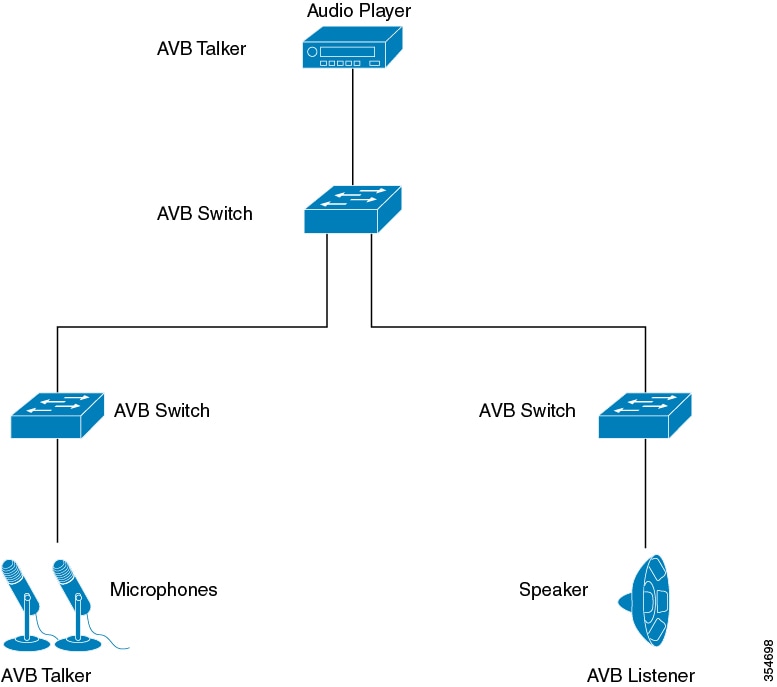
AVB protocols operate only in domains where every device is AVB capable. The AVB network comprises of AVB talkers, AVB listeners, AVB switches and the grandmaster clock source.
-
AVB Talker - An AVB end station that is the source or producer of a stream, i.e. microphones, video camera, and so on.
-
AVB Listener - An AVB end station that is the destination or consumer of a stream, i.e. speaker, video screen, and so on.
-
AVB Switch - An Ethernet switch that complies with IEEE802.1 AVB standards (IE-9300).
-
AVB stream: A data stream associated with a stream reservation compliant with the Stream Reservation Protocol (SRP).
Note
In some instances, the word “bridge” is used. In this context, it references to a switch.
The IEEE 802.1BA specification requires that an AVB talker must be grandmaster capable. In a typical deployment a network node can also be the grandmaster, provided it can either source or derive timing from a grandmaster capable device and provide the timing to the AVB network using IEEE 802.1AS.
The figure below shows a simple illustration of AVB network with different components.
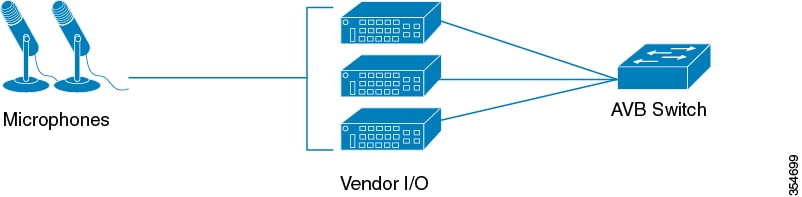
In many instances, the Audio/Video end points (Microphone, Speaker, and so on) are analog devices. AVB end-point vendors introduce Digital Signal Processors (DSP) and I/O devices that provide extensive audio/video processing and aggregate the end-points into an AVB Ethernet interface, as shown in the figure Vendor Audio I/O System below.
 Feedback