Monitor

This section contains context-sensitive Online Help content for the Cisco DCNM Web Client UI Monitor tab.

Inventory

This section contains context-sensitive Online Help content for the Cisco DCNM Web Client UI Monitor > Inventory tab.

The Inventory menu includes the following submenus:

Viewing Inventory Information for Switches

To view the inventory information for switches from the Cisco DCNM Web UI, perform the following steps:

Procedure


Step 1

Choose Monitor > Inventory > Switches.

The Switches window with a list of all the switches for a selected Scope is displayed.

Step 2

You can also view the following information.

  • Group column displays the switch group to which the switch belongs.

  • In the Device Name column, select a switch to display the Switch Dashboard.

  • IP Address column displays the IP address of the switch.

  • WWN/Chassis ID displays the Worldwide Name (WWN) if available or chassis ID.

  • Health displays the health situation of the switch.

    Note 

    To refresh and recalculate the latest health data for all the switches on Cisco DCNM, click the Recalculate Health button above the switches table.

  • Status column displays the status of the switch.

  • # Ports column displays the number of ports.

  • Model column displays the model name of the switch.

  • Serial No. column displays the serial number of the switch.

  • Release column displays the switch version.

  • License column displays the DCNM license that is installed on the switch.

  • Up Time column displays the time period for which the switch is active.

Step 3

In the Health column, the switch health is calculated by the capacity manager based on the following formula in the server.properties file.

The function to implement is:

# calculate(x, x1, y, y1, z).

# @param x: Total number of modules.

# @param x1: Total number of modules in warning.

# @param y: Total number of switch ports.

# @param y1: Total number of switch ports in warning.

# @param z: Total number of events with severity of warning or above.

Step 4

The value in the Health column is calculated based on the following default equation.

((x-x1)*1.0/x) *0.4 + ((y-y1)*1.0/y)*0.3 + ((z*1.0/1000>=1) ? 0: ((1000-z)*1.0/1000)*0.3).

In the above formula, the switch health value is calculated based on the following:

  • Percentage of Warning Modules (Contributes 40% of the total health).

  • Percentage of Warning Ports (Contributes 30% of the total health).

  • Percentage of events with severity of Warning or above (Contributes 30% of the total health. If there are more than 1000 warning events, the event health value is 0).

You may also have your own health calculation formula by implementing the common interface class: com.cisco.dcbu.sm.common.rif.HealthCalculatorRif. Add the .jar file to the DCNM server and modify the health.calculator property to point to the class name you have created.

The default Java class is defined as: health.calculator=com.cisco.dcbu.sm.common.util.HealthCalculator.

  • Capacity Manager calculates health only for the license switches. If the health column does not display a value, the switch either does not have a license or it has missed the capacity manager daily cycle.

  • If the switch is unlicensed, click Unlicensed in the DCNM License column. The Administration > License window appears which allows you to assign a license to the user.

  • The capacity manager runs two hours after the DCNM server starts. So, if you discover a device after two hours of the DCNM start time, the health will be calculated 24 hours after this DCNM start time


Viewing System Information

The switch dashboard displays the details of the selected switch.

Procedure

Step 1

From the Cisco DCNM home page, choose Monitor > Inventory > Switches.

An inventory of all the switches that are discovered by Cisco Prime DCNM Web Client is displayed.

Step 2

Click a switch in the Device Name column.

The Switch dashboard that corresponds to that switch is displayed along with the following information:

Step 3

Click the System Information tab. This tab displays detailed system information such as group name, health, module, time when system is up, serial number, the version number, contact, location, DCNM license, status, system log sending status, CPU and memory utilization, and VTEP IP address are displayed. Click Health to access the Health score screen, which includes health score calculation and health trend. The popup contains Overview, Modules, Switch Ports, and Events tabs.

  • (Optional) Click SSH to access the switch through Secure Shell (SSH).

  • (Optional) Click Device Manager to view a graphical representation of a Cisco MDS 9000 Family switch chassis, a Cisco Nexus 5000 Series switch chassis, a Cisco Nexus 7000 Series switch chassis, or a Cisco Nexus 9000 Series switch chassis including the installed switching modules, the supervisor modules, the status of each port within each module, the power supplies, and the fan assemblies.

  • (Optional) Click HTTP to access the switch through Hypertext Transfer Protocol (HTTP) for that switch.

  • (Optional) Click Accounting to go to the Viewing Accounting Information window pertaining to this switch.

  • (Optional) Click Backup to go to the Viewing a Configuration window.

  • (Optional) Click Events to go to the Viewing Events Registration window.

  • (Optional) Click Show Commands to display the device show commands. The Device Show Commands page helps you to view commands and execute them.

  • (Optional) Click Copy Running Config to Startup Config to copy the running configuration to the startup configuration.


VXLAN

You can view VXLANs and their details under the VXLAN tab.

To view VXLANs, choose Inventory > View > Switches, and then click a switch name in the Device Name column.

The following table describes the fields that are displayed:

Table 1. The VXLAN Tab

Field

Description

VNI

Displays the Layer 2 (network) or Layer 3 (VRF) VXLAN VNI that is configured on a switch.

Multicast address

Displays the multicast address that is associated with the Layer 2 VNI, if applicable.

VNI Status

Displays the status of the VNI.

Mode

Displays the VNI modes: Control Plane or Data Plane.

Type

Displays whether the VXLAN VNI is associated with a network (Layer 2) or a VRF (Layer 3).

VRF

Displays the VRF name that is associated with the VXLAN VNI if it is a Layer 3 VNI.

Mapped VLAN

Displays the VLAN or Bridge domain that is mapped to VNI.

VLAN

You create a VLAN by assigning a number to it; you can delete VLANs and move them from the active operational state to the suspended operational state.

To configure VLANs, choose Inventory > View > Switches, and then click a switch in the Device Name column.

The following table describes the buttons that appear on this page.

Table 2. VLAN Tab

Field

Description

Clear Selections

Allows you to unselect all the VLANs that you selected.

Add

Allows you to create Classical Ethernet or Fabric Path VLANs.

Edit

Allows you to edit a VLAN.

Delete

Allows you to delete a VLAN.

No Shutdown

Allows you to enable a VLAN.

Shutdown

Allows you to disable a VLAN.

Show

Allows you to display the VLAN show commands.

This section contains the following:

Adding a VLAN
Procedure

Step 1

Choose Inventory > View > Switches.

You see the Switches window displaying a list of all the switches for a selected Scope.

Step 2

In the Device Name column, select a switch to display the Switch Dashboard.

Step 3

Click the VLAN tab.

Step 4

Click Add to create Classical Ethernet or Fabric Path VLANs. In the Add VLAN window, specify the following fields:

  1. In the Vlan Id field, enter the VLAN ID.

  2. In the Mode field, specify whether you are adding Classical Ethernet or Fabric Path VLAN.

  3. Select the Admin State ON check box to specify whether the VLAN is shutdown or not.


Editing a VLAN
Procedure

Step 1

Choose Inventory > View > Switches.

You see the Switches window displaying a list of all the switches for a selected Scope.

Step 2

In the Device Name column, select a switch to display the Switch Dashboard.

Step 3

Select one or more VLANs, and then click the Edit button.


Deleting a VLAN
Procedure

Step 1

Choose Inventory > View > Switches.

You see the Switches window displaying a list of all the switches for a selected Scope.

Step 2

In the Device Name column, select a switch to display the Switch Dashboard.

Step 3

Click VLAN tab.

Step 4

Select the VLAN that you want to delete, and then click Delete.


Shutting Down a VLAN
Procedure

Step 1

Choose Inventory > View > Switches.

You see the Switches window displaying a list of all the switches for a selected Scope.

Step 2

In the Device Name column, select a switch to display Switch Dashboard.

Step 3

Click the VLAN tab.

Step 4

Click Shutdown to disable a VLAN. For example, if you want to stop traffic on a you can shut the VLAN.

To enable a VLAN, click No Shutdown button. For example, if you want to start traffic flow on a VLAN you can enable it.


Displaying VLAN Show Commands
Procedure

Step 1

Choose Inventory > View > Switches.

You see the Switches window displaying a list of all the switches for a selected Scope.

Step 2

In the Device Name column, select a switch to display Switch Dashboard.

Step 3

Click the VLAN tab.

Step 4

Click Show to display the VLAN show commands. Based on the VLAN selection, you can show the VLAN commands. Interface Show Commands window helps you to view commands and execute them.


FEX

The Fabric Extender feature allows you to manage a Cisco Nexus 2000 Series Fabric Extender and its association with the Cisco NX-OS switch that it is attached to. A Fabric Extender is connected to the switch through physical Ethernet interfaces or a Port Channel. By default, the switch does not allow the attached Fabric Extender to connect until it has been assigned a chassis ID and is associated with the connected interface. You can configure a Fabric Extender host interface port as a routed or Layer 3 port. However, no routing protocols can be tied to this routed interface.


Note

FEX feature is available on LAN devices only. Therefore, you will see FEX on Cisco DCNM Inventory Switches. FEX is also not supported on Cisco Nexus 1000V devices.

Note

4x10G breakout for FEX connectivity is not supported on Cisco Nexus 9500 Switches.


Note

The Fabric Extender may connect to the switch through several separate physical Ethernet interfaces or at most one port channel interface.


This section describes how to manage Fabric Extender (FEX) on Cisco Nexus Switches through Cisco DCNM.

You can create and manage FEX from Cisco DCNM Inventory > Switches.


Note

FEX tab is visible only if you choose a LAN device.


The following table describes the fields that appear on this page.

Table 3. FEX Operations

Field

Description

Add

Click to add a new FEX to a Cisco Nexus Switch.

Edit

Select any active FEX radio button and click Edit to edit the FEX configuration.

You can create an edit template and use it for editing FEX. Select template type as POLICY and sub type as FEX.

Delete

Select the FEX radio button, and click Delete icon to delete the FEX associated with the switch.

Show

Allows you to view various configuration details for the selected FEX ID. You can select the following from the drop-down list.

  • show_diagnostic

  • show_fex

  • show_fex_detail

  • show_fex_fabric

  • show_fex_inventory

  • show_fex_module

The variables for respective show commands are displayed in the Variables area. Review the Variables and click Execute. The output appears in the Output area.

You can create a show template for FEX. Select template type as SHOW and sub type as FEX.

FEX History

Allows you to view the history of the FEX configuration tasks for a particular FEX. You can review the Event Type, Policy Name, Status, Time of Execution, User Name for the selected FEX.

Table 4. FEX Table Field and Description

Field

Description

Fex Id

Uniquely identifies a Fabric Extender that is connected to a Cisco NX-OS device.

Fex Description

Description that is configured for the Fabric Extender.

Fex Version

Specifies the version of the FEX that is associated with the switch.

Pinning

An integer value that denotes the maximum pinning uplinks of the Fabric Extender that is active at a time.

State

Specifies the status of the FEX as associated with the Cisco Nexus Switch.

Model

Specifies the model of the FEX.

Serial No.

Specifies the configured serial number.

Note 

If this configured serial number and the serial number of the Fabric Extender are not the same, the Fabric Extender will not be active.

Port Channel

Specifies the port channel number to which the FEX is physically connected to the Switch.

Ethernet

Refers to the physical interfaces to which the FEX is connected.

vPC ID

Specifies the vPC ID configured for FEX.

This chapter includes the following sections:

Add FEX

To add single-home FEX from the Cisco DCNM Web UI, perform the following steps:

Before you begin

You can add a Fabric Extender (FEX) to the Cisco Nexus Switches through the Cisco DCNM Web Client. If the FEX is physically connected to the switch, FEX will become online after it is added. If the FEX is not physically connected to the switch, the configuration is deployed to the switch, which in turn enables FEX when connected.


Note

You can create only single homed FEX through Inventory > Switches > FEX > Add FEX. To create a dual-homed FEX, use the vPC wizard through Configure > Deploy > vPC.


Ensure that you have successfully discovered LAN devices and configured LAN credentials before you configure FEX.

Procedure

Step 1

Choose Inventory > Switches > FEX.

The FEX window is displayed.

Step 2

Click the Add FEX icon.

Step 3

In the General tab, in the PORTCHANNEL field, enter the interface port channel number which is connected to the FEX.

Step 4

In the INT_RANGE field, enter the interface range within which the FEX is connected to the switch.

Note 

Do not enter the interface range, if the interfaces are already a part of port channel.

Step 5

In the FEX_ID field, enter the ID for FEX that is connected to a Cisco NX-OS device.

The identifier must be an integer value between 100 to 199.

Step 6

Click Add.

The configured Single-home FEX appears in the list of FEXs associated to the device.


Edit FEX

To edit and deploy FEX from the Cisco DCNM Web UI, perform the following steps:

Procedure

Step 1

Choose Inventory > Switches > FEX.

The FEX window is displayed.

Step 2

Select the FEX radio button that you must edit. Click Edit FEX icon.

Step 3

In the Edit Configuration window, from the Policy drop-down list, select Edit_FEX to edit the FEX configuration.

Step 4

Edit the pinning and FEX_DESC fields, as required.

Note 

If you initially configured port 33 on the parent switch as your only fabric interface, all 48 host interfaces are pinned to this port. If you provision another port, for example 35, then you must perform this procedure to redistribute the host interfaces. All host interfaces are brought down and host interfaces 1 to 24 are pinned to fabric interface 33 and host interfaces 25 to 48 are pinned to fabric interface 35.

Step 5

Click Preview.

You can view the generated configuration for the selected FEX ID. The following is a configuration example for FEX ID 101.

fex 101
pinning max-links 1
description test
Step 6

After you review the configuration summary on the Preview window, on the Edit Configuration screen, click Deploy to deploy the FEX for the switch.


VDCs

This section describes how to manage Virtual Device Contexts (VDCs) on Cisco Nexus 7000 Switches through Cisco DCNM.

Users with the network administrator (network-admin) role can create Virtual Device Contexts (VDCs). VDC resource templates limit the amount of physical device resources available to the VDC. The Cisco NX-OS software provides a default resource template, or you can create resource templates.

You can create and manage VDCs from Cisco DCNM Inventory > Switches > VDCs. As Cisco DCNM supports DCNM on Cisco Nexus 7000 Series only, click an active Cisco Nexus 7000 Switch. After you create a VDC, you can change the interface allocation, VDC resource limits, and the high availability (HA) policies.

The following table describes the fields that appear on this page.

Table 5. Vdc Operations

Field

Description

Add

Click to add a new VDC.

Edit

Select any active VDC radio button and click Edit to edit the VDC configuration.

Delete

Allows you to edit the VDC configuration. Select any active VDC radio button and click Edit to edit the VDC configuration.

Resume

Allows you to delete the VDC. Select any active VDC radio button and click Delete to remove the VDC associated with the device.

Suspend

Allows you to suspend an active non-default VDC.

Save the VDC running configuration to the startup configuration before suspending the VDC. Otherwise, you will lose the changes to the running configuration.

Note 

You cannot suspend the default VDC.

Caution 

Suspending a VDC disrupts all traffic on the VDC.

Rediscover

Allows you to resume a non-default VDC from the suspended state. The VDC resumes with the configuration that is saved in the startup configuration.

Show

Allows you to view the Interfaces and Resources that are allocated to the selected VDC.

In the Interface tab, you can view the mode, admin-status, and operational status for each interface associated with the VDC.

In the Resource tab, you can view the allocation of resources and current usage of these resources.

Table 6. Vdc Table Field and Description

Field

Description

Name

Displays the unique name for the VDC

Type

Species the type of VDC. The two types of VDCs are:

  • Ethernet

  • Storage

Status

Specifies the status of the VDC.

Resource Limit-Module Type

Displays the allocated resource limit and module type.

HA-Policy

  • Single Supervisor

  • Dual Supervisor

Specifies the action that the Cisco NX-OS software takes when an unrecoverable VDC fault occurs.

You can specify the HA policies for single supervisor module and dual supervisor module configurations when you create the VDC. The HA policy options are as follows:

Single supervisor module configuration:

  • Bringdown—Puts the VDC in the failed state. To recover from the failed state, you must reload the physical device.

  • Reload—Reloads the supervisor module.

  • Restart—Takes down the VDC processes and interfaces and restarts it using the startup configuration.

Dual supervisor module configuration:

  • Bringdown—Puts the VDC in the failed state. To recover from the failed state, you must reload the physical device.

  • Restart—Takes down the VDC processes and interfaces and restarts it using the startup configuration.

  • Switchover—Initiates a supervisor module switchover.

The default HA policies for a non-default VDC that you create is restart for a single supervisor module configuration and switchover for a dual supervisor module configuration. The default HA policy for the default VDC is reload for a single supervisor module configuration and switchover for a dual supervisor module configuration.

Mac Address

Specifies the default VDC management MAC address.

Management Interface

  • IP Address Prefix

  • Status

Species the IP Address of the VDC Management interface. The status shows if the interface if up or down.

SSH

Specifies the SSH status

This chapter includes the following sections:

Add VDCs

To add VDC from the Cisco DCNM Web UI, perform the following steps:

Before you begin

Ensure that you have discovered the physical device using a username that has the network-admin role.

Obtain an IPv4 or IPv6 address for the management interface (mgmt 0) if you want to use out-of-band management for the VDC.

Create a storage VDC to run FCoE. The storage VDC cannot be the default VDC and you can have one storage VDC on the device.

Procedure

Step 1

Choose Inventory > Switches > VDC.

The VDC window is displayed.

Step 2

Click the Add VDC icon.

Step 3

From the drop-down list, select the VDC type.

You can configure the VDC in two modes.

  • Ethernet VDC

  • Storage VDC

The default VDC type is Ethernet.

Step 4

Click OK.


Configuring Ethernet VDCs

To configure VDC in Ethernet mode from the Cisco DCNM Web UI, perform the following steps:

Procedure

Step 1

In the General Parameter tab, specify the VDC Name, Single supervisor HA-policy, Dual supervisor HA-policy, and Resource Limit - Module Type.

Step 2

In the Allocate Interface tab, select the network interfaces (dedicated interfaces membership) to be allocated to the VDC.

Click Next.

Step 3

In the Allocate Resource tab, specify the resource limits for the VDC.

Select the radio button and choose Select a Template from existing Templates or Create a New Resource Template. VDC resource templates describe the minimum and maximum resources that the VDC can use. If you do not specify a VDC resource template when you create a VDC, the Cisco NX-OS software uses the default template, vdc-default.

  • If you choose Select a Template from existing Templates, from the Template Name drop-down list, you can select None, global-default, or vdc-default.

    The template resource limits are detailed in the following below:

    Table 7. Template Resource Limits

    Resource

    Minimum

    Maximum

    Global Default VDC Template Resource Limits

    Anycast Bundled

    IPv6 multicast route memory

    8

    8

    Route memory is in megabytes.

    IPv4 multicast route memory

    48

    48

    IPv6 unicast route memory

    32

    32

    IPv4 unicast route memory

    VDC Default Template Resource Limits

    Monitor session extended

    Monitor session mx exception

    Monitor SRC INBAND

    Port Channels

    Monitor DST ERSPAN

    SPAN Sessions

    VLAN

    Anycast Bundled

    IPv6 multicast route memory

    IPv4 multicast route memory

    IPv6 unicast route memory

    IPv4 unicast route memory

    VRF

  • If you choose Create New Resource Template, enter a unique Template Name. In the Resource Limits area, enter the minimum and maximum limits, as required for the resources.

You can edit individual resource limits for a single VDC through the Cisco DCNM Web Client > Inventory > Switches > VDC.

Click Next.

Step 4

In the Authenticate tab, you can allow the Admin to configure the password and also authenticate users using AAA Server Groups.

In the Admin User Area:

  • Check the Enable Password Strength Check checkbox, if necessary.

  • In the Password field, enter the admin user password.

  • In the Confirm Password field, reenter the admin user password.

  • In the Expiry Date field, click the down arrow and choose an expiry date for the admin user from the Expiry Date dialog box. You can also select Never radio button not to expire the password.

In the AAA Server Groups area:

  • In the Group Name field, enter an AAA server group name.

  • In the Servers field, enter one or more host server IPv4 or IPv6 addresses or names, which are separated by commas.

  • In the Type field, choose the type of server group from the drop-down list.

Click Next.

Step 5

In the Management Ip tab, enter IPv4 or IPv6 Address information.

Click Next.

Step 6

In the Summary tab, review the VDC configuration.

Click Previous to edit any parameters.

Click Deploy to configure VDC on the device.

Step 7

In the Deploy tab, the status of the VDC deployment is displayed.

A confirmation message appears. Click Know More to view the commands that are executed to deploy the VDC.

Click Finish to close the VDC configuration wizard and revert to view the list of VDCs configured on the device.


Configuring Storage VDCs

To configure VDCs in storage mode from the Cisco DCNM Web UI, perform the following steps:

Before you begin

Create a separate storage VDC when you run FCoE on the device. Only one of the VDCs can be a storage VDC, and the default VDC cannot be configured as a storage VDC.

You can configure shared interfaces that carry both Ethernet and Fibre Channel traffic. In this specific case, the same interface belongs to more than one VDC. The shared interface is allocated to both an Ethernet and a storage VDC.

Procedure

Step 1

In the General Parameter tab, specify the VDC Name, Single supervisor HA-policy, Dual supervisor HA-policy, and Resource Limit - Module Type.

Step 2

In the Allocate FCoE Vlan tab, select the available Ethernet Vdc from the drop-down list.

The existing Ethernet VLANs range is displayed. Select None not to choose any available Ethernet VDCs.

You can allocate specified FCoE VLANs to the storage VDC and specified interfaces.

Click Next.

Step 3

In the Allocate Interface tab, add the dedicated and shared interfaces to the FCoE VDC.

Note 

The dedicated interface carries only FCoE traffic and the shared interface carries both the Ethernet and the FCoE traffic.

You can configure shared interfaces that carry both Ethernet and Fibre Channel traffic. In this specific case, the same interface belongs to more than one VDC. FCoE VLAN and shared interface can be allocated from same Ethernet VDC.

Click Next.

Step 4

In the Authenticate tab, you can allow the Admin to configure the password and also authenticate users using AAA Server Groups.

In the Admin User Area:

  • Check the Enable Password Strength Check checkbox, if necessary.

  • In the Password field, enter the admin user password.

  • In the Confirm Password field, reenter the admin user password.

  • In the Expiry Date field, click the down arrow and choose an expiry date for the admin user from the Expiry Date dialog box. You can also select Never radio button not to expire the password.

In the AAA Server Groups area:

  • In the Group Name field, enter an AAA server group name.

  • In the Servers field, enter one or more host server IPv4 or IPv6 addresses or names, which are separated by commas.

  • In the Type field, choose the type of server group from the drop-down list.

Click Next.

Step 5

In the Management Ip tab, enter IPv4 or IPv6 Address information.

Click Next.

Step 6

In the Summary tab, review the VDC configuration.

Click Previous to edit any parameters.

Click Deploy to configure VDC on the device.

Step 7

In the Deploy tab, the status of the VDC deployment is displayed.

A confirmation message appears. Click Know More to view the commands that are executed to deploy the VDC.

Click Finish to close the VDC configuration wizard and revert to view the list of VDCs configured on the device.


Edit VDC

To edit VDC from the Cisco DCNM Web UI, perform the following steps:

Procedure

Step 1

Choose Inventory > Switches > VDC.

The VDC window is displayed.

Step 2

Select the VDC radio button that you must edit. Click the Edit VDC icon.

Step 3

Modify the parameters as required.

Step 4

After you review the configuration summary on the Summary tab, click Deploy the VDC with the new configuration.


Switch On-Board Analytics

The Switch On-Board Analytics dashboard displays the following charts:

  • Top 10 Slowest Ports

  • Top 10 Slowest Target Ports

  • Top 10 Slowest Flows

  • Top 10 Slowest ITLs

  • Top 10 Port Traffic

  • Top 10 Target Ports Traffic

  • Top 10 Flow Traffic

  • Top 10 ITL Traffic

The following metrics are supported by the Switch On-Board Analytics charts:

  • Read and Write Completion Time—Time that is taken for an IO to complete successfully, that is, the time gap between IO status from a Target and IO command from an Initiator. The following metrics are supported:

    • Read Completion Time Min

    • Read Completion Time Max

    • Write Completion Time Min

    • Write Completion Time Max

    The IO engine tracks the maximum and minimum IO completion time for read and write commands in the context of a switch’s port, target port, flows, initiators, and LUNs.

  • Read and Write Initiation Time—Time that is taken for an IO to initiate, that is, the time gap between the first response packet from a Target and IO Command from Initiator. The following metrics are supported:

    • Read Initiation Time Min

    • Read Initiation Time Max

    • Write Initiation Time Min

    • Write Initiation Time Max

    The IO engine tracks the maximum and minimum IO initiation time for read and write commands in the context of a switch’s port, target port, flows, initiators, and LUNs.

  • Read and Write IO Bandwidth—Read and write command bandwidth observed in the context of a switch's port traffic, target port traffic, flow traffic, initiators, and LUNs. The IO bandwidth is computed at every four second time interval based on the number of bytes read or written.

  • Read and Write IO Rate—Read and write command IO rate observed in the context of a switch's port traffic, target port traffic, flow traffic, initiators, and LUNs. The IO rate is computed at every four second time interval that is based on the number of IO performed.

  • Read and Write IO Size—Read and write command IO size observed in the context of a switch's port traffic, target port traffic, flow traffic, initiators, and LUNs. The following metrics are supported:

    • Read IO Size Min

    • Read IO Size Max

    • Write IO Size Min

    • Write IO Size Max

    The IO engine tracks the maximum and minimum IO size for read and write commands.

Viewing Switch On-Board Analytics

You can view the switch on-board analytics information from the Cisco DCNM Web UI, perform the following steps:

Procedure

Step 1

Choose Inventory > View > Switches.

The discovered switches are displayed.

Step 2

Click a switch name in the Device Name column.

The Switch dashboard that corresponds to that switch is displayed.

Step 3

Click the Switch On-Board Analytics tab.

This tab displays the Switch On-Board Analytics charts.


Configuring Settings for the Switch On-Board Analytics Charts

Perform the following actions to configure the settings for the switch on-board analytics charts:

  • From the Show Time drop-down list, choose time to be shown in the charts. You can choose one of the following options:

    • Microseconds

    • Milliseconds

    • Seconds

    By default, Microseconds is chosen.


    Note

    The Show Time drop-down list is applicable only for the top ten slowest ports, target ports, flows, and ITLs.


  • From the Show Flow From drop-down list, choose whether to show flows from a Target or from an Initiator. By default, flows from a Target are chosen.


    Note

    The Show Flow From drop-down list is applicable only for the charts displaying flows and ITLs.


  • From the bandwidth and size drop-down list, choose the traffic information to be shown in the charts. You can choose one of the following options:

    • Bytes

    • KB

    • MB

    By default, Bytes is chosen.

  • Check the Single Column check box to display the charts in a single column instead of double columns.

  • Click the Refresh icon in the upper-right corner to refresh the charts.

Viewing Switch On-Board Analytics Charts

Perform the following actions to view the charts under the Switch On-Board Analytics tab:

  • View the charts for the top ten slowest ports, target ports, flows, and ITLs by choosing one of the following variables from the drop-down list:

    • Read Completion Time—The read command completion time observed in the context of a switch’s port.

    • Write Completion Time—The write command completion time observed in the context of a switch’s port.

    • Read Initiation Time—The read command initiation time observed in the context of a switch’s port.

    • Write Initiation Time—The write command initiation time observed in the context of a switch’s port.


    Note

    • By default, Read Completion Time is selected and all the units for time are in Microseconds.

    • Each chart contains a legend that provides information about the variable displayed. Each variable has a check box. Unselecting the check box removes the variable data from the chart or table.


  • View the charts for the top ten port traffic, target port traffic, flow traffic, and ITL traffic by choosing one of the following variables from the drop-down list:

    • Read IO Rate—The read command data observed in the context of a switch’s port.

    • Write IO Rate—The write command observed in the context of a switch’s port.

    • Read IO Size—The read command size observed in the context of a switch’s port.

    • Write IO Size—The write command size observed in the context of a switch’s port.

    • Read IO Bandwidth—The read command bandwidth observed in the context of a switch’s port.

    • Write IO Bandwidth—The write command bandwidth observed in the context of a switch’s port.


    Note

    • By default, Read IO Rate is selected. The Read IO Rate is IO per second. Both Rate and Bandwidth units are per second over an 8-second range. The Size value is for the life of the switch or since the last clear command was run from the CLI.

    • The Read IO Size and Read IO Bandwidth units are in bytes per second. You can change this unit by using the Show Bandwidth and Size drop-down list. You can choose from the three options: Bytes, KB, and MB.

    • Each chart contains a legend that provides information about the variable displayed. Each variable has a check box. Unselecting the check box removes the variable data from the chart or table.


  • Choose the format to display information from the Show drop-down list. You can choose one of the following formats:

    • Chart

    • Table

    • Chart and Table


    Note

    • To display information in the Chart and Table format, enlarge your browser window or check the Single Column check box on the upper right corner.

    • The default for Top ten Slowest Ports and Top 10 Port Traffic is Chart and Table.


  • Use the Chart Type drop-down list to display information in the Bar Chart or Stacked Bar Chart.

  • Use the Actions drop-down list to export information in a CSV or PDF, or print the required information.

  • To view a chart or a table in a new window, click the Detach icon on the upper-right corner of a chart or a table. After detaching a chart or table, you can view the top 25 slowest ports, target ports, flows, ITLs, or their traffic.

Viewing Inventory Information for Modules

To view the inventory information for modules from the Cisco DCNM Web UI, perform the following steps:

Procedure


Step 1

Choose Inventory > View > Modules.

The Modules window is displayed with a list of all the switches and its details for a selected Scope.

Step 2

You can view the following information.

  • Group column displays the group name of the module.

  • Switch column displays the switch name on which the module is discovered.

  • Name displays the module name.

  • ModelName displays the model name.

  • SerialNum column displays the serial number.

  • 2nd SerialNum column displays the second serial number.

  • Type column displays the type of the module.

  • Slot column displays the slot number.

  • Hardware Revision column displays the hardware version of the module.

  • Software Revision column displays the software version of the module.

  • Asset ID column displays the asset id of the module.

  • OperStatus column displays the operation status of the module.


Viewing Inventory Information for Licenses

To view the inventory information for licenses from the Cisco DCNM Web UI, perform the following steps:

Procedure


Step 1

Choose Inventory > View > Licenses.

The Licenses window is displayed based on the selected Scope.

Step 2

You can view the following information.

  • Group column displays the group name of switches.

  • Switch column displays the switch name on which the feature is enabled.

  • Feature displays the installed feature.

  • Status displays the usage status of the license.

  • Type column displays the type of the license.

  • Warnings column displays the warning message.


Monitoring Switch

The Switch menu includes the following submenus:

Viewing Switch CPU Information

To view the switch CPU information from the Cisco DCNM Web UI, perform the following steps:

Procedure


Step 1

Choose Monitor > Switch > CPU.

The CPU window is displayed. This window displays the CPU information for the switches in that scope.

Step 2

You can use the drop-down to filter the view by Last 10 Minutes, Last Hour, Last Day, Last Week, Last Month, and Last Year.

Step 3

In the Switch column, click the switch name to view the Switch Dashboard.

Step 4

Click the chart icon in the Switch column to view the CPU utilization.

You can also change the chart timeline to Last 10 Minutes, Last Hour, Last Day, Last Week, Last Month, and Last Year. You can choose the chart type and chart options to show as well.


Viewing Switch Memory Information

To view the switch memory information from the Cisco DCNM Web UI, perform the following steps:

Procedure


Step 1

Choose Monitor > Switch > Memory.

The memory panel is displayed. This panel displays the memory information for the switches in that scope.

Step 2

Use the drop-down to filter the view by Last 10 Minutes, Last Hour, Last Day, Last Week, Last Month, and Last Year.

Step 3

Click the chart icon in the Switch column to see a graph of the memory usage of the switch.

Step 4

In the Switch column, click the switch name to view the Switch Dashboard.

Step 5

You can use the drop-down to view the chart in different time lines. Use the chart icons to view the memory utilization chart in varied views.


Viewing Switch Traffic and Errors Information

To view the switch traffic and errors information from the Cisco DCNM Web UI, perform the following steps:

Procedure


Step 1

Choose Monitor > Switch > Traffic.

The Switch Traffic panel is displayed. This panel displays the traffic on that device for the past 24 hours.

Step 2

Use the drop-down to filter the view by 24 hours, Week, Month, and Year.

Step 3

Click the Export icon in the upper-right corner to export the data into a spreadsheet.

Step 4

Click Save.

Step 5

Click the switch name to view the Switch Dashboard section.


Viewing Switch Temperature

Cisco DCNM includes the module temperature sensor monitoring feature, using which you can view the sensor temperature of a switch. You can choose an interval by which to filter the sensor list. The default interval is Last Day. Only sensors that have historical temperature data is shown in the list. You can choose between Last ten Minutes, Last Hour, Last Day, Last Week, and Last Month.

Note

It is not necessary to configure the LAN credentials under the Configure > Credentials Management > LAN Credentials screen to fetch the temperature monitoring data from the switches.


To view the switch temperature information from the Cisco DCNM Web UI, perform the following steps:

Procedure


Step 1

Choose Monitor > Switch > Temperature.

The Switch Temperature window is displayed with the following columns.

  • Scope: The sensor belongs to a switch, which is part of a fabric. The fabric that it belongs to is shown as its scope. When the scope selector at the top of Cisco DCNM is used, the sensor list is filtered by that scope.
  • Switch: Name of the switch the sensor belongs to.
  • IP Address: IP Address of the switch.
  • Temperature Module: The name of the sensor module.
  • Avg/Range: The first number is the average temperature over the interval that is specified at the top of the table. The second set of numbers is the range of the temperature over that interval.
  • Peak: The maximum temperature over the interval
Step 2

From this list, each row has a chart icon, which you can click.

A chart is displayed, which shows historical data for the sensor. The interval for this chart can be changed as well, between 24 hours, 1 week, and 1 month.

Enabling Temperature Monitoring

You can enable the temperature monitoring feature for LAN switches from the LAN Collections screen, and for the SAN switches by setting a few properties under Administration > DCNM Server > Server Properties screens.

Enabling Temperature Monitoring for LAN Switches
  1. From the menu bar, choose Administration > Performance Setup > LAN Collections.

  2. Select the Temperature Sensor check box.

  3. Select the type of LAN switches for which you want to collect performance data.

  4. Click Apply to save the configuration.

Viewing Accounting Information

To view the accounting information from the Cisco DCNM Web UI, perform the following steps:

Procedure


Step 1

Choose Monitor > Switch > Accounting.

The fabric name or the group name along with the accounting information is displayed.

Step 2

Select Advanced Filter beside the filter icon to search the accounting information by Source, Username,Time, and Description. Or select Quick Filter to search under each column.

Step 3

You can also select a row and click the Delete icon to delete accounting information from the list.

Step 4

You can use the Print icon to print the accounting details and use the Export icon to export the data to a Microsoft Excel spreadsheet.


Viewing Events Information

To view the events and syslog from the Cisco DCNM Web UI, perform the following steps:

Procedure


Step 1

Choose Monitor > Switch > Events.

The fabrics along with the switch name and the events details are displayed.

The Count column displays the number of times the same event has occurred during the time period as shown in the Last Seen and First Seen columns.

Click a switch name in the Switch column to view the switch dashboard.

Step 2

Select an event in the table and click the Add Suppressor icon to open the shortcut of adding an event suppressor rule.

Step 3

Select one or more events from the table and click the Acknowledge icon to acknowledge the event information for the fabric.

  • After you acknowledge the event for a fabric, the acknowledge icon is displayed in the Ack column next to the fabric.
Step 4

Select the fabric and click the Unacknowledge icon to cancel an acknowledgment for a fabric.

Step 5

Select Advanced Filter beside the filter icon to search the accounting information by Source, Username,Time, and Description. Or select Quick Filter to search under each column.

Step 6

Select a fabric and use the Delete icon to delete the fabric and event information from the list.

Step 7

Click the Print icon to print the event details.

Step 8

Click the Export to Excel icon to export the data.


Monitoring LAN

The LAN menu includes the following submenus:

Monitoring Performance Information for Ethernet

To monitor the performance information for ethernet from the Cisco DCNM Web UI, perform the following steps:

Procedure


Step 1

Choose Monitor > LAN > Ethernet.

The Ethernet window is displayed.

Step 2

You can use the drop-down to filter the view by Last 10 Minutes, Last Hour, Last Day, Last Week, Last Month, and Last Year.

There are variations to this procedure. In addition to these basic steps, you can also perform the following steps:

  • Select the name of an Ethernet port from the Name column to see a graph of the traffic across that Ethernet port for the past 24 hours. You can change the time range for this graph by selecting it from the drop-down list in the upper-right corner.

  • To export the data into a spreadsheet, click the Export icon in the upper-right corner and click Save.

  • Use the chart icons to view the traffic chart in varied views. You can also use the icons to Append, Predict, and Interpolate Data.

  • For the Rx/Tx calculation, see the following Rx/Tx calculation.

    Note 
    The conversion for Fabrics is 10 bit = 1 byte and for LAN traffic, the conversion is 8 bit = 1 byte.
    • Average Rx/Tx % = Average Rx/Tx divided by Speed * 100
    • Peak Rx/Tx % = Peak Rx/Tx divided by Speed * 100
Note 
If the performance tables do not contain any data, see the Thresholds section to turn on performance data collection.

Monitoring ISL Traffic and Errors

To monitor the ISL traffic and errors from the Cisco DCNM Web UI, perform the following steps:

Procedure


Step 1

Choose Monitor > LAN > Link.

The ISL Traffic and Errors window is displayed. This panel displays the ISL information for the end devices in that scope. You can reduce or expand the scope of what is displayed by using the scope menu.

Step 2

You can use the drop-down to filter the view by Last 10 Minutes, Last Hour, Last Day, Last Week, Last Month, and Last Year.

Note 
NaN (Not a Number) in the data grid means that the data is not available.

There are variations to this procedure. In addition to these basic steps, you can perform the following steps to view detailed information for ISLs:

  • To change the time range for this graph, select it from the drop-down list in the upper-right corner.

  • To view the detailed information for a specific period, drag the slider control to choose the time interval for which you need the information.

  • Use the chart icons to view the traffic chart in varied views. You can also use the icons to Append, Predict, and Interpolate Data. To view real-time information, choose Real Time from the drop-down list in the Chart menu.

  • To export the data into a spreadsheet, choose Export from the drop-down list in the Chart menu and then click Save.

  • For the Rx/Tx calculation, see the following Rx/Tx calculation.

    Note 
    The conversion for Fabrics is 10 bit = 1 byte and for LAN traffic, the conversion is 8 bit = 1 byte.
    • Average Rx/Tx % = Average Rx/Tx divided by Speed * 100
    • Peak Rx/Tx % = Peak Rx/Tx divided by Speed * 100
Note 
If the performance tables do not contain any data, see the Performance Setup Thresholds section to turn on performance.

Monitoring a vPC

The virtual port channel (vPC) feature enables you to view the links that are physically connected to different devices as a single port channel. A vPC is an extended form of a port channel which allows you to create redundancy and increase bisectional bandwidth by enabling multiple parallel paths between nodes and allowing load balancing traffic. Traffic is distributed among two single device vPC endpoints. If there is an inconsistency in the vPC configurations, the vPC does not function correctly.


Note

To view the vPC in vPC Performance, both primary and secondary device should be designated to the user. If either one kind of switch is not designated, vPC information is isplayed.


Cisco DCNM Web Client > Monitor> vPC displays only consistent vPCs displays both the consistent and inconsistent vPCs.

You can identify the inconsistent vPCs and resolve the inconsistencies in each vPC by using the Cisco DCNM Web UI > Configure > Deploy > vPC Peer and Web Client > Configure > Deploy > vPC.

Table 1 displays the following vPC configuration details in the data grid view.

Table 8. vPC Performance

Column

Description

Search box

Enter any string to filter the entries in their respective column.

vPC ID

Displays vPC ID's configured device.

Domain ID

Displays the domain ID of the vPC peer switches.

Multi Chassis vPC EndPoints

Displays the multi-chassis vPC endpoints for each vPC ID under a vPC domain.

Primary vPC Peer - Device Name

Displays the vPC Primary device name.

Primary vPC Peer - Primary vPC Interface

Displays the primary vPC interface.

Primary vPC Peer - Capacity

Displays the capacity for the primary vPC peer.

Primary vPC Peer - Avg. Rx/sec

Displays the average receiving speed of primary vPC peer.

Primary vPC Peer - Avg. Tx/sec

Displays the average sending speed of primary vPC peer.

Primary vPC Peer - Peak Util%

Displays the peak utilization percentage of primary vPC peer.

Secondary vPC Peer - Device Name

Displays the vPC secondary device name.

Secondary vPC Interface

Displays the secondary vPC interface.

Secondary vPC Peer - Capacity

Displays the capacity for the secondary vPC peer.

Secondary vPC Peer - Avg. Rx/sec

Displays the average receiving speed of secondary vPC peer.

Secondary vPC Peer - Avg. Tx/sec

Displays the average sending speed of secondary vPC peer.

Secondary vPC Peer - Peak Util%

Displays the peak utilization percentage of secondary vPC peer.

You can use this feature as following:

Monitoring vPC Performance

You can view the relationship among consistent virtual port channels (vPCs). You can view the statistics of all member interfaces and the aggregate of the statistics at the port channel level.


Note

This tab only displays consistent vPCs.


To view the VPC performance information from the Cisco DCNM Web UI, perform the following steps:

Procedure

Step 1

Choose Monitor > LAN > vPC.

The vPC Performance statistics is displayed. The aggregated statistics of all vPCs are displayed in a tabular manner.

Step 2

Click the vPC ID.

The vPC topology, vPC Details, Peer-link Details, and Peer-link Status is displayed.

The vPC Consistency, Peer-link Consistency, and vPC Type2 Consistency for the vPC is displayed.

  • Click the vPC Details tab, you can view the parameter details of vPC Basic Setting and Layer 2 Settings for both Primary and Secondary vPC devices.

  • Click the Peer-link Details tab, to view the parameter details of peer-link vPC Global Setting and STP Global Settings for both Primary and Secondary vPC devices.

  • Click the Peer-link Status tab, the vPC Consistency, and Peer-Link Consistency status is displayed. The parameter details of Role Status and vPC Peer keep-alive Status for both Primary and Secondary vPC devices is also displayed.

Step 3

Click the peer-link icon in front of the Device Name in the Primary vPC peer or Secondary vPC peer column to view its member interface.

Step 4

Click the Show Chart icon of the corresponding interface to view its historical statistics.

The traffic distribution statistics appear at the bottom of the vPC window. By default, the Cisco DCNM Web Client displays the historical statistics for 24 hours.

There are variations to this procedure. In addition to these basic steps, you can also perform the following steps to view detailed information for flows:

  • To change the time range for this graph, select it from the drop-down list in the upper right corner.

  • To view the detailed information for a specific period, drag the slider control to choose the time interval for which you need the information.

  • Use the chart icons to view the traffic chart in varied views.

  • You can also use the icons to Append, Predict, and Interpolate Data.

  • To export the data into a spreadsheet, click the Export icon in the upper-right corner and click Save.

Note 
If the performance tables do not contain any data, see the Thresholds section to turn on performance data collection.

Monitoring Endpoint Locator

The Endpoint Locator menu includes the following submenus:

Exploring Endpoint Locator Details

Procedure


From the menu bar, choose Monitor > Endpoint Locator > Explore. The Endpoint Locator dashboard appears.

The Endpoint Locator Dashboard displays the following information:
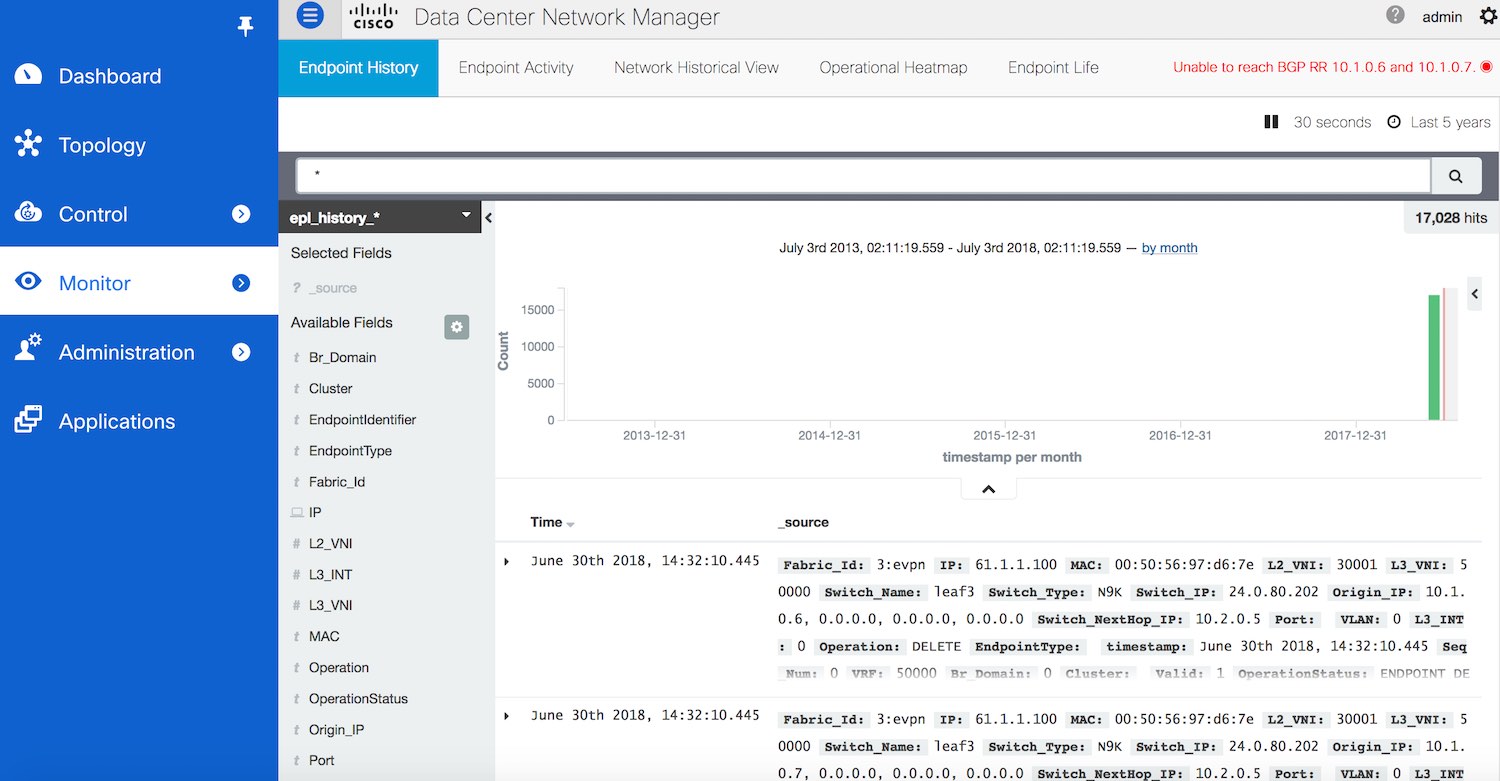
  • Endpoint History—Real time plot displaying Endpoint events for the period specified in the relative or absolute date range. A user can search for a specific metric value in the search bar. Search is supported on any of the fields as specified under the “Available Fields” column on the menu on the left. A sample screenshot of the endpoint history based on an IP address specified in the search field is depicted below.

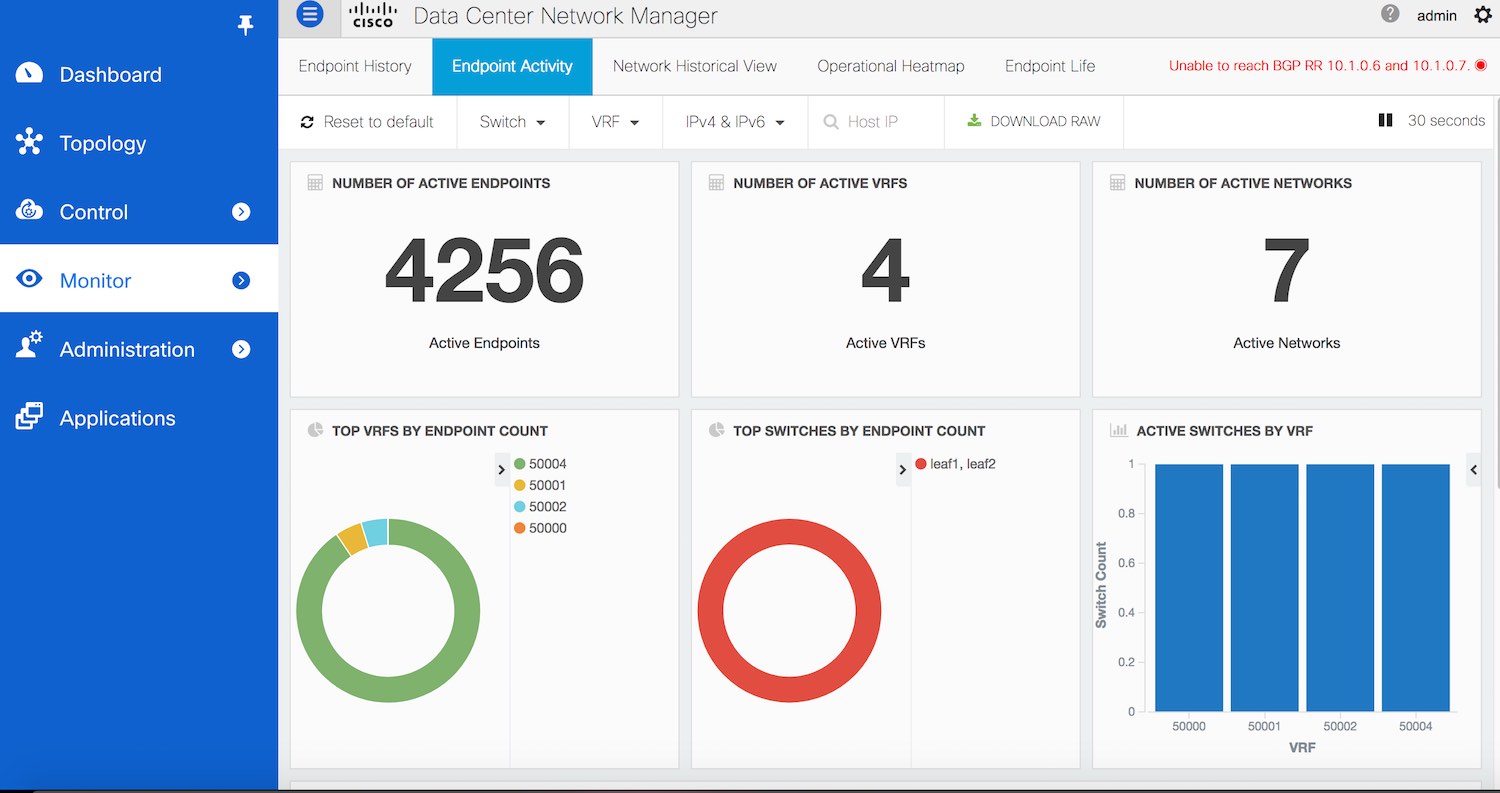
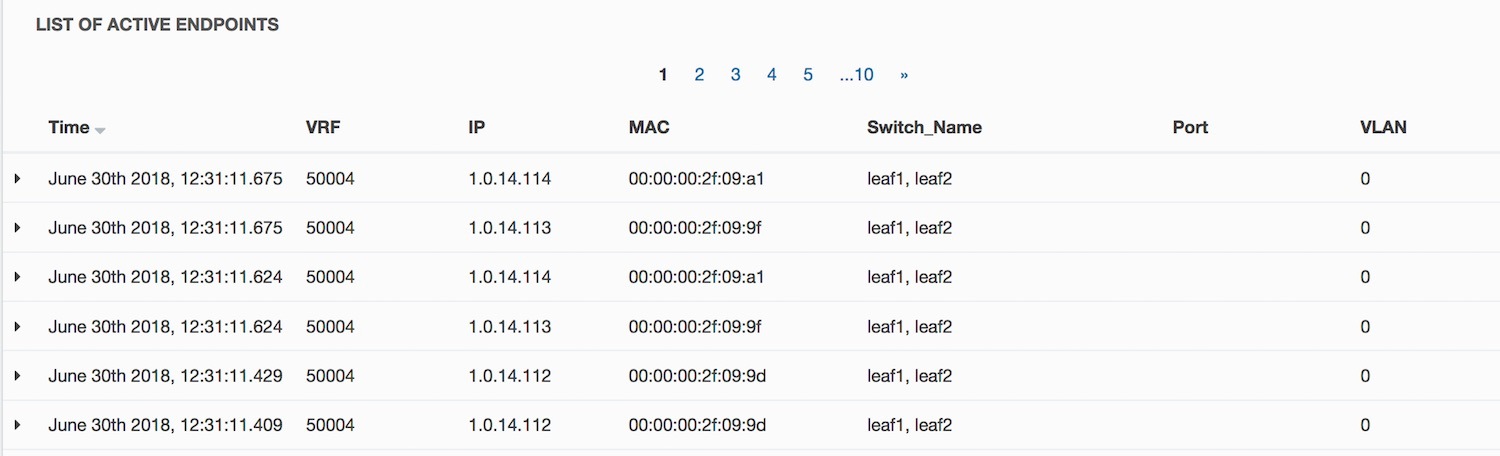
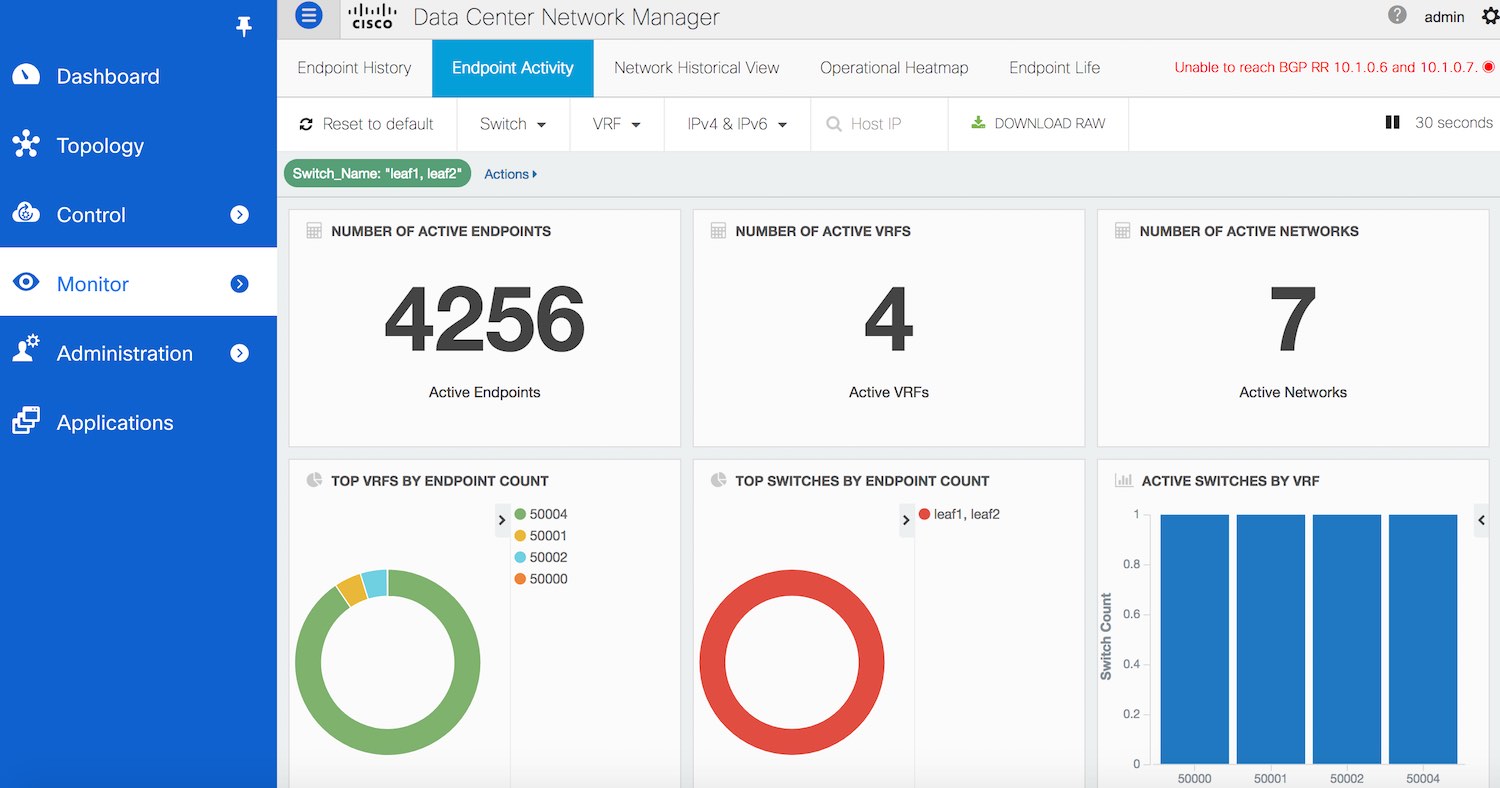
  • Endpoint Activity—This view displays the current state of the active endpoints in the fabric. The number of active endpoints including the number of active VRFs and active networks are listed in the top 3 tiles. The break-up of active endpoints is also available on a per VRF as well as a per switch basis. This is depicted by the first two tiles in the second row. If there is at least one active endpoint in a given VRF behind a switch, then that VRF is considered as active on that switch. Note that the VRF may be configured on a number of switches but it is only considered active and justifies burning resources on the switch, if there is at least one active endpoint in that VRF behind that switch. In that sense, the “ACTIVE SWITCHES BY VRF” tile can provide a good insight for the network administrator into removing extraneous VRF configurations from switches where it may not be needed. At the bottom of the dashboard, there is a data table that provides a list of endpoints with context information such as the VRF, IP, MAC, Switch, VLAN, Port etc. By default, the endpoint information is refreshed every 30 seconds. However, the refresh interval may be changed as desired.

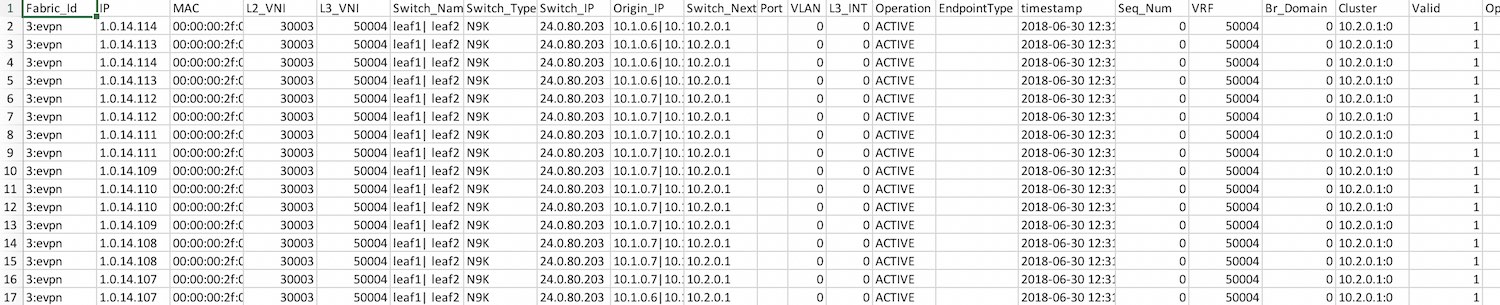
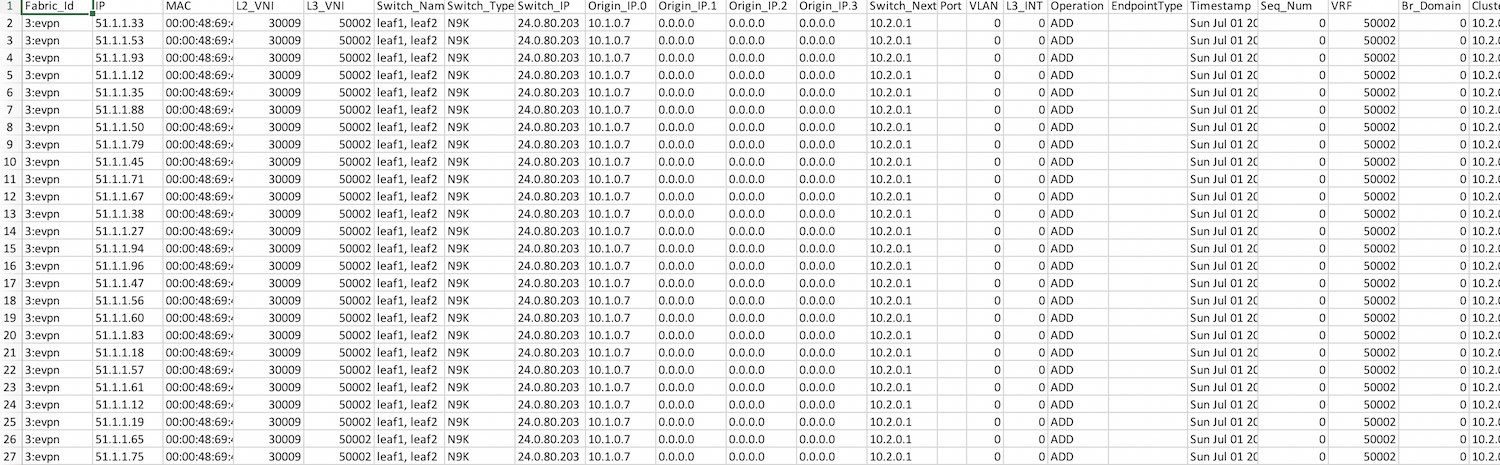
    Users can search for specific endpoints using various search filters such as VRF, switch, IPv4/IPv6 address etc. Multiple filters may be applied at the same time. The entire dashboard view across all tiles and the data table, are updated as soon as the search filters are applied. The search results can be downloaded in csv format by clicking on the “DOWNLOAD RAW” icon. A sample snippet of the downloaded csv file from a search result is shown below:

    It is possible to search based on any of the fields describing the information of each endpoint. For example, if the user wants to know the list of endpoints in a given network, that can be achieved as follows. Recall that each network is represented by a unique 24-bit identifier. This parameter is represented by the field L2_VNI. Here are the steps:

    1. Go to the ‘List of endpoints’ data table and click on any row. This will expand the row as shown below:

    2. Click on the + icon next to the L2_VNI field. This selects the highlighted value (10000 in this example) and filters the search results based on that. In other words, the information of all active endpoints in the network associated with L2_VNI 10000 is displayed on the dashboard. If instead, all endpoints that are not in the network L2_VNI are required, click the – icon next to the L2_VNI value of 10000. In the same manner, one can choose any combination of fields to get the set of endpoints matching the corresponding selected filter criteria.

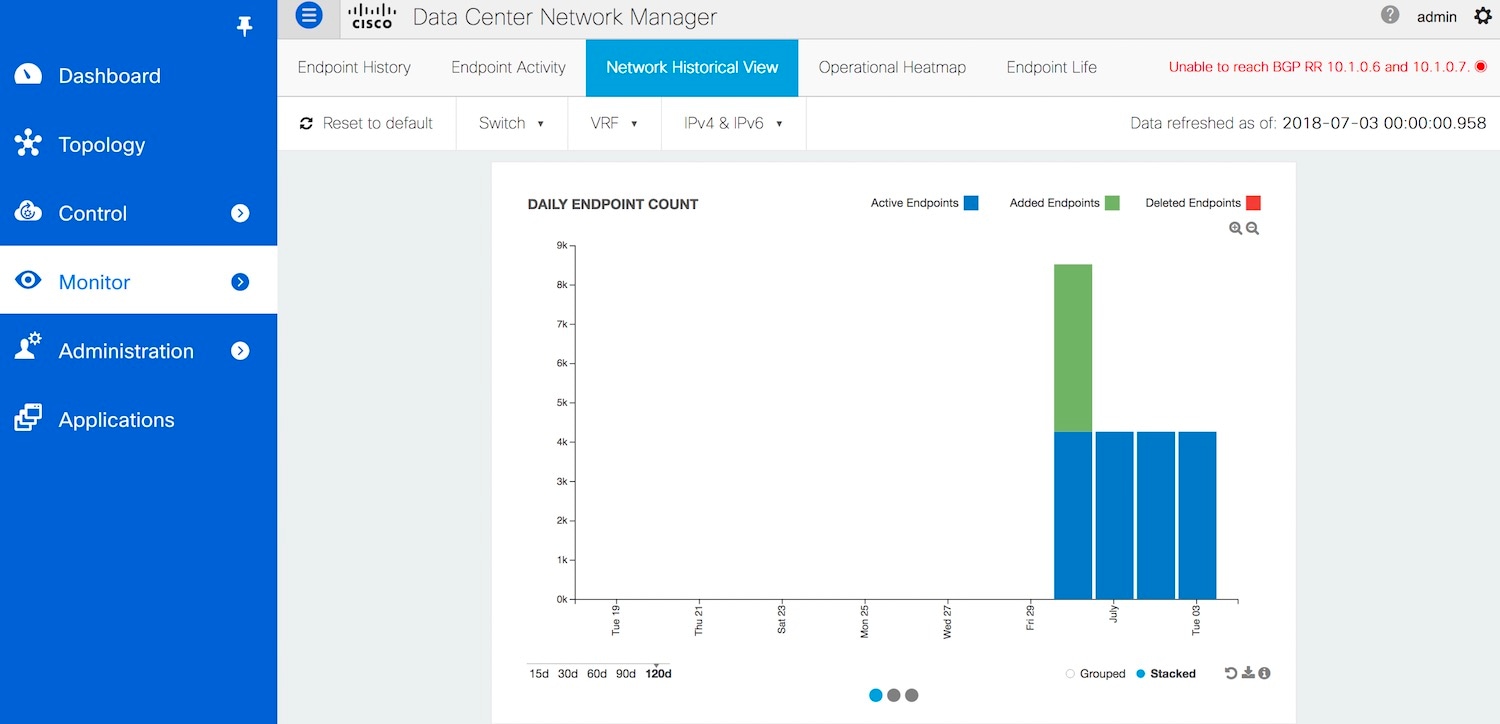
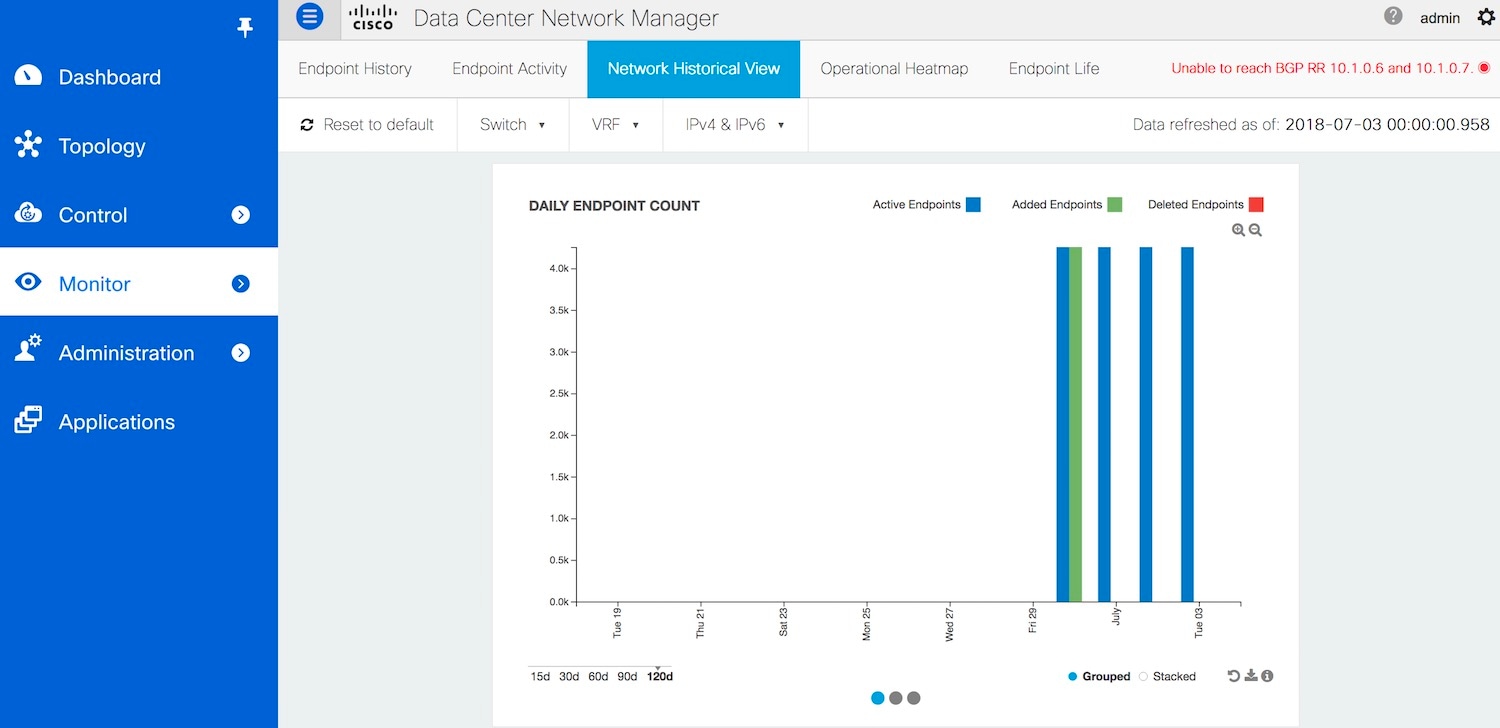
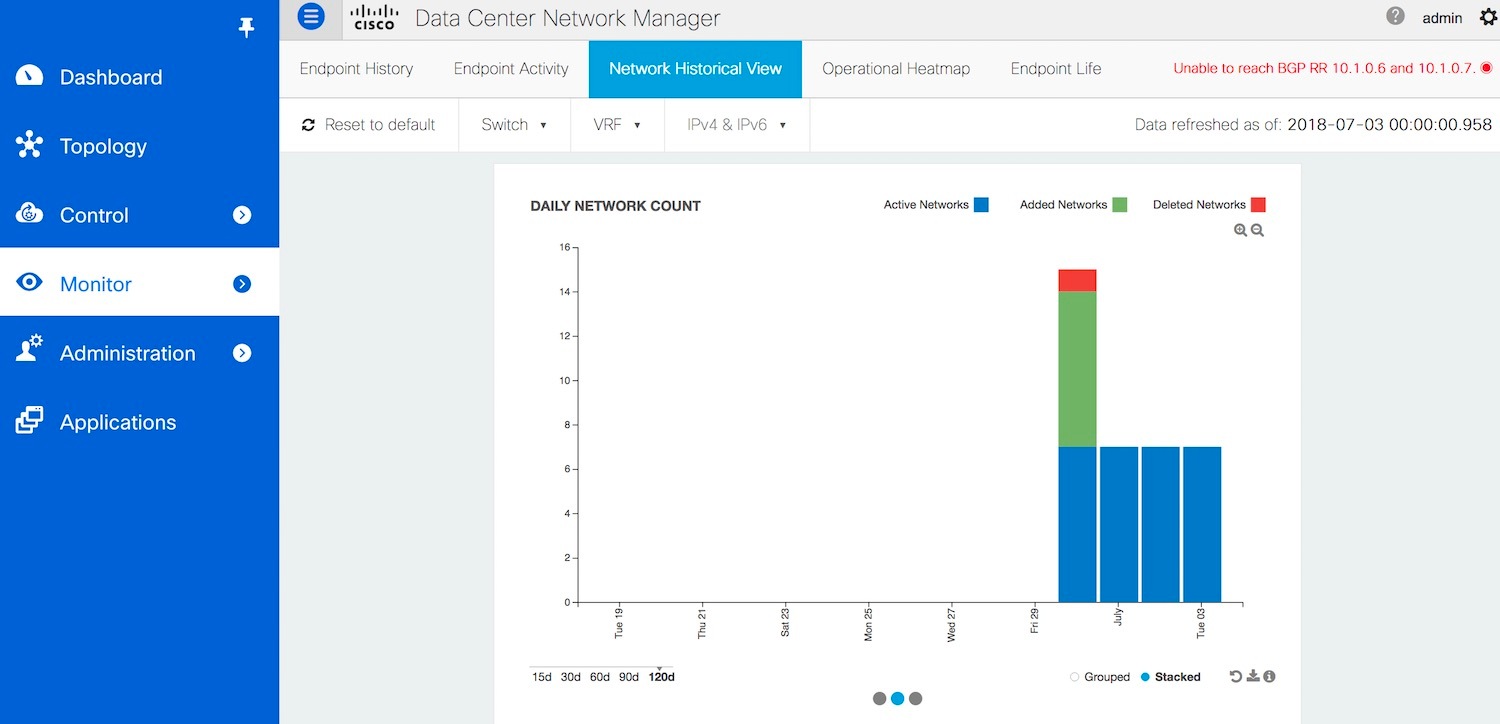
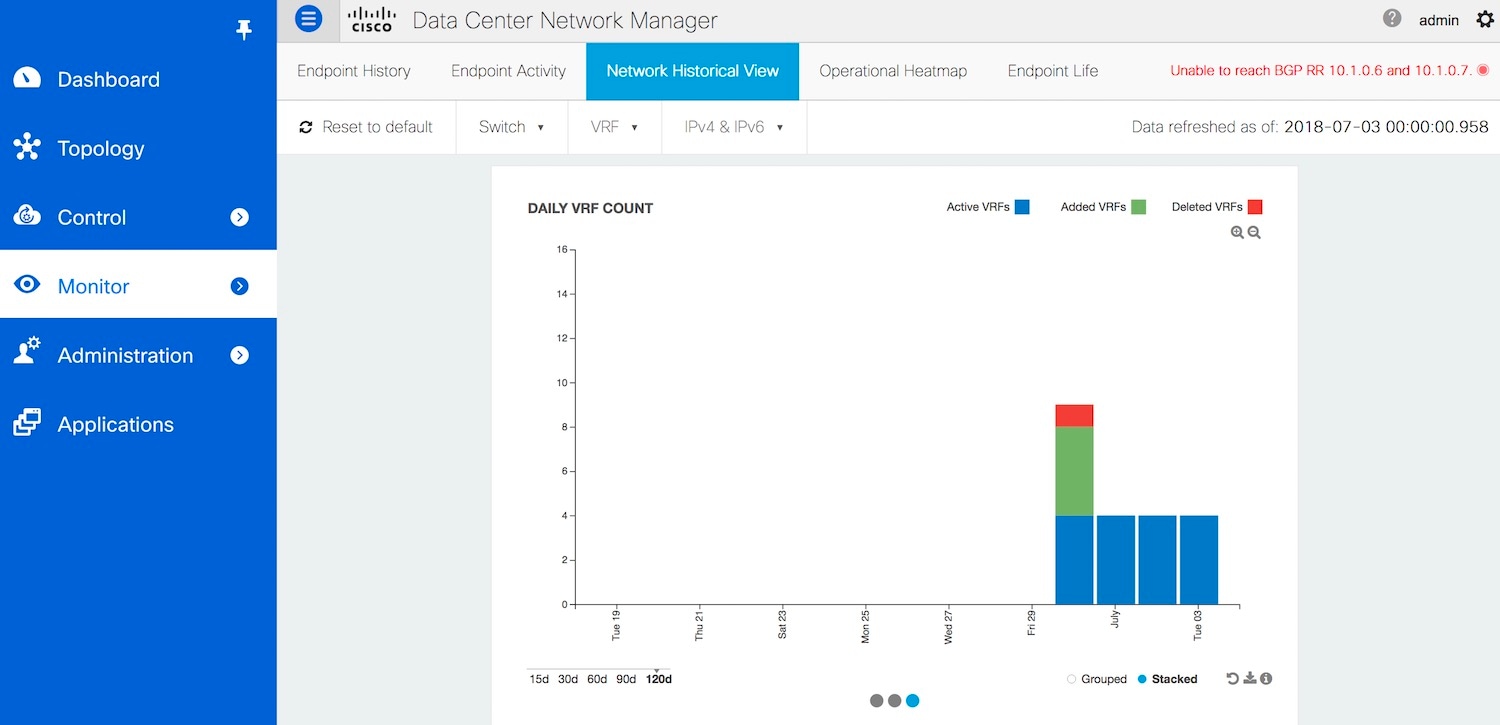
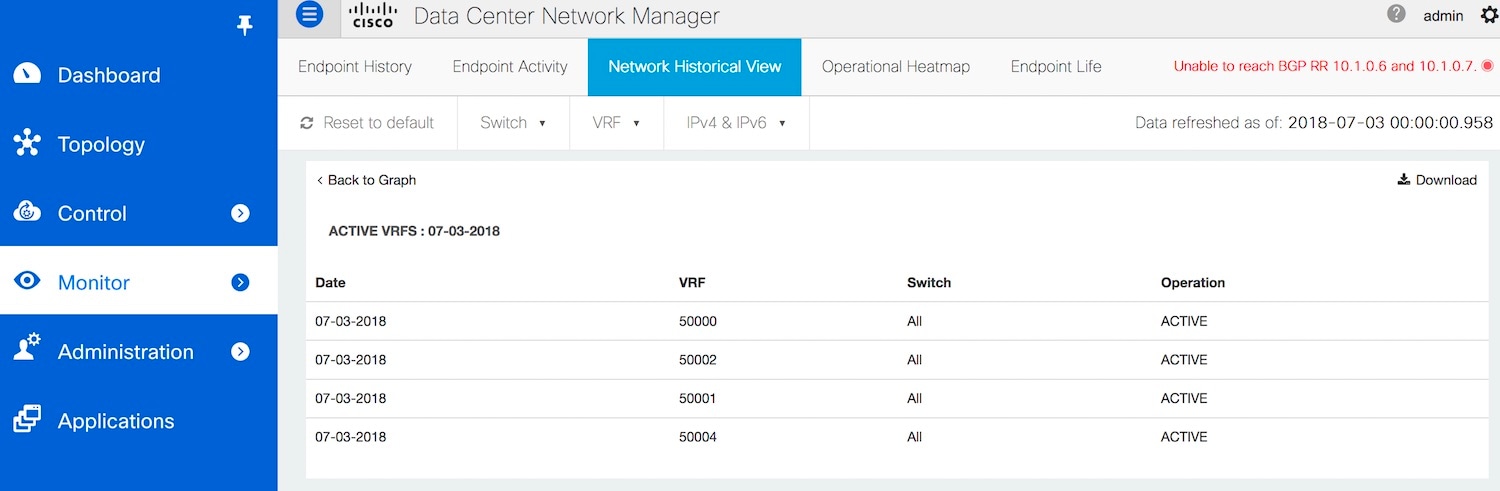
  • Network Historical View— The NHV view displays historical information of endpoints, networks, and VRFs (tenants) captured on a daily basis. These graphs are updated once a day at mid-night based on the DCNM server time. The time at which the data is refreshed/updated is listed at the top right. The idea is to provide a daily report of the Active, Added (New) and Deleted endpoints, networks, and VRFs respectively. If the same endpoint is added and removed on a day, then that contributes to an add count of 1 and a delete count of 1. Users can select one of the 3 dots at the bottom to toggle between the endpoints, networks, & VRF views. There are options to zoom in/out using zoom icons on top right. The users can also select the type of visualization with the choices being – Grouped or Stacked (shown below). Daily reports up to 180 days in the past can be displayed. Active endpoints/networks/VRFs are shown in blue color, deleted ones are shown in red color while the added ones are shown in green color. Every block in all screens is ‘clickable’ and the complete dataset associated with the selection, can be downloaded in csv format.

    The historic endpoint count in ‘Stacked’ format is shown below:

    The same representation with the Grouped visualization selection is shown below:

    Similarly, the figure below depicts the historic network count in stacked format:

    Along the same lines, the figure below depicts the historic vrf count:

    The figure below provides a sample screenshot of the endpoints added on 01-03-2018 obtained by clicking on the blue bar for that day.

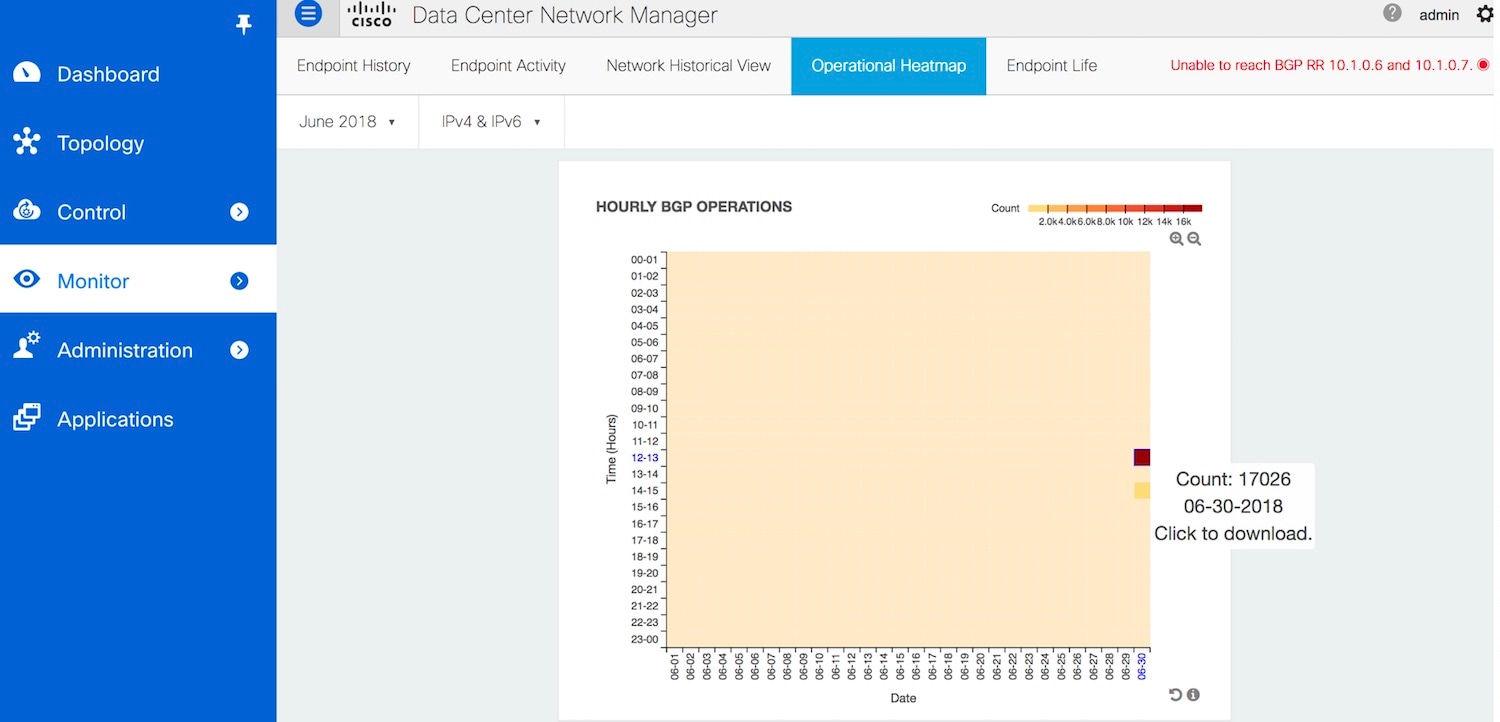
  • Operational Heatmap—This view displays a heat-map of all endpoint operations occurring in the fabric.

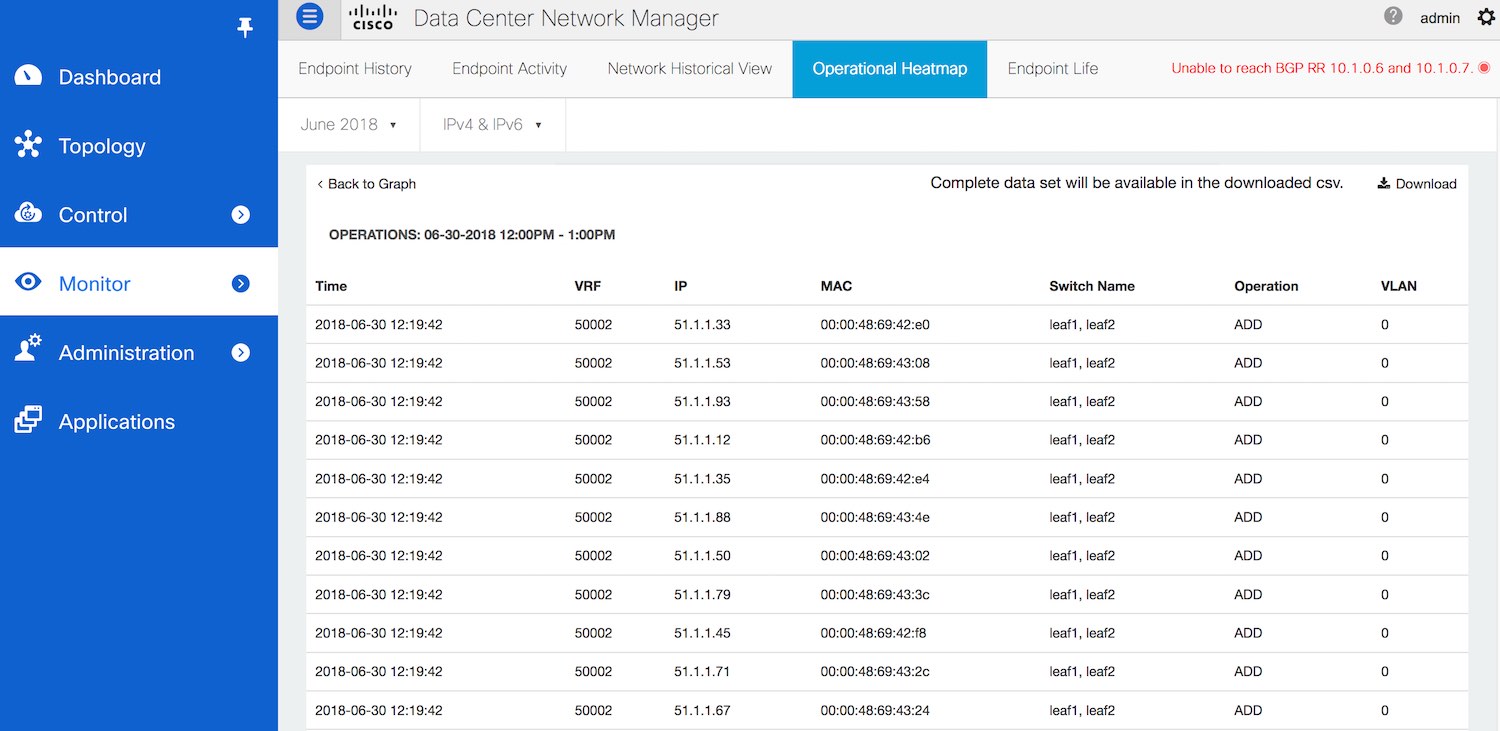
    The heat-map is color coded and the intensity of the color varies based on the number of endpoint operations captured on an hourly basis. The break down is available per hour across dates, and user can see the details of operations that occurred during a particular hour on a particular day by clicking on the appropriate square. The figure below depicts the endpoint operations reported by BGP on 01-02-2018 between 12 and 1pm.

    Again, as with the other views, the complete data set can be downloaded in csv format using the Download option. A sample screenshot of a downloaded csv file is shown below:

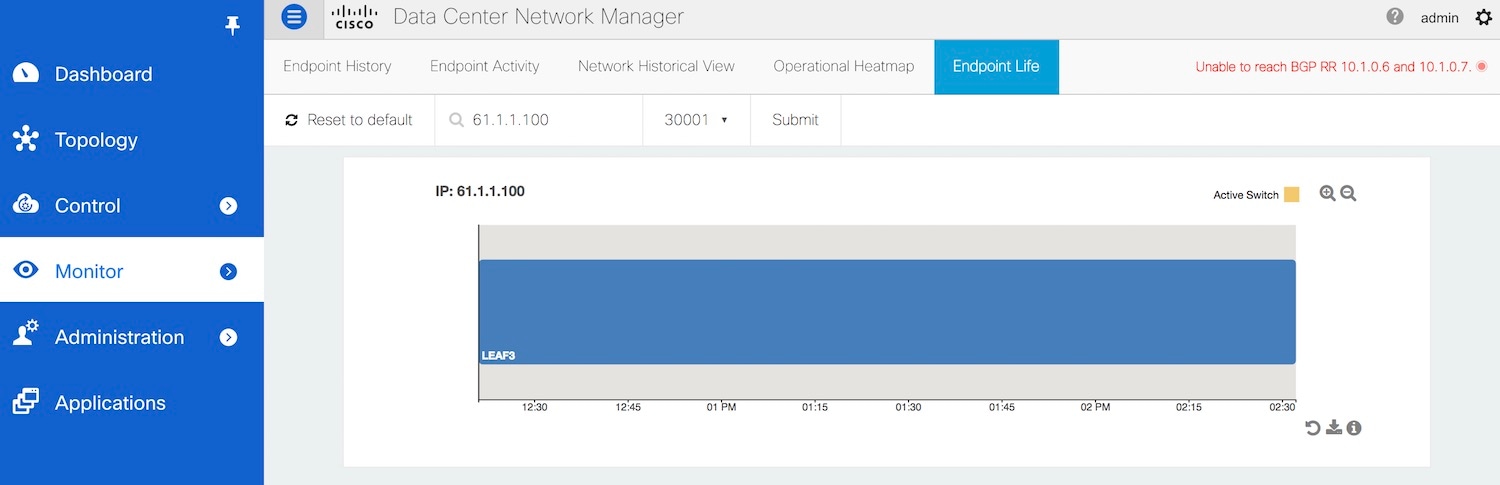
  • Endpoint Life—This view displays a time line of a particular endpoint in its entire existence within the fabric. Specifically, given an identity of an endpoint in terms of its IP address and VRF/Network-identifier, the output displays the list of switches that an endpoint was present under including the associated start and end dates. This view is essentially the network life view of an endpoint. If the endpoint is viewed as active by the network, it will have a band here. If an endpoint is dual-homed, then there will be 2 horizontal bands reporting the endpoint existence, one band for each switch (typically the VPC pair of switches). As endpoints move within the network, for example with VM move, this view provides a succinct and intuitive pictorial view of this activity.

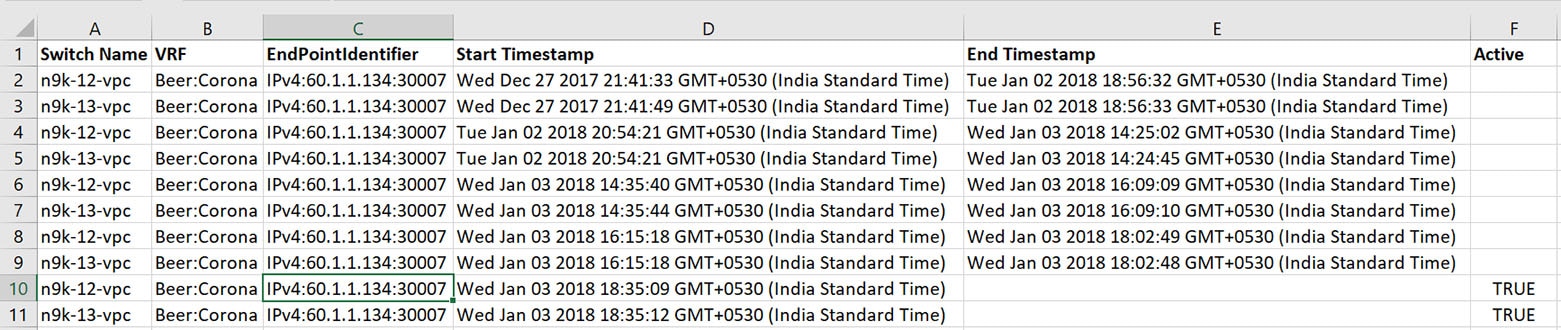
    The underlying data that drives this view can also be downloaded in csv format (shown below) by clicking on download icon on right bottom corner.


LAN Telemetry

The LAN Telemetry menu includes the following submenus:

Monitoring LAN Telemetry

Procedure


Step 1

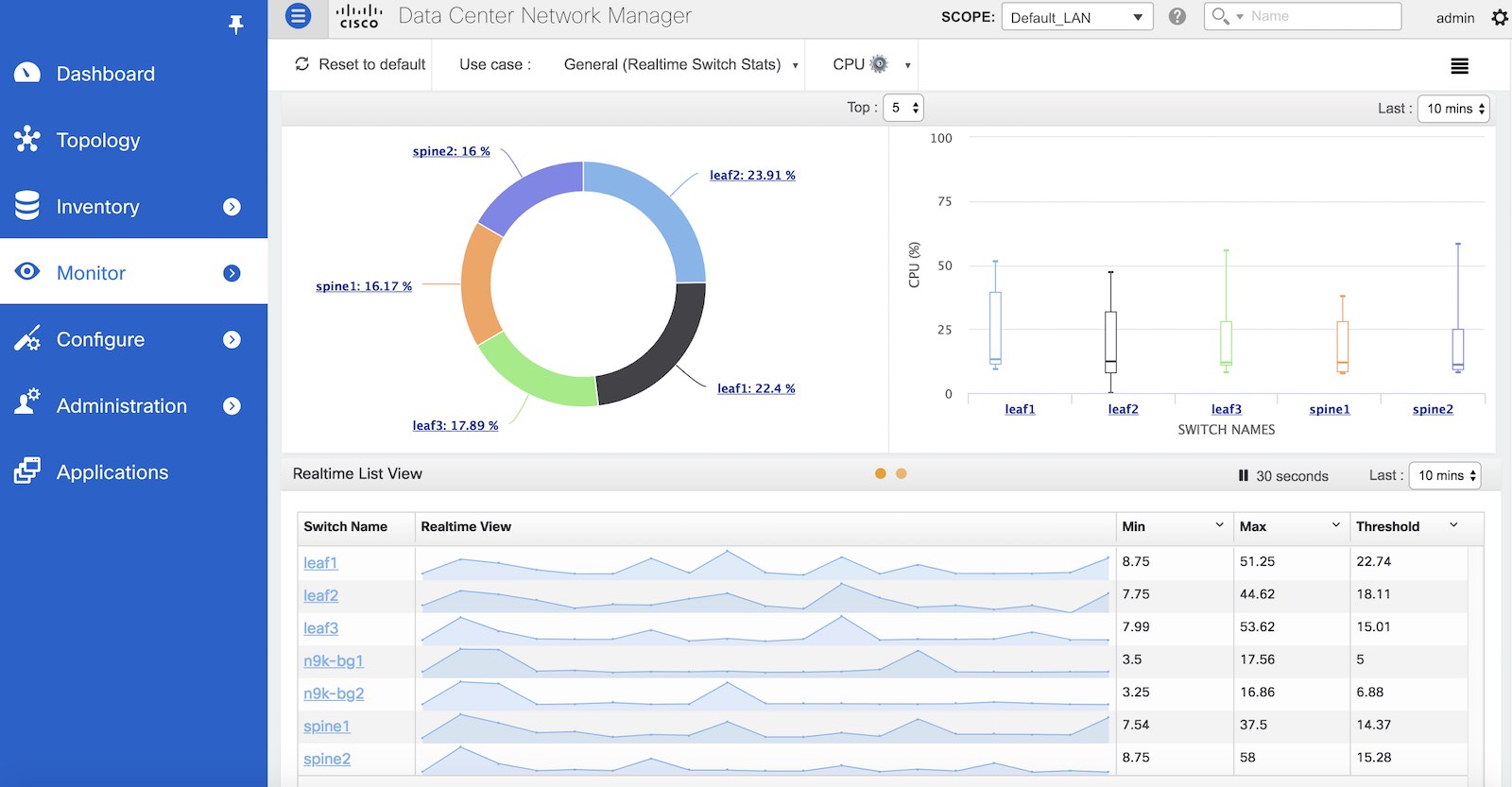
Once LAN telemetry has been successfully enabled, a new Telemetry Explore screen is available. You can navigate to the Telemetry Explore screen by choosing Monitor > LAN Telemetry > Explore. Select the fabric for which LAN telemetry has been enabled through the SCOPE at the top. After selecting one of the fabrics (Default_LAN), LAN insights will appear.

Step 2

There are three insights shown below through interactive visualizations depicting different aspects of Switch metric data based on the metric selected.

Step 3

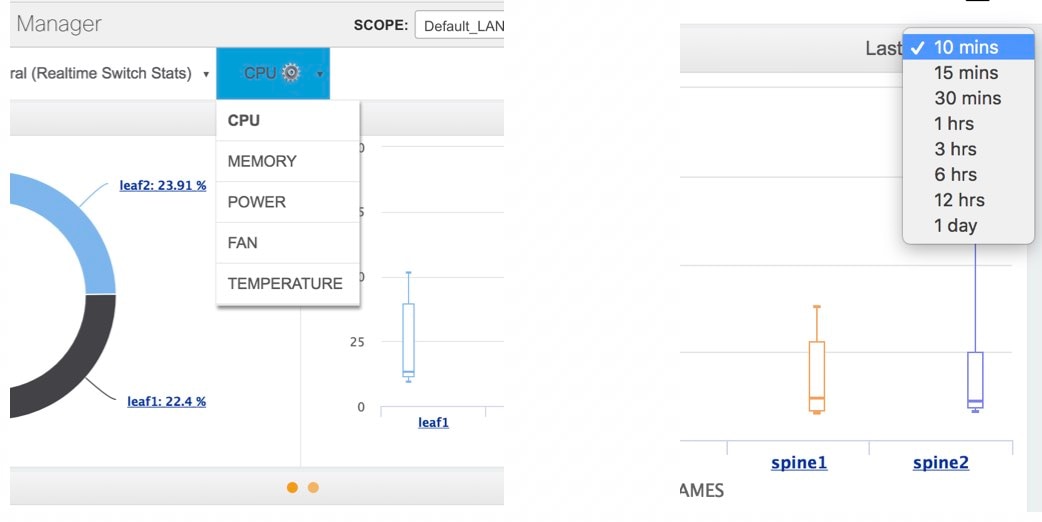
You can select metric from the metric dropdown as shown below(left):

Step 4

You can select the time-interval from Start With Last dropdown (shown above). The first two insights (Donut chart & Box plot) show the data for the selected time-interval.

Step 5

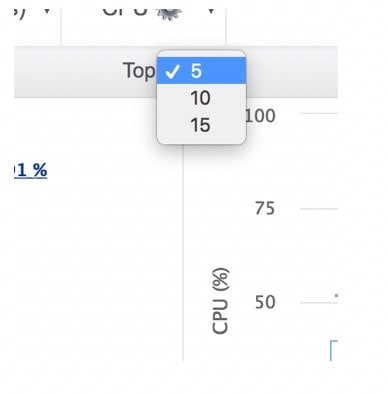
You can select Top N switches from Top dropdown which is applicable for the first row insights (Donut chart & Box plot). For example if 5 is selected, Donut chart & Box plot is plotted for top five switches (based on selected metric value).

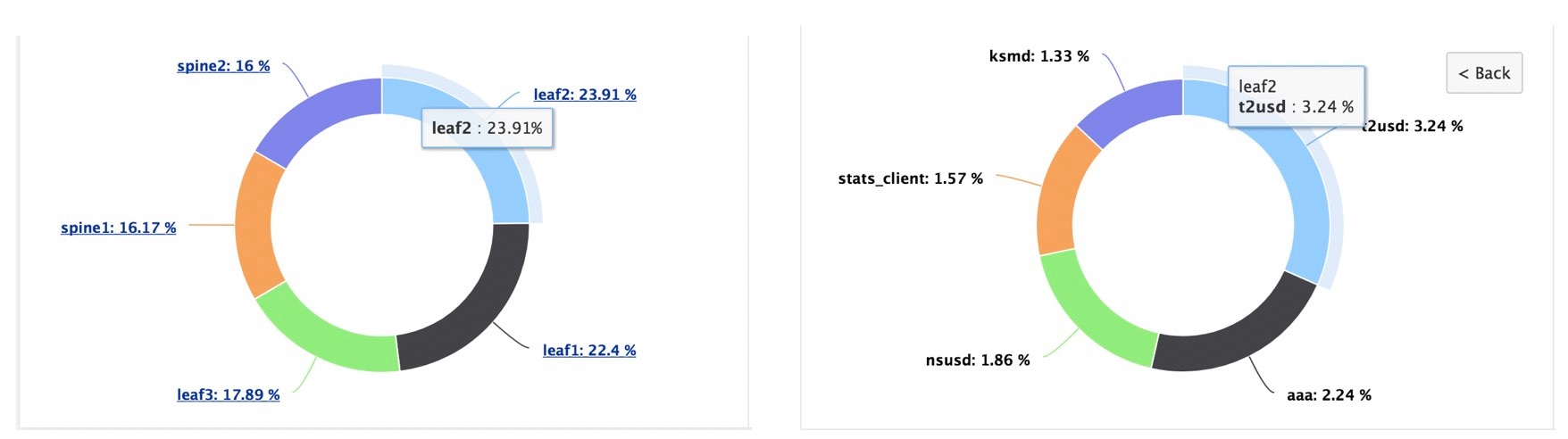
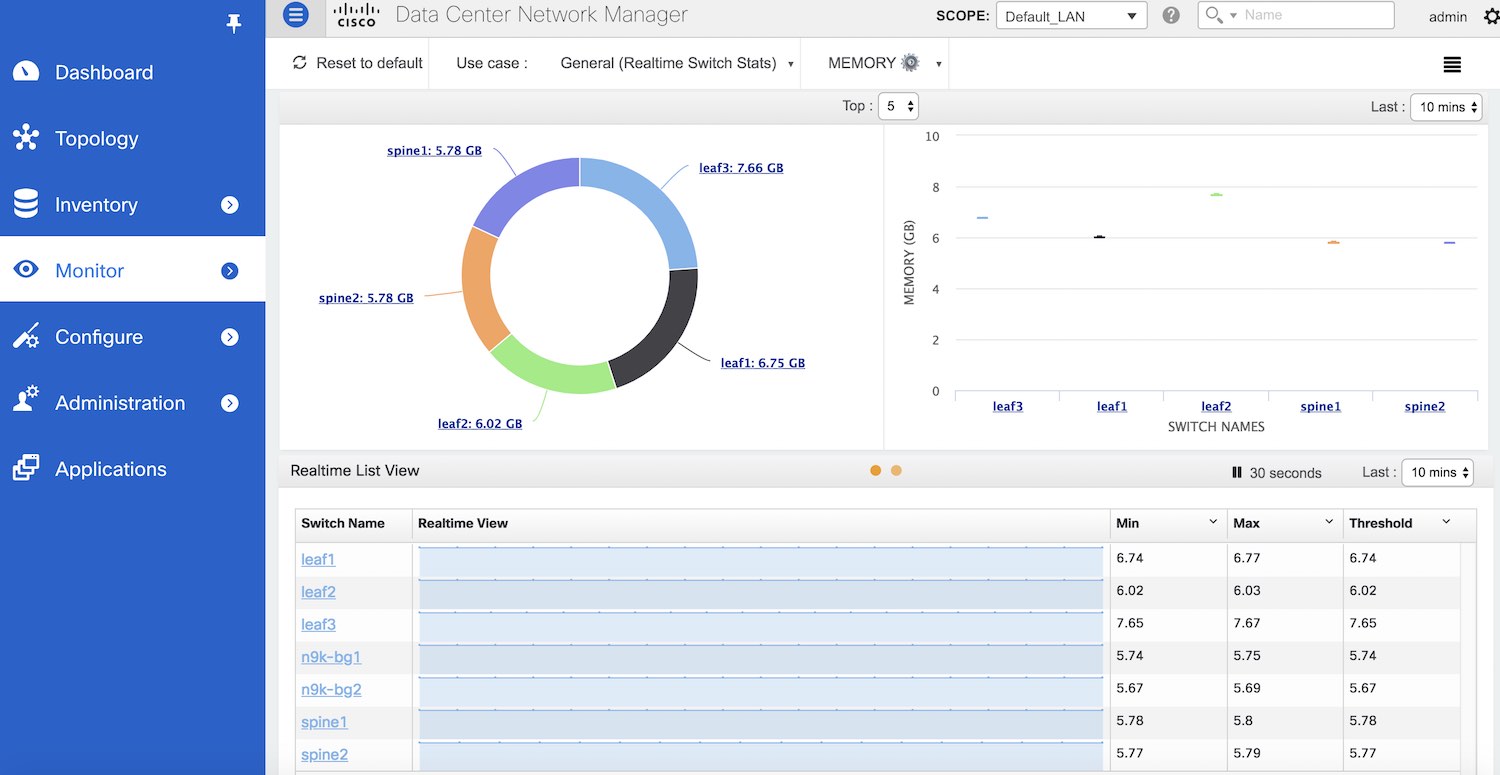
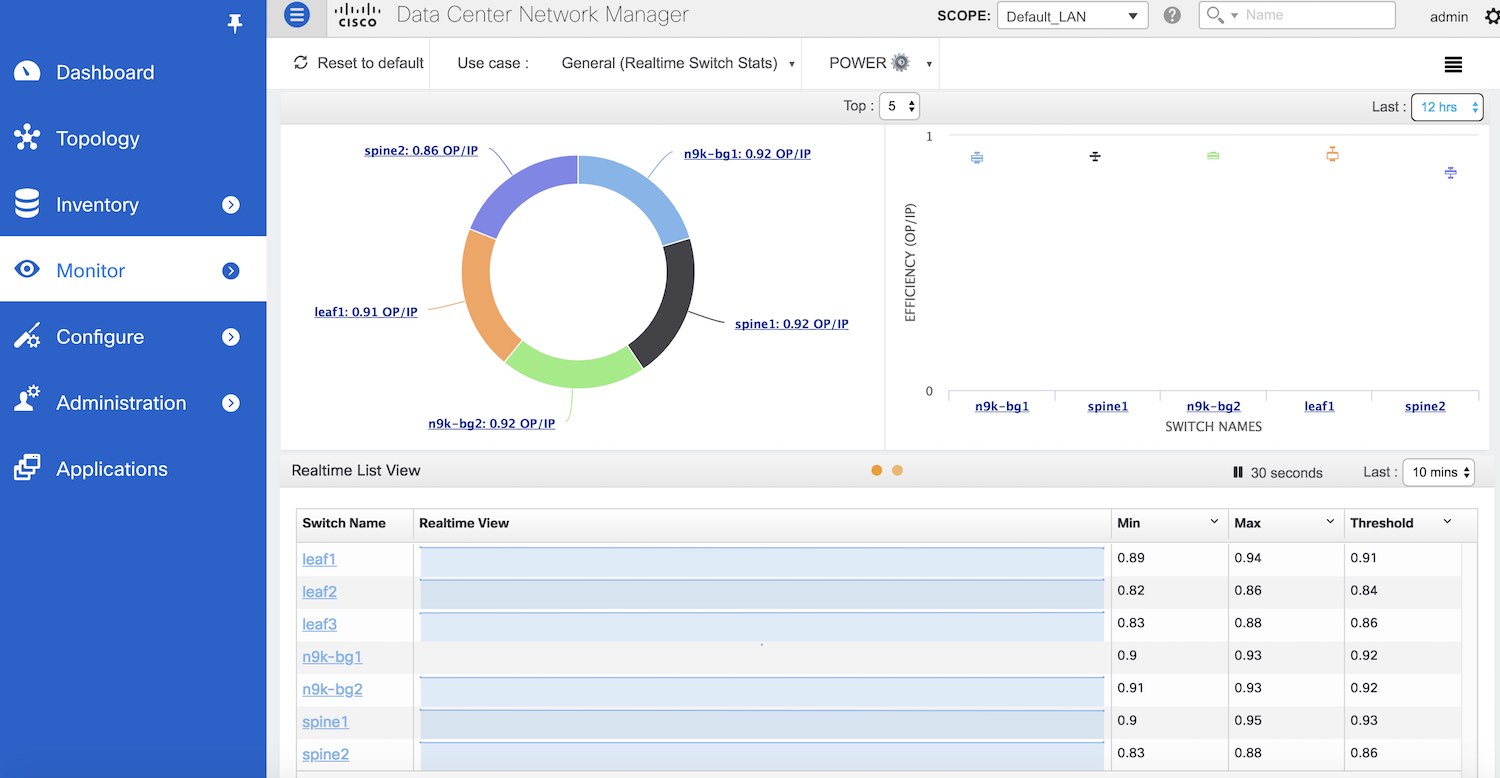
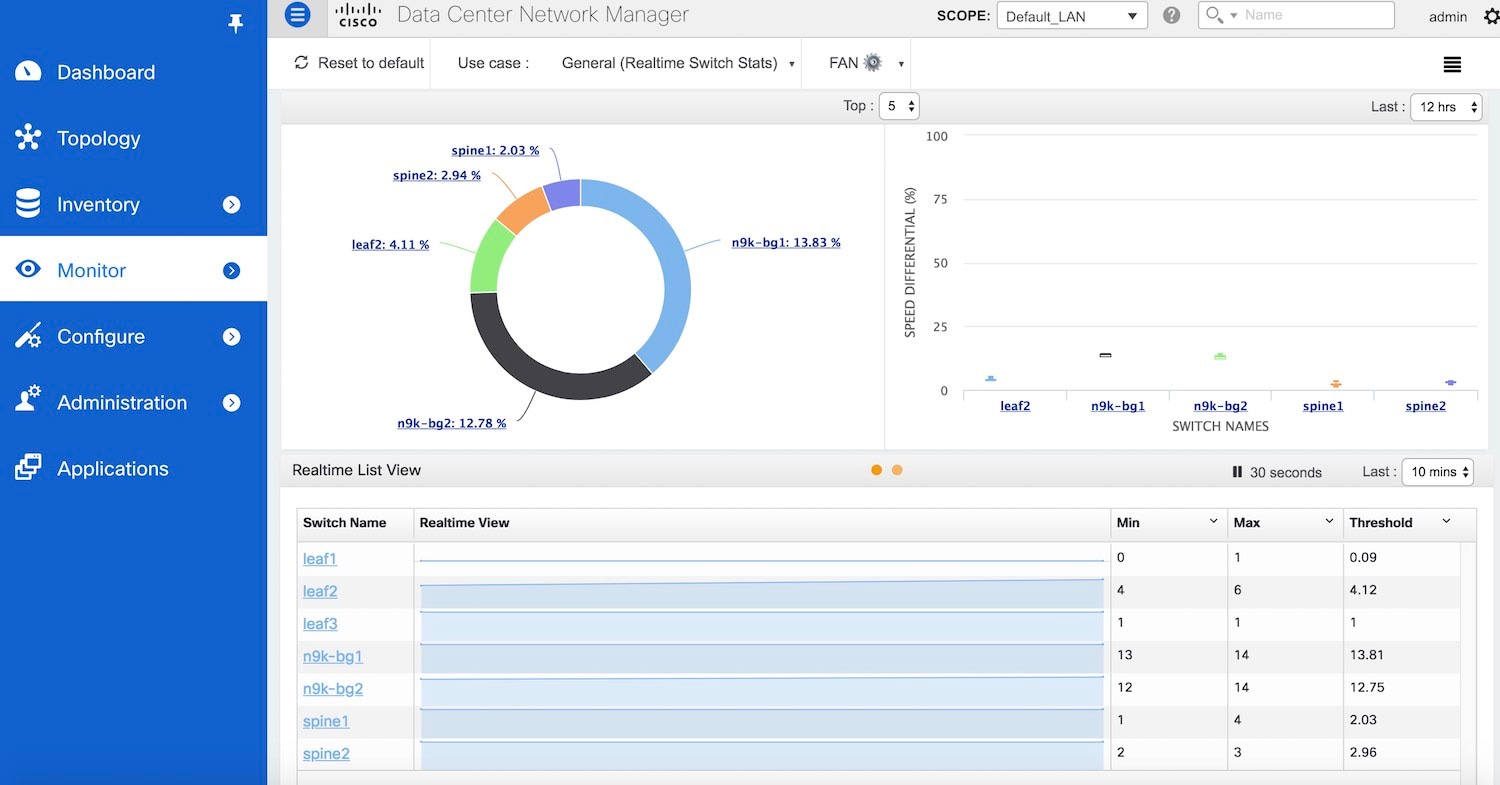
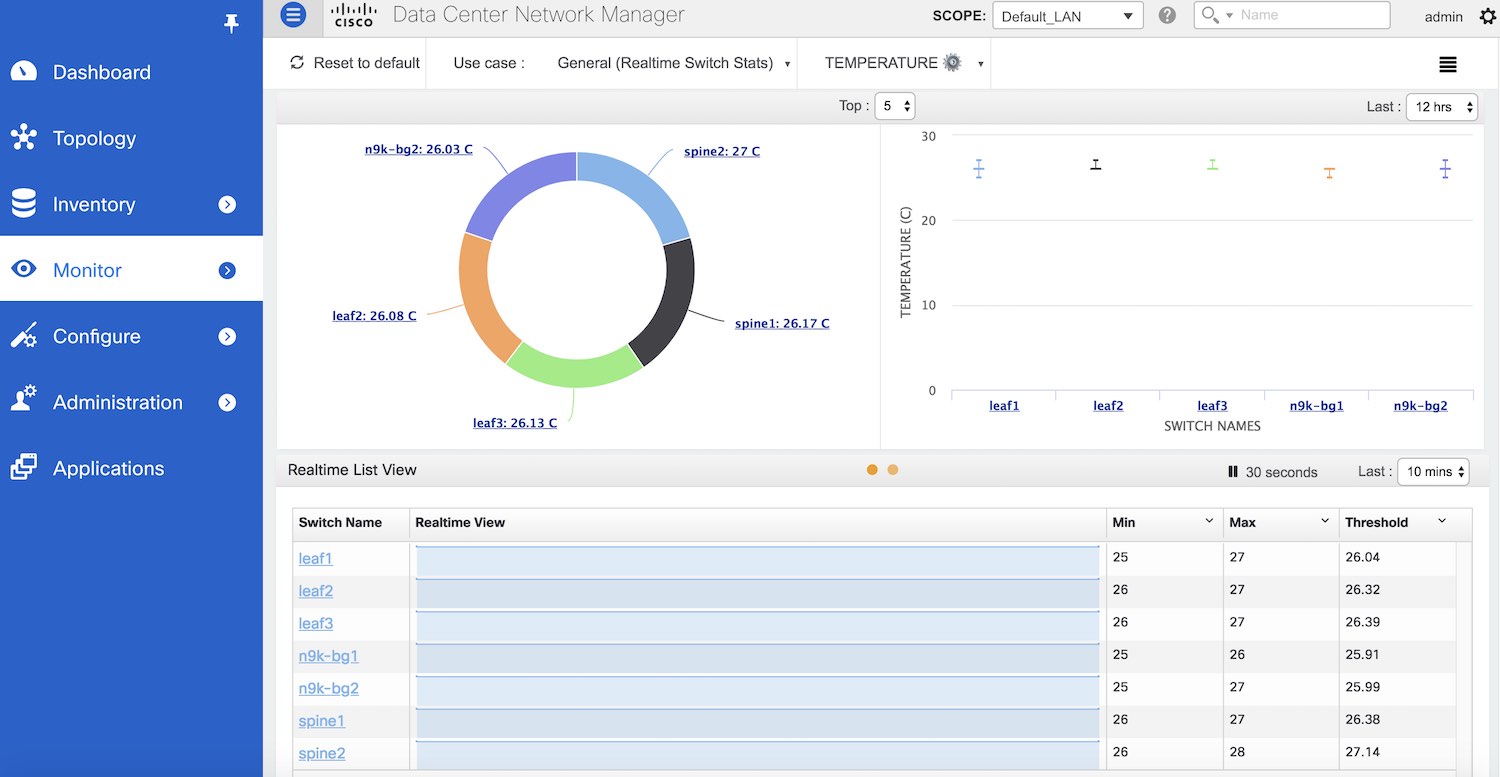
First insight is a Donut Chart showing numerical proportion of Top N switches based on selected metric. For example, donut chart below (left) shows the proportion of top five switches based on CPU usage values. When hovered, it shows the switch name and the corresponding metric value. Drilldown functionality is implemented in this insight too. Clicking on any of the slices goes to second level as shown below (right), which is a process-level donut chart of the selected switch showing numerical proportion of Top N processes of the selected switch based on selected metric. You can go back to switch-level donut chart using the back button that is provided in the top right corner.

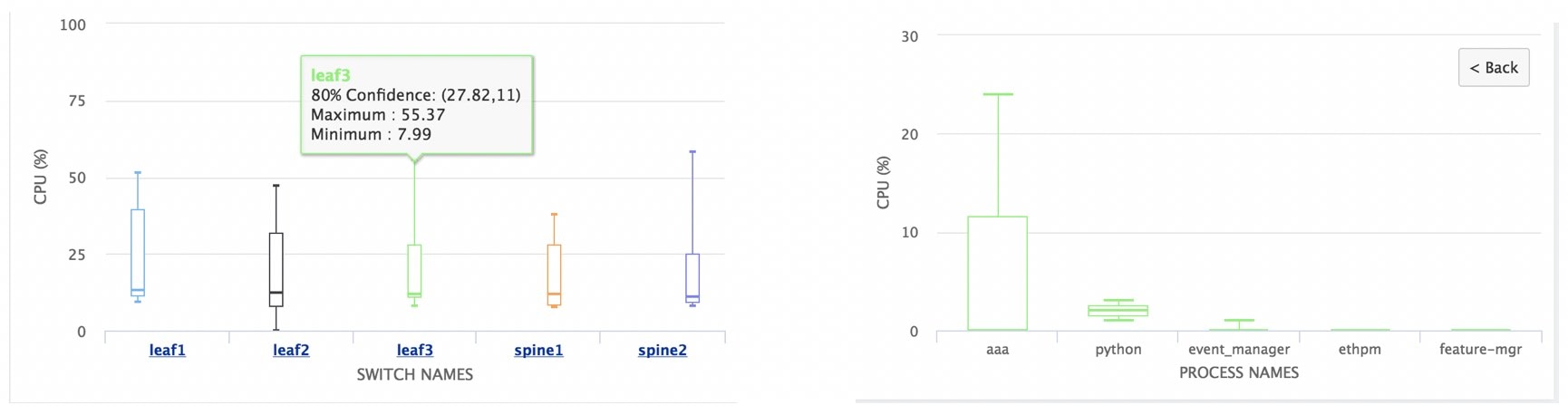
Second insight is a Box Plot showing the variation of the selected metric for Top N switches in the selected time interval. Each Box in the visualization corresponds to one of the top N switches. It shows MIN, MAX metric value along with 80% Confidence interval of the selected metric. For example, Box plot below shows the top five switches and the variation of the CPU usage for each switch. When hovered, it shows Minimum and Maximum CPU Usage value with 80% Confidence interval. Drilldown functionality is implemented in this insight too. Clicking any of the boxes goes to second level as shown below (right), which is a process-level box plot of the selected switch showing MIN, MAX metric value, and 80% Confidence interval of Top N processes of the selected switch based on selected metric. You can go back to switch-level box plot using the Back button that is provided in the top right corner.

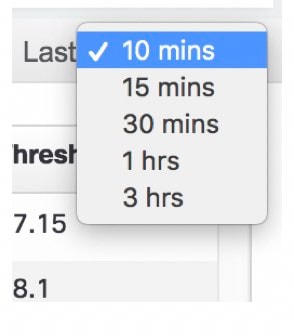
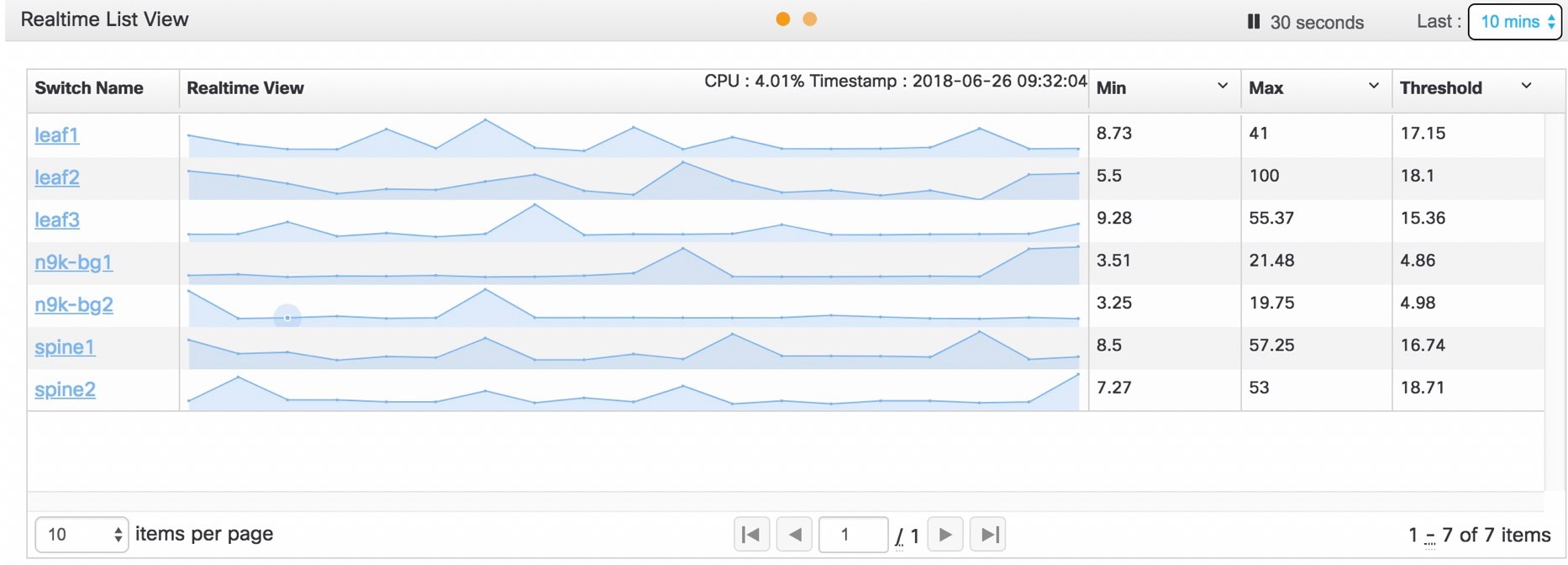
Third component is a Real time list view of all the switches, which were active for the selected metric for last 10 minutes (by default). You can change the time interval from the Last dropdown which will show the list of switches available for the selected time interval.

The data-table is updated every 30 seconds, which you can stop by enabling the pause button.

Real time List View is a tabular representation of switches for the selected metrics which shows the Minimum, Maximum and Threshold values of respective switches along with their real time view which is updated on every 30seconds. On hovering over the real-time view, you can view the exact usage per timestamp for the particular switch.

You can also sort the data-table in ascending/descending order on Min, Max & Threshold columns. The list of switches, which you can view per page, can also be customized. By default, only 10 switches per page are shown but you can change the “Items per page” that he wants to view by selecting the desired values from the dropdown.

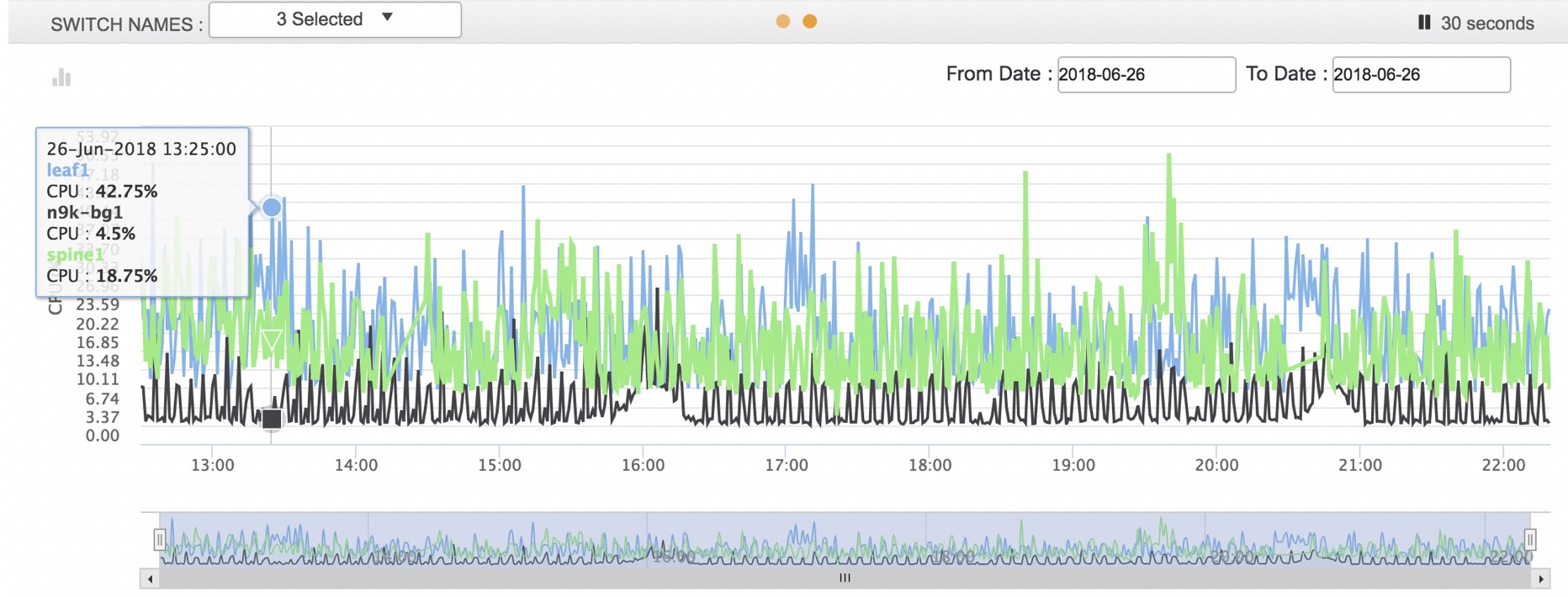
Fourth component is a multiline graph, which is activated when you click the second orange dot present next to the “Realtime List View” heading.

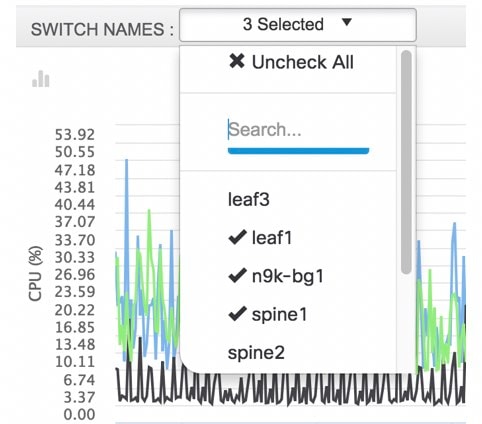
This multiline graph shows real time selected metric data (shown below) for the selected switches where each line corresponds to a switch. Switches can be selected from the Switch Name dropdown (shown in right) which shows all switches in the fabric. You can use the time slider below to select any time range or choose from predefined Zoom options (1M, 5M, 10M and so on). You can also pause and resume the live data refreshing every 30 seconds using the pause button provide in the top right corner. When hovered, it shows the switch name, metric value and the corresponding timestamp.

Advanced setting icon placed on the top left corner of the graph gives you an option to view events and analytics pertaining to the list of selected switches. This button is disabled by default and you have to click it to activate the button. Advanced setting icon is currently only available for CPU and MEMORY metrics. You can select up to 2 items from the advanced setting list.

You can also change the dates from the "From Date" and "To Date" date picker and select the respective dates for which he wants to view the real time data. By default, data for current date is displayed.

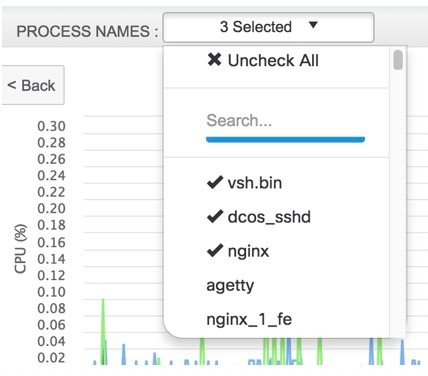
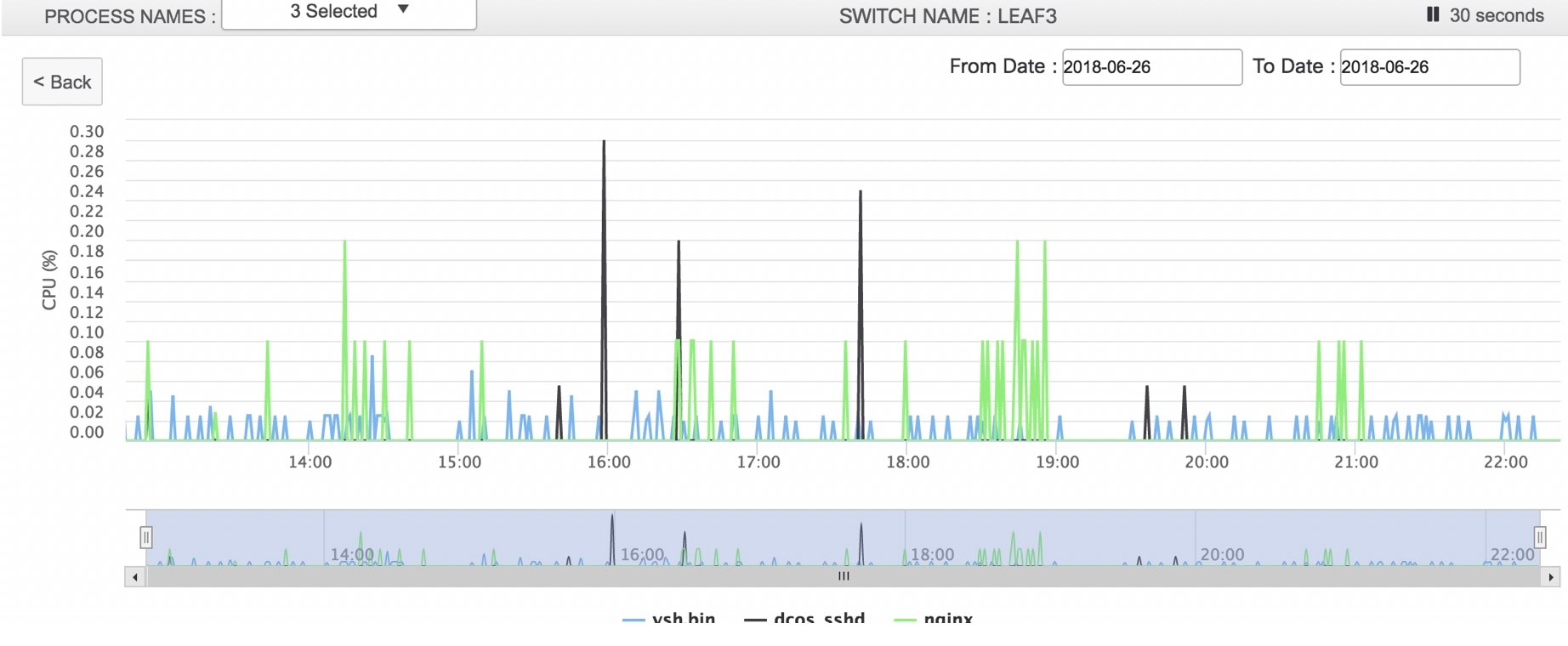
Drilldown functionality is implemented in this insight also and clicking on any of the lines goes to 2nd level as shown below, which is process level multiline graph of the selected switch showing real time selected metric data for the selected processes of the clicked switch. Processes can be selected from the Process Name dropdown (shown in right) which is populated by all process names of the clicked switch. You can go back to switch level multiline graph using the Back button that is provided in the top right corner.

Drilldown functionality is available for all metrics and the second level metric value for each switch is as follows:

  • CPU: Switch > Process level CPU Usage

  • Memory: Switch > Process level Memory Usage

  • Fan: Switch > Fan level Speed

  • Power: Switch > Model level Efficiency

  • Temperature: Switch > Temperature level Sensor

Step 6

For the remaining four features, the functionality remains same as CPU, but the data that are shown on the page vary depending on the feature that you choose in the feature that you have selected.

  • Memory Data View: The memory dashboard depicts the actual memory consumption (RAM) on every switch in Gigabytes (GB). The per-process memory consumption is available at a later stage.

  • Power Data View: The top-level view for the power dashboard depicts the efficiency of the power supplies. By definition, efficiency is Output-Power/Input-Power, which therefore results in a maximum efficiency of 1.0.

  • Fan Data View—The top-level view for the fan dashboard depicts the speed difference between the various fans in the system. In the typical case, the expectation is that all the fans in the same tray, operate at more or less the same speed.

  • Temperature Data View—The top-level view for the temperature dashboard displays information about the temperature level sensor.


Alarms

The Alarms menu includes the following submenus:

Viewing Alarms and Events

You can view the alarms, cleared alarms, and events.

Procedure


Step 1

Choose Monitor > Alarms > Alarms.

Step 2

Choose any of the following tabs.

  • Alarms: This tab displays the alarms that are generated for various categories. This tab displays information such as ID (optional), Severity, Failure Source, Name, Category, Acknowledged, Creation Time, Last Updated (optional), Policy, and Message. You can specify the Refresh Interval in this tab. You can select one or more alarms and then acknowledge or unacknowledge their status using the Change Status drop-down list. In addition, you can select one or more alarms and then click the Delete button to delete them.
  • Cleared Alarms: This tab displays the cleared alarms. This tab displays information such as ID (optional), Severity, Failure Source, Name, Category, Acknowledged, Creation Time, Cleared At (optional), Cleared By, Policy, and Message. You can select one or more alarms and then click the Delete button to delete them.
  • Events: This tab displays the events that are generated for the switches. This tab displays information such as Ack, Acknowledged user, Group, Switch, Severity, Facility, Type, Count, Last Seen, and Description. You can select one or more events and then acknowledge or unacknowledge their status using the Change Status drop-down list. In addition, you can select one or more alarms and then click the Delete button to delete them. If you want to delete all events, click the Delete All button.

Monitoring and Adding Alarm Policies

You can add alarm policies for the following:

  • Device Health: Device health policies enable you to create alarms when Device ICMP Unreachable, Device SNMP Unreachable, or Device SSH Unreachable. Also, these policies enable you to monitor chassis temperature, CPU, and memory usage.

  • Interface Health: Interface health policies enable you to monitor Up or Down, Packet Discard, Error, Bandwidth details of the interfaces. By default all interfaces are selected for monitoring.

  • Syslog Alarm: Syslog Alarm Policy defines a pair of Syslog messages formats; one which raises the alarm, and one which clears the alarm.

Procedure


Step 1

Choose Monitor > Alarms > Alarm Policies.

Step 2

Select the Enable Alarms check box to enable alarm policies.

Step 3

From the Add drop-down list, choose any of the following:

  • Device Health Policy: Select the devices for which you want to create policies. Specify the policy name, description, CPU Utilization parameters, Memory Utilization parameters, Environment Temperature parameters, device availability, and device features.
  • Interface Health Policy: Select the devices for which you want to create policies. Specify the policy name, description, link-state, Bandwidth (In/Out), Inbound errors, Outbound errors, Inbound Discards, and Outbound Discards.
  • Syslog Alarm Policy: Select the devices for which you want to create policies and then specify the following parameters.
    • Devices: Define the scope of this policy. Select individual devices or all devices to apply this policy.

    • Policy Name: Specify the name for this policy. It must be unique.

    • Description: Specify a brief description for this policy.

    • Severity: Define the severity level for this syslog alarm policy. Choices are: Critical, Major, Minor, and Warning.

    • Identifier: Specify the identifier portions of the raise & clear messages.

    • Raise Regex: Define the format of a syslog raise message.

    • Clear Regex: Define the format of a syslog clear message.

    Table 9. Example1

    Identifier

    ID1-ID2

    Raise Regex

    ETH_PORT_CHANNEL-5-PORT_DOWN: $(ID1): $(ID2) is down

    Clear Regex

    ETH_PORT_CHANNEL-5-PORT_UP: $(ID1): $(ID2) is up

    Table 10. Example2

    Identifier

    ID1-ID2

    Raise Regex

    ETHPORT-5-IF_SFP_WARNING: Interface $(ID1), High Rx Power Warning

    Clear Regex

    ETHPORT-5-IF_SFP_WARNING: Interface $(ID1), High Rx Power Warning cleared

Step 4

Click OK to add the policy.


Activating Policies

After you create new alarm policies, activate them.
Procedure

Step 1

Choose Monitor > Alarms > Policies.

Step 2

Select the policies that you want to activate and then click the Activate button.


Deactivating Policies

You can deactivate the active alarm policies.
Procedure

Step 1

Choose Monitor > Alarms > Policies.

Step 2

Select the policies that you want to deactivate and then click the Deactivate button.


Importing Policies

You can create alarm policies using the import functionality.
Procedure

Step 1

Choose Monitor > Alarms > Policies and then click the Import button.

Step 2

Browse and select the policy file saved on your computer.

You can only import policies in text format.


Exporting Policies

You can export the alarm policies into a text file.
Procedure

Step 1

From the menu bar, choose Monitor > Alarms > Policies.

Step 2

Click the Export button and then select a location on your computer to store the exported file.


Editing Policies

Procedure

Step 1

From the menu bar, choose Monitor > Alarms > Policies.

Step 2

Select the policy that you want to edit.

Step 3

Click the Edit button and then make necessary changes.

Step 4

Click the OK button.


Deleting Policies

Procedure

Step 1

From the menu bar, choose Monitor > Alarms > Policies.

Step 2

Select the policy that you want to delete.

Step 3

Click the Delete button. The policy is deleted.