Contents

Configuring ERSPAN

This chapter includes the following sections:

Information About ERSPAN

The Cisco NX-OS system supports the Encapsulated Remote Switching Port Analyser (ERSPAN) feature onboth source and destination ports. ERSPAN transports mirrored traffic over an IP network. The traffic is encapsulated at the source router and is transferred across the network. The packet is decapsulated at the destination router and then sent to the destination interface.

ERSPAN consists of an ERSPAN source session, routable ERSPAN generic routing encapsulation (GRE)-encapsulated traffic, and an ERSPAN destination session. You separately configure ERSPAN source sessions and destination sessions on different switches.

ERSPAN Sources

The interfaces from which traffic can be monitored are called ERSPAN sources. Sources designate the traffic to monitor and whether to copy ingress, egress, or both directions of traffic. ERSPAN sources include the following:
  • Ethernet ports and port channels.

  • VLANs—When a VLAN is specified as an ERSPAN source, all supported interfaces in the VLAN are ERSPAN sources.

ERSPAN source ports have the following characteristics:
  • A port configured as a source port cannot also be configured as a destination port.

  • ERSPAN does not monitor any packets that are generated by the supervisor, regardless of their source.

ERSPAN Destinations

Destination ports receive the copied traffic from ERSPAN sources.

ERSPAN destination ports have the following characteristics:
  • Destinations for an ERSPAN session include Ethernet ports or port-channel interfaces in either access or trunk mode.

  • A port configured as a destination port cannot also be configured as a source port.

  • A destination port can be configured in only one ERSPAN session at a time.

  • Destination ports do not participate in any spanning tree instance or any Layer 3 protocols.

  • Ingress and ingress learning options are not supported on monitor destination ports

  • HIF port channels, and fabric port channel ports are not supported as SPAN destination ports.

ERSPAN Sessions

You can create ERSPAN sessions that designate sources and destinations to monitor.

When configuring ERSPAN source sessions, you need to configure the destination IP address. When configuring ERSPAN destination sessions, you need to configure the source IP address. See ERSPAN Sources for the properties of source sessions and ERSPAN Destinations for the properties of destination sessions.


Note


Only two ERSPAN or SPAN source sessions can run simultaneously across all switches. Only 23 ERSPAN destination sessions can run simultaneously across all switches.


The following figure shows an ERSPAN configuration.
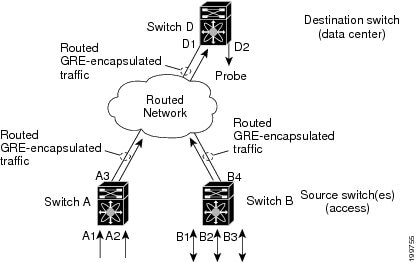
Figure 1. ERSPAN Configuration


Multiple ERSPAN Sessions

Although you can define up to 48 ERSPAN sessions, only two ERSPAN or SPAN sessions can be running simultaneously. You can shut down an unused ERSPAN session.

For information about shutting down ERSPAN sessions, see the “Shutting Down or Activating an ERSPAN Session” section on page 17-11.

High Availability

The ERSPAN feature supports stateless and stateful restarts. After a reboot or supervisor switchover, the running configuration is applied.

Licensing Requirements for ERSPAN

The following table shows the licensing requirements for this feature:

Product License Requirement

Cisco NX-OS

ERSPAN requires no license. Any feature not included in a license package is bundled with the Cisco NX-OS system images and is provided at no extra charge to you. For a complete explanation of the Cisco NX-OS licensing scheme, see the Cisco NX-OS Licensing Guide.

Prerequisites for ERSPAN

ERSPAN has the following prerequisite:

•You must first configure the ports on each switch to support the desired ERSPAN configuration.

Guidelines and Limitations for ERSPAN

ERSPAN has the following configuration guidelines and limitations:

  • ERSPAN supports the following:

    • From 4 to 6 tunnels

    • Non-tunnel packets

    • IP-in-IP tunnels

    • IPv4 tunnels (limited)

    • ERSPAN source session type (Packets are encapsulated as GRE-tunnel packets and sent on the IP network. However, unlike other Cisco devices, the ERSPAN header is not added to the packet.)

    • ERSPAN destination session type (However, support for decapsulating the ERSPAN packet is not available. The entire encapsulated packet is spanned to a front panel port at the ERSPAN terminating point.)

  • ERSPAN packets are dropped if the encapsulated mirror packet fails Layer 2 MTU checks.

  • There is a 112-byte limit for egress encapsulation. Packets exceeding this limit are dropped. This scenario might be encountered when tunnels and mirroring are intermixed.

  • ERSPAN sessions are shared with local sessions. A maximum of 18 sessions can be configured; however only a maximum of four sessions can be operational at the same time. If both receive and transmit sources are configured in the same session, then only two sessions can be operational.

  • If you install NX-OS 5.0(3)U2(2), configure ERSPAN, and then downgrade to a lower version of software, the ERSPAN configuration is lost. This situation occurs because ERSPAN is not supported in versions before NX-OS 5.0(3)U2(2).

    For information about a similar SPAN limitation, see Guidelines and Limitations for SPAN for SPAN.

  • ERSPAN and ERSPAN ACLs are not supported for packets generated by the supervisor.

  • ERSPAN and ERSPAN ACL sessions are terminated identically at the destination router.

  • ERSPAN is not supported for management ports.

  • A destination port can be configured in only one ERSPAN session at a time.

  • You cannot configure a port as both a source and destination port.

  • A single ERSPAN session can include mixed sources in any combination of the following:

    • Ethernet ports or port channels but not subinterfaces.

    • VLANs or port channels, which can be assigned to port channel subinterfaces.

    • The port channels to the control plane CPU.


      Note


      ERSPAN does not monitor any packets that are generated by the supervisor, regardless of their source.


  • Destination ports do not participate in any spanning tree instance or Layer 3 protocols.

  • When an ERSPAN session contains source ports that are monitored in the transmit or transmit and receive direction, packets that these ports receive may be replicated to the ERSPAN destination port even though the packets are not actually transmitted on the source ports. Some examples of this behavior on source ports include:

    • Traffic that results from flooding

    • Broadcast and multicast traffic

  • For VLAN ERSPAN sessions with both ingress and egress configured, two packets (one from ingress and one from egress) are forwarded from the destination port if the packets get switched on the same VLAN.

  • VLAN ERSPAN monitors only the traffic that leaves or enters Layer 2 ports in the VLAN.

  • When packets are mirrored and sent to the ERSPAN destination port, GRE headers are not stripped off. Packets are sent along with the GRE headers as GRE packets with the original packet as the GRE payload.

Default Settings

The following table lists the default settings for ERSPAN parameters.

Table 1 Default ERSPAN Parameters

Parameters

Default

ERSPAN sessions

Created in the shut state

Configuring ERSPAN

Configuring an ERSPAN Source Session

You can configure an ERSPAN session on the local device only. By default, ERSPAN sessions are created in the shut state.

For sources, you can specify Ethernet ports, port channels, and VLANs. A single ERSPAN session can include mixed sources in any combination of Ethernet ports or VLANs.


Note


ERSPAN does not monitor any packets that are generated by the supervisor, regardless of their source.


SUMMARY STEPS

    1.    config t

    2.    monitor erspan origin ip-address ip-address global

    3.    no monitor session {session-number | all}

    4.    monitor session {session-number | all} type erspan-source

    5.    description description

    6.    source {[interface [type slot/port[-port][, type slot/port[-port]]] [port-channel channel-number]] | [vlan {number | range}]} [rx | tx | both]

    7.    (Optional) Repeat Step 6 to configure all ERSPAN sources.

    8.    destination ip ip-address

    9.    vrf vrf-name

    10.    (Optional) ip ttl ttl-number

    11.    (Optional) ip dscp dscp-number

    12.    no shut

    13.    (Optional) show monitor session {all | session-number | range session-range}

    14.    (Optional) show running-config monitor

    15.    (Optional) show startup-config monitor

    16.    (Optional) copy running-config startup-config


DETAILED STEPS
     Command or ActionPurpose
    Step 1config t


    Example:
    switch# config t
    switch(config)#
     

    Enters global configuration mode.

     
    Step 2monitor erspan origin ip-address ip-address global


    Example:
    switch(config)# monitor erspan origin 
    ip-address 10.0.0.1 global
     

    Configures the ERSPAN global origin IP address.

     
    Step 3no monitor session {session-number | all}


    Example:
    switch(config)# no monitor session 3
     

    Clears the configuration of the specified ERSPAN session. The new session configuration is added to the existing session configuration.

     
    Step 4monitor session {session-number | all} type erspan-source


    Example:
    switch(config)# monitor session 3 type erspan-source
    switch(config-erspan-src)#
     

    Configures an ERSPAN source session.

     
    Step 5description description


    Example:
    switch(config-erspan-src)# description erspan_src_session_3
     

    Configures a description for the session. By default, no description is defined. The description can be up to 32 alphanumeric characters.

     
    Step 6source {[interface [type slot/port[-port][, type slot/port[-port]]] [port-channel channel-number]] | [vlan {number | range}]} [rx | tx | both]


    Example:
    switch(config-erspan-src)# source interface ethernet 2/1-3, ethernet 3/1 rx


    Example:
    switch(config-erspan-src)# source interface port-channel 2


    Example:
    switch(config-erspan-src)# source interface sup-eth 0 both


    Example:
    switch(config-erspan-src)# source vlan 3, 6-8 tx


    Example:
    switch(config-monitor)# source interface ethernet 101/1/1-3
     

    Configures the sources and traffic direction in which to copy packets. You can enter a range of Ethernet ports, a port channel, or a range of VLANs.

    You can configure one or more sources, as either a series of comma-separated entries or a range of numbers. You can specify up to 128 interfaces. For information on the VLAN range, see the Cisco Nexus 3000 Series NX-OS Layer 2 Switching Configuration Guide, Release 5.x.

    You can specify the traffic direction to copy as ingress, egress, or both. The default direction is both.

     
    Step 7Repeat Step 6 to configure all ERSPAN sources.  (Optional)

     
    Step 8destination ip ip-address


    Example:
    switch(config-erspan-src)# destination ip 10.1.1.1
     

    Configures the destination IP address in the ERSPAN session. Only one destination IP address is supported per ERSPAN source session.

     
    Step 9vrf vrf-name


    Example:
    switch(config-erspan-src)# vrf default
     

    Configures the VRF that the ERSPAN source session uses for traffic forwarding.

     
    Step 10ip ttl ttl-number


    Example:
    switch(config-erspan-src)# ip ttl 25
     
    (Optional)

    Configures the IP time-to-live (TTL) value for the ERSPAN traffic. The range is from 1 to 255.

     
    Step 11ip dscp dscp-number


    Example:
    switch(config-erspan-src)# ip dscp 42
     
    (Optional)

    Configures the differentiated services code point (DSCP) value of the packets in the ERSPAN traffic. The range is from 0 to 63.

     
    Step 12no shut


    Example:
    switch(config-erspan-src)# no shut
     
    Enables the ERSPAN source session. By default, the session is created in the shut state.
    Note   

    Only two ERSPAN source sessions can be running simultaneously.

     
    Step 13show monitor session {all | session-number | range session-range}


    Example:
    switch(config-erspan-src)# show monitor session 3
     
    (Optional)

    Displays the ERSPAN session configuration.

     
    Step 14show running-config monitor


    Example:
    switch(config-erspan-src)# show running-config monitor
     
    (Optional)

    Displays the running ERSPAN configuration.

     
    Step 15show startup-config monitor


    Example:
    switch(config-erspan-src)# show startup-config monitor
     
    (Optional)

    Displays the ERSPAN startup configuration.

     
    Step 16copy running-config startup-config


    Example:
    switch(config-erspan-src)# copy running-config startup-config
     
    (Optional)

    Copies the running configuration to the startup configuration.


    Configuring an ERSPAN Destination Session

    You can configure an ERSPAN destination session to copy packets from a source IP address to destination ports on the local device. By default, ERSPAN destination sessions are created in the shut state.

    Before You Begin

    Ensure that you have already configured the destination ports in monitor mode.

    SUMMARY STEPS

      1.    config t

      2.    interface ethernet slot/port[-port]

      3.    switchport

      4.    switchport mode [access | trunk]

      5.    switchport monitor

      6.    Repeat Steps 2 to 5 to configure monitoring on additional ERSPAN destinations.

      7.    no monitor session {session-number | all}

      8.    monitor session {session-number | all} type erspan-destination

      9.    description description

      10.    source ip ip-address

      11.    destination {[interface [type slot/port[-port][, type slot/port[-port]]] [port-channel channel-number]]}

      12.    (Optional) Repeat Step 11 to configure all ERSPAN destinations.

      13.    no shut

      14.    (Optional) show monitor session {all | session-number | range session-range}

      15.    (Optional) show running-config monitor

      16.    (Optional) show startup-config monitor

      17.    (Optional) copy running-config startup-config


    DETAILED STEPS
       Command or ActionPurpose
      Step 1config t


      Example:
      switch# config t
      switch(config)#
       

      Enters global configuration mode.

       
      Step 2 interface ethernet slot/port[-port]


      Example:
      switch(config)# interface ethernet 2/5
      switch(config-if)#
       

      Enters interface configuration mode on the selected slot and port or range of ports.

       
      Step 3switchport


      Example:
      switch(config-if)# switchport
       

      Configures switchport parameters for the selected slot and port or range of ports.

       
      Step 4switchport mode [access | trunk]


      Example:
      switch(config-if)# switchport mode trunk
       
      Configures the following switchport modes for the selected slot and port or range of ports:
      • access

      • trunk

       
      Step 5switchport monitor


      Example:
      switch(config-if)# switchport monitor
       

      Configures the switchport interface as an ERSPAN destination.

       
      Step 6Repeat Steps 2 to 5 to configure monitoring on additional ERSPAN destinations. 

       
      Step 7no monitor session {session-number | all}


      Example:
      switch(config-if)# no monitor session 3
       

      Clears the configuration of the specified ERSPAN session. The new session configuration is added to the existing session configuration.

       
      Step 8monitor session {session-number | all} type erspan-destination


      Example:
      switch(config-if)# monitor session 3 type erspan-destination
      switch(config-erspan-dst)#
       

      Configures an ERSPAN destination session.

       
      Step 9description description


      Example:
      switch(config-erspan-dst)# description erspan_dst_session_3
       

      Configures a description for the session. By default, no description is defined. The description can be up to 32 alphanumeric characters.

       
      Step 10source ip ip-address


      Example:
      switch(config-erspan-dst)# source ip 10.1.1.1
       

      Configures the source IP address in the ERSPAN session. Only one source IP address is supported per ERSPAN destination session.

       
      Step 11destination {[interface [type slot/port[-port][, type slot/port[-port]]] [port-channel channel-number]]}


      Example:
      switch(config-erspan-dst)# destination interface ethernet 2/5, ethernet 3/7
       
      Configures a destination for copied source packets. You can configure one or more interfaces as a series of comma-separated entries.
      Note   

      You can configure destination ports as trunk ports.

       
      Step 12Repeat Step 11 to configure all ERSPAN destinations.  (Optional)

       
      Step 13no shut


      Example:
      switch(config)# no shut
       
      Enables the ERSPAN destination session. By default, the session is created in the shut state.
      Note   

      Only 23 ERSPAN destination sessions can be running simultaneously.

       
      Step 14show monitor session {all | session-number | range session-range}


      Example:
      switch(config)# show monitor session 3
       
      (Optional)

      Displays the ERSPAN session configuration.

       
      Step 15show running-config monitor


      Example:
      switch(config-erspan-src)# show running-config monitor
       
      (Optional)

      Displays the running ERSPAN configuration.

       
      Step 16show startup-config monitor


      Example:
      switch(config-erspan-src)# show startup-config monitor
       
      (Optional)

      Displays the ERSPAN startup configuration.

       
      Step 17copy running-config startup-config


      Example:
      switch(config-erspan-src)# copy running-config startup-config
       
      (Optional)

      Copies the running configuration to the startup configuration.


      Shutting Down or Activating an ERSPAN Session

      You can shut down ERSPAN sessions to discontinue the copying of packets from sources to destinations. Because only two ERSPAN sessions can be running simultaneously, you can shut down one session in order to free hardware resources to enable another session. By default, ERSPAN sessions are created in the shut state.

      You can enable ERSPAN sessions to activate the copying of packets from sources to destinations. To enable an ERSPAN session that is already enabled but operationally down, you must first shut it down and then enable it. You can shut down and enable the ERSPAN session states with either a global or monitor configuration mode command.

      SUMMARY STEPS

        1.    config t

        2.    monitor session {session-range | all} shut

        3.    no monitor session {session-range | all} shut

        4.    monitor session session-number type erspan-source

        5.    monitor session session-number type erspan-destination

        6.    shut

        7.    no shut

        8.    (Optional) show monitor session all

        9.    (Optional) show running-config monitor

        10.    (Optional) show startup-config monitor

        11.    (Optional) copy running-config startup-config


      DETAILED STEPS
         Command or ActionPurpose
        Step 1config t


        Example:
        switch# config t
        switch(config)#
         

        Enters global configuration mode.

         
        Step 2 monitor session {session-range | all} shut


        Example:
        switch(config)# monitor session 3 shut
         

        Shuts down the specified ERSPAN sessions. The session range is from 1 to 48. By default, sessions are created in the shut state. Only two sessions can be running at a time.

         
        Step 3no monitor session {session-range | all} shut


        Example:
        switch(config)# no monitor session 3 shut
         
        Resumes (enables) the specified ERSPAN sessions. The session range is from 1 to 48. By default, sessions are created in the shut state. Only two sessions can be running at a time.
        Note   

        If a monitor session is enabled but its operational status is down, then to enable the session, you must first specify the monitor session shut command followed by the no monitor session shut command.

         
        Step 4monitor session session-number type erspan-source


        Example:
        switch(config)# monitor session 3 type erspan-source
        switch(config-erspan-src)#
         

        Enters the monitor configuration mode for the ERSPAN source type. The new session configuration is added to the existing session configuration.

         
        Step 5monitor session session-number type erspan-destination


        Example:
        switch(config-erspan-src)# monitor session 3 type erspan-destination
         

        Enters the monitor configuration mode for the ERSPAN destination type.

         
        Step 6shut


        Example:
        switch(config-erspan-src)# shut
         

        Shuts down the ERSPAN session. By default, the session is created in the shut state.

         
        Step 7no shut


        Example:
        switch(config-erspan-src)# no shut
         
        Enables the ERSPAN session. By default, the session is created in the shut state.
        Note   

        Only two ERSPAN sessions can be running simultaneously.

         
        Step 8show monitor session all


        Example:
        switch(config-erspan-src)# show monitor session all
         
        (Optional)

        Displays the status of ERSPAN sessions.

         
        Step 9show running-config monitor


        Example:
        switch(config-erspan-src)# show running-config monitor
         
        (Optional)

        Displays the running ERSPAN configuration.

         
        Step 10show startup-config monitor


        Example:
        switch(config-erspan-src)# show startup-config monitor
         
        (Optional)

        Displays the ERSPAN startup configuration.

         
        Step 11copy running-config startup-config


        Example:
        switch(config-erspan-src)# copy running-config startup-config
         
        (Optional)

        Copies the running configuration to the startup configuration.


        Verifying the ERSPAN Configuration

        To display the ERSPAN configuration, perform one of the following tasks:

        Command

        Purpose

        show monitor session {all | session-number | range session-range}

        Displays the ERSPAN session configuration.

        show running-config monitor

        Displays the running ERSPAN configuration.

        show startup-config monitor

        Displays the ERSPAN startup configuration.

        Configuration Examples for ERSPAN

        Configuration Example for an ERSPAN Source Session

        This example shows how to configure an ERSPAN source session:

        switch# config t
        switch(config)# interface e14/30
        switch(config-if)# no shut
        switch(config-if)# exit
        switch(config)# monitor erspan origin ip-address 3.3.3.3 global
        switch(config)# monitor session 1 type erspan-source
        switch(config-erspan-src)# source interface e14/30
        switch(config-erspan-src)# ip ttl 16
        switch(config-erspan-src)# ip dscp 5
        switch(config-erspan-src)# vrf default
        switch(config-erspan-src)# destination ip 9.1.1.2
        switch(config-erspan-src)# no shut
        switch(config-erspan-src)# exit
        switch(config)# show monitor session 1

        Configuration Example for an ERSPAN Destination Session

        This example shows how to configure an ERSPAN destination session:

        switch# config t
        switch(config)# interface e14/29
        switch(config-if)# no shut
        switch(config-if)# switchport
        switch(config-if)# switchport monitor
        switch(config-if)# exit
        switch(config)# monitor session 2 type erspan-destination
        switch(config-erspan-dst)# source ip 9.1.1.2
        switch(config-erspan-dst)# destination interface e14/29
        switch(config-erspan-dst)# no shut
        switch(config-erspan-dst)# exit
        switch(config)# show monitor session 2

        Additional References

        Related Documents

        Related Topic

        Document Title

        ERSPAN commands: complete command syntax, command modes, command history, defaults, usage guidelines, and examples

        Cisco Nexus 3000 Series NX-OS System Management Command Reference


        Configuring ERSPAN

        Configuring ERSPAN

        This chapter includes the following sections:

        Information About ERSPAN

        The Cisco NX-OS system supports the Encapsulated Remote Switching Port Analyser (ERSPAN) feature onboth source and destination ports. ERSPAN transports mirrored traffic over an IP network. The traffic is encapsulated at the source router and is transferred across the network. The packet is decapsulated at the destination router and then sent to the destination interface.

        ERSPAN consists of an ERSPAN source session, routable ERSPAN generic routing encapsulation (GRE)-encapsulated traffic, and an ERSPAN destination session. You separately configure ERSPAN source sessions and destination sessions on different switches.

        ERSPAN Sources

        The interfaces from which traffic can be monitored are called ERSPAN sources. Sources designate the traffic to monitor and whether to copy ingress, egress, or both directions of traffic. ERSPAN sources include the following:
        • Ethernet ports and port channels.

        • VLANs—When a VLAN is specified as an ERSPAN source, all supported interfaces in the VLAN are ERSPAN sources.

        ERSPAN source ports have the following characteristics:
        • A port configured as a source port cannot also be configured as a destination port.

        • ERSPAN does not monitor any packets that are generated by the supervisor, regardless of their source.

        ERSPAN Destinations

        Destination ports receive the copied traffic from ERSPAN sources.

        ERSPAN destination ports have the following characteristics:
        • Destinations for an ERSPAN session include Ethernet ports or port-channel interfaces in either access or trunk mode.

        • A port configured as a destination port cannot also be configured as a source port.

        • A destination port can be configured in only one ERSPAN session at a time.

        • Destination ports do not participate in any spanning tree instance or any Layer 3 protocols.

        • Ingress and ingress learning options are not supported on monitor destination ports

        • HIF port channels, and fabric port channel ports are not supported as SPAN destination ports.

        ERSPAN Sessions

        You can create ERSPAN sessions that designate sources and destinations to monitor.

        When configuring ERSPAN source sessions, you need to configure the destination IP address. When configuring ERSPAN destination sessions, you need to configure the source IP address. See ERSPAN Sources for the properties of source sessions and ERSPAN Destinations for the properties of destination sessions.


        Note


        Only two ERSPAN or SPAN source sessions can run simultaneously across all switches. Only 23 ERSPAN destination sessions can run simultaneously across all switches.


        The following figure shows an ERSPAN configuration.

        Figure 1. ERSPAN Configuration


        Multiple ERSPAN Sessions

        Although you can define up to 48 ERSPAN sessions, only two ERSPAN or SPAN sessions can be running simultaneously. You can shut down an unused ERSPAN session.

        For information about shutting down ERSPAN sessions, see the “Shutting Down or Activating an ERSPAN Session” section on page 17-11.

        High Availability

        The ERSPAN feature supports stateless and stateful restarts. After a reboot or supervisor switchover, the running configuration is applied.

        Licensing Requirements for ERSPAN

        The following table shows the licensing requirements for this feature:

        Product License Requirement

        Cisco NX-OS

        ERSPAN requires no license. Any feature not included in a license package is bundled with the Cisco NX-OS system images and is provided at no extra charge to you. For a complete explanation of the Cisco NX-OS licensing scheme, see the Cisco NX-OS Licensing Guide.

        Prerequisites for ERSPAN

        ERSPAN has the following prerequisite:

        •You must first configure the ports on each switch to support the desired ERSPAN configuration.

        Guidelines and Limitations for ERSPAN

        ERSPAN has the following configuration guidelines and limitations:

        • ERSPAN supports the following:

          • From 4 to 6 tunnels

          • Non-tunnel packets

          • IP-in-IP tunnels

          • IPv4 tunnels (limited)

          • ERSPAN source session type (Packets are encapsulated as GRE-tunnel packets and sent on the IP network. However, unlike other Cisco devices, the ERSPAN header is not added to the packet.)

          • ERSPAN destination session type (However, support for decapsulating the ERSPAN packet is not available. The entire encapsulated packet is spanned to a front panel port at the ERSPAN terminating point.)

        • ERSPAN packets are dropped if the encapsulated mirror packet fails Layer 2 MTU checks.

        • There is a 112-byte limit for egress encapsulation. Packets exceeding this limit are dropped. This scenario might be encountered when tunnels and mirroring are intermixed.

        • ERSPAN sessions are shared with local sessions. A maximum of 18 sessions can be configured; however only a maximum of four sessions can be operational at the same time. If both receive and transmit sources are configured in the same session, then only two sessions can be operational.

        • If you install NX-OS 5.0(3)U2(2), configure ERSPAN, and then downgrade to a lower version of software, the ERSPAN configuration is lost. This situation occurs because ERSPAN is not supported in versions before NX-OS 5.0(3)U2(2).

          For information about a similar SPAN limitation, see Guidelines and Limitations for SPAN for SPAN.

        • ERSPAN and ERSPAN ACLs are not supported for packets generated by the supervisor.

        • ERSPAN and ERSPAN ACL sessions are terminated identically at the destination router.

        • ERSPAN is not supported for management ports.

        • A destination port can be configured in only one ERSPAN session at a time.

        • You cannot configure a port as both a source and destination port.

        • A single ERSPAN session can include mixed sources in any combination of the following:

          • Ethernet ports or port channels but not subinterfaces.

          • VLANs or port channels, which can be assigned to port channel subinterfaces.

          • The port channels to the control plane CPU.


            Note


            ERSPAN does not monitor any packets that are generated by the supervisor, regardless of their source.


        • Destination ports do not participate in any spanning tree instance or Layer 3 protocols.

        • When an ERSPAN session contains source ports that are monitored in the transmit or transmit and receive direction, packets that these ports receive may be replicated to the ERSPAN destination port even though the packets are not actually transmitted on the source ports. Some examples of this behavior on source ports include:

          • Traffic that results from flooding

          • Broadcast and multicast traffic

        • For VLAN ERSPAN sessions with both ingress and egress configured, two packets (one from ingress and one from egress) are forwarded from the destination port if the packets get switched on the same VLAN.

        • VLAN ERSPAN monitors only the traffic that leaves or enters Layer 2 ports in the VLAN.

        • When packets are mirrored and sent to the ERSPAN destination port, GRE headers are not stripped off. Packets are sent along with the GRE headers as GRE packets with the original packet as the GRE payload.

        Default Settings

        The following table lists the default settings for ERSPAN parameters.

        Table 1 Default ERSPAN Parameters

        Parameters

        Default

        ERSPAN sessions

        Created in the shut state

        Configuring ERSPAN

        Configuring an ERSPAN Source Session

        You can configure an ERSPAN session on the local device only. By default, ERSPAN sessions are created in the shut state.

        For sources, you can specify Ethernet ports, port channels, and VLANs. A single ERSPAN session can include mixed sources in any combination of Ethernet ports or VLANs.


        Note


        ERSPAN does not monitor any packets that are generated by the supervisor, regardless of their source.


        SUMMARY STEPS

          1.    config t

          2.    monitor erspan origin ip-address ip-address global

          3.    no monitor session {session-number | all}

          4.    monitor session {session-number | all} type erspan-source

          5.    description description

          6.    source {[interface [type slot/port[-port][, type slot/port[-port]]] [port-channel channel-number]] | [vlan {number | range}]} [rx | tx | both]

          7.    (Optional) Repeat Step 6 to configure all ERSPAN sources.

          8.    destination ip ip-address

          9.    vrf vrf-name

          10.    (Optional) ip ttl ttl-number

          11.    (Optional) ip dscp dscp-number

          12.    no shut

          13.    (Optional) show monitor session {all | session-number | range session-range}

          14.    (Optional) show running-config monitor

          15.    (Optional) show startup-config monitor

          16.    (Optional) copy running-config startup-config


        DETAILED STEPS
           Command or ActionPurpose
          Step 1config t


          Example:
          switch# config t
          switch(config)#
           

          Enters global configuration mode.

           
          Step 2monitor erspan origin ip-address ip-address global


          Example:
          switch(config)# monitor erspan origin 
          ip-address 10.0.0.1 global
           

          Configures the ERSPAN global origin IP address.

           
          Step 3no monitor session {session-number | all}


          Example:
          switch(config)# no monitor session 3
           

          Clears the configuration of the specified ERSPAN session. The new session configuration is added to the existing session configuration.

           
          Step 4monitor session {session-number | all} type erspan-source


          Example:
          switch(config)# monitor session 3 type erspan-source
          switch(config-erspan-src)#
           

          Configures an ERSPAN source session.

           
          Step 5description description


          Example:
          switch(config-erspan-src)# description erspan_src_session_3
           

          Configures a description for the session. By default, no description is defined. The description can be up to 32 alphanumeric characters.

           
          Step 6source {[interface [type slot/port[-port][, type slot/port[-port]]] [port-channel channel-number]] | [vlan {number | range}]} [rx | tx | both]


          Example:
          switch(config-erspan-src)# source interface ethernet 2/1-3, ethernet 3/1 rx


          Example:
          switch(config-erspan-src)# source interface port-channel 2


          Example:
          switch(config-erspan-src)# source interface sup-eth 0 both


          Example:
          switch(config-erspan-src)# source vlan 3, 6-8 tx


          Example:
          switch(config-monitor)# source interface ethernet 101/1/1-3
           

          Configures the sources and traffic direction in which to copy packets. You can enter a range of Ethernet ports, a port channel, or a range of VLANs.

          You can configure one or more sources, as either a series of comma-separated entries or a range of numbers. You can specify up to 128 interfaces. For information on the VLAN range, see the Cisco Nexus 3000 Series NX-OS Layer 2 Switching Configuration Guide, Release 5.x.

          You can specify the traffic direction to copy as ingress, egress, or both. The default direction is both.

           
          Step 7Repeat Step 6 to configure all ERSPAN sources.  (Optional)

           
          Step 8destination ip ip-address


          Example:
          switch(config-erspan-src)# destination ip 10.1.1.1
           

          Configures the destination IP address in the ERSPAN session. Only one destination IP address is supported per ERSPAN source session.

           
          Step 9vrf vrf-name


          Example:
          switch(config-erspan-src)# vrf default
           

          Configures the VRF that the ERSPAN source session uses for traffic forwarding.

           
          Step 10ip ttl ttl-number


          Example:
          switch(config-erspan-src)# ip ttl 25
           
          (Optional)

          Configures the IP time-to-live (TTL) value for the ERSPAN traffic. The range is from 1 to 255.

           
          Step 11ip dscp dscp-number


          Example:
          switch(config-erspan-src)# ip dscp 42
           
          (Optional)

          Configures the differentiated services code point (DSCP) value of the packets in the ERSPAN traffic. The range is from 0 to 63.

           
          Step 12no shut


          Example:
          switch(config-erspan-src)# no shut
           
          Enables the ERSPAN source session. By default, the session is created in the shut state.
          Note   

          Only two ERSPAN source sessions can be running simultaneously.

           
          Step 13show monitor session {all | session-number | range session-range}


          Example:
          switch(config-erspan-src)# show monitor session 3
           
          (Optional)

          Displays the ERSPAN session configuration.

           
          Step 14show running-config monitor


          Example:
          switch(config-erspan-src)# show running-config monitor
           
          (Optional)

          Displays the running ERSPAN configuration.

           
          Step 15show startup-config monitor


          Example:
          switch(config-erspan-src)# show startup-config monitor
           
          (Optional)

          Displays the ERSPAN startup configuration.

           
          Step 16copy running-config startup-config


          Example:
          switch(config-erspan-src)# copy running-config startup-config
           
          (Optional)

          Copies the running configuration to the startup configuration.


          Configuring an ERSPAN Destination Session

          You can configure an ERSPAN destination session to copy packets from a source IP address to destination ports on the local device. By default, ERSPAN destination sessions are created in the shut state.

          Before You Begin

          Ensure that you have already configured the destination ports in monitor mode.

          SUMMARY STEPS

            1.    config t

            2.    interface ethernet slot/port[-port]

            3.    switchport

            4.    switchport mode [access | trunk]

            5.    switchport monitor

            6.    Repeat Steps 2 to 5 to configure monitoring on additional ERSPAN destinations.

            7.    no monitor session {session-number | all}

            8.    monitor session {session-number | all} type erspan-destination

            9.    description description

            10.    source ip ip-address

            11.    destination {[interface [type slot/port[-port][, type slot/port[-port]]] [port-channel channel-number]]}

            12.    (Optional) Repeat Step 11 to configure all ERSPAN destinations.

            13.    no shut

            14.    (Optional) show monitor session {all | session-number | range session-range}

            15.    (Optional) show running-config monitor

            16.    (Optional) show startup-config monitor

            17.    (Optional) copy running-config startup-config


          DETAILED STEPS
             Command or ActionPurpose
            Step 1config t


            Example:
            switch# config t
            switch(config)#
             

            Enters global configuration mode.

             
            Step 2 interface ethernet slot/port[-port]


            Example:
            switch(config)# interface ethernet 2/5
            switch(config-if)#
             

            Enters interface configuration mode on the selected slot and port or range of ports.

             
            Step 3switchport


            Example:
            switch(config-if)# switchport
             

            Configures switchport parameters for the selected slot and port or range of ports.

             
            Step 4switchport mode [access | trunk]


            Example:
            switch(config-if)# switchport mode trunk
             
            Configures the following switchport modes for the selected slot and port or range of ports:
            • access

            • trunk

             
            Step 5switchport monitor


            Example:
            switch(config-if)# switchport monitor
             

            Configures the switchport interface as an ERSPAN destination.

             
            Step 6Repeat Steps 2 to 5 to configure monitoring on additional ERSPAN destinations. 

             
            Step 7no monitor session {session-number | all}


            Example:
            switch(config-if)# no monitor session 3
             

            Clears the configuration of the specified ERSPAN session. The new session configuration is added to the existing session configuration.

             
            Step 8monitor session {session-number | all} type erspan-destination


            Example:
            switch(config-if)# monitor session 3 type erspan-destination
            switch(config-erspan-dst)#
             

            Configures an ERSPAN destination session.

             
            Step 9description description


            Example:
            switch(config-erspan-dst)# description erspan_dst_session_3
             

            Configures a description for the session. By default, no description is defined. The description can be up to 32 alphanumeric characters.

             
            Step 10source ip ip-address


            Example:
            switch(config-erspan-dst)# source ip 10.1.1.1
             

            Configures the source IP address in the ERSPAN session. Only one source IP address is supported per ERSPAN destination session.

             
            Step 11destination {[interface [type slot/port[-port][, type slot/port[-port]]] [port-channel channel-number]]}


            Example:
            switch(config-erspan-dst)# destination interface ethernet 2/5, ethernet 3/7
             
            Configures a destination for copied source packets. You can configure one or more interfaces as a series of comma-separated entries.
            Note   

            You can configure destination ports as trunk ports.

             
            Step 12Repeat Step 11 to configure all ERSPAN destinations.  (Optional)

             
            Step 13no shut


            Example:
            switch(config)# no shut
             
            Enables the ERSPAN destination session. By default, the session is created in the shut state.
            Note   

            Only 23 ERSPAN destination sessions can be running simultaneously.

             
            Step 14show monitor session {all | session-number | range session-range}


            Example:
            switch(config)# show monitor session 3
             
            (Optional)

            Displays the ERSPAN session configuration.

             
            Step 15show running-config monitor


            Example:
            switch(config-erspan-src)# show running-config monitor
             
            (Optional)

            Displays the running ERSPAN configuration.

             
            Step 16show startup-config monitor


            Example:
            switch(config-erspan-src)# show startup-config monitor
             
            (Optional)

            Displays the ERSPAN startup configuration.

             
            Step 17copy running-config startup-config


            Example:
            switch(config-erspan-src)# copy running-config startup-config
             
            (Optional)

            Copies the running configuration to the startup configuration.


            Shutting Down or Activating an ERSPAN Session

            You can shut down ERSPAN sessions to discontinue the copying of packets from sources to destinations. Because only two ERSPAN sessions can be running simultaneously, you can shut down one session in order to free hardware resources to enable another session. By default, ERSPAN sessions are created in the shut state.

            You can enable ERSPAN sessions to activate the copying of packets from sources to destinations. To enable an ERSPAN session that is already enabled but operationally down, you must first shut it down and then enable it. You can shut down and enable the ERSPAN session states with either a global or monitor configuration mode command.

            SUMMARY STEPS

              1.    config t

              2.    monitor session {session-range | all} shut

              3.    no monitor session {session-range | all} shut

              4.    monitor session session-number type erspan-source

              5.    monitor session session-number type erspan-destination

              6.    shut

              7.    no shut

              8.    (Optional) show monitor session all

              9.    (Optional) show running-config monitor

              10.    (Optional) show startup-config monitor

              11.    (Optional) copy running-config startup-config


            DETAILED STEPS
               Command or ActionPurpose
              Step 1config t


              Example:
              switch# config t
              switch(config)#
               

              Enters global configuration mode.

               
              Step 2 monitor session {session-range | all} shut


              Example:
              switch(config)# monitor session 3 shut
               

              Shuts down the specified ERSPAN sessions. The session range is from 1 to 48. By default, sessions are created in the shut state. Only two sessions can be running at a time.

               
              Step 3no monitor session {session-range | all} shut


              Example:
              switch(config)# no monitor session 3 shut
               
              Resumes (enables) the specified ERSPAN sessions. The session range is from 1 to 48. By default, sessions are created in the shut state. Only two sessions can be running at a time.
              Note   

              If a monitor session is enabled but its operational status is down, then to enable the session, you must first specify the monitor session shut command followed by the no monitor session shut command.

               
              Step 4monitor session session-number type erspan-source


              Example:
              switch(config)# monitor session 3 type erspan-source
              switch(config-erspan-src)#
               

              Enters the monitor configuration mode for the ERSPAN source type. The new session configuration is added to the existing session configuration.

               
              Step 5monitor session session-number type erspan-destination


              Example:
              switch(config-erspan-src)# monitor session 3 type erspan-destination
               

              Enters the monitor configuration mode for the ERSPAN destination type.

               
              Step 6shut


              Example:
              switch(config-erspan-src)# shut
               

              Shuts down the ERSPAN session. By default, the session is created in the shut state.

               
              Step 7no shut


              Example:
              switch(config-erspan-src)# no shut
               
              Enables the ERSPAN session. By default, the session is created in the shut state.
              Note   

              Only two ERSPAN sessions can be running simultaneously.

               
              Step 8show monitor session all


              Example:
              switch(config-erspan-src)# show monitor session all
               
              (Optional)

              Displays the status of ERSPAN sessions.

               
              Step 9show running-config monitor


              Example:
              switch(config-erspan-src)# show running-config monitor
               
              (Optional)

              Displays the running ERSPAN configuration.

               
              Step 10show startup-config monitor


              Example:
              switch(config-erspan-src)# show startup-config monitor
               
              (Optional)

              Displays the ERSPAN startup configuration.

               
              Step 11copy running-config startup-config


              Example:
              switch(config-erspan-src)# copy running-config startup-config
               
              (Optional)

              Copies the running configuration to the startup configuration.


              Verifying the ERSPAN Configuration

              To display the ERSPAN configuration, perform one of the following tasks:

              Command

              Purpose

              show monitor session {all | session-number | range session-range}

              Displays the ERSPAN session configuration.

              show running-config monitor

              Displays the running ERSPAN configuration.

              show startup-config monitor

              Displays the ERSPAN startup configuration.

              Configuration Examples for ERSPAN

              Configuration Example for an ERSPAN Source Session

              This example shows how to configure an ERSPAN source session:

              switch# config t
              switch(config)# interface e14/30
              switch(config-if)# no shut
              switch(config-if)# exit
              switch(config)# monitor erspan origin ip-address 3.3.3.3 global
              switch(config)# monitor session 1 type erspan-source
              switch(config-erspan-src)# source interface e14/30
              switch(config-erspan-src)# ip ttl 16
              switch(config-erspan-src)# ip dscp 5
              switch(config-erspan-src)# vrf default
              switch(config-erspan-src)# destination ip 9.1.1.2
              switch(config-erspan-src)# no shut
              switch(config-erspan-src)# exit
              switch(config)# show monitor session 1

              Configuration Example for an ERSPAN Destination Session

              This example shows how to configure an ERSPAN destination session:

              switch# config t
              switch(config)# interface e14/29
              switch(config-if)# no shut
              switch(config-if)# switchport
              switch(config-if)# switchport monitor
              switch(config-if)# exit
              switch(config)# monitor session 2 type erspan-destination
              switch(config-erspan-dst)# source ip 9.1.1.2
              switch(config-erspan-dst)# destination interface e14/29
              switch(config-erspan-dst)# no shut
              switch(config-erspan-dst)# exit
              switch(config)# show monitor session 2

              Additional References

              Related Documents

              Related Topic

              Document Title

              ERSPAN commands: complete command syntax, command modes, command history, defaults, usage guidelines, and examples

              Cisco Nexus 3000 Series NX-OS System Management Command Reference