Getting Started with Security Analytics and Logging (On Premises) v3.2


Note

If you want to store Firewall event data in the Cisco cloud, as opposed to on-premises, see the Cisco Security Analytics and Logging (SaaS) documentation for more information.


Concepts and Architecture

In a Security Analytics and Logging (OnPrem) deployment, you can use a Secure Network Analytics appliance to store data from another Cisco product deployment. In the case of the Secure Firewall deployment, you can export your Security Events and data plane events from your Secure Firewall Threat Defense devices managed by the management center to a Manager to store that information.

You have two options for Secure Network Analytics deployment:

  • Manager only - Deploy a standalone Manager to receive and store events, and from which you can review and query events

  • Data Store - Deploy Cisco Secure Network Analytics Flow Collectors (up to 5) to receive events, a Cisco Secure Network Analytics Data Store containing 1, 3, or more (in sets of 3) Cisco Secure Network Analytics Data Nodes to store events, and a Manager from which you can review and query events

Manager Only

See the following diagram for an example of a Manager only deployment:
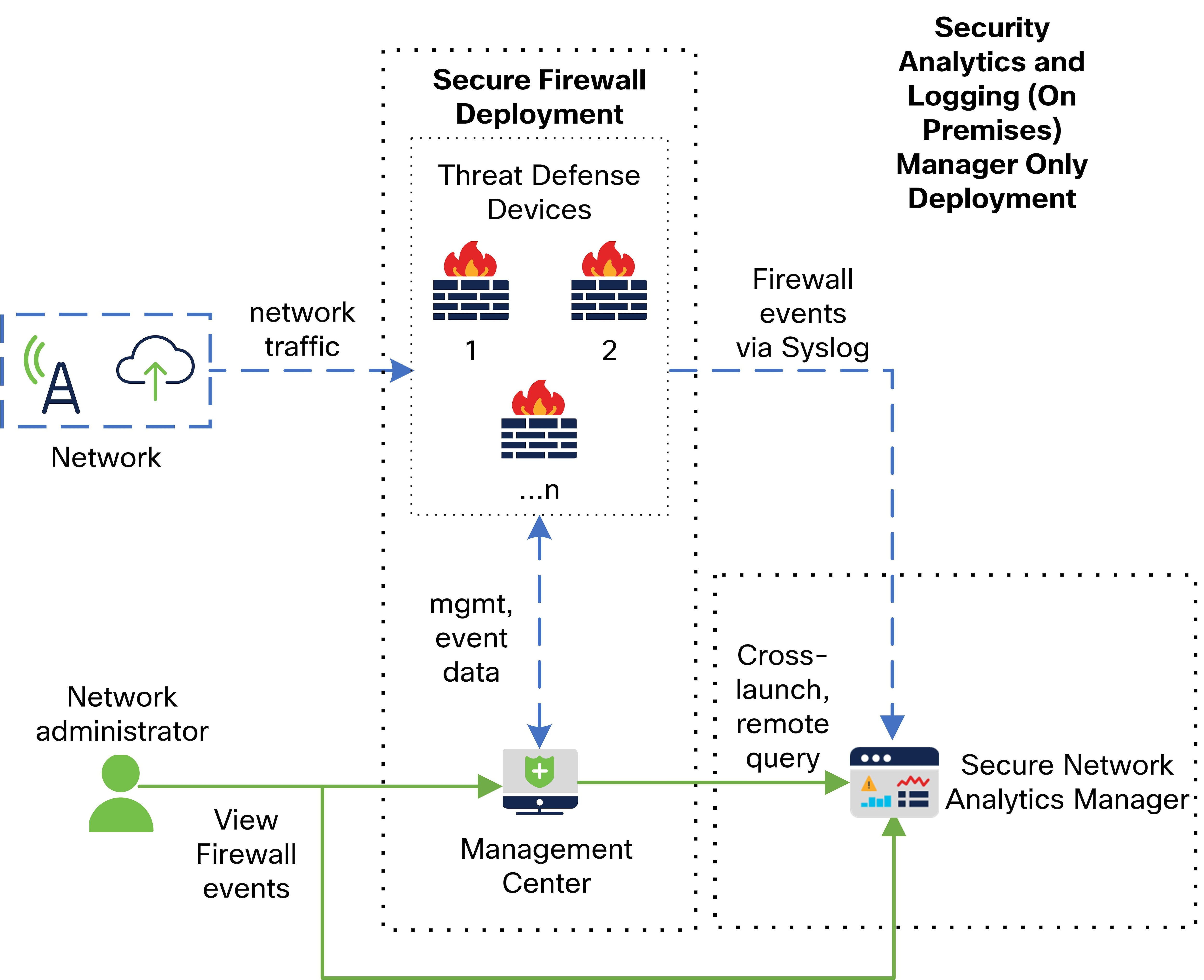
In this deployment, the threat defense devices send Secure Firewall events to the Manager, and the Manager stores these events. From the management center UI, users can cross-launch to the Manager to view more information about the stored events. They can also query remotely the events from the management center.

Data Store

See the following diagram for an example of a Data Store deployment with a Manager, Data Nodes, and Flow Collector(s):
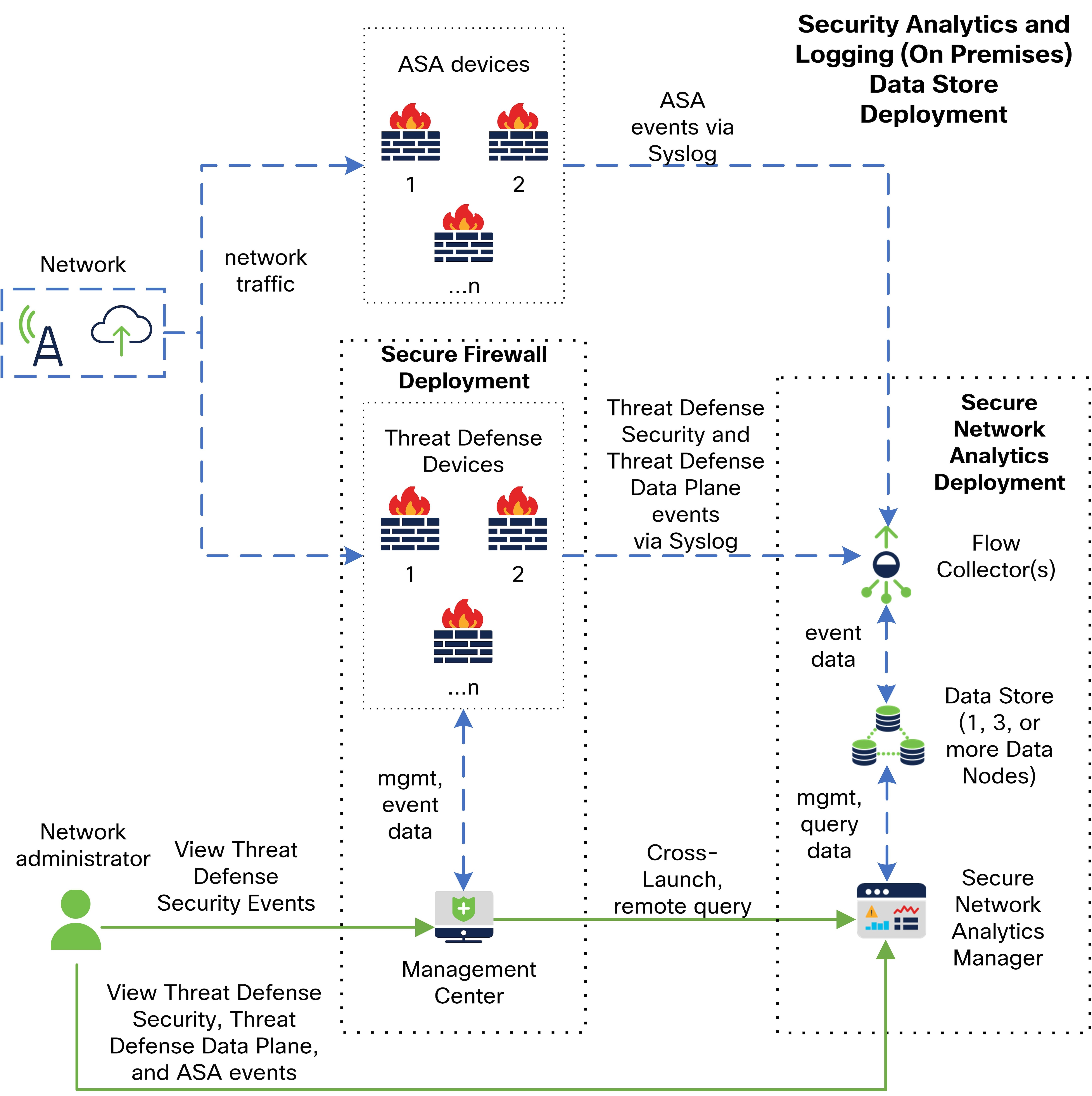
In this deployment, the threat defense and Secure Firewall ASA devices send Firewall events to the Flow Collector. The Flow Collector sends the events to the Data Store for storage. From the management center UI, users can cross-launch to the Manager to view more information about the stored events. They can also query remotely the events from the management center.

Reference Documentation

The following table describes relevant reference documentation for Security Analytics and Logging (OnPrem) appliance compatibility, deployment, and use:

Table 1.

Document

Description

Secure Firewall Release Notes

Review the Secure Firewall Release Notes to understand the latest information about the current Secure Firewall release, including last-minute information.

Secure Network Analytics Smart Licensing Guide

Review the Secure Network Analytics Smart Licensing Guide to understand how to register your Secure Network Analytics product instance and license your Secure Network Analytics appliances.

Secure Network Analytics Installation Guide

Review the Secure Network Analytics Installation Guide to understand how to deploy your Secure Network Analytics appliances.

Secure Network Analytics Configuration Guide

Review the Secure Network Analytics Configuration Guide to understand how to configure your Secure Network Analytics appliances.

Secure Network Analytics Release Notes

Review the Secure Network Analytics Release Notes to understand the latest information about the current Secure Network Analytics release, including last-minute information.

Security Analytics and Logging (OnPrem) Release Notes

Review the Security Analytics and Logging (OnPrem) Release Notes to understand the latest information about the current Security Analytics and Logging (OnPrem) release and Security Analytics and Logging (OnPrem) app, including last-minute information.

If you have not already deployed Secure Firewall or configured your Secure Firewall deployment to generate the expected connection, intrusion, file, and malware events, see the following:

Table 2.

Document

Description

Secure Firewall Compatibility Guide

Review the Secure Firewall Compatibility Guide to understand the version support for Secure Firewall Management Center and Secure Firewall Threat Defense device appliance models.

Secure Firewall Installation and Configuration Guides

Review the Secure Firewall Installation and Configuration Guides to understand how to install and configure your Secure Firewall appliances.

Secure Firewall Management Center Configuration Guide

Review the Secure Firewall Management Center Configuration Guide to understand Secure Firewall appliance licensing and configuration of your Secure Firewall Threat Defense devices managed by your Secure Firewall Management Center, access control policies, intrusion policies, and file policies.

Requirements

The following lists the appliance requirements for deploying Security Analytics and Logging (OnPrem) to store your Firewall event data.

Firewall Appliances

You must deploy the following Firewall appliances:

Solution Component

Required Version

Licensing for Security Analytics and Logging (OnPrem)

Notes

Secure Firewall Management Center (hardware or virtual)

v7.2+

For the management center running earlier versions, see https://cisco.com/go/sal-on-prem-docs.

none

  • You can deploy one Manager per management center, and optionally multiple Flow Collectors and Data Nodes.

Secure Firewall managed devices

v7.0+ using the wizard

Threat Defense v6.4 or later using syslog

NGIPS v6.4 using syslog

none

ASA devices

v9.12+

none

Secure Network Analytics Appliances

You have the following options for deploying Secure Network Analytics:

  • Manager only - Deploy only a Manager to ingest and store events, and review and query events

  • Data Store - Deploy Flow Collector(s) to ingest events, Data Store to store events, and Manager to review and query events

Table 3. Manager only

Solution Component

Required Version

Licensing for Security Analytics and Logging (OnPrem)

Notes

Manager

Secure Network Analytics v7.4.2

none

  • The Manager can receive events from multiple threat defense devices, all managed by one management center.
  • Make sure to install the Security Analytics and Logging (OnPrem) app for event ingest, and for viewing Firewall events on the Manager.

Security Analytics and Logging (OnPrem) app

Security Analytics and Logging (OnPrem) app v3.2.x

Logging and Troubleshooting Smart License, based on GB/day

  • Install this app on the Manager and configure to enable event ingest.

Table 4. Data Store

Solution Component

Required Version

Licensing for Security Analytics and Logging (OnPrem)

Notes

Manager

Secure Network Analytics v7.4.2

none

  • Make sure to install theSecurity Analytics and Logging (OnPrem) app for event ingest, and for viewing Firewall events on the Manager.

  • Secure Network Analytics v7.4.1+ is required for Single Node Data Store and multi-telemetry,

Flow Collector

Secure Network Analytics v7.4.2

none

  • You can deploy up to 5 Flow Collectors that are configured for Data Store.

  • The Flow Collector can receive events from multiple threat defense devices, all managed by one management center.

  • The Flow Collector can receive ASA events from multiple ASA devices.

  • Secure Network Analytics v7.4.1+ is required for Single Node Data Store and multi-telemetry.

Data Store

Secure Network Analytics v7.4.2

none

  • You can deploy either 1, 3, or more (in sets of 3) Data Nodes.

  • Stores Firewall events received by Flow Collector(s).

  • Secure Network Analytics v7.4.1+ is required for Single Node Data Store and multi-telemetry.

Security Analytics and Logging (OnPrem) app

Security Analytics and Logging (OnPrem) app v3.2.x

Logging and Troubleshooting Smart License, based on GB/day

  • Install this app on the Manager and configure to enable event ingest.

In addition to these components, you must make sure that all of the appliances can synchronize time using NTP.

If you want to remotely access the Secure Firewall or Secure Network Analytics appliances' consoles, you can enable access over SSH.

Secure Network Analytics Licensing

You can use Security Analytics and Logging (OnPrem) for 90 days without a license in Evaluation Mode. To continue using Security Analytics and Logging (OnPrem) after the 90 day period, you must obtain a Logging and Troubleshooting Smart License for Smart Licensing, based on the GB per day you anticipate sending in syslog data from your Firewall deployment to your Secure Network Analytics appliance.


Note

For license calculation purposes, the amount of data is reported to the nearest whole GB, truncated. For example, If you send 4.9 GB in a day, it is reported as 4 GB.


See the Secure Network Analytics Smart Software Licensing Guide for more information on licensing your Secure Network Analytics appliances.

Secure Network Analytics Resource Allocation

Secure Network Analytics offers the following ingest rates when deployed for Security Analytics and Logging (OnPrem):

  • a hardware or virtual edition (VE) Manager only deployment can ingest up to roughly 20k events per second (EPS) on average, with short bursts of up to 35k EPS

  • a virtual edition (VE) Data Store deployment, with 3 Data Nodes, can ingest up to roughly 50k EPS on average, with short bursts of up to 175k EPS

  • a hardware Data Store deployment, with 3 Data Nodes, can ingest up to roughly 100k EPS on average, with short bursts of up to 350k EPS

Based on the allocated hard drive storage, you can store the data for several weeks or months. These estimates are subject to various factors, including network load, traffic spikes, and information transmitted per event.


Note

At higher EPS ingest rates, the Security Analytics and Logging (OnPrem) app may drop data. In addition, if you send all event types, instead of only connection, intrusion, file, and malware events, the app may drop data as your overall EPS rises. Review the log files in this case.


Manager Only Recommendations

Manager VE Resources

For optimum performance, allocate the following resources if you deploy a Manager VE:

Resource

Recommendation

CPUs

12

RAM

64 GB

Hard drive storage

2 TB

Manager 2210 Specifications

For hardware specifications, see the Manager 2210 Specification Sheet.

Estimated Retention

Based on the storage space that you allocate for your Manager VE or if you have a Manager 2210, you can store your data for roughly the following time frames on a Manager only deployment:

Average EPS

Average Daily Events

Estimated Retention Period for 1 TB Storage

Estimated Retention Period for 2 TB Storage

Estimated Retention Period for 4 TB Storage (Hardware)

1,000

86.5 million

250 days

500 days

1000 days

5,000

430 million

50 days

100 days

200 days

10,000

865 million

25 days

50 days

100 days

20,000

1.73 billion

12.5 days

25 days

50 days

When the Manager reaches maximum storage capacity, it deletes the oldest data first to make room for incoming data.


Note

We have tested the Manager VE with these resource allocations for this estimated ingest and storage period. You may note unanticipated errors due to insufficient resource allocation if you do not assign enough CPUs or RAM to the virtual appliance. If you increase the storage allocation beyond 2 TB, you may note unanticipated errors due to insufficient resource allocation.


Data Store Recommendations

For optimum performance, allocate the following resources if you deploy a Manager VE, Flow Collector VE, and Data Store VE:


Note

If you are using a Single Node Data Store or if you have enabled multi-telemetry in Secure Network Analytics, your resource allocation and storage capacity may be different from the following recommendations. For more information, refer to the Secure Network Analytics Appliance Installation Guide (Hardware or Virtual Edition) and the System Configuration Guide v7.4.1.


Table 5. Manager VE

Resource

Recommendation

CPUs

8

RAM

64 GB

Hard drive storage

480 GB

Table 6. Flow Collector VE

Resource

Recommendation

CPUs

8

RAM

70 GB

Hard drive storage

480 GB

Table 7. Data Nodes VE (as part of a Data Store)

Resource

Recommendation

CPUs

12 per Data Node

RAM

32 GB per Data Node

Hard drive storage

5 TB per Data Node VE, or 15 TB total across 3 Data Nodes

Hardware Specifications

For hardware specifications, refer to the appliance specification sheets.

Estimated Retention (3 Data Nodes)

Based on the storage space that you allocate for your Data Store VE or if you have a hardware deployment, you can store your data for roughly the following time frames on your Data Store deployment:

Average EPS

Average Daily Events

Virtual

Hardware

1,000

86.5 million

1,500 days

3,000 days

5,000

430 million

300 days

600 days

10,000

865 million

150 days

300 days

20,000

1.73 billion

75 days

150 days

25,000

2.16 billion

60 days

120 days

50,000

4.32 billion

30 days

60 days

75,000

6.48 billion

Not supported

40 days

100,000

8.64 billion

Not supported

30 days

When the Data Store reaches maximum storage capacity, it deletes the oldest data first to make room for incoming data. To increase your storage capacity, add more Data Nodes using the Secure Network Analytics System Configuration Guide.


Note

We have tested the virtual appliances with these resource allocations for this estimated ingest and storage period. You may note unanticipated errors due to insufficient resource allocation if you do not assign enough CPUs or RAM to the virtual appliance. If you increase the Data Node storage allocation beyond 5 TB, you may note unanticipated errors due to insufficient resource allocation.


Communication Ports

The following table lists the communication ports you must open for the Security Analytics and Logging (OnPrem) integration for a Manager only deployment.

Table 8. Manager only

From (Client)

To (Server)

Port

Protocol or Purpose

Management Center, Threat Defense devices, and Manager

External internet (NTP server)

123/UDP

NTP time synchronization, all to the same NTP server

User workstations

Management Center and Manager

443/TCP

Logging into the appliances' web interfaces over HTTPS using a web browser

Threat Defense devices managed by a management center

Manager

8514/UDP

Syslog export from the threat defense devices, ingest to the Manager

Management Center Manager

443/TCP

remote query from management center to the Manager

The following table lists the communication ports you must open for the Security Analytics and Logging (OnPrem) integration for a Data Store deployment. In addition, see the x2xx Series Hardware Appliance Installation Guide or the Virtual Edition Appliance Installation Guide for the ports you must open for your Secure Network Analytics deployment.

Table 9. Data Store

From (Client)

To (Server)

Port

Protocol or Purpose

Management Center, Threat Defense devices, Manager, Flow Collector, and Data Store

External internet (NTP server)

123/UDP

NTP time synchronization, all to the same NTP server

user workstations

Management Center and Manager

443/TCP

Logging into the appliances' web interfaces over HTTPS using a web browser

Threat Defense devices managed by a management center

Flow Collector

8514/UDP

Syslog export from the threat defense devices, ingest to Flow Collector

ASA devices

Flow Collector

8514/UDP

Syslog export from ASA devices, ingest to Flow Collector

Management Center Manager

443/TCP

Remote query from the management center to the Manager

Configuration Overview

The following describes the high-level steps for configuring your deployment to store firewall event data.

Review these tasks before starting your deployment.

Component and Task

Steps

Deploy Manager only

You have the following options:

Deploy Data Store

Download and install the Security Analytics and Logging (OnPrem) app on your Manager, and configure your Secure Network Analytics deployment to receive and store Firewall events.

Configure the Secure Firewall Management Center to send events to Security Analytics and Logging (OnPrem)

You have the following options:

Configure ASA devices to send events to Security Analytics and Logging (OnPrem)

Review Next Steps

Review the Next Steps:

Next Steps

After you configure your Firewall devices to send event data to your Secure Network Analytics appliance as part of Security Analytics and Logging (OnPrem), you can take the following steps:

  • Review the management center online help.

  • Review the Manager Web App online help to learn more about Secure Network Analytics.