Cisco Nexus One Solution Overview
Available Languages
Bias-Free Language
The documentation set for this product strives to use bias-free language. For the purposes of this documentation set, bias-free is defined as language that does not imply discrimination based on age, disability, gender, racial identity, ethnic identity, sexual orientation, socioeconomic status, and intersectionality. Exceptions may be present in the documentation due to language that is hardcoded in the user interfaces of the product software, language used based on RFP documentation, or language that is used by a referenced third-party product. Learn more about how Cisco is using Inclusive Language.
Unifying data center operations with open choice and no compromises
Data center architectures have evolved rapidly over the last decade. As applications proliferate and AI workloads demand unprecedented scale, infrastructure has become increasingly fragmented. Organizations often find themselves managing disparate fabrics, struggling with complex operations, and facing security vulnerabilities across expanded perimeters.
While Software Defined Networking (SDN) solved initial connectivity challenges, it often introduced operational silos. Today’s IT leaders need more than just connectivity; they need a unified, flexible operating model that simplifies scale and security.
When launched in 2014, Cisco ACI® has introduced groundbreaking innovations and lots of industry firsts to the market, including:
● Zero-trust networking with microsegmentation and macrosegmentation capabilities based on endpoint security groups and contracts
● Highly advanced service chaining and service redirection capabilities
● Object model–based APIs that fit well with cloud-operating models and with CI/CD pipelines, to deliver a Network-as-Code experience for DevOps engineers
● Controller-based networking with Cisco® APIC
With all these innovations, Cisco ACI has delivered tremendous customer value. Customers have loved Cisco ACI, and we have a greater than 13,000 strong Cisco ACI customer base across all industries and all verticals. Here is the key point: The innovations brought by Cisco ACI were unique in the IT industry There were no industry standards for these innovations because these were trailblazers.
And what does Cisco typically do with any innovations? Cisco, in effect, contributes these innovations back to the IT industry by standardizing them.
This is exactly what we did with Cisco ACI innovations. We are standardizing the ACI innovations with the Internet Engineering Task Force (IETF). We have IETF standardization happening for the protocols in the data plane, the EVPN control plane, and the policy plane. These standards are being built on top of the widely popular and deployed VXLAN EVPN technology.
What is the next step after the standardization? Evolve the architecture to the next revision as per the standards while maintaining backward compatibility. That’s exactly what Cisco Nexus® One is: evolution of SDN architecture for AI-ready data centers based on open standards and open choices while maintaining backward compatibility.
Since its introduction in 2014, Cisco Application Centric Infrastructure (Cisco ACI) has pioneered foundational networking innovations, including zero-trust segmentation, advanced service chaining, and object-model APIs that enable a Network-as-Code experience. Having empowered over 13,000 customers globally, Cisco is now standardizing these trailblazing capabilities within the IETF across the data, control, and policy planes. Building upon widely adopted VXLAN EVPN technology, this commitment to open standards culminates in Cisco Nexus One: the next evolution in SDN architecture designed specifically for AI-ready data centers.
Cisco Nexus One expands upon the traditional ACI framework by offering unprecedented flexibility across all four layers of the networking stack, while maintaining full backward compatibility:
● Silicon: expands beyond Cisco Cloud Scale to include Cisco Silicon One® and NVIDIA Spectrum-X Ethernet switch silicon
● Systems: continues to leverage the flagship Cisco Nexus 9000 Series Switches as unified hardware, coupled with high-performance optics
● Software: offers the choice of Cisco ACI, Cisco NX-OS, or the recently added open-source SONiC
● Operating model: provides versatile management through the on-premises Cisco Nexus Dashboard or the SaaS-based Cisco Nexus Hyperfabric™
This open and extensible architecture enables deep, multi-plane unification and seamless interoperability. Organizations can deploy and interconnect diverse fabric architectures side-by-side-stretching Layer 2, Layer 3, and security policies across ACI, NX-OS, and SONiC environments. Furthermore, the architecture allows for seamless integration into cloud-native Kubernetes deployments utilizing Isovalent® and Cilium.
Ultimately, Nexus One represents a paradigm shift: an open, unified management plane that integrates silicon, systems, software, and operating models with embedded security and observability. Designed to adapt to unique network transformation stages, it delivers on a simple philosophy of "open choice, no compromises." Whether modernizing enterprise data centers or scaling massive AI clusters, Nexus One provides the consistency, flexibility, and performance required for the future of networking.
Here is how Cisco Nexus One transforms data-center infrastructure, structured by its core architectural layers.
Cisco Nexus One: a unified operating model
At the top of the Cisco Nexus One framework lies the Operating Model. This layer is designed to orchestrate across multiple sites and fabrics, streamlining how you scale and operate networks. The goal is to deliver a consistent experience, regardless of where your workloads live. Nexus One provides consistent networking across on-premises, sovereign cloud, underlay, overlay, and Kubernetes environments. With Cisco Isovalent, you also gain deep visibility into service IPs and traffic patterns, eliminating operational blind spots.
On-premises with Nexus Dashboard
For organizations managing on-premises data centers, the Cisco Nexus Dashboard serves as a single point of control for provisioning, visibility, troubleshooting, and automation.
● Unified management: It offers unified operations across Cisco NX-OS VXLAN EVPN, Cisco ACI, and SONiC fabrics. Easily automate the provisioning of your data-center network infrastructure using consistent configurations to drive fast, simple, and secure network connectivity, with full lifecycle management, embedded automation, and Infrastructure-as-Code (IaC) integrations.
● Deep observability: Gain actionable insights into network performance, avoid unplanned outages, discover energy usage, costs, and emissions, with recommendations to optimize uptime and minimize environmental impact. With native Splunk® on Nexus Dashboard you get unified analytics and federated search across network telemetry and the Nexus Dashboard Data Lake without any requirement for data duplication. This helps maintain data sovereignty, cut operational costs, and speed up anomaly detection and root cause analysis.
● Agentic automation: The platform is enhanced by AgenticOps, a framework that uses reasoning agents to resolve multidomain issues and validate changes under human guardrails to enable intelligent, automated, and collaborative operations.
Cloud-managed with Nexus Hyperfabric
Cisco Nexus Hyperfabric brings cloud-managed simplicity to distributed infrastructure. It is specifically designed to scale AI and non-AI fabrics faster, automating the entire lifecycle of the network. This ensures that even as you deploy network infrastructure to the edge or across colocation facilities, your operational model remains consistent.
● Design before you buy: Customers can build a validated fabric design tailored to their specific needs, such as host and port capacity, oversubscription, and environmental factors such as cabling and power. The design process is integrated with Cisco ordering tools to ensure error-free conversion of the design into a bill of materials, enabling confident and accurate planning before purchase.
● Common Nexus One hardware platform with Cisco N9000 Series Switches: Cisco Nexus Hyperfabric leverages a unified hardware foundation, including Cisco 6000 Series Switches currently and extending support to Cisco N9000 Series Switches. This common platform simplifies infrastructure investments by allowing customers to use familiar hardware across different operating models, maximizing flexibility and scalability.
● Assertion-based monitoring: The solution continuously verifies the availability and reliability of the fabric and connected resources through assertion-based monitoring. It immediately identifies the root cause of any detected issues, enabling proactive management and minimizing downtime.
API-driven flexibility
For teams that prefer Infrastructure-as-Code (IaC), Nexus One is built to be API-driven first. This allows DevOps teams to integrate network provisioning directly into their CI/CD pipelines, ensuring that the network moves as fast as the applications it supports.

Cisco Nexus One delivers intelligent data center and AI networking
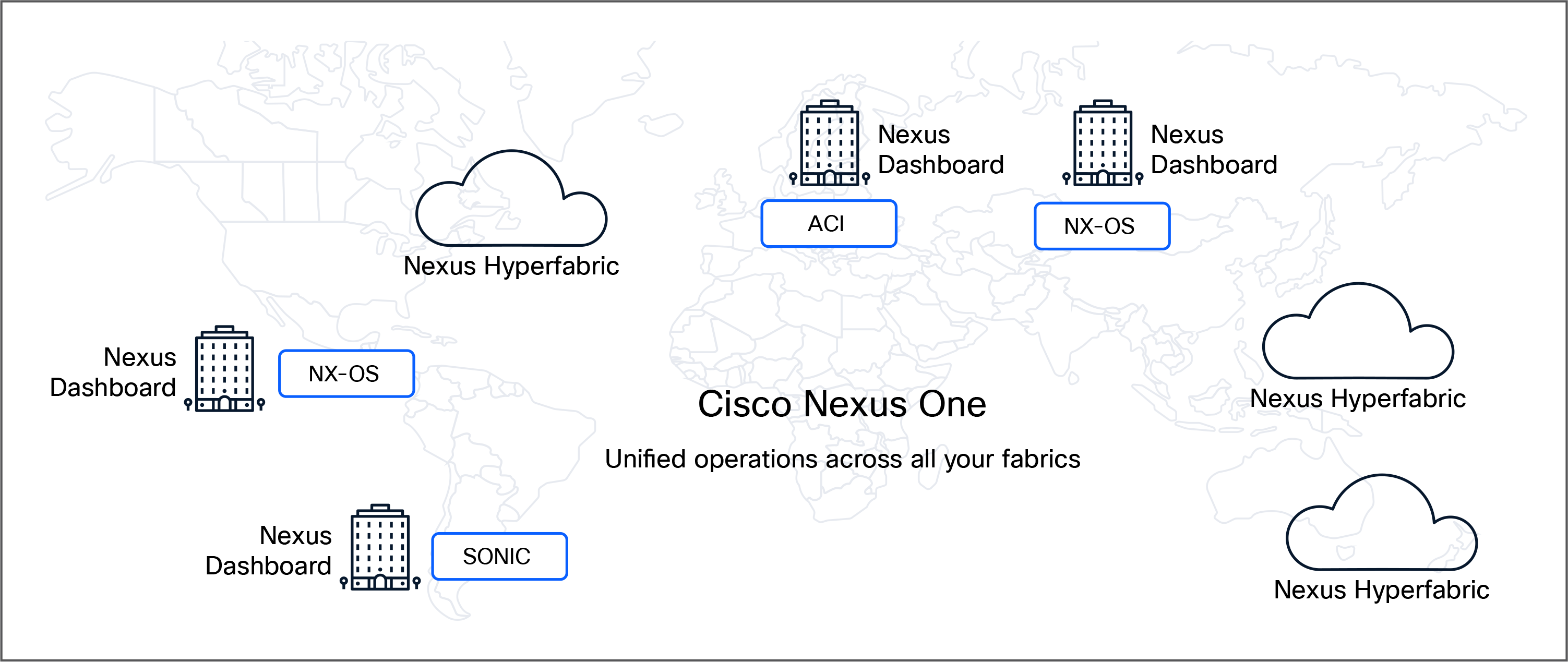
Proven distributed architectures and multisite orchestration
Cisco Nexus One: software flexibility true to the promise of “open choice,” Nexus One does not lock you into a single environment. You can run:
● Cisco NX-OS: for highly scalable, modular, open-standards-based VXLAN EVPN fabrics
● Cisco ACI: for API-driven, automated fabrics
● SONiC: for customers who prefer an open-source containerized operating system
By supporting these diverse OS options on common hardware, Cisco ensures investment protection. You can pivot your software strategy without overhauling your hardware.
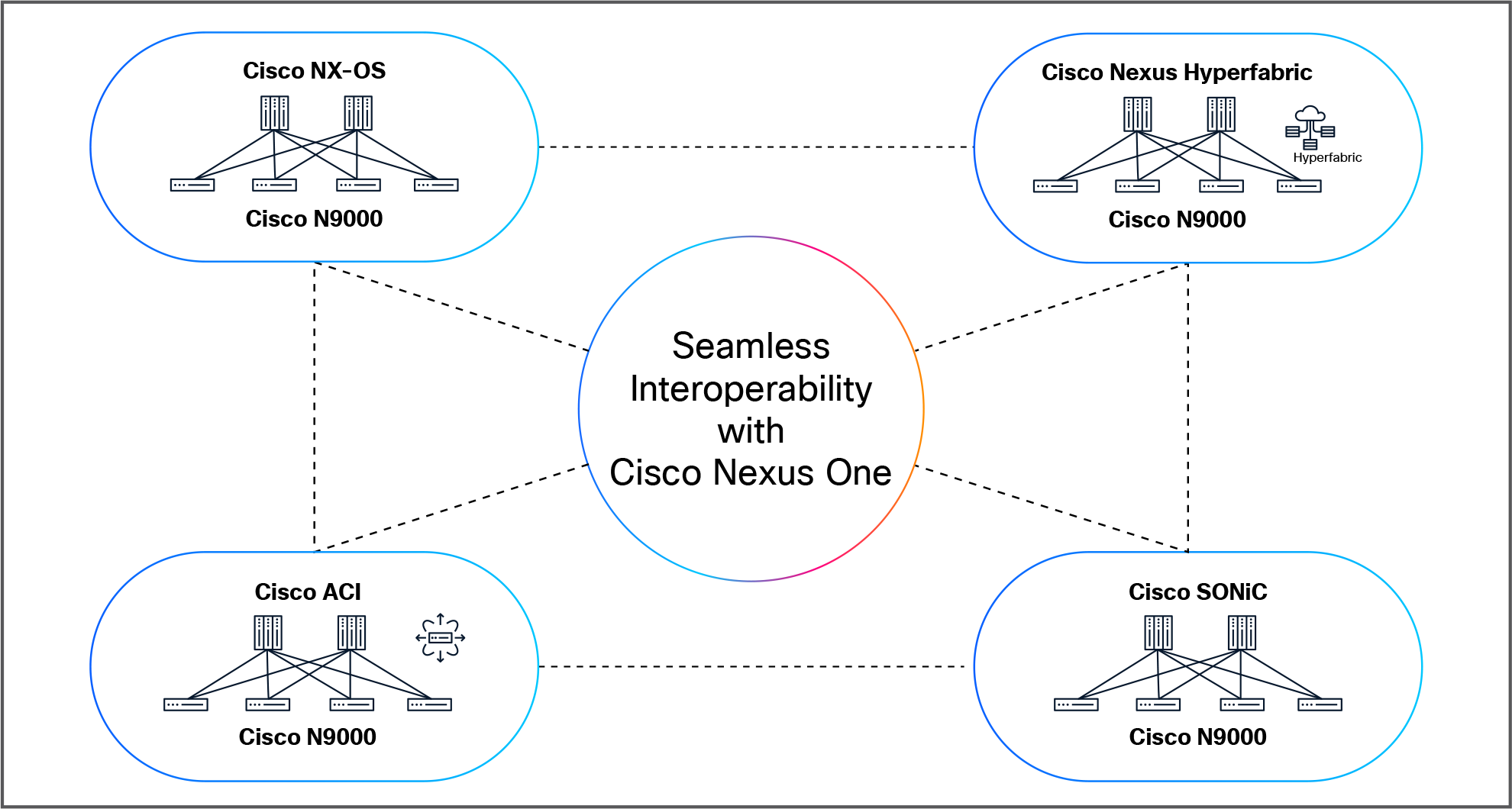
Seamless interoperability with Cisco Nexus One
Cisco Nexus One: N9000 Series Switches
At the heart of the Nexus One framework lies a transformative layer of hardware and software that powers your network with unmatched agility and intelligence. Experience complete flexibility with Nexus One, empowering you to tailor your infrastructure and operating models precisely to your unique business requirements. Whether you prioritize scalability, performance, or operational simplicity, Nexus One provides the freedom to innovate without compromise.
Systems
● Massive AI Scale-Out fabric: Support 1M+ GPU clusters with G300, providing ultra-high-bandwidth, scale-out fabrics for sustained, bursty AI workloads with higher cluster level performance and utilization than prior generations. Performance isn't just bandwidth- it's what the network does with every packet.
● Distributed AI performance for Scale-Across: Silicon One P200 ASIC brings quantum threat-resilient line-rate encryption and industry-leading deep buffers - optimized for universal spine use cases in distributed and multicloud environments. This architecture enables organizations to deploy AI workloads across geographic regions, sovereign clouds, or multiple data center sites while maintaining the performance characteristics of a single, unified infrastructure. [D(1.1]
● Programmable Silicon One foundation: highly programmable, field-upgradable for new features for adaptive future-proofed Intelligent networks
Cisco N9000 systems
The foundation of this layer is the Cisco N9000 series switches. These switches act as a universal platform capable of running different operating systems.
● New Innovations: The newly introduced Cisco N9364-SG3 systems are purpose-built for AI scale. Featuring 1.6T-capable ports and direct-to-chip liquid cooling options, they deliver wire-speed performance and massive throughput (102.4 Tbps) needed for GPU clusters.
● Sustainability: New systems support Linear Pluggable Optics (LPO), which can lower switch power consumption by up to 30%.
Cisco MDS
Cisco MDS 9000 is a complete family of fixed and modular Storage Area Network (SAN) switches built for enterprise today and tomorrow with AI.
MDS fits every environment, delivering consistent speed and reliability, whether you're deploying compact fixed models or large-scale modular directors.
Cisco Optics
Cisco Optics leads in the optical networking industry, offering an unparalleled breadth of solutions that cater to diverse network needs. With a portfolio spanning speeds from 1G to 1.6T, Cisco provides high-performance optical transceivers designed for data centers, service providers, and enterprise networks. These solutions are rigorously tested for quality and reliability, ensuring seamless interoperability across Cisco and alternative platforms.
Cisco Nexus One: silicon, the foundation of performance
Custom silicon is the cornerstone of Cisco’s competitive edge, driving unmatched innovation and differentiation. It enables groundbreaking advancements such as flexible forwarding tiles, intelligent buffering, and advanced load-balancing capabilities, setting Cisco apart in the industry. Custom silicon embodies seamless integration across hardware and software.
Cisco Silicon One
Cisco’s proprietary Silicon One architecture powers the latest Nexus switches, offering industry-leading efficiency and scale.
● G300 Series: Designed for massive AI scale-out fabrics, supporting clusters of over 1 million GPUs. It features large, shared buffers to absorb the microbursts typical of AI training traffic.
● P200 Series: The Cisco Silicon One P200 is a 51.2 Tbps, deep-buffer networking ASIC designed for AI/ML data centers requiring high-capacity at 800G and deep buffers. It is built for distributed performance and is ideal for connecting training sites across vast distances.
● E100: The Cisco Silicon One E100 is a 6.4-Τbps, high-performance, flexible, power-efficient networking ASIC for enterprise data centers enabling smooth speed and services upgrades to meet the changing needs of virtualized data centers and automated cloud environments.
● Q200 Series: The Cisco Silicon One Q200 switches offer highly scalable, deep-buffered, on-chip High Bandwidth Memory (HBM), 400G-optimized modular data-center switches.
NVIDIA Spectrum-X Ethernet switch silicon
Recognizing the diverse needs of modern data centers, Nexus One also embraces open ecosystem partnerships, including new Nexus switching platforms such as the Cisco N9100 series switches, that are NVIDIA Cloud Partner (NCP) reference architecture compliant, powered by NVIDIA Spectrum-X Ethernet Switch silicon. This flexibility ensures that customers can choose the technologies that best fits their specific workload requirements.
Cisco Cloud Scale
Cisco Cloud Scale ASIC is designed for high-density leaf-and-spine data center networks, prioritizing wire-rate telemetry, security, and flexible port speeds.
The pillars: Observability and security
Observability and security are critical pillars in data center networking, enabling organizations to manage complex, high-performance infrastructures effectively.
● Unmatched Observability: Effective management begins with comprehensive visibility. Cisco Nexus One delivers real-time, end-to-end visibility spanning from the network port to the GPU. This unparalleled observability enables IT teams to monitor traffic patterns meticulously, detect anomalies promptly, and proactively troubleshoot issues before they impact operations. By providing deep insights into every aspect of the network fabric, Nexus One empowers organizations to optimize performance, enhance security, and maintain operational continuity with confidence.
● Enhancing AI Job Observability: Cisco Nexus One delivers end-to-end observability from AI jobs to network fabric and hardware telemetry, including GPU and optics health metrics. This unified visibility, combined with AI-driven assurance and automation, empowers IT teams to optimize AI workload performance, troubleshoot issues proactively, and maximize resource utilization.
● AgenticOps: Traditional network operations models can’t keep pace with the scale and complexity of managing AI infrastructure. The next step is true autonomous, intelligent network operations. With AgenticOps for data center networking through AI Canvas, teams get the ability to troubleshoot, gain insights, configure, and optimize enterprise infrastructure, including AI fabrics, through guided, human-in-the-loop conversations.
● Splunk Integration: Because Cisco owns both the network and the operational telemetry layer through Splunk, we deliver true end-to-end Time to Remediation (TTR) across your entire infrastructure stack. Whether it’s application behavior, network conditions, or security signals, issues are detected, correlated, and resolved faster—reducing downtime and protecting your business outcomes.
Security without compromise
Security is a foundational element of modern data center networking, not an afterthought. Cisco Nexus One exemplifies this principle by embedding security deeply within its architecture to reduce the attack surface across the entire data center and perimeter. Leveraging hardware-accelerated enforcement and distributed protections at the workload level, Cisco Nexus One delivers robust, scalable defense that safeguards critical infrastructure against evolving threats.
● Secure products
◦ Seamless protection, uncompromised performance: Cisco N9300 Series Smart Switches transform your data center by fusing high-performance networking with Cisco Hypershield™'s advanced security. By fusing defense directly into the network and workloads, you can seamlessly protect your infrastructure without sacrificing performance. As Cisco’s first Data-Processing Unit (DPU)-enhanced switch, it offloads complex processing to DPUs, turning traditional hardware into a highly scalable, multifunctional service host. Leveraging Hypershield's eBPF technology, the switch embeds distributed exploit protection, giving you massive scale, advanced L3/L4 segmentation, and uncompromised network security.
◦ Continuous defense: Cisco Live Protect delivers powerful vulnerability shielding for your Cisco N9000 Series Switches. You can now stop attacks without stopping your network. The solution uses CVE Shields to provide immediate, targeted protection against unpatched vulnerabilities. It also features foundation shields to proactively reduce the attack surface and harden your platform. Live Protect safeguards your critical infrastructure while maintaining complete operational continuity. You can apply essential security policies directly to live systems with zero downtime, eliminating the immediate need for emergency patching or switch reboots.
◦ Bring security to your AI workloads: Cisco, in partnership with NVIDIA, is revolutionizing AI networking with the Cisco N9100 Series Switches, powered by NVIDIA Spectrum-X Ethernet silicon, compliant with NCP RA designs. Bring security to your AI workloads with Cisco’s Hybrid Mesh Firewall and NVIDIA BlueField DPU embedded in AI servers in Cisco Nexus One fabrics. With this, unlock strategies to optimize performance, secure workloads, and lead the future of AI innovation.
◦ Full chain of trust: Cisco N9000 Series Switches ensure robust security with a full chain of trust, including hardware root verification and quantum-safe boot keys, safeguarding against evolving threats.
● Secure communication
◦ Quantum-safe line-rate encryption: Cisco Nexus One mitigates “harvest now, decrypt later” risk through quantum-safe key exchange for MACsec, IPSec, and SSH/TLS aligned with NIST-approved post-quantum algorithms. New platforms incorporate quantum-safe digital signatures for secure boot, secure storage, and device identity. By leveraging these advanced protocols, Cisco enables seamless, encrypted communication across networks, ensuring data integrity, regulatory compliance, and resilience against quantum-era vulnerabilities.
◦ Consistent policy: Whether you use Cisco ACI or NX-OS, Nexus One offers end-to-end policy enforcement across the heterogenous domains, helping to ensure distinct microsegmentation across east/west traffic.
Use Cisco lifecycle services to boost Cisco Nexus deployment success
Cisco Services has helped companies implement the Cisco Nexus switches in thousands of locations globally. We help you succeed across the various phases of your network and IT lifecycle, combining services from Cisco and our partners and providing on-site support if you need it.
In planning, we help you assess existing infrastructure, identify gaps and end-state goals, and develop a deployment plan. In the build phase, we help you design and deploy your Cisco Nexus installation and integrate your solution with existing systems. Then we’ll help you manage the deployment, through network optimization and operational efficiency.
Security is of utmost importance to us and VXLAN GPO will give us the freedom to granularly segment our east west traffic at scale. We are excited to deploy the functionality within our data center.
- Lead Architect, top European University
Having a VXLAN gateway on ACI is a good move. Offers a choice of operating model and allows for more design patterns – like aggregated fabrics. Additionally, providing transition/migration options.
- CTO, leading telecommunications provider
ACI expands its open architecture.
“ACI VXLAN EVPN BGW enables VXLAN EVPN inter-op with policy aware and policy unaware non-ACI fabrics.”
NX-OS brings policy into its VXLAN EVPN solution.
“NX-OS brings security groups into its VXLAN EVPN architecture that can be deployed optionally to implement policy.”
Nexus Dashboard is the single point of control and operations.
Cisco Nexus Dashboard becomes the single point of control and operations for all the data center fabrics including policy implementation and multi-fabric interconnectivity in a consistent way.
“We can move quicker as business and deliver new services faster, because we have faith in that infrastructure. It allows us to test a lot of our services and deliver our internal applications quicker.”
Source: Nexus Dashboard IDC Business Value Study
“NX-OS is very mature, it offers high availability features like stateful switchover, and it has open APIs that make it easy to integrate with tools like Ansible and Python,” Ghayas says. “We used those tools to automate the entire fabric rollout for each data center.”
Source: Workday case study
“Together with Cisco, we’ve established end-to-end service automation and orchestration. In this way, we provide our customers with the most innovative services in the shortest time via a solid and secure data center infrastructure,” says Durmus.
Source: Turkcell case study
The Cisco Advantage: Why Choose Nexus One?
In a fragmented landscape of data-center solutions, Cisco stands apart by delivering unified experience. Cisco Nexus One does not just bring together hardware and software; it also provides a strategic approach to modernizing infrastructure that prioritizes your operational freedom with security and observability.
Consistent fabric experience
Whether you are managing a single on-premises data center or a distributed network spanning multiple clouds, Nexus One provides a cohesive operational experience. We eliminate the complexity of managing disparate networks by offering a unified fabric that behaves consistently across all environments. This means your teams can apply the same skills and processes everywhere, reducing the learning curve and operational overhead.
Security at every layer
We believe security should be foundational, not an afterthought. Nexus One integrates robust protection directly into the fabric, securing both east-west and north-south traffic. From quantum-resilient encryption to continuous runtime defense, we help you mitigate risks and reduce your attack surface without compromising performance.
Unified management
Simplicity drives speed. Unified management with Cisco Nexus One goes beyond the Nexus Dashboard, integrating Nexus Hyperfabric for cloud-managed operations and robust API-driven automation. This combination gives you a single point of control for your entire network, enabling consolidated provisioning, troubleshooting, and deep observability— regardless of where your infrastructure resides or how you choose to manage it. This unified approach streamlines workflows and empowers your teams to move from reactive troubleshooting to proactive optimization.
Commitment to open standards
Innovation thrives on openness. Cisco is committed to open standards-based networking, ensuring that your investment today does not limit your choices tomorrow. Nexus One allows you to leverage end-to-end policy enforcement and interoperability across diverse ecosystems. By embracing open APIs and multi-vendor support, we ensure your infrastructure remains flexible and future-ready.
Financing to help you achieve your objectives
Cisco Capital® can help you acquire the technology you need to achieve your objectives and stay competitive. We can help you reduce CapEx. Accelerate your growth. Optimize your investment dollars and ROI. Cisco Capital financing gives you flexibility in acquiring hardware, software, services, and complementary third-party equipment. And there’s just one predictable payment. Cisco Capital is available in more than 100 countries. Learn more.
The data center is the engine of modern innovation, but complexity can stall that engine. Cisco Nexus One offers a path forward that clears the clutter. By unifying operations, offering unmatched flexibility in hardware and software, and embedding security and observability at every level, it empowers organizations to innovate faster.
With Nexus One, you no longer have to choose between openness and performance. You get open choice with no compromises.
Start building heterogenous fabrics (consisting of NX-OS VXLAN EVPN, Cisco ACI and SONiC) seamlessly
Are you managing separate NX-OS VXLAN EVPN, Cisco ACI and SONiC fabrics manually? Are you facing challenges in integrating policy and troubleshooting across diverse architectures? Dramatically reduce your time to deploy and automate your operations and troubleshooting for heterogenous fabrics with Cisco Nexus One.
Resources:
Cisco Nexus 9000 Series Switches
Cisco Nexus One Fabric: Unify Data Center Operations with Open VXLAN/EVPN Standards