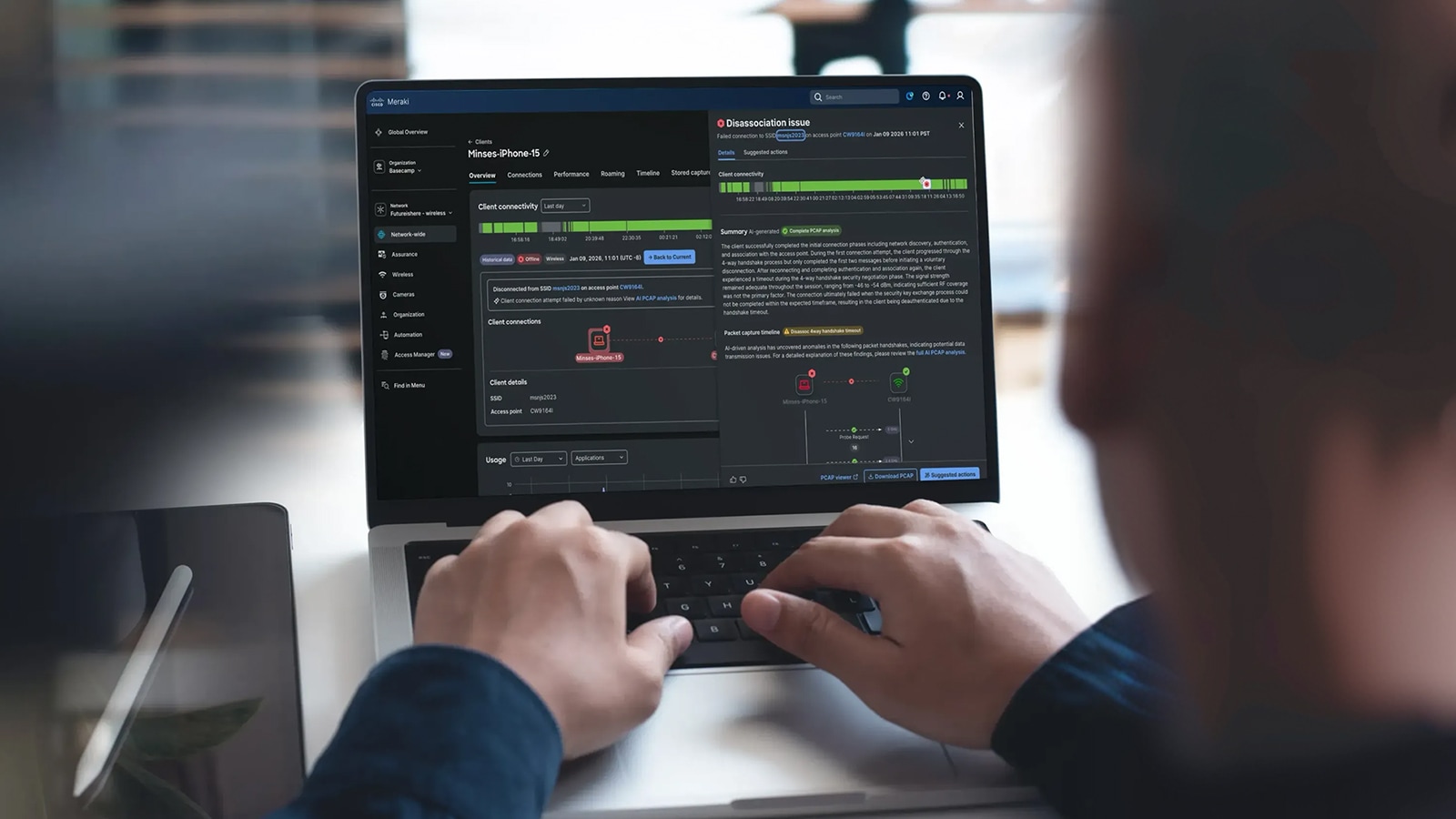
Mesh networking allows cost-effective deployment of city- or campuswide Wi-Fi networks.
A Cisco wireless mesh network eliminates the need for a wireless hotspot to be connected to its own wired LAN. Instead, wireless access points in a mesh network discover each other automatically and choose the best path for maximizing system capacity and minimizing latency. If a link is degraded, the access point determines whether a better path exists and reroutes traffic to it.
A Cisco Wireless Mesh Networking Solution is based on new wireless routing protocols and:
- Makes it easier and more cost-effective to extend the reach of a wireless network to large venues
- Is easy to connect to an existing indoor wired or wireless network so that users can roam from one area to another without reconnecting
- Allows administrators to set one access policy that works across all environments, increasing security and making the systemwide network infrastructure more manageable
Widespread Demand for Wireless Access
Wi-Fi hotspots alone could provide enough capacity for widespread coverage, but without mesh technology, it can be challenging and expensive to expand the reach of coverage beyond a hotspot. As for cellular networks, they cannot be used to provide shared data services to hundreds or thousands of users, and they are expensive to own and operate.
Meanwhile, according to Gartner Research, "Mesh networking in various applications is becoming a low-cost alternative for municipalities. Cities and towns should evaluate mesh technologies to enhance data communications and improve public safety interoperability. Behind such deployments are productivity gains, ease of deployment, and the ability to deliver first-responder interoperability at a fraction of the cost of a land mobile radio system."
Technical Capabilities
The Cisco Wireless Mesh Networking Solution is based on the Cisco Aironet 1500 Series, a Wi-Fi (802.11/a/b/g) mesh network access point specifically designed for secure outdoor coverage, using Cisco's patent-pending Adaptive Wireless Path Protocol. It offers the following capabilities:
- Ease of Deployment: Zero-configuration deployment allows you to add new access points without onsite configuration. It offers multiple power options, including Power over Ethernet (PoE), and vertical or horizontal pole-mounting options.
- Manageability: The mesh network can be integrated with an existing Cisco wired indoor network, allowing central configuration and identical policy management. Cisco mesh networks also self-heal after interference or outages.
- Scalability: The architecture makes it easy to scale coverage, allowing you to increase access point density; add wired connections, controllers, and radios; and use dual high-powered, high-sensitive radios and a selection of high-gain antennas.
- Security: Multilayered security is built in, including IEEE 802.11i, AES encryption on backhaul links, access point authentication, secure control traffic between the access point and the controller, and IPSec VPNs for confidential mesh client traffic. Administrators can create security policies for different user types or location-based traffic.
- Reliability: Rugged enclosures protect against weather and vibration from storms or road traffic. The network features self-healing, automatic load balancing across WLAN controllers, and channel or controller reassignment in case of conflicts.
- Performance: A Cisco mesh network delivers high performance using dynamic path optimization when new sectors are added, resiliency, and interference mitigation.
- Flexibility: The access points feature dual-band, simultaneous support for IEEE 802.11a and 802.11b/g and hardware support for the 4.9 GHz public safety band. Multiple WLAN support allows multiple services to be offered to different user types (such as police, fire, or the public) over a single access point.
- Mobility: Wi-Fi clients have Layer 2 and 3 mobility across a mesh network. Users can roam between access points on the same or different controllers as well as between the Cisco WLAN and mesh networks.
Support from Cisco Partners
Cisco partners are trained to manage the entire solution, from planning to deployment, and can even manage your network on an ongoing basis. In addition to a global network of qualified resellers, Cisco CCIE professionals and the Technical Assistance Center provide comprehensive design and support.