

Data Sheet
Catalyst 8540
The Catalyst 8500 series Multiservice Switch Routers integrate multiservice ATM switching with wire-speed Layer 3 switching for Gigabit Ethernet into a single platform that also supports advanced Cisco IOS services. The Catalyst 8500 family delivers campus and metropolitan network solutions with scalable performance, lower cost of ownership, and the features needed by intranet-based applications to deliver increased business productivity.
Historically, enterprise network managers faced a choice of several different technologies when building or upgrading campus network backbones. Today, the choice is between Fast Ethernet/Gigabit Ethernet on one hand, which provides high performance, low cost, and familiarity (relative to Ethernet), and ATM on the other hand, with its high performance, advanced QoS capabilities, support for multiservice voice/data integration and metro/wide area extendability. The network designer must also think about the role of routing in the backbone, which is required for network scalability. The Catalyst 8500 family takes the risk out of this choice by supporting Fast Ethernet/Gigabit Ethernet, ATM, and wire-speed multiprotocol routing in a single platform. This combination enables network designers to combine multiple technologies in a single network, using each to its best advantage.
High-Performance Campus Backbone
The Catalyst 8500 series provides the high bandwidth and performance that is required for a campus backbone and it is ideal for aggregating multiprotocol traffic from multiple wiring closets or from workgroup switches such as the Catalyst 5000/5500.
The Catalyst 8500 series can be deployed as a Layer 3 switch providing nonblocking routing for IP, IPX, and IP multicast.
The Catalyst 8500 series can also be deployed as a multiservice ATM switch or as an integrated Layer 3 and multiservice ATM switch.
Catalyst 8540 Overview
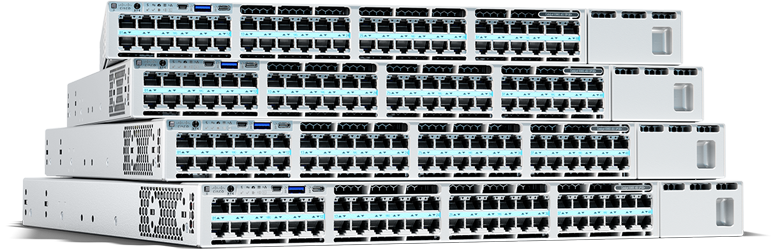
The Catalyst 8540 provides a 40-Gbps switching fabric with aggregate throughput of 24 million packets per second (pps) for Layer 3 switching. Deployed as an ATM switch, the Catalyst 8540 provides wire-speed nonblocking switching on all interfaces.
The Catalyst 8540 uses a 13-slot, modular chassis with optional dual, fault-tolerant, load-sharing power supplies. The Catalyst 8540 can be deployed with optional, redundant route processors and optional, redundant switch processors. Typically the devices are deployed as redundant systems within a campus providing the ultimate in redundancy as redundant systems can back each other up and provide incremental bandwidth and performance.
Catalyst 8540 Layer 3 Highlights
When deployed with the C8541-RP route processor and two C8542-SP switch processors, the Catalyst 8540 is equipped as a Layer 3 switch. The section below summarizes the Layer 3 features.
IP at 24 Millions of Packets-per-Second
The Catalyst 8500 provides a complete IP routing solution without sacrificing any of the services required to build a scalable network. The Catalyst 8500 series is a feature-rich campus switch router with full Cisco IOS® implementation that allows network managers to continue to administer and manage their networks much as they do today while scaling their backbone bandwidths to gigabit speeds. The Catalyst 8500 series supports all the routing protocols that are used today in enterprise and Internet environments. These protocols include:
In addition to these routing protocols, the Catalyst 8500 series supports all the additional protocols that are necessary to build scalable, reliable networks, including:
- Hot Standby Router Protocol (HSRP)
- Internet Group Management Protocol (IGMP) Versions 1 and 2
- Dynamic Host Configuration Protocol (DHCP) Relay
- Cisco Group Management Protocol (CGMP)
- Internet Control Message Protocol (ICMP)
- Gateway Discovery Protocol (GDP)
- ICMP Router Discovery Protocol (IRDP)
- Bootstrap Protocol (BOOTP) Relay
The Catalyst 8500 series uses Cisco Express Forwarding (CEF), which provides Layer 3 switching based on a topology map of the entire network that is distributed to each line card, allowing the line card to make autonomous switching decisions without the involvement of a centralized CPU.
IPX Switching with Enhanced Feature Set
The Catalyst 8500 series, with its IPX wire-speed performance, is also a full-fledged IPX router with the enhancements only Cisco IOS can offer. The Catalyst 8500 provides basic services such as Novell NetWork RIP and Service Advertising Protocols (SAPs). In addition, the Catalyst 8500 supports features that help to make a large Novell network scale. These features include:
- Get nearest server (GNS) response filtering and round robin GNS support
- Novell RIP
- SAP, protocol, and NetBIOS name filtering
- Equal-cost path loadsharing
- Variable RIP and SAP timers
- Novell NetBIOS type 20 propagation support for legacy applications that continue to be mission critical
- Novell compliant IPX ping utility
This feature set as well as the wire-speed IPX switching make the Catalyst 8500 unique in terms of Campus switch router platforms.
IP Multicast Switching and Routing
The Catalyst 8500 series supports IP multicast at wire speeds across all its line cards. As multicast applications such as Microsoft NetShow and NetMeeting become more widely deployed, end-to-end support becomes increasingly important with Multicast routing protocols that are integral to a consistent end-to-end multicast solution. The Catalyst 8500 supports both Protocol Independent Multicast (PIM) sparse and dense modes, and Distance Vector Multicast Routing Protocol (DVMRP) interoperability for legacy applications. The Catalyst 8500 provides support for IGMP, Versions 1 and 2, and CGMP server capabilities for integrating IP multicast support with Catalyst wiring closet switches. These protocols are necessary not only for IP multicast clients to join groups but also for efficient leave processing, which saves bandwidth and end-station CPU cycles.
Flexible Modularity with Fast EtherChannel, Gigabit EtherChannel, ATM, and Packet-over-SONET
The Catalyst 8500 series of multilayer modular switches offers a wide range of interfaces and uplink technologies. As with the award-winning Catalyst 5000 family of switches, the Catalyst 8500 series supports both Fast EtherChannel® as well as Gigabit EtherChannel, and all line card modules are hot swappable. Line card modules support both fiber and copper interfaces. Table 1 below outlines the Catalyst 8540 L2/L3 based interface modules.
Table 1 C8540 L2/L3 Frame Interfaces
Quality of Service (QoS)
The Catalyst 8500 series incorporates a nonblocking centralized shared-memory switching fabric. The rich quality of service (QoS) capabilities of the switching fabric enable network managers to protect mission-critical applications by supporting delay-sensitive traffic, while managing bandwidth in the campus backbone. The switching fabric supports per-flow queuing (PFQ), differentiated delay priorities using a weighted round robin (WRR) scheduler for delay-sensitive applications, and differentiated loss priorities for managing congestion and traffic policing and shaping. The fast packet memory embedded in the switching fabric is allocated dynamically on a per-queue (flow) basis. This dynamic allocation used in conjunction with user-defined queue thresholds and configurable queue scheduling weights ensures that time-sensitive traffic is handled properly with no packet loss. These thresholds and queuing weights can be dynamically adjusted with CiscoAssure Policy Networking, allowing an end-to-end QoS solution.
Nonroutable Protocols
Networks today incorporate many protocols that will continue to be strategic, because the business applications built with them are strategic to the corporation. Unfortunately, these protocols are often not routable and, therefore, must be bridged. The Catalyst 8500 is fully compliant with the IEEE 802.1d specifications. In addition, the Catalyst 8500 supports Integrated Routing and Bridging (IRB), which allows network managers to route packets between routed interfaces, create bridge groups, and bridge the nonroutable packets among those interfaces.
Catalyst 8540 ATM Highlights
When deployed with the C8545-MRP and two C8546-MSP the C8540 is equipped as a multiservice ATM switch. Future software enhancements and the addition of an ATM router module will allow the deployment of Multiservice ATM and Layer 3 interfaces in a single chassis. The section below gives details of the ATM interfaces available.
The common equipment supports all the defined traffic classes in the ATM Forum Traffic Management 4.0 specification and offers the flexibility needed for bursty client/server traffic patterns. For service-provider or customer-premises deployments, per-flow queuing, which can support greater traffic-shaping granularity and service individual QoS contracts for several thousand flows at once, makes it perfect for wide-area environments that demand more unique and granular QoS features.
All PAMs from the LightStream® 1010 can be deployed in the Catalyst 8540 except the ATM 25 PAM, providing superior investment protection. In addition to supporting all the existing LS1010 PAMs (except the 25 MB ATM PAMs) via the Super CAMs (SCAMs), there are several new, high density ATM modules developed for the Catalyst 8540. These are highlighted in Table 2 below.
Table 2 Catalyst 8540 Multiservice ATM Interfaces
| Module Type | Description | Maximum Density at Switch |
|---|---|---|
| OC-12 | ||
| OC-3 | ||
| 1 OC-48c and 4 OC-12 | ||
| 2 OC-48 |
The Catalyst 8540 offers the sophistication and depth of functionality required for true ATM production deployment. Advanced traffic management mechanisms allow for the support of bursty client/server traffic, while also delivering the QoS guarantees required for voice and video applications. The unique intelligent packet-handling mechanisms of the Catalyst multiservice switch router family allow the switches to discard entire packets (early packet discard) or the remaining cells of a packet that has experienced loss (partial or tail packet discard), or to merge packets from different incoming connections onto the same outgoing connection (virtual circuit [VC] merge), increasing the effective goodput and scalability. The Catalyst multiservice switch-router family supports all the ATM Forum-defined traffic classes.
With support for the ATM Forum Private Network-to-Network Interface (PNNI) v1.0 protocol since 1996, and with hierarchical PNNI routing and Tag Switching available since April 1998, networks of Catalyst 8500, LightStream 1010, and Catalyst 5500s can scale to several hundred ATM switch nodes with QoS-based routing. Value-added PNNI and User-Network Interface (UNI) signaling capabilities from Cisco provide for ATM access lists, load sharing across parallel links, and PNNI closed user groups (CUGs) used to construct virtual private networks at the ATM layer. All this sophistication does not result in complexity for the user, because the Catalyst 8500 family, LightStream 1010, support standards-based, plug-and-play, and autodiscovery capabilities. Advanced ATM management functions in the Catalyst 8500, LightStream 1010, and Catalyst 5500 allow for unprecedented levels of network visibility and control, including support for two specifications first introduced to the industry by Cisco and a few partners, specifically the ATM Remote Monitoring (RMON) Management Information Base (MIB) and ATM Accounting MIB.
Table 3 Catalyst 8540 ATM Features
Network Management
Network management must be considered when enhancing the performance of the campus backbone. The Catalyst 8500 series is supported by CiscoAssure networking services, which include CiscoWorks for planning, troubleshooting, and analyzing Campus networks and Cisco Resource Manager (CRM) for automated scheduling of software upgrades. From a security perspective, TACACS+, Message Digest 5 (MD5) route authentication, Kerberos, encrypted passwords, and lock and key features will be available for the Catalyst 8500. The Catalyst 8500 series provides access list control of routing updates and supports route redistributions, and future enhancements will provide access lists and extended access lists for data traffic.
The wide variety of CiscoAssure Policy Networking management tools and applications enable fault management, configuration management, performance management, security management, and other functions. CWSI leverages the power of the CiscoWorks applications for managing and maintaining an internetwork of Catalyst series switching products. The CiscoWorks features provide the following capabilities:
- To simplify administration tasks from network management platforms, the Catalyst 8500 family offers full Simple Network Management Protocol (SNMP) functions that allow it to be managed from any SNMP-based management station
- To provide protection against unauthorized configuration changes, the administration interface requires a password for local access or remote access via Telnet
- To allow more flexibility for network administrators, remote (out-of-band) management through SNMP (sets and gets) or Telnet connections is accessible through any interface, allowing the Catalyst 8500 to be managed from anywhere in the network
- To reduce the costs of administering software upgrades, Flash memory allows remote downloads using Trivial File Transfer Protocol (TFTP) of new revisions of operating systems without hardware changes
- To simplify diagnosis and switch troubleshooting, status LEDs allow the user to visually monitor operation of power supplies, fans, switches, and backbone interfaces
Migration and Investment Protection
The Catalyst 8500 is future-proof and serves as a platform that provides network managers with investment protection for their Catalyst series switches. The line modules each contain ASIC technology that enables the wire-speed Layer 3 switching, and these ASICs are field upgradable with a simple microcode update. This feature allows the Catalyst 8500 to be used today in networks that are primarily IPv4 and Novell IPX, but also in the future as IPv6 becomes more prevalent. Additionally, the Catalyst 8500 series switches support the feature sets of the Catalyst 5000 family, including Fast EtherChannel, virtual LAN (VLANs), ISL, dynamic ISL (DISL), and Port Aggregation Group Protocol (PAGP) allowing the Catalyst 8500 to seamlessly integrate into the network.
Technical Update
Catalyst 8500 Series Components
Catalyst 8540 Switch Router
- Thirteen-slot chassis and fan tray
- Optional redundant AC or DC, autosensing, load-sharing power supplies, each with its own power cord
- C8541CSR-RP and C8542CSR-RP modules running Layer 3 Cisco IOS software or C8545-MRP and C8546-MSP modules running ATM and in the future ATM and L3 Cisco IOS software
- 40-Gbps shared memory, nonblocking fabric
- 8 MB of Flash memory standard, internally expandable up to 16 MB, plus up to 20 MB through PC Flash cards
- 256 MB DRAM system memory
- Ethernet port for out-of-band management
- Dual EIA/TIA-232 serial ports (console, auxiliary port)
Indicators
Chassis Specifications
AC Power Supply Specifications
¯ Maximum power budget: 17.6A @ 100 VAC, 60 Hz
¯ 14.6A @ 115 VAC, 60 Hz; 7A @ 230 VAC, 50 Hz with chassis fully configured
DC Power Supply Specifications
¯ Maximum power draw: 43A @ 42 VDC.38A @ 48 VDC, 30A @ 60 VDC with chassis fully configured
- DC-input voltage: -48 to -60 VDC continuous
- Typical range (U.S. and Canada): -48 VDC (nominal) -56 VDC (high) -42 VDC (low)
- Typical range (international): -60 VDC (nominal -72 VDC (high) -52 VDC (low)
- Heat dissipation: 1800 W (6140 Btu/hr)
- DC wire gauge for power cable: 82 AWG3, 90° , copper conductor (recommended4)
Safety Certifications
Electromagnetic Emissions Certificate
Network Clock Module
Operating Conditions
1Btu = British thermal units
2The DC terminal block has been evaluated for use with maximum 8 AWG
3AWG = American Wire Gauge
4You can use smaller wire if the minimum input voltage for the installation is not violated