

Overview
Cisco Catalyst 4500 Series Optimizes Control of Voice,
Video, and Data Traffic for Metro Ethernet Networks
Overview
The Cisco Catalyst 4500 Series switches with integrated resiliency are designed specifically for both aggregation of business services and subscriber access in metropolitan-area networks (MANs) that take advantage of the simplicity and flexibility of optical Ethernet in the First Mile. These switches deliver integrated resiliency combined with the mechanisms for per-subscriber traffic management, security, performance, and QoS, which network operators and service providers need to deliver revenue-generating data, voice, and video services. With the Cisco Catalyst 4500, network operators can now extend control and intelligence to large and small sites at the MAN edge in their EFM networks.
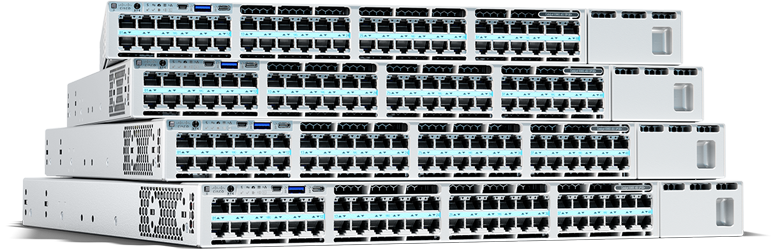
Figure 1
Cisco Catalyst 4500 Series

Metro Ethernet
Because of the high availability, cost, and speed advantages of Ethernet, service providers are looking to offer metropolitan (metro) Ethernet as a connectivity option to their customers. Ethernet technology offers unique cost advantages by eliminating unnecessary protocol conversion in the MAN because most traffic begins and ends as Ethernet. Ethernet delivers flexibly provisioned bandwidth for today's data communication service offerings while its performance future proofs the network for any service delivery in the future.
The delivery of voice, video, and data traffic for residential or business services over a single (IP-based) network requires a switching infrastructure that can differentiate between traffic types and handle each type according to its unique requirements. The Cisco Catalyst 4500 Series delivers this advanced functionality through sophisticated control features of Cisco IOS® Software and specialized hardware.
Optimal Control
The Cisco Catalyst 4500 Series provides metro Ethernet edge networks the optimal control from handling security to service differentiation. The Cisco Catalyst 4500 Series delivers control with:
- Integrated resiliencyNetwork downtime is minimized with redundant supervisor engine capability (Cisco Catalyst 4507R), software-based fault tolerance, and 1+1 power-supply redundancy across the Cisco Catalyst 4500 Series. With time-sensitive traffic, including voice and video, running over the edge network, integrated resiliency is a must for maintaining profitability.
- Sophisticated quality of service (QoS)Integrated Layer 2-, 3-, or 4-based QoS and traffic management capabilities classify and prioritize end-customer traffic with 32,000 QoS policies. The system has the ability to shape and rate limit bandwidth-intensive traffic with mechanisms such as input and output policers based on user, network, and application information. These QoS mechanisms are delivered with no adverse impact on performance.
- Predictable performanceThe Cisco Catalyst 4500 Series delivers up to 48-Mpps wire-speed forwarding in hardware for Layer 2, 3, and 4 traffic. Switching performance is independent of the number of route entries, the types of QoS mechanisms enabled, or the number of active virtual LANs (VLANs). Metro networks need to respond reliably to changes in traffic in order to meet end-customer service-level agreements (SLAs).
- Advanced security32,000 wire-rate Layer 2 through 4 access lists, DHCP Interface Tracker (Option 82) for subscriber tracking, DHCP snooping to prevent malicious or misconfigured DHCP servers, and other advanced security capabilities such as user authentication secure the network for privacy and robust service.
Scalable Architecture
The modular architecture of the Cisco Catalyst 4500 Series provides the scalability and flexibility to grow the network from start to scale. With up to 4096 VLANs and private VLANs, service providers can easily address security in mixed networks with residences and businesses. The switches can be configured for high-density access with up to 240 10-, 100-, or 1000-Mbps interfaces, or for gigabit aggregation with 32 nonshared Gigabit Ethernet ports. In addition, the Cisco Catalyst 4500 Series offers different entry points for high- and low-density end-customer locations with the Cisco Catalyst 4503, 4506, or 4507R chassis.
Applications
Metro Ethernet Network Delivering Services to Mixed Business and Residential Area
- A typical metro Ethernet network design utilizes a Layer 2 or 3 edge switch (Cisco Catalyst 4500 Series) to deliver Ethernet transport to the end customer (Figure 2). The distribution layer is a combination of Layer 2 and Layer 3 plus Multiprotocol Label Switching (MPLS) or Universal Transport Interface (UTI) (Cisco Catalyst 6000 Series, Cisco 7600 Router, and Cisco 12000 Internet Router). The backbone comprises optical transport technology (10 Gigabit Ethernet, SONET, Dynamic Packet Transport (DPT or RPR)).
- The Cisco Catalyst 4500 Series supports up to 240 ports of optical Gigabit and Fast Ethernet interfaces providing high density metro access. The Cisco Catalyst 4500 can be placed in the remote terminal in the neighborhood or in the local central office. End customers, both businesses and residences, are connected with optical Gigabit Ethernet or Fast Ethernet.
- Intelligence is provided at the edge to ensure end-to-end service success and security. Services include site interconnectivity supporting voice, video, and data streams, IP multicast video, voice-over-IP (VoIP) telephony, and tiered Internet access. Intelligent, predictable performance is delivered by Cisco Catalyst switches that use the hardware-based Cisco Express Forwarding Routing Engine, capable of scaling to 48 Mpps. This enables multiple millions of packets per second throughput of Layer 3 switching, with no penalty IP mechanisms, for example, access control lists (ACLs) and QoS.
Figure 2
Metro Ethernet Network with Cisco Catalyst 4500 Switches

Key Cisco Catalyst metro Ethernet switching solution advantages with the Cisco Catalyst 4500 Series in
Figure 2 follow:
- Traffic differentiation and service agreements benefit from rich multilayer QoSincluding policing (ingress and egress), classification, shaping, sharing, marking, and advanced schedulingimplemented in hardware with advanced parallel pipeline processing (Supervisor Engines III and IV).
- ASIC-based Layer 2 to 4 performance delivers network predictability for data, voice, and IP multicast trafficnecessary for meeting SLAs.
- Resiliency is realized through mature Hot-Standby Router Protocol (HSRP) for Layer 3 redundancy and Uplink Fast, 802.1s, and 802.1w for fast failover at Layer 2.
- Security offers resiliency against denial-of-service attacks with DHCP snooping and Layer 2-4 ACLs, subscriber tracking with 802.1x, and DHCP option 82 and privacy between customers with private VLANs.
Cisco Catalyst 4500 Series
A next-generation Cisco Catalyst 4000 Series platform, the Cisco Catalyst 4500 Series includes three new Cisco Catalyst chassis: Cisco Catalyst 4507R (7 slots), Cisco Catalyst 4506 (6 slots), and Cisco Catalyst 4503 (3 slots). Integrated resiliency enhancements offered in the Cisco Catalyst 4500 Series include 1+1 supervisor-engine redundancy (Cisco Catalyst 4507R only), integrated inline power for IP telephony, software-based fault tolerance, and 1+1 power-supply redundancy. Integrated resiliency in both hardware and software minimizes network downtime, ensuring workforce productivity, profitability, and customer success.
The Cisco Catalyst 4500 Series provides a common architecture that takes advantage of the Cisco Catalyst 4000 Series line cards, scaling to 240 ports of 10/100/1000BASE-T or 1000BASE-LX Gigabit Ethernet.
Cisco Catalyst 4500 Series Key Benefits
The new Cisco Catalyst 4500 Series switches with integrated resiliency are ideal for business services aggregation and subscriber access in the MAN. Key benefits include:
- PerformanceDelivering advanced switching solutions that scale bandwidth as you add ports and features, the Cisco Catalyst 4000 Series solution is powered by leading-edge ASIC technology that offers wire-speed Layer 2 and Layer 3 10/100 or gigabit switching. Offering modular supervisor flexibility, each with complete line-card compatibility, Layer 2 switching can scale up to 64 Gbps, 48 Mpps. Layer 3 and 4 switching is Cisco Express Forwarding based and can also scale up to 64 Gbps, 48 Mpps.
- Port densityThe Cisco Catalyst 4500 Series is capable of connecting up to 240 customers with up to 240 copper or fiber Fast Ethernet or Gigabit Ethernet ports in a chassis. The Cisco Catalyst 4500 Series offers different entry points for high- and low-density locations with the Cisco Catalyst 4503, 4506, or 4507R chassis. The hot-swappable modular "plug and play" (meaning that it will work as soon as it is active in the network) switching solution of the Cisco Catalyst 4000 Series enables maintenance with minimal disruption of other users.
- Supervisor engine redundancyThe Cisco Catalyst 4507R is capable of supporting 1+1 supervisor-engine redundancy for integrated resiliency. Redundant supervisor engines ensure that network downtime is minimized. Minimal network downtime ensures end-customer productivity and service provider profitability.
- Cisco IOS network servicesCisco Catalyst 4500 Series switches provide mature service provider Layer 2 and Layer 3 features. These features meet the advanced networking demands of service providers because they have been improved based on years of customer feedback.
- Investment protectionThe flexible modular architecture provides cost-effective interface upgrades for metro edge connections. Compatible sparing between Cisco Catalyst 4006, 4503, 4506, and 4507R chassis provides commonality of power supplies and switching line cards, lowering the overall deployment, migration, and support costs.
- Functionally transparent line cardsThe Cisco Catalyst 4500 Series switch can easily upgrade all system ports to higher-layer switching functionality by simply adding a new supervisor engine such as the Supervisor Engine IV. Higher-layer functionality enhancements are possible on all system ports without replacing existing line cards and wiring, unlike conventional switching products where complete equipment upgrades are typical during migration. This architecture advantage extends the useful deployment life of line cards.
- Gigabit to the end customerThe Cisco Catalyst 4500 Series provides a rich variety of 1000-Mbps interfaces, including copper and fiber, to deliver connectivity to the end customer. By delivering a Gigabit Ethernet connection, the network operator can dial in the bandwidth purchased through policing, upgrading at anytime without a complete equipment upgrade.
- Hardware-based multicastProtocol Independent Multicast (PIM), dense and sparse mode, Internet Group Multicast Protocol (IGMP), and Cisco Group Multicast Protocol (GMP) support standards-based and Cisco product-enhanced efficient multimedia networking without compromising performance.
- Shared-memory architectureThe low-latency, centralized, shared-memory switching fabric architecture delivers leading-edge, wire-speed broadcast and multicast capabilities without the need of replicating packets. It also eliminates any possibility of head-of-line blocking.
- Bandwidth protection for mission-critical applicationsQoS for both Layer 2 class of service (CoS) and Layer 3 type of service (ToS) combine to guarantee customer SLAs from the edge to the core. Even when using only Layer 2 switching, the Supervisor Engine IV benefits from looking at the Layer 3 (IP address) and Layer 4 (TCP/User Datagram Protocol [UDP] port number) header information for additional control without the all-too-common performance penalty of turning on advanced features.
Cisco Catalyst 4500 Series Features and Benefits
Table 1 gives Cisco Catalyst 4500 Series Features, Functions, and Benefits.
Table 1 Cisco Catalyst 4500 Series Features, Functions, and Benefits