Product Overview
Cisco® Unified Communications is a comprehensive IP communications system of voice, video, data, and mobility products and applications. It enables more effective, more secure, and more personal communications that directly affect both sales and profitability. It brings people together by enabling a new way of communicating in which your business moves with you, security is everywhere, and information is always available whenever and wherever it is needed. Cisco Unified Communications is part of an integrated solution that includes network infrastructure, security, mobility, network management products, lifecycle services, flexible deployment and outsourced management options, end-user and partner financing packages, and third-party communications applications.
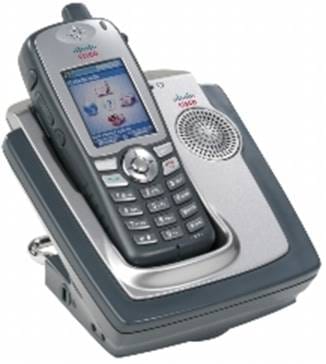
The power of Cisco Unified Communications extends throughout the enterprise with a powerful, converged wireless solution with intelligent wireless infrastructure and an innovative product: the new Cisco Unified Wireless IP Phone 7921G (Figure 1). The device delivers on-campus mobility to users using the voice-over-wireless LAN.
Figure 1. Cisco Unified Wireless IP Phone 7921G
Features
The Cisco Unified Wireless IP Phone 7921G supports a host of calling features and voice-quality enhancements. The device is an advanced media IP phone, delivering wideband audio capabilities. In addition to wideband audio, Cisco Unified Wireless IP Phone 7921G supports presence, which enables users in a mobile Wi-Fi environment to view the current status of other users. Because the Cisco Unified Wireless IP Phone 7921G is designed to grow with system capabilities, features will keep pace with new system enhancements. Table 1 provides a list of the features, Table 2 summarizes wireless characteristics, Table 3 lists specifications, Table 4 lists accessories, and Table 5 provides certification and compliance information.
Table 1. Features
| Feature |
Description |
| Features |
● Adjustable ringing and volume levels
● Adjustable display brightness and timeout
● Audible and vibrating ringers
● Autodetection of headset and autoanswer from headset
● Extension mobility service
● Hotkey for keypad lock, vibration and ring toggle, and voicemail access
● Message-waiting indicator
● Multilevel precedence and preemption (MLPP)
● Network profiles (automatic)
● On- and off-network distinctive ringing
● Predialing before sending
● Quality report tool (QRT)
● Ring tone per line appearance
|
| Buttons |
● Two soft-key buttons to access screen-based applications, features, and functions
● Application button that can support push-to-talk using XML
● 5-way navigation support
● Send button and power and end button
|
| Display |
● 2 in. (5 cm) color display with 176 x 220–pixel resolution
|
| LED |
● Ring, message waiting, and charging LED
|
| Protocol support |
● Skinny Client Control Protocol (SCCP)
● Cisco Unified Communications Manager Versions 4.1, 4.2, 4.3, 5.0, 5.1, 6.0, 6.1, 7.0, and later
● Cisco Unified Communications Manager Express Version 4.1 and later
● Cisco Unified Survivable Remote Site Telephony (SRST) Version 4.1 and later
● Cisco Compatible Extensions Version 4.0
|
| Codec support |
● G.711a, G.711u, G.729a, G.729ab, G.722, and iLBC audio compression codecs
|
| Configuration options |
● Dynamic Host Configuration Protocol (DHCP) client or statically configured
● Support for online firmware upgrades using Trivial File Transfer Protocol (TFTP)
● Domain Name System (DNS)
|
| Network features |
● Cisco Discovery Protocol
● Transparent secure roaming
● Provisioning of network parameters through DHCP
|
| Security features |
● Signaling authentication
● Secure Cisco Unified SRST
● Media encryption using Secure Real-Time Protocol (SRTP)
● Signaling encryption using Transport Layer Security (TLS) Protocol
● Certificate authority proxy function (CAPF)
● Encrypted configuration files
Cryptography is not enabled by default and may only be enabled through a cryptographically enabled CUCM. |
| Provisioning and management |
● Web server for configuration and statistics
● Capability to disable local phone settings
● Quality-of-service (QoS) reporting: jitter, delay, dropped packets, and latency on a per-call basis
● Real Time Control Protocol (RTCP) support and monitoring
|
| Deployment tools |
Integrated site survey tool |
| Language support |
Bulgarian, Catalan, Chinese, Croatian, Czech, Danish, Dutch, English, Finnish, French, German, Greek, Hungarian, Italian, Japanese, Korean, Norwegian, Polish, Portuguese, Romanian, Russian, Serbian, Slovak, Slovenian, Spanish, and Swedish |
Table 2. Wireless Characteristics
| Item |
Description |
| Network standard |
IEEE 802.11a, 802.11b, and 802.11g |
| Frequency band and operating channels |
FCC: (-A)
●
2.412-2.462 GHz; 11 channels
●
5.180-5.240 GHz Unlicensed National Information Infrastructure (UNII-1); 4 channels
●
5.260-5.320 GHz (UNII-2); 4 channels
●
5.500-5.700 GHz; (UNII-2 Extended); 8 channels
●
5.745-5.805 GHz (UNII-3); 4 channels
ETSI: (-E)
●
2.412-2.472 GHz; 13 channels
●
5.180-5.700 GHz; 19 channels
Japan : (-P)
● 2.412-2.472 GHz; 13 channels Orthogonal Frequency Division Multiplexing (OFDM)
● 2.412-2.484 GHz; 14 channels Complementary Code Keying (CCK)
● 5.180-5.700 GHz; 19 channels
Rest of world: (-W)
● Uses IEEE 802.11d to identify band ranges and channels
|
| Support mode |
● Autosensing; IEEE 802.11b/g preferred over IEEE 802.11a
● Autosensing; IEEE 802.11a preferred over IEEE 802.11b/g
● Received signal strength indicator (RSSI) (default)
|
| Data rates |
IEEE 802.11a:
● 6, 9, 12, 18, 24, 36, 48, and 54 Mbps
|
IEEE 802.11b:
|
IEEE 802.11g:
● 6, 9, 12, 18, 24, 36, 48, and 54 Mbps
|
| Nonoverlapping channels |
● IEEE 802.11a: Up to 23 (including radar channels)
● IEEE 802.11b/g: 3 (Japan can use 4)
|
| Wireless modulation |
● IEEE 802.11b: Direct sequence spread spectrum (DSSS)
● IEEE 802.11g: OFDM and DSSS
|
| Receiver sensitivity
(typical) |
IEEE 802.11a:
|
IEEE 802.11b:
|
IEEE 802.11g:
|
| Transmitter output power |
IEEE 802.11a OFDM:
|
IEEE 802.11b CCK:
|
IEEE 802.11g OFDM:
|
| Range
(stated ranges are from measured open-site range testing) Security features |
IEEE 802.11a:
● 6 Mbps: 610 ft (186 m)
● 9 Mbps: 610 ft (186 m)
● 12 Mbps: 558 ft
(170 m)
● 18 Mbps: 541 ft
(165 m)
● 24 Mbps: 508 ft
(155 m)
● 36 Mbps: 426 ft
(130 m)
● 48 Mbps: 328 ft
(100 m)
● 54 Mbps: 295 ft (90 m)
|
IEEE 802.11b:
● 1 Mbps: 1,027 ft
(313 m)
● 2 Mbps: 951 ft (290 m)
● 5.5 Mbps: 853 ft
(260 m)
● 11 Mbps: 787 ft
(240 m)
|
IEEE 802.11g:
● 12 Mbps: 623 ft
(190 m)
● 18 Mbps: 623 ft
(190 m)
● 24 Mbps: 623 ft
(190 m)
● 36 Mbps: 492 ft
(150 m)
● 48 Mbps: 410 ft
(125 m)
● 54 Mbps: 394 ft
(120 m)
|
| Ranges and actual throughput vary based upon numerous environmental factors so individual performance may differ. |
| Access Point support |
● Cisco Aironet
® 350 Series Access Point
● Cisco Aironet 1000 Series Lightweight Access Point
● Cisco Aironet 1100 Series Access Point
● Cisco Aironet 1130 AG Access Point
● Cisco Aironet 1140 Series Access Point
● Cisco Aironet 1200 Series Access Point
● Cisco Aironet 1240 AG Access Point
● Cisco Aironet 1300 Series Access Point
|
Required versions:
● Cisco Wireless LAN Controller (Lightweight) 4.0 or later
● Version 5.2.157.0.0 or later recommended
●
● Cisco IOS Software Access Points (Autonomous), Release 12.3(8)JEA or later
● Version 12.3(4g)JA1 or later recommended (applies to Cisco Aironet 1130 AG and 1240 AG Access Points and Cisco Aironet 1250 Series only)
|
| Wireless security |
Authentication:
● Cisco Wireless Security Suite IEEE 802.1X
● Lightweight Extensible Authentication Protocol (LEAP) Authentication
● Protected Extensible Authentication Protocol (PEAP) MS-CHAP v2
● Extensible Authentication Protocol-Flexible Authentication via Secure Tunneling (EAP-FAST)
● Extensible Authentication Protocol-Transport Layer Security (EAP-TLS)
● Wi-Fi Protected Access (WPA) Versions 1 and 2; Personal and Enterprise
● Cisco Centralized Key Management (CCKM)
|
Encryption:
● 40- and 128-bit static Wired Equivalent Privacy (WEP)
● Temporal Key Integrity Protocol (TKIP) and Message Integrity Check (MIC)
● Advanced Encryption Standard (AES)
|
| QoS |
IEEE 802.11e/Wi-Fi Multimedia (WMM)
● Traffic Specification (TSPEC)
● Enhanced Distributed Channel Access (EDCA)
● QoS Basic Service Set (QBSS)
|
| Radar detection |
Dynamic frequency selection (DFS) and transmit power control (TPC) according to 802.11h |
| Power save mode |
● Power Save Poll (PS-Poll)
|
| Antenna |
● Vertical and horizontal antennas
● Antenna switched diversity (5-GHz band only)
|
|
|
|
|
|
Table 3. Specifications
| Item |
Description |
| Dimensions (H x W x D) |
● Phone: 5.0 x 2.1 x 1.0 in. (12.7 x 5.3 x 2.5 cm)
● Desktop charger: 3.4 x 4.8 x 5.1 in. (8.6 x 12.2 x 13 cm)
|
| Weight |
● Phone with standard battery: 5 oz (145g)
● Desktop charger: 12.9 oz (365g)
|
| Battery |
● Standard lithium-ion (Li-ion) battery life: up to 11.5 hours talk time and 150 hours standby (Release 1.0.4 or later)
● Extended Li-ion battery life: up to 15.5 hours talk time and 200 hours standby (Release 1.0.4 or later)
● Actual battery life varies based on environmental factors
|
| Input Power |
● Phone: 100-240 VAC, ~0.2 A, 50 to 60 Hz
● Desktop charger: 100 to 240 VAC, ~0.3 A, 50 to 60 Hz
● AC adapters (by geographical region)
|
| Operating temperature |
32 to 104°F (0 to 40°C) |
| Storage temperature |
–22 to 140°F (–30 to 60°C) |
| Relative humidity |
10 to 95% (noncondensing) |
| Vibration |
1.5 Grms maximum, 0.1 in. (2.5 mm) double amplitude at 0.887 octaves per minute from 5-500-5 Hz sweep, 10-minute dwell on 3 major peaks, in each of the 3 major mutually perpendicular axes |
| Thermal shock |
–22°F (–30°C) 24 hours; 158°F (70°C) 24 hours |
| Altitude |
Certified for operation: 0 to 6,500 ft (0 to 2 km) |
| Headset jack |
2.5 mm (4 conductor tri-band) |
| Connector |
USB 1.1 primary and secondary |
| Material |
Latex free and lead free |
Table 4. Accessories
| Item |
Description |
| Accessories |
● Desktop charger with speakerphone (not available in Brazil)
● Leather carry case with bungee cord
● Shoulder strap for leather carry case
● Phone to A-type 48 in. (1.2m) USB cable
|
Table 5. Certification and Compliance
| Item |
Description |
| Safety |
|
| Electromagnetic compatibility/electromagnetic interference (EMC/EMI) |
|
| Telecom |
● FCC Part 68 (CFR) (HAC)
● PTC 220/06/098 (2003, New Zealand)
● AS/ACIF S004 and AS/ACIF S040 (Australia)
|
| Radio |
● USA: FCC Part 15.247 (2.4 GHz), FCC Part 15.407 (5 GHz), and FCC Part 2
(Software Defined Radio)
● Canada: RSS-210 Rev 5 (does not include 5.470-5.725 GHz band; RSS-210 Revision 6 in preparation)
● Japan: RCR STD-33 and ARIB STD-T66 (2.4 GHz), and ARIB STD-T70 and T71
(4.9/5 GHz)
● ETSI : EN 300.328 (2.4 GHz) and EN 301.893 (5 GHz)
● Australia and New Zealand: AS/NZS 4268
|
| RF exposure |
● ACA Radio communications (Electromagnetic Radiation-Human Exposure)
Standard 2003
|
Ordering Information
Note: All Cisco Unified IP Phones require the purchase of a phone technology license, regardless of the call protocol being used. The Cisco Unified Wireless IP Phone 7921G is not approved for use in Argentina, Chile, Israel, or China.
Tables 6 and 7 provide ordering information for the Cisco Unified Wireless IP Phone 7921G.
Table 6. Product and License Ordering Information
| Part Number |
Description |
| CP-7921G-A-K9 |
Cisco Unified Wireless IP Phone 7921G FCC; Cisco Unified Communications Manager and Cisco Unified Communications Manager Express User License Required; Battery/Power Supply Not Included |
| CP-7921G-A-K9= |
Cisco Unified Wireless IP Phone 7921G FCC; Battery/Power Supply Not Included |
| CP-7921G-E-K9 |
Cisco Unified Wireless IP Phone 7921G ETSI; Cisco Unified Communications Manager and Cisco Unified Communications Manager Express User License Required; Battery/Power Supply Not Included |
| CP-7921G-E-K9= |
Cisco Unified Wireless IP Phone 7921G ETSI; Battery/Power Supply Not Included |
| CP-7921G-P-K9 |
Cisco Unified Wireless IP Phone 7921G Japan; Cisco Unified Communications Manager and Cisco Unified Communications Manager Express User License Required; Battery/Power Supply Not Included |
| CP-7921G-P-K9= |
Cisco Unified Wireless IP Phone 7921G Japan; Battery/Power Supply Not Included |
| CP-7921G-W-K9 |
Cisco Unified Wireless IP Phone 7921G Rest of World; Cisco Unified Communications Manager and Cisco Unified Communications Manager Express User License Required; Battery/Power Supply Not Included |
| CP-7921G-W-K9= |
Cisco Unified Wireless IP Phone 7921G Rest of World; Battery/Power Supply Not Included |
| CP-7921G-AC-CH1-K9 |
Cisco Unified Wireless IP Phone 7921G FCC; Cisco Unified Communications Manager User License; Battery/Power Supply Not Included |
| CP-7921G-EC-CH1-K9 |
Cisco Unified Wireless IP Phone 7921G ETSI; Cisco Unified Communications Manager User License; Battery/Power Supply Not Included |
| CP-7921G-PC-CH1-K9 |
Cisco Unified Wireless IP Phone 7921G Japan; Cisco Unified Communications Manager User License; Battery/Power Supply Not Included |
| CP-7921G-WC-CH1-K9 |
Cisco Unified Wireless IP Phone 7921G Rest of World; Cisco Unified Communications Manager User License; Battery/Power Supply Not Included |
| CP-7921G-AE-CH1-K9 |
Cisco Unified Wireless IP Phone 7921G FCC; Cisco Unified Communications Manager Express User License; Battery/Power Supply Not Included |
| CP-7921G-EE-CH1-K9 |
Cisco Unified Wireless IP Phone 7921G ETSI; Cisco Unified Communications Manager Express User License; Battery/Power Supply Not Included |
| CP-7921G-PE-CH1-K9 |
Cisco Unified Wireless IP Phone 7921G Japan; Cisco Unified Communications Manager Express User License; Battery/Power Supply Not Included |
| CP-7921G-WE-CH1-K9 |
Cisco Unified Wireless IP Phone 7921G Rest of World; Cisco Unified Communications Manager Express User License; Battery/Power Supply Not Included |
| SW-CCM-UL-7921G |
Cisco Unified Communications Manager User License for single Cisco Unified Wireless IP Phone 7921G |
| SW-CCME-UL-7921G |
Cisco Unified Communications Manager Express User License for single Cisco Unified Wireless IP Phone 7921G |
| SW-CCM-UL-7921G= |
Cisco Unified Communications Manager User License for single Cisco Unified Wireless IP Phone 7921G |
| SW-CCME-UL-7921G= |
Cisco Unified Communications Manager Express User License for single Cisco Unified Wireless IP Phone 7921G |
Table 7. Optional Accessories Ordering Information
| Part Number |
Description |
| CP-BATT-7921G-STD= |
Cisco Unified Wireless IP Phone 7921G Battery, Standard |
| CP-BATT-7921G-EXT= |
Cisco Unified Wireless IP Phone 7921G Battery, Extended |
| CP-CASE-7921G= |
Cisco Unified Wireless IP Phone 7921G Leather Carry Case |
| CP-SHOULDER-7921G= |
Cisco Unified Wireless IP Phone 7921G Shoulder Strap For Leather Carry Case |
| CP-HOLSTER-7921G= |
Cisco Unified Wireless IP Phone 7921G Holster Carry Case |
| CP-LOCK-7921G= |
Cisco Unified Wireless IP Phone 7921G Lock Set |
| CP-CAB-USB-7921G= |
Cisco Unified Wireless IP Phone 7921G to A-type USB Cable |
| CP-DSKCH-7921G-BUN |
Cisco Unified Wireless IP Phone 7921G Desktop Charger, Power Supply |
| CP-DSKCH-7921G= |
Cisco Unified Wireless IP Phone 7921G Desktop Charger Spare |
| CP-MCHGR-7921G-BUN |
Cisco Unified Wireless IP Phone 7921G Multi-Charger, Power Supply, AC Power Cord |
| CP-MCHGR-7921G= |
Cisco Unified Wireless IP Phone 7921G Multi-Charger Spare |
| CP-PWR-MC7921G= |
Cisco Unified Wireless IP Phone 7921G Multi-Charger Power Supply Spare |
| CP-PWR-7921G-AU= |
Cisco Unified Wireless IP Phone 7921G Power Supply for Australia (not required when using Desktop Charger) |
| CP-PWR-7921G-CE= |
Cisco Unified Wireless IP Phone 7921G Power Supply for Central Europe (not required when using Desktop Charger) |
| CP-PWR-7921G-JP= |
Cisco Unified Wireless IP Phone 7921G Power Supply for Japan (not required when using Desktop Charger) |
| CP-PWR-7921G-NA= |
Cisco Unified Wireless IP Phone 7921G Power Supply for North America (not required when using Desktop Charger) |
| CP-PWR-7921G-UK= |
Cisco Unified Wireless IP Phone 7921G Power Supply for United Kingdom (not required when using Desktop Charger) |
| CP-PWR-7921G-CN= |
Cisco Unified Wireless IP Phone 7921G Power Supply for China (not required when using Desktop Charger) |
| CP-PWR-DC7921G-AU= |
Cisco Unified Wireless IP Phone 7921G Desktop Charger Power Supply for Australia Spare |
| CP-PWR-DC7921G-CE= |
Cisco Unified Wireless IP Phone 7921G Desktop Charger Power Supply for Central Europe Spare |
| CP-PWR-DC7921G-JP= |
Cisco Unified Wireless IP Phone 7921G Desktop Charger Power Supply for Japan Spare |
| CP-PWR-DC7921G-NA= |
Cisco Unified Wireless IP Phone 7921G Desktop Charger Power Supply for North America Spare |
| CP-PWR-DC7921G-UK= |
Cisco Unified Wireless IP Phone 7921G Desktop Charger Power Supply for United Kingdom Spare |
| CP-PWR-DC7921G-CN= |
Cisco Unified Wireless IP Phone 7921G Desktop Charger Power Supply for China Spare |
| CAB-AC2AUS= |
AC Power Cord Australia for Cisco Unified Wireless IP Phone 7920/7921G Multi-Charger Spare |
| CAB-AC2E= |
AC Power Cord Europe for Cisco Unified Wireless IP Phone 7920/7921G Multi-Charger Spare |
| CAB-AC2J= |
AC Power Cord Japan for Cisco Unified Wireless IP Phone 7920/7921G Multi-Charger Spare |
| CAB-AC2= |
AC Power Cord N. America for Cisco Unified Wireless IP Phone 7920/7921G Multi-Charger Spare |
| CAB-AC2UK= |
AC Power Cord United Kingdom for Cisco Unified Wireless IP Phone 7920/7921G Multi-Charger Spare |
| CAB-AC2CHI= |
AC Power Cord China for Cisco Unified Wireless IP Phone 7920/7921G Multi-Charger Spare |
Warranty
Cisco Unified IP Phones are covered by a Cisco standard 1-year replacement warranty. A Cisco SMARTnet® optional service agreement is available for the Cisco Unified Wireless IP Phone 7921G hardware, Desktop Charger, and Multi-Charger only, not for other accessories, such as batteries.
Note: This product is not a medical device and may use an unlicensed frequency band that is susceptible to interference from other devices or equipment.
Cisco Unified Communications Services and Support
Using the Cisco Lifecycle Services approach, Cisco and its partners offer a broad portfolio of end-to-end services to support the Cisco Unified Communications system. These services are based on proven methodologies for deploying, operating, and optimizing IP communications solutions. Initial planning and design services, for example, can help you meet aggressive deployment schedules and reduce network disruption during implementation. Operate services reduce the risk of communications downtime with expert technical support, and optimize services enhance solution performance for operational excellence. Cisco and its partners offer a system-level service and support approach that can help you create and maintain a resilient, converged network that meets your business needs.
 Feedback