


Japan Railway Hokkaido futureproofs network for advanced voice and video services

Business Challenge
Japan Railway Hokkaido (JR Hokkaido) operates nearly 2,500 km of railway across Japan's northernmost island, the prefecture of Hokkaido. Approximately 7,000 employees support operations at 465 stations stretching across the island's 83,452 square kilometers, providing passenger and cargo service for 5.7 million residents.
The rail system links the prefecture capital of Sapporo to Hokkaido's more rural areas and connects Hokkaido to Japan's main island, Honshu, via a rail tunnel under the Tsugaru Strait to the south. Known as the Seikan Tunnel and completed in 1988, the tunnel is 33.5 miles (54 km) long and is the longest and deepest undersea tunnel in the world.
Hokkaido's cold winters often lead to drift ice in northern sea passages and high winds that complicate air travel and maritime activity, making rail an important link for goods and people moving in and out of the island. With snowy weather and heavy rains also capable of causing trains to run late, disrupting the rail schedule, JR Hokkaido depends on having a reliable computer network for real-time communications between stations and to help keep business operations on track.
Faced with an aging network infrastructure at its headquarters in Sapporo, JR Hokkaido saw an opportunity to consolidate a number of separate networks into a single robust network to support its railway traffic management system, emergency system, rechargeable smart card ticketing system, and other core business functions. In addition, it wanted updated capabilities for even greater efficiency and productivity, such as wireless, IP phone and IP video technologies.
Network Solution
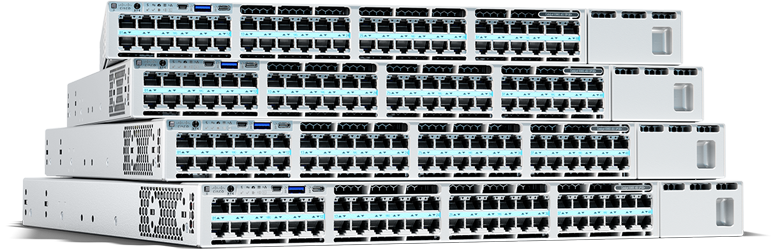
To provide JR Hokkaido with the high availability and enhanced performance it needs at the network core, it deployed two Cisco Catalyst 6500 Series Switches with Supervisor Engine 720 (10G), connected by Virtual Switch Links (VSLs) running at 10 GbE, creating a Virtual Switching System (VSS), which acts as a single switch.
Figure 1. Outlines the Previous JR Hokkaido Network Environment

Figure 2. Diagrams the New, High-Performance Cisco Catalyst Environment Designed to Support the Company's Current and Future Network Needs

The VSS configuration offers JR Hokkaido operational simplicity, with the two Catalyst 6500 switches sharing a single point of management, single gateway IP address, and single routing instance. It also eliminates JR Hokkaido's dependence on Hot Standby Redundancy Protocols (HSRP) and Spanning Tree Protocol. The virtual system uses Non-Stop Forwarding/Stateful Switchover (NSF/SSO) for resilience with link recovery in less than 200 milliseconds. The system scales bandwidth capacity to 1.4 Tbps by activating all available bandwidth across the two Catalyst 6500 switches, with up to 132 ports of 10 GbE per system.
JR Hokkaido also deployed Multiprotocol Label Switching (MPLS) on its core Catalyst 6500 infrastructure, enabling the railway to create multiple logical networks on a single physical infrastructure, providing the consolidation in hardware and management it was seeking. Each logical or virtual network appears completely distinct and separate from the others with its own unique security and access control. MPLS is highly secure and highly scalable, allowing integration of MPLS application components, including Layer 3 VPNs, Layer 2 VPNs, Quality of Service (QoS), and IPV6.
Cisco Catalyst 3750-X and 2960-C Series Switches were deployed at the edge and access layers. Securing a high-redundancy configuration and high bandwidth using StackWise and Gigabit EtherChannel, these switches make it possible to supply high-QoS technology to accommodate real-time-protocol voice applications, along with the graphic applications that will be required in the future.
JR Hokkaido evaluated a number of vendors, with Cisco's Quality of Service capabilities for voice and video comprising a key deciding factor. "Cisco shines as a clear winner with its industry-leading QoS technology that is optimized for complex video and voice data streams," says Takeshi Fukuda, Operating department sub leader for JR Hokkaido's System Development department.
Cisco IOS Software provides advanced QoS features to optimize network performance for delay-sensitive voice and bandwidth-intensive video applications. An array of specialized technologies, such as the Modular Quality of Service Command-Line Interface (MQC), Cisco Low Latency Queuing (LLQ), and Cisco Link Fragmentation and Interleaving (LFI), optimize packet classification, congestion avoidance and management, compression, and traffic prioritizing - all while maintaining simplicity, scalability, and manageability. In situations where enterprises may not be able to continually upgrade the link speeds in their networks, Cisco QoS technology helps leverage available bandwidth and manages it efficiently to meet application demands.

Cisco Catalyst 2960-C Compact Switches are also an integral part of the office environment, as they offer the same QoS and industry-leading capabilities of larger switches, yet their silent operation and small form factor allows them to be deployed outside of wiring closets in working spaces, for example, attached directly to desks. As these compact switches include 12 ports for powering devices with Power over Ethernet (PoE), JR Hokkaido can efficiently extend voice, video, and wireless services to work areas and save on extra cabling expenses. The company is considering the future deployment of IP Phones, Cisco TelePresence video devices, and Cisco wireless access points that will all leverage the refreshed network.
JR Hokkaido appreciates the added value Cisco offers with the stackability of Catalyst 3750-X Switches. It uses Cisco StackPower technology, which creates power redundancy by aggregating all of the available power in the stack of switches in one common power pool for the entire stack. By reducing both the number of outlets required in the wiring closet and the power supplies required per switch, in addition to lowering energy usage and wiring closet cooling requirements, StackPower delivers immediate cost savings for JR Hokkaido.

JR Hokkaido also uses Cisco StackWise Plus technology to intelligently join individual Catalyst 3750-X Switches and create a single switching unit with a 32-Gbps switching stack interconnect. Leveraging Cisco CrossStack EtherChannel technology, multiple switches in a stack create an EtherChannel connection and loss of an individual switch will not affect connectivity for the other switches. The result is higher switching operation efficiency, redundancy in the event of switch failure, and a lighter administrative burden for IT.
"Cisco provides very unique technologies for important power and switch operation redundancies that are critical to maintaining high availability and performance for JR Hokkaido's network," says Yoshiaki Sato, operating department assistant leader for JR Hokkaido's System Development department.
Business Results
Consolidating its aging, disparate networks with a unified Cisco network solution allows JR Hokkaido to reap the benefits of streamlined deployment and ongoing management, for a low total cost of ownership. The robust Cisco switching technologies ensure high availability of the network to support JR Hokkaido's critical business operations amidst changing rail traffic conditions.
With the futureproofing features embedded in its Catalyst switches, such as QoS technology optimized for IP telephony and video, JR Hokkaido is well positioned to add additional services over time, including an already-planned rollout of IP phones, the deployment of Cisco TelePresence video devices, and wireless access points, that the company is currently mulling. These new services will further maximize JR Hokkaido's investment in its network infrastructure by enabling additional savings as well as promoting greater collaboration, faster decision-making, and higher productivity.
"It is crucial for Japan Railways Hokkaido to have a reliable, high-performance network to support excellent service for our customers while helping make our railway operations more efficient. Cisco helps us deliver on this goal without compromising quality," says Hisao Ookawara, project manager, Marketing and Sales Planning, at JR Hokkaido. "In 2012 we will celebrate our 25th anniversary since privatization, and with our refreshed Cisco network we have an excellent foundation for our real-time communication and collaboration needs now and in the years to come."
For More Information
To find out more about Cisco Catalyst switches, go to: http://www.cisco.com/en/US/products/ps5718/Products_Sub_Category_Home.html